 Talmud Bavli
The learning on the whole site is dedicated : L'ilui Nishmat Rav Chlomo Ben Jamilla
The learning on the whole site is dedicated : L'ilui Nishmat Margalit bat Ledicia
The learning on the whole site is dedicated : L'ilui Nishmat רינה בת לדיסיה
Bava Batra 60b : Youtube
Daf TubeYoutube
2 video classes :
Bava Batra Page 60b
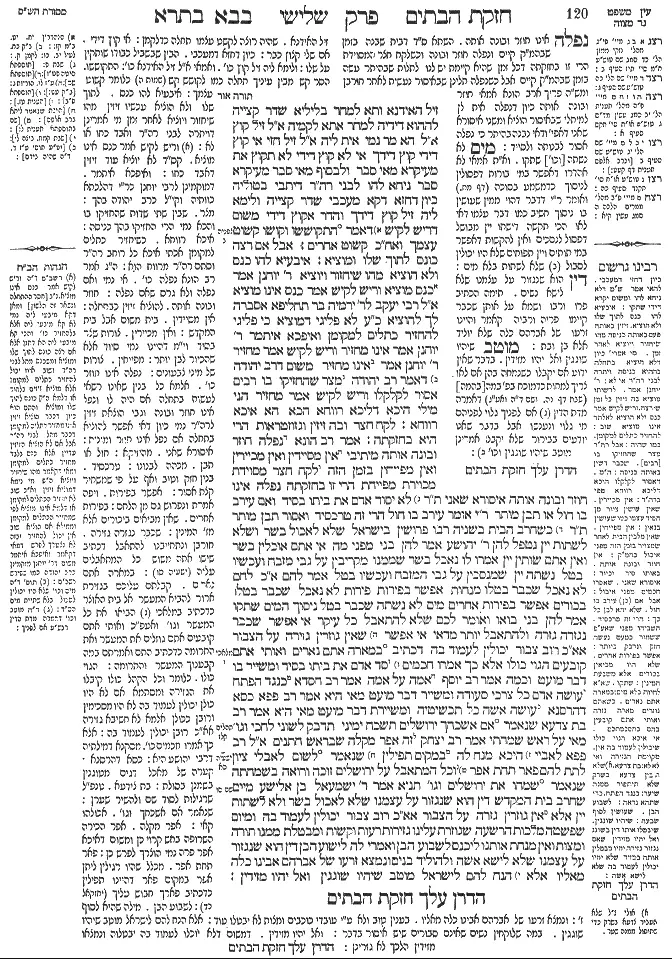
Bava Batra 60b - Guemara
זיל האידנא ותא למחר בליליא שדר קצייה לההוא דידיה למחר אתא לקמיה א"ל זיל קוץ א"ל הא מר נמי אית ליה א"ל זיל חזי אי קוץ דידי קוץ דידך אי לא קוץ דידי לא תקוץ את מעיקרא מאי סבר ולבסוף מאי סבר מעיקרא סבר ניחא להו לבני רה"ר דיתבי בטוליה כיון דחזא דקא מעכבי שדר קצייה ולימא ליה זיל קוץ דידך והדר אקוץ דידי משום דריש לקיש דאמר (צפניה ב, א) התקוששו וקושו קשוט עצמך ואח"כ קשוט אחרים:
אבל אם רצה כונס לתוך שלו ומוציא:
איבעיא להו כנס ולא הוציא מהו שיחזור ויוציא ר' יוחנן אמר כנס מוציא וריש לקיש אמר כנס אינו מוציא א"ל רבי יעקב לר' ירמיה בר תחליפא אסברה לך להוציא כ"ע לא פליגי דמוציא כי פליגי להחזיר כתלים למקומן ואיפכא איתמר ר' יוחנן אמר אינו מחזיר וריש לקיש אמר מחזיר ר' יוחנן אמר אינו מחזיר משום דרב יהודה דאמר רב יהודה מצר שהחזיקו בו רבים אסור לקלקלו וריש לקיש אמר מחזיר הני מילי היכא דליכא רווחא הכא הא איכא רווחא:
לקח חצר ובה זיזין וגזוזטראות הרי היא בחזקתה:
אמר רב הונא נפלה חוזר ובונה אותה מיתיבי אין מסיידין ואין מכיירין ואין מפייחין בזמן הזה לקח חצר מסוידת מכוירת מפויחת הרי זו בחזקתה נפלה אינו חוזר ובונה אותה איסורא שאני תנו רבנן לא יסוד אדם את ביתו בסיד ואם עירב בו חול או תבן מותר ר"י אומר עירב בו חול הרי זה טרכסיד ואסור תבן מותר תנו רבנן כשחרב הבית בשניה רבו פרושין בישראל שלא לאכול בשר ושלא לשתות יין נטפל להן ר' יהושע אמר להן בני מפני מה אי אתם אוכלין בשר ואין אתם שותין יין אמרו לו נאכל בשר שממנו מקריבין על גבי מזבח ועכשיו בטל נשתה יין שמנסכין על גבי המזבח ועכשיו בטל אמר להם א"כ לחם לא נאכל שכבר בטלו מנחות אפשר בפירות פירות לא נאכל שכבר בטלו בכורים אפשר בפירות אחרים מים לא נשתה שכבר בטל ניסוך המים שתקו אמר להן בני בואו ואומר לכם שלא להתאבל כל עיקר אי אפשר שכבר נגזרה גזרה ולהתאבל יותר מדאי אי אפשר שאין גוזרין גזירה על הצבור אא"כ רוב צבור יכולין לעמוד בה דכתיב (מלאכי ג, ט) במארה אתם נארים ואותי אתם קובעים הגוי כולו אלא כך אמרו חכמים סד אדם את ביתו בסיד ומשייר בו דבר מועט וכמה אמר רב יוסף אמה על אמה אמר רב חסדא כנגד הפתח עושה אדם כל צרכי סעודה ומשייר דבר מועט מאי היא אמר רב פפא כסא דהרסנא עושה אשה כל תכשיטיה ומשיירת דבר מועט מאי היא אמר רב בת צדעא שנאמר (תהלים קלז, ה) אם אשכחך ירושלים תשכח ימיני תדבק לשוני לחכי וגו' מאי על ראש שמחתי אמר רב יצחק זה אפר מקלה שבראש חתנים א"ל רב פפא לאביי היכא מנח לה במקום תפילין שנאמר (ישעיהו סא, ג) לשום לאבלי ציון לתת להם פאר תחת אפר וכל המתאבל על ירושלים זוכה ורואה בשמחתה שנאמר (ישעיהו סו, י) שמחו את ירושלים וגו' תניא אמר ר' ישמעאל בן אלישע מיום שחרב בית המקדש דין הוא שנגזור על עצמנו שלא לאכול בשר ולא לשתות יין אלא אין גוזרין גזרה על הצבור אא"כ רוב צבור יכולין לעמוד בה ומיום שפשטה מלכות הרשעה שגוזרת עלינו גזירות רעות וקשות ומבטלת ממנו תורה ומצות ואין מנחת אותנו ליכנס לשבוע הבן ואמרי לה לישוע הבן דין הוא שנגזור על עצמנו שלא לישא אשה ולהוליד בנים ונמצא זרעו של אברהם אבינו כלה מאליו אלא הנח להם לישראל מוטב שיהיו שוגגין ואל יהיו מזידין:
הדרן עלך חזקת הבתים:
Comments from Rashbam - Bava Batra 60b
זיל האידנא . שהיה רוצה לקשט עצמו תחלה כדלקמן: אי קוץ דידי . אם שלי קצוץ כבר: כיון דחזא דמעכבי . הבין שבשביל כבודו שותקין על שלו: ולימא ליה זיל קוץ כו' . ואמאי א"ל זיל האידנא כו': התקוששו . הסר קש מבין עיניך תחלה כמו לקושש קש (שמות ה) כלומר קשוט עצמך: איבעיא להו כנס . לתוך שלו ולא הוציא עכשיו זיזין מהו שיחזור ויוציא לאחר זמן מי אמרינן דויתרה לבני רה"ר ואבד כחו או לא: וריש לקיש אמר כנס אינו מוציא . קס"ד לא יוציא עוד זיזין דאבד כחו: ואיפכא איתמר . דמוקמינן לרבי יוחנן כר"י דהלכתא כוותיה וקי"ל כרב יהודה בהך: מצר . שבין שתי שדות שהחזיקו בו והכא נמי הרי החזיקו בהך כניסה: איכא רווחא . כשיחזיר כתלים למקומן אכתי איכא כל רוחב רה"ר וסתם רה"ר מרווח הוא: ה"ג אמר רב הונא נפלה כו' . אי נמי ואם נפלה ולא גרס שאם נפלה: חוזר ובונה אותה . להוציא זיזין כבתחלה: אין מסיידין . בית משום אבל בית המקדש: ואין מכיירין . צורות שצר בסיד וי"מ דהיינו נמי סיוד אלא שהכיור לבן יותר: מפייחין . צורות של מיני צבעונים: נפלה אינו חוזר כו' . אלמא כל בנין שאינו רשאי לעשות בתחלה אם היה לו ונפל אינו חוזר ובונה וגבי הוצאת זיזין לרה"ר נמי כיון דאי אפשר להוציא בתחלה אם נפל אינו חוזר ומוציא: איסורא שאני . מהיזיקא: חול או תבן . מכהה לבנונו: טרכסיד . בנין חזק וטוב ואף על פי שמשחיר קצת אסור: אפשר בפירות . ויפה אמרת ונפרוש גם מן הלחם: בפירות אחרים . שאין מביאים ביכורים אלא מז' המינין: שכבר נגזרה גזירה . חורבן ונתחייבנו להתאבל דכתיב שישו אתה משוש כל המתאבלים עליה (ישעיהו סו): במארה אתם נארים . קבלתם עליכם בגזירת ארור להביא המעשר אל בית האוצר כדכתיב במלאכי (ג) הביאו את כל המעשר וגו' ואעפ"כ ואותי אתם קובעים אתם גוזלים את המעשר ואת התרומה כדכתיב התם ואמרתם במה קבענוך המעשר והתרומה: הגוי כולו . כלומר וכל הקהל כולו קיבלו את הגזירה ומסתמא אם לא היו כולן יכולין לעמוד בה לא היו מסכימין ורובן ככולן אלמא לא חשיבא גזירה אא"כ רובן יכולין לעמוד בה: אלא כך אמרו חכמים כו' . מסקנא דמילתיה דרבי יהושע היא: כסא דהרסנא . קערה של מאכל דגים מטוגנין בשמנן בסולת: בת צידעא . טנפ"ל שרגילות לסוד שם ולהשיר שערן: שנאמר אם אשכחך וגו' . אכולהו קאי: אפר מקלה . אפר הכירה השרופה באש קרוי כן ומשום דאיכא אפר פרה נמי הוצרך לפרש כן: פאר תחת אפר . מכלל שהיו רגילין ליתן אפר במקום פאר דהיינו תפילין כדכתיב פארך חבוש עליך (יחזקאל כד): לשבוע הבן . מילה שהיא לסוף ז': ונמצא זרעו של אברהם אבינו כלה מאליו . בענין טוב ולא ע"י עובדי כוכבים ומצות לא יבטלו עוד: אלא הנח להם לישראל מוטב שיהיו שוגגין . במה שלוקחין נשים שאינם סבורים שיש איסור בדבר: ואל יהיו מזידין . דמשום דלא יוכלו לעמוד בה יבטלוה ונמצאו מזידין הלכך לא גזרינן:
Comments from Tosafot - Bava Batra 60b
נפלה אינו חוזר ובונה אותה. השתא ס"ד דבית שבנה בזמן שבהמ"ק קיים ונפלה חוזר ובונה וכשלקח חצר המסוידת הרי זו בחזקתה דכל זמן שהיא קיימת יש לנו לתלות שבהיתר עשה בזמן שבהמ"ק קיים אבל כשנפלה תלינן שבאיסור נעשית לאחר חורבן ומש"ה פריך ארב הונא אמאי חוזר ובונה אותה כיון דנפלה אית לן למיתלי שבאיסור הוציא ומשני איסורא שאני דאפי' ודאי נבנה בהיתר כי נפלה אסור לבנותה ולסייד: מים לא נשתה [וכו'] שתקו. וא"ת אמאי לא אהדרו דאפשר במי בורות דפסולין לניסוך כדמשמע בסוכה (דף מח.) ואומר ר"י דדבר דהוי ממין שעושין בו ניסוך חשיב כמו דבר עצמו דאי לאו הכי תקשה דישתו יין מבושל דפסול לנסכים ואין להקשות דאפשר במי תותים ויין תפוחים שלא היו יכולין לסבול שלא לשתות בלא מים: דין הוא שנגזור על עצמנו שלא לישא נשים. תימה הכתיב פרו ורבו ושמא על אותן שכבר קיימו פריה ורביה קאמר והיינו זרעו של אברהם כלה שלא יוליד אלא בן ובת: מוטב שיהיו שוגגין ואל יהיו מזידין. בדבר שאין ידוע אם יקבלו כשנמחה בהן אם לאו צריך למחות כדמוכח בפ' במה [בהמה] (שבת דף נה. ושם ד"ה ואע"ג) דאמרה מדת הדין אם לפניך גלוי לפניהם מי גלוי ונענשו אבל בדבר שאנו יודעים בבירור שלא יקבלו אמרינן מוטב שיהיו שוגגין וכו':
Bava Batra 60b - Mishnah translated into english
Go now, and come tomorrow. At night, Rabbi Yannai sent and had someone cut down that tree that belonged to him.
The next day, that man came before Rabbi Yannai, who said to him: Go, cut down your tree. The man said to him: But the Master also has a tree that leans into the public domain. Rabbi Yannai said to him: Go and see: If mine is cut down, then cut yours down. If mine is not cut down, you do not have to cut yours down, either.
The Gemara asks: At the outset what did Rabbi Yannai hold, and ultimately, what did he hold? The Gemara replies: At the outset, he held that the general public is amenable to having the tree there, as they sit in its shade. Once he saw that they were preventing someone else who owned a tree from keeping his, he understood that it was only out of respect that they did not object to his tree being there. He therefore sent someone to cut it down. The Gemara asks: But why did he tell the man to return the next day? Let him say to him: Go cut down your tree, and then I will cut mine down. The Gemara answers: Because of the statement of Reish Lakish, who said: The verse states: “Gather yourselves together and gather [hitkosheshu vakoshu]” (Zephaniah 2:1), and this can be explained homiletically to mean: Adorn [keshot] yourself and afterward adorn others, i.e., act properly before requiring others to do so.
§ The mishna teaches that one may not extend projections or balconies into the public domain. Rather, if he desired to build one he may draw back into his property by moving his wall, and extend the projection to the end of his property line. A dilemma was raised before the Sages: If one drew back into his property but did not extend the projection at that time, what is the halakha concerning whether he may return and extend it at a later date? Rabbi Yoḥanan says: If one drew back into his property, he may extend it even later, and Reish Lakish says: If one drew back into his property but did not build the projection at that time, he may not extend it later.
The Gemara presents an alternative version of the dispute: Rabbi Ya’akov said to Rabbi Yirmeya bar Taḥlifa: I will explain the matter to you. To later extend a projection, everyone agrees that he may extend it, since he is adding within his own property. Where they disagree is with regard to whether he may return the walls to their prior place. And with regard to this disagreement the opposite was stated: Rabbi Yoḥanan says he may not return the walls to their prior place, and Reish Lakish says he may return them.
Rabbi Ya’akov explains their reasoning: Rabbi Yoḥanan says that he may not return the walls to their prior place because of the statement of Rav Yehuda, as Rav Yehuda says: With regard to a path that the public has established as a public thoroughfare, it is prohibited to ruin it, i.e., to prevent people from using it. Once the public has become accustomed to using the place where his wall had stood, he may not repossess that space. And Reish Lakish says that he may return the walls to their prior place, because that matter applies in a case where there is no space, i.e., if he were to move back the wall there would be no space for the public to walk, but here there is space, since they can still walk through the public domain.
The mishna teaches that if one purchased a courtyard in which there are projections and balconies extending into the public domain, this courtyard retains its presumptive status, allowing the owner to use the projections. Rav Huna says: If the wall of the courtyard fell, he may return and build it as it was, including the projections or balconies.
The Gemara raises an objection based on that which is taught in a baraita (Tosefta 9:17): One may not plaster, and one may not tile, and one may not paint [mefayyeḥin] images in the present, as a sign of mourning for the destruction of the Temple. But if one purchased a courtyard that was plastered, tiled, or painted with images, this courtyard retains its presumptive status, and it is assumed that it was done in a permitted manner. If it then fell, he may not return and build it in its previous form. This indicates that one may not rebuild a building in a manner that is prohibited, even if there was an acquired privilege to maintain it in that manner.
The Gemara answers: A case of forbidden matters is different, i.e., in the case of the baraita, he may not rebuild it because it is prohibited for him to do so. In this mishna, the issue is encroachment upon the rights of others, and once he had an acquired privilege to use the projections or balconies, he maintains that right.
§ With regard to the ruling of the above-quoted baraita, the Sages taught (Tosefta, Sota 15:9): A person may not plaster his house with plaster, but if he mixed sand or straw into the plaster, which dulls its luster, it is permitted. Rabbi Yehuda says: If he mixed sand into it, it is white cement [terakesid], which is of a higher quality than standard plaster, and it is prohibited, but if he mixed in straw, it is permitted.
§ Having mentioned the prohibition against plastering, which is a sign of mourning over the destruction of the Temple, the Gemara discusses related matters. The Sages taught in a baraita (Tosefta, Sota 15:11): When the Temple was destroyed a second time, there was an increase in the number of ascetics among the Jews, whose practice was to not eat meat and to not drink wine. Rabbi Yehoshua joined them to discuss their practice. He said to them: My children, for what reason do you not eat meat and do you not drink wine? They said to him: Shall we eat meat, from which offerings are sacrificed upon the altar, and now the altar has ceased to exist? Shall we drink wine, which is poured as a libation upon the altar, and now the altar has ceased to exist?
Rabbi Yehoshua said to them: If so, we will not eat bread either, since the meal-offerings that were offered upon the altar have ceased. They replied: You are correct. It is possible to subsist with produce. He said to them: We will not eat produce either, since the bringing of the first fruits have ceased. They replied: You are correct. We will no longer eat the produce of the seven species from which the first fruits were brought, as it is possible to subsist with other produce. He said to them: If so, we will not drink water, since the water libation has ceased. They were silent, as they realized that they could not survive without water.
Rabbi Yehoshua said to them: My children, come, and I will tell you how we should act. To not mourn at all is impossible, as the decree was already issued and the Temple has been destroyed. But to mourn excessively as you are doing is also impossible, as the Sages do not issue a decree upon the public unless a majority of the public is able to abide by it, as it is written: “You are cursed with the curse, yet you rob Me, even this whole nation” (Malachi 3:9), indicating that the prophet rebukes the people for neglecting observances only if they were accepted by the whole nation.
Rabbi Yehoshua continues: Rather, this is what the Sages said: A person may plaster his house with plaster, but he must leave over a small amount in it without plaster to remember the destruction of the Temple. The Gemara interjects: And how much is a small amount? Rav Yosef said: One cubit by one cubit. Rav Ḥisda said: This should be opposite the entrance, so that it is visible to all.
Rabbi Yehoshua continues: The Sages said that a person may prepare all that he needs for a meal, but he must leave out a small item to remember the destruction of the Temple. The Gemara interjects: What is this small item? Rav Pappa said: Something akin to small, fried fish.
Rabbi Yehoshua continues: The Sages said that a woman may engage in all of her cosmetic treatments, but she must leave out a small matter to remember the destruction of the Temple. The Gemara interjects: What is this small matter? Rav said: She does not remove hair from the place on the temple from which women would remove hair. The source for these practices is a verse, as it is stated: “If I forget you, Jerusalem, let my right hand forget its cunning. Let my tongue cleave to the roof of my mouth, if I remember you not; if I set not Jerusalem above my highest joy” (Psalms 137:5–6).
The Gemara asks: What is the meaning of: Above my highest [rosh] joy? Rav Yitzḥak says: This is referring to the burnt ashes that are customarily placed on the head [rosh] of bridegrooms at the time of their wedding celebrations, to remember the destruction of the Temple. Rav Pappa said to Abaye: Where are they placed? Abaye replied: On the place where phylacteries are placed, as it is stated: “To appoint to them that mourn in Zion, to give to them a garland in place of ashes” (Isaiah 61:3). Since phylacteries are referred to as a garland (see Ezekiel 24:17), it may be inferred from this verse that the ashes were placed in the same place as the phylacteries.
The baraita continues: And anyone who mourns for the destruction of Jerusalem will merit and see its joy, as it is stated: “Rejoice with Jerusalem, and be glad with her, all that love her; rejoice for joy with her, all that mourn for her” (Isaiah 66:10).
It is taught in a baraita (Tosefta, Sota 15:10) that Rabbi Yishmael ben Elisha said: From the day that the Temple was destroyed, by right, we should decree upon ourselves not to eat meat and not to drink wine, but the Sages do not issue a decree upon the public unless a majority of the public is able to abide by it.
And from the day that the wicked kingdom, i.e., Rome, spread, who decree evil and harsh decrees upon us, and nullify Torah study and the performance of mitzvot for us, and do not allow us to enter the celebration of the first week of a son, i.e., circumcision, and some say: To enter the celebration of the salvation of a firstborn son; by right we should each decree upon ourselves not to marry a woman and not to produce offspring, and it will turn out that the descendants of Abraham our forefather will cease to exist on their own, rather than being forced into a situation where there are sons who are not circumcised.
But concerning a situation such as this, the following principle is applied: Leave the Jews alone and do not impose decrees by which they cannot abide. It is better that they be unwitting sinners, who do not know that what they are doing is improper considering the circumstances, and not be intentional wrongdoers, who marry and procreate despite knowing that they should not.
Traduction : The William Davidson digital edition of the Koren Noé Talmud, with commentary by Rabbi Adin Even-Israel Steinsaltz.