 Talmud Bavli
Bava Batra 4b : Youtube
Daf TubeYoutube
2 video classes :
Bava Batra Page 4b
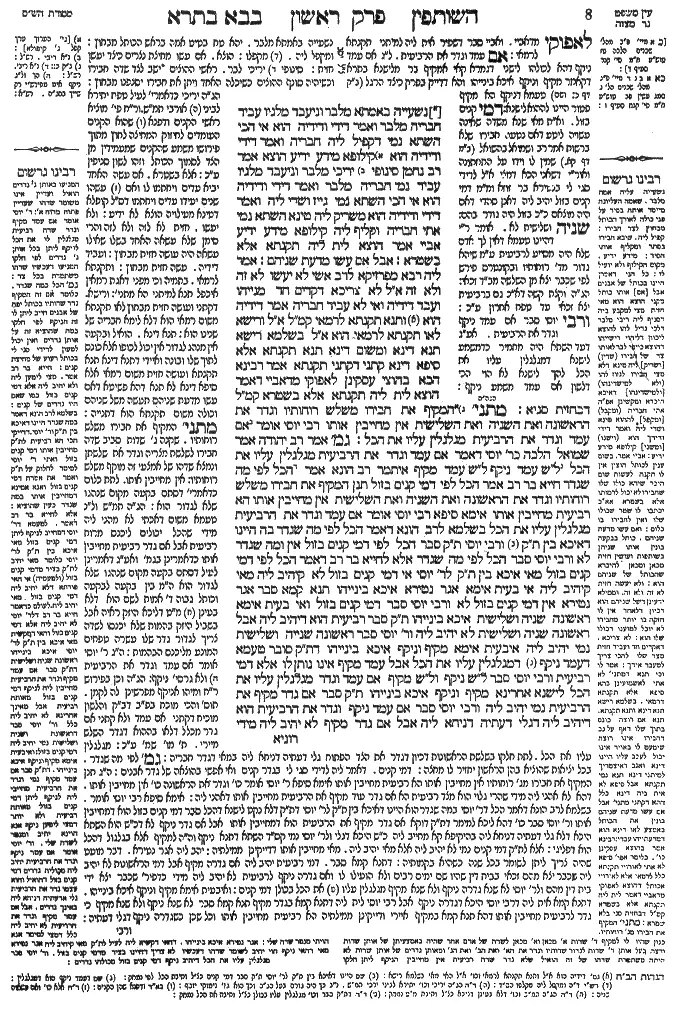
Bava Batra 4b - Guemara
נשעייה באמתא מלבר וניעבד מלגיו עביד חבריה מלבר ואמר דידי ודידיה הוא אי הכי השתא נמי דקפיל ליה חבריה ואמר דידי ודידיה הוא קילופא מידע ידיע הוצא אמר רב נחמן סינופי יריכי מלבר וניעבד מלגיו עביד נמי חבריה מלבר ואמר דידי ודידיה הוא אי הכי השתא נמי גייז ושדי ליה ואמר דידי ודידיה הוא משריק ליה טינא השתא נמי אתי חבריה וקליף ליה קילופא מידע ידיע אביי אמר הוצא לית ליה תקנתא אלא בשטרא:
אבל אם עשו מדעת שניהם:
אמר ליה רבא מפרזיקא לרב אשי לא יעשו לא זה ולא זה אמר ליה לא צריכא דקדים חד מנייהו ועבד דידיה ואי לא עביד חבריה אמר דידיה הוא ותנא תקנתא לרמאי קמ"ל אמר ליה ורישא לאו תקנתא לרמאי הוא אמר ליה בשלמא רישא תנא דינא ומשום דינא תנא תקנתא אלא סיפא דינא קתני דקתני תקנתא אמר רבינא הכא בהוצי עסקינן לאפוקי מדאביי דאמר הוצא לית ליה תקנתא אלא בשטרא קמ"ל דבחזית סגיא:
מתני׳ המקיף את חבירו משלש רוחותיו וגדר את הראשונה ואת השניה ואת השלישית אין מחייבין אותו רבי יוסי אומר אם עמד וגדר את הרביעית מגלגלין עליו את הכל:
גמ׳ אמר רב יהודה אמר שמואל הלכה כר' יוסי דאמר אם עמד וגדר את הרביעית מגלגלין עליו את הכל לא שנא עמד ניקף ל"ש עמד מקיף איתמר רב הונא אמר הכל לפי מה שגדר חייא בר רב אמר הכל לפי דמי קנים בזול תנן המקיף את חבירו משלש רוחותיו וגדר את הראשונה ואת השניה ואת השלישית אין מחייבין אותו הא רביעית מחייבין אותו אימא סיפא רבי יוסי אומר אם עמד וגדר את הרביעית מגלגלין עליו את הכל בשלמא לרב הונא דאמר הכל לפי מה שגדר בה היינו דאיכא בין ת"ק ורבי יוסי ת"ק סבר הכל לפי דמי קנים בזול אין ומה שגדר לא ורבי יוסי סבר הכל לפי מה שגדר אלא לחייא בר רב דאמר הכל לפי דמי קנים בזול מאי איכא בין ת"ק לר' יוסי אי דמי קנים בזול לא קיהיב ליה מאי קיהיב ליה אי בעית אימא אגר נטירא איכא בינייהו תנא קמא סבר אגר נטירא אין דמי קנים בזול לא ורבי יוסי סבר דמי קנים בזול ואי בעית אימא ראשונה שניה ושלישית איכא בינייהו ת"ק סבר רביעית הוא דיהיב ליה אבל ראשונה שניה ושלישית לא יהיב ליה ור' יוסי סבר ראשונה שנייה ושלישית נמי יהיב ליה איבעית אימא מקיף וניקף איכא בינייהו דת"ק סובר טעמא דעמד ניקף דמגלגלין עליו את הכל אבל עמד מקיף אינו נותן לו אלא דמי רביעית ורבי יוסי סבר ל"ש ניקף ול"ש מקיף אם עמד וגדר מגלגלין עליו את הכל לישנא אחרינא מקיף וניקף איכא בינייהו ת"ק סבר אם גדר מקיף את הרביעית נמי יהיב ליה ורבי יוסי סבר אם עמד ניקף וגדר את הרביעית הוא דיהיב ליה דגלי דעתיה דניחא ליה אבל אם גדר מקיף לא יהיב ליה מידי
Comments from Rashi on Masechet Bava Batra Page 4b
נשעייה באמתא מלבר . יהא טח בטיט אמה בראש הכותל מבחוץ: ומקפל ליה . מקפלו: הוצא . אם עשו מחיצת נצרים כיצד יעשו חזית: סינופי יריכי לבר . ראשי ההוצים ישב לצד שדה חבירו וכשיהיה סונף ההוצים כשיכלה האחד ויתן את חבירו יסנפנו מבחוץ: הג"ה יריכי כדאמרי' לעיל טפח יתירא לביני אורבי תמ"ש . ור"ח פי' מוציא ראשי הקנים ודפנא שהוא הקנים העומדים לחיזוק המחיצה לחוץ מתוך פירושו משמע שהקנים שמעמידין מן הצד לסמוך הכותל וזהו לשון סניפין ע"כ: אלא בשטרא . אם עשה האחד יביא עדים ויחתמו לו ואם עשהו שנים יעידו עדים ויחתמו דס"ל קופלא דטינא מעילויה הוצא לא ידיע: ולא יעשו . חזית לא לזה ולא לזה והרי סימן שלא עשאה האחד בשלו שאילו עשאה היה עושה חזית מבחוץ: ועביד דידיה . עשה חזית מבחוץ: ותקנתא לרמאי . בתמיה וכי מפני דאגת רמאין איכפל תנא למיתני הא מתני': ורישא . דקתני ועושה חזית מבחוץ לאו תקנתא משום רמאי הוא דלא לימא חבריה של שנינו הוא: תנא דינא . הואיל ובקעה אין מנהג לגדור אין יכול לכופו אלא כונס לתוך שלו ובונה ואיידי דתנא דינא תנא תקנתא ועושה חזית משום רמאי אלא סיפא דינא לא תנא דהא פשיטא דאם עשו מדעת שניהם תעשה משל שניהם וכולה משום תקנתא הוא דתנייה: מתני' המקיף את חבירו משלש רוחותיו . שקנה ג' שדות סביב שדה חבירו לשלשת מצריה וגדר את שלשתן ונמצא שדהו של אמצעי זה מוקף משלש רוחותיו: אין מחייבין אותו . לתת כלום כדאמרי' דסתם בקעה מקום שנהגו שלא לגדור הוא: הג"ה תמ"ש ול"נ טעמא משום דאכתי לא מהני ליה מידי שהכל יכולים ליכנס מרוח רביעית אבל אם גדר רביעית מחייבין אותו כדאמרינן בגמ' ואע"ג דאמרינן לעיל דסתם בקעה מקום שנהגו שלא לגדור הוא ה"מ בין בקעה לבקעה וכותל גבוה ד' אמות לשם הוא דלא בעינן מ"ט דליכא היזק ראיה אבל בשביל היזק בהמות שלא יכנסו לשדה צריך לגדור גדר שלו עשרה טפחים המונע מליכנס הבהמות: ה"ג ר' יוסי אומר אם עמד וגדר את הרביעית ולא גרסי' ניקף: הג"ה וכן בפירוש ר"ח ומיהו אניקף מפרשינן לה לקמן . תוס' והכי מוכח בפ"ב דב"ק והלשון מוכיח דקתני אם עמד ולא קתני אם גדר מכלל דלאו בההוא דגדר השלש מיירי. ת' מו' שמ' ע"כ: מגלגלין עליו את הכל . לתת חלקו בשלשת הראשונות דכיון דגדר את הצד הפתוח גלי דעתיה דניחא ליה במאי דגדר חבריה: גמ' לפי מה שגדר . בכל יציאות שהוציא בהן הראשון יחזיר לו מחצה: דמי קנים . דאמר ליה לדידי סגי לי בגדר קנים ואי אפשי בהוצאה של גדר אבנים: ה"ג תנן המקיף את חבירו מג' רוחותיו אין מחייבין אותו הא רביעית מחייבין אותו אימא סיפא ר' יוסי אומר כו' וגדר את הראשונה כו' אין מחייבין אותו . דהא לא אהני ליה מידי שהרי גלוי הוא מצד רביעית הא אם גדר עוד מקיף את הרביעית מחייבין אותו דאהני ליה: אימא סיפא רבי יוסי אומר . בשלמא לרב הונא דאמר הכל דר' יוסי במה שגדר הוא היינו דאיכא בין ת"ק לר' יוסי דת"ק דלא נקט לישנא דהכל סבר דמי קנים בזול הוא דמחייבין אותו ור' יוסי סבר כו' דהא ליכא למימר דת"ק דוקא אם גדר מקיף את הרביעית הוא דמחייבין אותו אבל אם גדר ניקף לא דכ"ש הוא השתא היכא דלא גלי דעתיה דניחא ליה בהיקיפא קא מחייב ליה כ"ש היכא דגלי ולר' יוסי נמי קס"ד השתא דתנא ניקף וה"ה למקיף אלא בגלגול דהכל הוא דפליגי: אלא לת"ק דמי קנים נמי לא יהיב ליה אלא מאי יהיב ליה . מאי מחייבין אותו דדייקינן ממילתיה: יהב ליה אגר נטירא . דבר מועט שהיה צריך ליתן לשומר בכל שנה כשהיא בקמותיה: דתנא קמא סבר . דמי רביעית יהיב ליה אם גדרה מקיף אבל דמי הראשונות לא יהיב ליה שכבר יצא מהם זכאי בבית דין שהיו שם ימים רבים ולא הועילו לו ואם גדרה ניקף לרביעית לא יהיב ליה מידי כדפיר' שכבר יצא ידי בית דין מהם ולר' יוסי לא שנא גדרה ניקף ולא שנא מקיף מגלגלין עליו את הכל בכולן דמי קנים: ואיבעית אימא מקיף וניקף איכא בינייהו . דתנא קמא אית ליה דרבי יוסי היכא דגדרה ניקף אבל רבי יוסי לית ליה דתנא קמא בגדר מקיף תנא קמא סבר לא שנא ניקף ולא שנא מקיף כי גדר לרביעית מחייבין אותו דהא תנא קמא במקיף איירי ודייקינן ממילתיה הא רביעית מחייבין אותו וכל שכן כשגדרה ניקף דגלי דעתיה:: ור' יוסי סבר . דוקא גדרה ניקף דגלי דעתיה אבל גדרה מקיף לא:
Comments from Tosafot - Bava Batra 4b
גייז ליה חבריה ושדי ליה. אע"ג דלעיל אמר גזוזא מידע ידיע בהוצא לא ידיע: לאפוקי מדאביי. ואביי סבר דשפיר אית ליה למיתני תקנתא לרמאי: אם עמד וגדר את הרביעית. ל"ג אם עמד ניקף דהא לכולהו לישני דגמרא קאי אמקיף בר מלישנא בתרא דקאמר מקיף וניקף איכא בינייהו והא דדייק בפרק כיצד הרגל (ב"ק דף כ: ושם) טעמא דניקף הא מקיף פטור היינו לההוא לישנא: דמי קנים בזול. וא"ת מאי שנא משדה שאינה עשויה ליטע דאם נטעה חבירו שלא ברשות אמר רב ושמואל בהשואל (ב"מ דף קא.) שמין לו וידו על התחתונה ואור"י דשאני הכא דמצי א"ל לדידי סגי לי בנטירא בר זוזא ומ"מ דמי קנים בזול יהיב ליה דאנן סהדי דאם היה מוצאם כ"כ בזול היה גודר בהם: שניה ושלישית לא. אומר ר"י דהיינו טעמא דאין לך אדם שלא היה מסייע לרביעית ע"מ שיהא גדור מד' רוחותיו ובקונטרס פירש לפי שכבר יצא מן השלשה מב"ד זכאי: הג"ה וקצת קשה דא"כ גם ברביעית יצא זכאי עד טפח אחרון ע"כ: ורבי יוסי סבר אם עמד ניקף וגדר את הרביעית. אע"ג דעד השתא היה מחמיר כדמשמע לישנא דמגלגלין עליו את הכל להך לישנא לא הוי הכי דלשון אם עמד משמע ניקף: הגה"ה כתב בספרים אבל מקיף לא יהיב ליה אלא דמי רביעית. וקשה דמנלן דיהיב ליה אפי' דמי רביעית דילמא לא יהיב ליה כלל וכן משמע בפ' כיצד הרגל (בבא קמא כ: ושם ד"ה טעמא) דקאמר טעמא דניקף הא מקיף פטור ש"מ זה נהנה וזה לא חסר פטור ודחי שאני התם דא"ל לדידי סגי לי בנטירא בר זוזא מיהו יש לדחות דה"ק לדידי סגי לי בנטירא בר זוזא הלכך פטור מלסייע לד' רוחות אבל רביעית יסייע דאין לך אדם שלא יסייע לרביעית שיהיה גדור מארבע רוחותיו:
Bava Batra 4b - Mishnah translated into english
The party who builds the wall should smear it with clay up to a cubit at the top of the wall on the outside. The Gemara suggests: Let him do this on the inside. The Gemara explains: In that case, his neighbor might also do it on the outside, that is, on the side facing his own property, and say: The wall is both mine and his. The Gemara responds: If so, that is, if there is a concern for such deception, now also when the person who builds the wall smears it with clay on the outside, his neighbor can peel it off and say: The wall is both mine and his. The Gemara explains: Peeling clay is noticeable and the deception will not succeed.
The Gemara asks: If he builds a partition of palm branches, how does he make a border mark? Rav Naḥman said: He directs the tips of the branches to the outside. The Gemara suggests: Let him do this to the inside. The Gemara states: If he so directs the branches, his neighbor might also do the same to the outside, that is, to the side facing his own property, and say: The partition is both mine and his. The Gemara objects: If so, that is, if there is concern for such deception, now also when the one who builds the partition directs the tips of the branches to the outside, the neighbor can cut off the tips and throw them away, and say: The partition is both mine and his. The Gemara counsels: He should smear the tips of the palm branches with clay. The Gemara comments: Now also, the neighbor might come and peel the clay off. The Gemara answers: Peeling is noticeable.
Abaye said: One who builds a partition of palm branches has no remedy to prove who erected it, except with a written document. The neighbor should draw up a document stating that he has no claim to the space or to the partition, because they belong exclusively to the other neighbor.
§ The mishna teaches: Nevertheless, in a place where it is not customary to build a partition between two people’s fields, if they made such a partition with the agreement of the two of them, they build it in the middle, i.e., on the property line, and make a border mark on the one side and on the other side. Therefore, if the wall later falls, the assumption is that the space where the wall stood and the stones belong to both of them, to be divided equally. Rava from Parzika said to Rav Ashi: Neither this one nor that one should make a border mark. Rav Ashi said to him: No, this ruling is necessary in a case where one of them went ahead and made a border mark for himself, so that if his neighbor does not make one as well, the first one will say that it is entirely his.
Rava from Parzika asked him: And is the tanna of the mishna teaching us a remedy to be used against a swindler? Rav Ashi said to him: But isn’t the former clause of the mishna’s ruling also a remedy to be used against a swindler? That clause teaches that one who builds a wall should make a border mark to indicate that the wall is his.
Rava from Parzika said to him: Granted, in the former clause the tanna taught the halakha that if one wishes to build a partition between his own field and that of his neighbor, he does so at his own expense and on his own land, and due to the need to teach that halakha he also taught a remedy to be used against a swindler. But does he teach a halakha in the latter clause, so that he also teaches a remedy to be used against a swindler? Ravina said: Here, in the latter clause, we are dealing with a barrier made of palm branches. This is to the exclusion of the opinion of Abaye, who said: One who builds a partition of palm branches has no remedy to prove who erected it, except with a written document. He teaches us that a border mark suffices.
MISHNA: With regard to one who surrounds another on three sides, that is, he owns parcels of land on three sides of the other person’s field, and he built a partition on the first, the second, and the third sides, the court does not obligate the neighbor who owns the inner field to contribute to the construction of the partition if he does not wish to do so. Rabbi Yosei says: If he arose and built a partition on the fourth side of the field, the court imposes upon the owner of the inner field the responsibility to pay his share for all of the partitions.
GEMARA: Rav Yehuda says that Shmuel says: The halakha is in accordance with the opinion of Rabbi Yosei, who says that if he arose and built a partition on the fourth side of the field, the court imposes upon the owner of the inner field the responsibility to pay his share for all of the partitions. The Gemara comments: It is no different if it was the owner of the surrounded field who arose and built a partition on the fourth side, and it is no different if it was the owner of the surrounding field who arose and built a partition on the fourth side. The halakha is the same in both cases.
It was stated that the amora’im disagreed with regard to the following point. Rav Huna says that when Rabbi Yosei said the court obligates the owner of the inner field to pay his share for all of the partitions, he pays in accordance with what the other person actually spent when he built the partitions. That is, the owner of the inner field must contribute his share according to the cost of the partition his neighbor built. Ḥiyya bar Rav says: He must pay his share for all of the partitions in accordance with a reduced assessment of the price of reeds, and no more. The owner of the surrounded field can claim he had no desire for a more substantial partition.
The Gemara attempts to bring a proof from what we learned in the mishna: With regard to one who surrounds another on three sides, that is, he owns parcels of land on three sides of the other person’s field, and he built a partition on the first, the second, and the third sides, the court does not obligate the neighbor who owns the inner field to contribute to the construction of the partition. By inference, if he also built a partition on the fourth side of the field, the court does obligate the owner of the inner field to contribute to the building of the partition. The Gemara continues with its proof: Say the latter clause of the mishna: Rabbi Yosei says: If he arose and built a partition on the fourth side of the field, the court imposes upon the owner of the inner field the responsibility to pay his share for all of the partitions. The first tanna and Rabbi Yosei seem to be stating the same ruling.
Granted, according to Rav Huna, who says that the owner of the inner field pays for all of the partitions in accordance with what the other person actually spent when he built the partitions, this is the difference between the first tanna and Rabbi Yosei: The first tanna maintains that yes, he pays his share for all of the partitions in accordance with a reduced assessment of the price of reeds, but not a larger sum in accordance with what the other person actually spent when he built the partitions. And Rabbi Yosei maintains that he pays his share for all of the partitions in accordance with what the other person actually spent when he built the partitions.
But according to Ḥiyya bar Rav, who says he pays his share for all of the partitions in accordance with the value of a partition fashioned from inexpensive reeds, what difference is there between the first tanna and Rabbi Yosei? If according to the first tanna he does not give him his share for all of the partitions in accordance with a reduced assessment of the price of reeds, what does he give him?
The Gemara answers: If you wish, say there is a practical difference between them with regard to the wage of a watchman. The first tanna maintains that yes, since his field is safeguarded by the partition which surrounds it, the one who built the partition can demand payment of the wage of a watchman. He cannot, however, demand the cost of building the partition, not even the other’s share for all of the partitions in accordance with a reduced assessment of the price of reeds. And Rabbi Yosei maintains that he can demand the other’s share for all of the partitions in accordance with a reduced assessment of the price of reeds.
And if you wish, say there is a practical difference between them with regard to the partitions built on the first, second, and third sides of the inner field. The first tanna maintains that the owner of the inner field must give to his neighbor money for the partition built on the fourth side, but he is not required to give him money for the partitions built on the first, second, and third sides. And Rabbi Yosei maintains that he must also give him money for the partitions built on the first, the second, and the third sides.
The Gemara suggests another difference between the two opinions: If you wish, say there is a practical difference between them with regard to the issue of whether the partition on the fourth side was built by the owner of the surrounding field or by the owner of the surrounded field. This is because the first tanna maintains that the reason the owner of the surrounded field must contribute his share of the entire expense is that he arose and built a partition on the fourth side of his field. Therefore, the court imposes upon him the responsibility to pay his share for all of the partitions, because his actions demonstrate that he wants the partition between their fields. But if the owner of the surrounding field arose and built a partition on the fourth side of the field, the owner of the surrounded field must give him only his share of the value of the partition of the fourth side.
And Rabbi Yosei maintains that it is no different if it was the owner of the surrounded field who arose and built a partition on the fourth side, and it is no different if it was the owner of the surrounding field who arose and built a partition on the fourth side. If either one arose and built a partition on the fourth side, the court imposes upon the owner of the inner field the obligation to pay his share for all of the partitions.
The Gemara reports another version of this last answer: There is a practical difference between them with regard to the issue of whether the partition on the fourth side was built by the owner of the surrounding field or by the owner of the surrounded field. The first tanna maintains that even if the owner of the surrounding field built a partition on the fourth side, the owner of the surrounded field also gives him his share of the cost of the partitions. And Rabbi Yosei maintains that only if the owner of the surrounded field arose and built a partition on the fourth side does he give the owner of the surrounding field his share of the cost of the partitions. Why is that? Because he reveals that he is pleased with the partitions. But if the owner of the surrounding field built a partition on the fourth side, the owner of the surrounded field does not give him anything, as he can continue to claim that he has no interest in the partitions.
Traduction : The William Davidson digital edition of the Koren Noé Talmud, with commentary by Rabbi Adin Even-Israel Steinsaltz.