 Talmud Bavli
Bava Batra 169b : Youtube
Daf TubeYoutube
2 video classes :
Bava Batra Page 169b
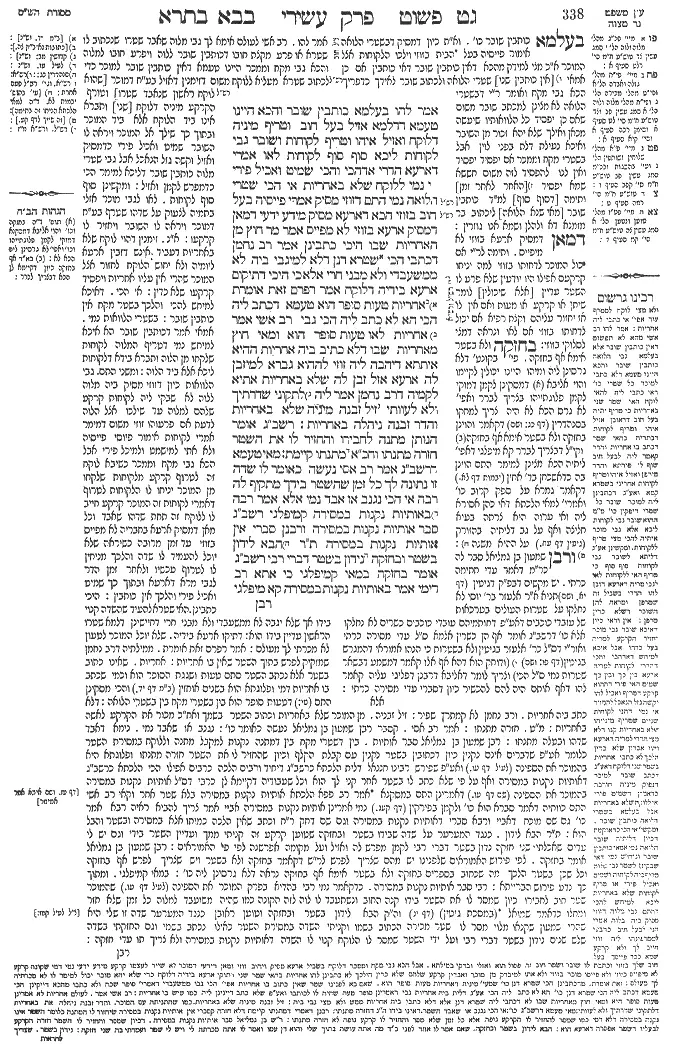
Bava Batra 169b - Guemara
אמר להו בעלמא כותבין שובר והכא היינו טעמא דדלמא אזיל בעל חוב וטריף מיניה דלוקח ואזיל איהו וטריף לקוחות ושובר גבי לקוחות ליכא סוף סוף לקוחות לאו אמרי דארעא הדרי אדהכי והכי שמיט ואכיל פירי אי נמי ללוקח שלא באחריות אי הכי שטרי הלואה נמי התם דזוזי מסיק אמרי פייסיה בעל חוב בזוזי הכא דארעא מסיק מידע ידעי דמאן דמסיק ארעא בזוזי לא מפייס אמר מר חוץ מן האחריות שבו היכי כתבינן אמר רב נחמן דכתבי הכי שטרא דנן דלא למיגבי ביה לא ממשעבדי ולא מבני חרי אלא כי היכי דתיקום ארעא בידיה דלוקח אמר רפרם זאת אומרת אחריות טעות סופר הוא טעמא דכתב ליה הכי הא לא כתב ליה הכי גבי רב אשי אמר אחריות לאו טעות סופר הוא ומאי חוץ מאחריות שבו דלא כתיב ביה אחריות ההיא איתתא דיהבה ליה זוזי לההוא גברא למיזבן לה ארעא אזל זבן לה שלא באחריות אתיא לקמיה דרב נחמן אמר ליה לתקוני שדרתיך ולא לעוותי זיל זבנה מיניה שלא באחריות והדר זבנה ניהלה באחריות:
רשב"ג אומר הנותן מתנה לחבירו והחזיר לו את השטר חזרה מתנתו וחכ"א מתנתו קיימת:
מאי טעמא דרשב"ג אמר רב אסי נעשה כאומר לו שדה זו נתונה לך כל זמן שהשטר בידך מתקיף לה רבה אי הכי נגנב או אבד נמי אלא אמר רבה באותיות נקנות במסירה קמיפלגי רשב"ג סבר אותיות נקנות במסירה ורבנן סברי אין אותיות נקנות במסירה ת"ר הבא לידון בשטר ובחזקה נידון בשטר דברי רבי רשב"ג אומר בחזקה במאי קמיפלגי כי אתא רב דימי אמר באותיות נקנות במסירה קא מיפלגי
Comments from Rashbam - Bava Batra 169b
אמר להו. רב אשי לעולם אימא לך גבי מלוה שאבד שטרו שנכתוב לו שטרא או פרע מקצת חובו דכותבין שובר ללוה ויפרע חובו למלוה והכא גבי מקח וממכר היינו טעמא דאין כותבין שובר למוכר כדי לכתוב שטרא מעליא ללוקח משום דזימנין דאזיל בע"ח דמוכר [שהוא לוקח ראשון שנאבד שטרו] וטורף הקרקע מיניה דלוקח [שני] ותברא אינו ביד הלוקח אלא ביד המוכר ובתוך כך שילך אל המוכר ויראה לו השובר שמיט ואכיל פירי כדמסיק ואזיל וקשה גזל הנאכל אבל גבי שטרי מלוה כותבין שובר דליכא למימר הכי כדמפרש לקמן ואזיל: ומקשינן סוף סוף לקוחות . לאו לגבי מוכר אזלי בתמיה לצעוק על שדהו שטרף בע"ח דמוכר ויראה לו השובר ויחזיר לו קרקעו: א"נ . זימנין דהוי לוקח שלא באחריות דעביד אינש דזבין ארעא ליומיה ולא יחוש הלוקח לחזור אצל המוכר שהרי אין עליו אחריות ויפסיד קרקעו שלא כדין: אי הכי . דאיכא למיחש להכי והלכך בשטר מקח אין כותבין שובר: בשטרי הלוואות נמי . אמאי אמר דכותבין שובר הא איכא למיחש נמי דטריף המלוה לקוחות שלקחו מן הלוה ותברא בידא דלקוחות ליכא אלא ביד הלוה: ומשני התם . גבי הלוואות כיון דזוזי מסיק ביה מלוה ללוה לא שבקי ליה לקוחות קרקע שלהם למלוה עד שילכו אצל הלוה לדעת אם פרעוהו זוזי משום דמימר אמרי לקוחות אימור פיוסי פייסיה ולא אתי למישמט ולמיכל פירי אבל הכא גבי מקח וממכר כשיבא לוקח זה לטרוף קרקע מלקוחות שלקחו מן המוכר יניחו לו הלקוחות לטרוף דאמרי לקוחות זה המוכר קרקע חייב לו ללוקח זה תחת שדהו שאבד וכל מאן דמסיק ארעא בחבריה לא מפייס בזוזי עד זמן מרובה כשיראה שלא יוכל להעמיד לו שדה והלכך מניחין לו לטרוף עכשיו ולאחר זמן הדר לגבי מרא דארעא ובתוך כך שמיט ואכיל פירי והלכך אין כותבין: היכי כתבינן . האי שטרא להעיד שהשדה קנוי בידו אך שלא יגבה לא ממשעבדי ולא מבני חרי דחיישינן דלמא שטרו הראשון עדיין בידו הוא: דתיקו ארעא בידיה . שלא יוכל המוכר לטעון לא מכרתי לך מעולם: אמר רפרם זאת אומרת . ממילתיה דרב נחמן שמזקיק לפרש בתוך השטר שאין בו אחריות: אחריות . שאינו כתוב בשטר אלא נכתב השטר סתם טעות ושגגת הסופר הוא וכמי שכתב בו אחריות דמי ופלוגתא הוא בשנים אוחזין (ב"מ דף יד.) והכי מסקינן התם (טו:) דטעות סופר הוא בין בשטרי מקח בין בשטרי הלואה: דלא כתב ביה אחריות . ורב נחמן לא קמתרץ שפיר: זיל זבניה . מן המוכר שלא באחריות וכתוב השטר בשמך ואח"כ מכור את הקרקע לאשה באחריות: מ"ט . חזרה מתנתו: אמר רב אסי . קסבר רבן שמעון בן גמליאל נעשה כאומר כו': נגנב או שאבד נמי . נימא דאבד שדהו ובטלה מתנתו: רבן שמעון בן גמליאל סבר אותיות . בין דשטרי מקח בין דמתנה נקנות למקבל מתנה וללוקח במסירת השטר כלומר אע"פ שדברים אינם נקנין כיון דכתובין בשטר נקנין עם קבלת הקלף וכיון שהחזיר לו את השטר חזרה מתנתו ופלוגתא היא בהמוכר את הספינה (לעיל בבא בתרא דף עו.) ואע"פ שפירש רבינו חננאל דלית הלכתא כרשב"ג דיחיד ורבים הלכה כרבים אפילו הכי הלכתא כרשב"ג דאותיות נקנות במסירה ואף על פי שלא כתב לו בשטר אחר קני לך הוא וכל שעבודיה דקיימא לן כרבי דס"ל אותיות נקנות במסירה בהמוכר את הספינה (שם דף עו.) דאמרינן התם במסקנא אמר רב פפא הלכתא אותיות נקנות במסירה בלא שטר אחר וקאי רב אשי התם כוותיה דאמר סברא הוא כו' ולקמן בפירקין (בבא בתרא דף קעג.) נמי אמרינן אותיות נקנות במסירה אביי אמר צריך להביא ראיה רבא אמר כו' גם שם מוכח דאביי ורבא סברי דאותיות נקנות במסירה וגם שם דחק ר"ח וכתב שאין הלכה כמותו אלא במסירה ובשטר והבל הוא: ת"ר הבא לידון . כנגד המערער על שדה שבידו בשטר ובחזקה שטוען קרקע זה קניתי ממך ועדיין השטר בידי וגם יש לי עדים שאכלתי שני חזקה נדון בשטר דברי רבי לקמן מפרש לה ואזיל ועל מקומה אפרשנה לפי פי' האמוראים: רבן שמעון בן גמליאל אומר בחזקה . לפי פירוש האמוראים שלפנינו יש מהם שצריך לפרש לר"ש דקאמר בחזקה ולא בשטר ויש שצריך לפרש אף בחזקה וכל שכן בשטר הלכך מה שכתוב בספרים בחזקה ולא בשטר אימא אף בחזקה נראה דלא גרסינן ליה כו': במאי קמיפלגי . ומתוך כך נדע פירוש הברייתא:
Comments from Tosafot - Bava Batra 169b
בעלמא כותבין שובר כו'. וא"ת כיון דמסיק דבשטרי הלואה אימור פייסיה בעל. הבית בזוזי וילכו הלקוחות אצל המוכר א"כ מצי למידק מהכא דאין כותבין שובר דאי כותבין אם כן אמאי [אין כותבין שני] שטרי הלואה ולכתוב שובר לאידך כדפריך הכא גבי מקח ואומר ר"י דבשטרי הלואה לא מצינן למכתב שובר משום שאם כן יפסיד כל הלוואותיו שיעשה מכאן ואילך שלא יהא זכור מן השובר ואיכא נעילת דלת בפני לוין אבל בשטרי מקח וממכר אם יפסיד יפסיד ואין לנו להפסיד לזה משום חששא שמא יפסיד [האחר לאחר זמן] ותימה [דסוף סוף] למ"ד כותבין שובר [מאי שנא הלואה] ליכתוב בר מזמנא דא ולהלן ושמא אנו גוזרין: דמאן דמסיק ארעא בזוזי לא מיפייס. ותימה לר"י אם יכול המוכר לדחותו בזוזי למה יניחו קרקעם אפילו היו יודעין שלא פרע לו השטר עדיין [אלא שיכולין] לומר שיתן או קרקע או מעות ואם אין לו אז יחזור עליהם וקצת רפיא אם יכול לדחותו בזוזי אם לאו ונראה דמצי לסלוקי בזוזי: בחזקה ולא בשטר אימא אף בחזקה. פי' בקונט' דלא גרסינן ליה ומיהו היינו יכולין לקיימו והוי אליבא דמסקינן לקמן דמוקי לקמן פלוגתייהו בצריך לברר ואפי' לא גרס הכא לא היה צריך למחקו בסנהדרין (דף כג: ושם) דקאמר והוינן בחזקה ולא בשטר אימא אף בחזקה וקי"ל דבצריך לברר קא מיפלגי דאפי' ליתיה הכא מצינן למימר התם הוינן בה כדאשכחן בד' אחין (יבמות דף לא.) דקאמר גמרא על ספק קרוב כו' ואמרי' למאי הלכתא דאי כהן אסירא ליה ואי ערוה היא צרתה בעיא חליצה ואף על גב דליתיה בהזורק (גיטין דף עח.) על ההיא משנה:
Bava Batra 169b - Mishnah translated into english
Rav Pappa or Rav Ashi said to them: Do not draw this conclusion. It is possible that the tanna of the baraita holds that generally the court writes a receipt when a creditor has lost his promissory note. And here, this is the reason that it does not write a receipt: As, perhaps the creditor, i.e., the one from whom the property was stolen, will go and repossess property from the purchaser who bought the stolen land, and the purchaser, seeking reimbursement in accordance with the guarantee, will go and repossess property from other purchasers who had later bought property from the same seller. And the receipt will not help, because it is not with the purchasers who bought property from the seller, but is in the possession of the seller himself. The purchasers, who are the ones who will suffer from the double collection, have no protection; they will in fact not even be aware that they are the victims of a double collection.
The Gemara asks: Ultimately, don’t these purchasers go back to the owner, i.e., the seller, of the land to demand reimbursement? At that point the seller will produce the receipt, exposing the double collection, and the entire process will be reversed, so that ultimately the purchaser who suffered from the unjust collection will obtain possession of his property.
The Gemara answers: While it is true that ultimately the deception will be discovered, in the interim, between the time the land was unjustly repossessed from the purchaser and the time when the injustice is reversed, the one who repossessed the land seizes the land and consumes its produce, i.e., he enjoys the profits produced by the land, and it will be difficult to receive full reimbursement for this stolen produce.
Alternatively, the reason the option of writing a receipt for the seller of the land is not pursued here is that there is a concern about one who purchases land without a guarantee. As such a purchaser knows that he has no recourse to be reimbursed from the seller if the land he bought is repossessed, he will never contact the seller and discover that the seller has a receipt and that he has been the victim of an unjust double collection.
The Gemara asks: If so, the same concern should be taken into consideration in the case of promissory notes as well. And yet Rav Pappa, or Rav Ashi, said that the tanna of the baraita concedes that a receipt may be written for the debtor to enable the collection of a debt in the event of the loss of the promissory note. Why are the aforementioned concerns not applicable to the case of debt collection?
The Gemara answers: There, where the debtor owes money, when the creditor seeks to repossess sold land, the purchaser of that land will say to himself: There is a possibility that the debtor appeased the creditor by paying him money, since debts are usually settled with money. I will therefore investigate the matter with the debtor before allowing the creditor to repossess my land. At that point the receipt, held by the debtor, will be discovered, and double collection will be prevented. Here, where he owes land, as the issue is that the claim is based on reimbursement for having bought stolen land, the purchaser knows that it is not common for one who is owed land to be appeased with money in such cases. The purchaser will therefore allow his land to be repossessed and will seek reimbursement at a later time.
§ The Gemara returns to the baraita and analyzes one of its statements. The Master says in the baraita: With regard to deeds of buying and selling land, the court may write a replacement document, excluding the guarantee that was in the first document that if the field is repossessed the seller will compensate the purchaser for his loss. How do we write a bill of sale in such a way that it does not include this guarantee? Rav Naḥman said that the case is one in which the court writes as follows: Our deed is not intended to enable the collection of reimbursement in event of repossession, neither collection from liened property that has been sold nor collection from unsold property; rather, it is intended merely to ensure that the land is established in the possession of the purchaser.
Rafram says: This statement of Rav Naḥman serves to say that the omission of the guarantee of the sale from a document is a scribal error. That is, it is assumed that when one purchases land he expects to have his purchase guaranteed, and that if such a clause is not stated in the document it is presumed to be a mere scribal oversight, and a guarantee is in effect. Rav Naḥman said, in explaining the baraita, that the only reason a land purchase would not have a guarantee is that the scribe wrote this for him, i.e., he wrote that there is no guarantee, explicitly in the deed; this indicates that if the scribe did not write this explicitly for the purchaser, but left out the subject of the guarantee altogether, the purchaser would nevertheless have the guarantee and would be able to collect reimbursement from the seller in the event of repossession.
Rav Ashi disagrees and says: The omission of the guarantee of the sale from a document is not a scribal error. Accordingly, if mention of a guarantee is omitted from a bill of sale, there is in fact no guarantee. And what does the baraita mean when it says: Excluding the guarantee that was in the first document? It means simply that in this case there was no clause about a guarantee written in it at all.
The Gemara relates: There was a certain woman who gave money to a certain man to act as her agent and purchase land for her. The agent went and purchased land for her, but he conducted the purchase in such a way that it was without a guarantee. The woman wanted to take action against the agent and came before Rav Naḥman to ask what recourse she had.
Rav Naḥman said to the agent: The principle with regard to an agent is that if he acts to the detriment of the one who appointed him, the one who appointed him can say: I sent you to act for my benefit and not to my detriment. Therefore, the entire agency is null and void, thereby negating the purchase. Nevertheless, you agreed to purchase the land without a guarantee. Therefore, go yourself and purchase the land from him without a guarantee, and then sell it to this woman with a guarantee that you will reimburse her in the event the land is repossessed.
§ The baraita teaches that Rabban Shimon ben Gamliel says: In the case of one who gives a gift of land to another, and the recipient returned the deed to him, his gift of land returns to him as well. But the Rabbis say: His gift of land remains in the possession of the recipient. The Gemara asks: What is the reason for the opinion of Rabban Shimon ben Gamliel? Rav Asi says: It becomes as if the giver said to the recipient: This field is given to you only as long as the deed remains in your possession. Therefore, by returning the deed to the giver, the recipient is canceling the gift.
Rabba objects to this: If that is so that these are the conditions of the gift, then when the deed is stolen from or lost by the recipient, the gift should also be canceled.
Rather, Rabba said a different explanation: Rabban Shimon ben Gamliel and the Rabbis disagree about whether or not the letters, i.e., the contents of a promissory note, are acquired by merely transferring the document from one holder of the document to another. Rabban Shimon ben Gamliel holds that the letters are acquired by transferring the document. Therefore, if the recipient returns the bill of sale to the giver, the land returns to the giver as well. And the Rabbis hold that the letters are not acquired by transferring the document.
The Sages taught in a baraita: With regard to one who comes to court to be judged over a claim that land that is in his possession belongs to another, if he claims ownership based on a deed, i.e., a bill of sale, and claims further that he is the owner based on presumptive ownership of the land, as it was in his uncontested possession for three years, and he therefore does not need the deed as proof, his claim is judged based on the deed. This is the statement of Rabbi Yehuda HaNasi. Rabban Shimon ben Gamliel says: His claim is judged based on his presumptive ownership.
The Gemara analyzes the baraita: With regard to what do Rabbi Yehuda HaNasi and Rabban Shimon ben Gamliel disagree? When Rav Dimi came from Eretz Yisrael to Babylonia he said: They disagree about whether or not letters are acquired by transferring the document from one holder of the document to another.
Traduction : The William Davidson digital edition of the Koren Noé Talmud, with commentary by Rabbi Adin Even-Israel Steinsaltz.
Bava Batra 169b : Significance
Next step
Finished studying Bava Batra 169b? Carry on with the rest of the tractate.
Study Bava Batra 170aFrequently asked questions: Bava Batra 169b
Where is Bava Batra 169b in tractate Bava Batra?
Bava Batra 169b is page 336 of 350 in tractate Bava Batra (Seder Nezikin).
When is daf 169 of Bava Batra studied in Daf Yomi?
Daf Yomi covers one daf a day, both sides. Daf 169 of Bava Batra will be studied on May 14, 2032.
Is there a video class on Bava Batra 169b?
Yes, by Daf Tube, Rabbi Dr. Moshe Weisblum. These classes were published on YouTube by their authors and are gathered on this site.
What is tractate Bava Batra about?
Masechet Baba Batra is the third tractate of the Seder Nezikin. The Baba Batra gemara is the study of laws relating to matters relating to individual responsibility and the rights of property holders. The Baba Batra tractate is a gemara which contains 10 chapters.
Your study is also dedicated to them
- L'ilui Nishmat Yaakov ben Myriam
- L'ilui Nishmat Margalit bat Ledicia
- L'ilui Nishmat Chemouel Eliezer ben Batcheva