 Talmud Bavli
Bava Batra 174b : Youtube
Daf TubeYoutube
2 video classes :
Bava Batra Page 174b
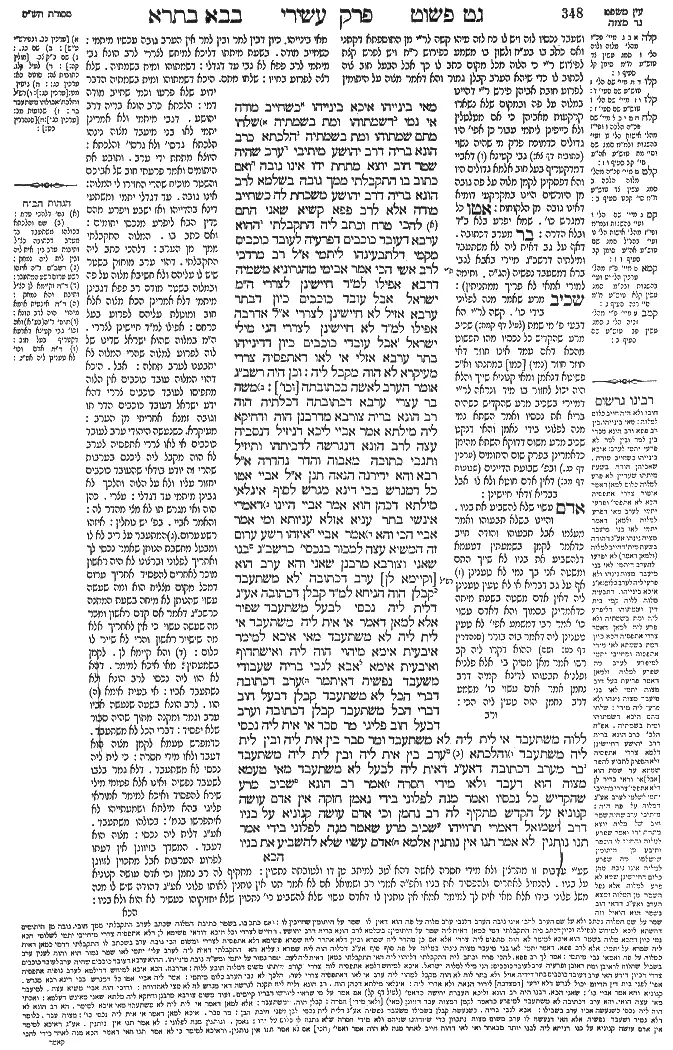
Bava Batra 174b - Guemara
מאי בינייהו איכא בינייהו כשחייב מודה אי נמי דשמתוהו ומת בשמתיה שלחו מתם שמתוהו ומת בשמתיה הלכתא כרב הונא בריה דרב יהושע מיתיבי ערב שהיה שטר חוב יוצא מתחת ידו אינו גובה ואם כתוב בו התקבלתי ממך גובה בשלמא לרב הונא בריה דרב יהושע משכחת לה כשחייב מודה אלא לרב פפא קשיא שאני התם להכי טרח וכתב ליה התקבלתי ההוא ערבא דעובד כוכבים דפרעיה לעובד כוכבים מקמי דלתבעינהו ליתמי א"ל רב מרדכי לרב אשי הכי אמר אבימי מהגרוניא משמיה דרבא אפילו למ"ד חיישינן לצררי ה"מ ישראל אבל עובד כוכבים כיון דבתר ערבא אזיל לא חיישינן לצררי א"ל אדרבה אפילו למ"ד לא חיישינן לצררי הני מילי ישראל אבל עובדי כוכבים כיון דדינייהו בתר ערבא אזלי אי לאו דאתפסיה צררי מעיקרא לא הוה מקבל ליה:
וכן היה רשב"ג אומר הערב לאשה בכתובתה [וכו']:
משה בר עצרי ערבא דכתובתה דכלתיה הוה רב הונא בריה צורבא מדרבנן הוה ודחיקא ליה מילתא אמר אביי ליכא דניזיל דנסביה עצה לרב הונא דנגרשה לדביתהו ותיזיל ותגבי כתובה מאבוה והדר נהדרה א"ל רבא והא ידירנה הנאה תנן א"ל אביי אטו כל דמגרש בבי דינא מגרש לסוף איגלאי מילתא דכהן הוא אמר אביי היינו דאמרי אינשי בתר עניא אזלא עניותא ומי אמר אביי הכי והא אמר אביי איזהו רשע ערום זה המשיא עצה למכור בנכסי' כרשב"ג בנו שאני וצורבא מרבנן שאני והא ערב הוא [וקיימא לן] ערב דכתובה לא משתעבד קבלן הוה הניחא למ"ד קבלן דכתובה אע"ג דלית ליה נכסי לבעל משתעבד שפיר אלא למאן דאמר אי אית ליה משתעבד אי לית ליה לא משתעבד מאי איכא למימר איבעית אימא מיהוי הוה ליה ואישתדוף ואיבעית אימא אבא לגבי בריה שעבודי משעבד נפשיה דאיתמר ערב דכתובה דברי הכל לא משתעבד קבלן דבעל חוב דברי הכל משתעבד קבלן דכתובה וערב דבעל חוב פליגי מר סבר אי אית ליה נכסי ללוה משתעבד אי לית ליה לא משתעבד ומר סבר בין אית ליה ובין לית ליה משתעבד והלכתא ערב בין אית ליה ובין לית ליה משתעבד בר מערב דכתובה דאע"ג דאית ליה לבעל לא משתעבד מאי טעמא מצוה הוא דעבד ולאו מידי חסרה אמר רב הונא שכיב מרע שהקדיש כל נכסיו ואמר מנה לפלוני בידי נאמן חזקה אין אדם עושה קנוניא על הקדש מתקיף לה רב נחמן וכי אדם עושה קנוניא על בניו דרב ושמואל דאמרי תרוייהו שכיב מרע שאמר מנה לפלוני בידי אמר תנו נותנין לא אמר תנו אין נותנין אלמא אדם עשוי שלא להשביע את בניו
Comments from Rashbam - Bava Batra 174b
מאי בינייהו . כיון דבין למר ובין למר אין הערב גובה עכשיו מיתמי: כשחייב מודה . בשעת מיתתו דליכא למיחש לצררי לרב הונא גבי מיתמי לרב פפא לא גבי עד דגדלי: דשמתוהו ומית בשמתיה . שלא רצה לפרוע בחייו: שלחו מתם . היכא דשמתוהו ומית בשמתיה הדבר ידוע שלא פרעו וכמי שחייב מודה דמי: הלכתא כרב הונא בריה דרב יהושע . דגבי מיתמי ולא אמרינן יתמי לאו בני מיעבד מצוה נינהו הלכתא גרסי' ולא גרסי' והלכתא: היוצא מתחת ידי ערב . ותובע את היתומים ואמר פרעתי חוב של אביכם והשטר מוכיח שהרי החזירו לי המלוה: אינו גובה . עד דגדלי יתמי ומשתעי דינא בהדייהו ואז ישבע ויפרע מהם כדין הבא ליפרע מנכסי יתומים: ואם כתב בו . המלוה התקבלתי ממך מן הערב: דלהכי כתב ליה התקבלתי . דהוי ערב מוחזק בשטר שיש לו עליהם ולא חשיבא מלוה על פה ובמלוה בשטר מודה רב פפא דגבינן מיתמי דלא אמרינן הכא מצוה אלא חוב ומוטלת עליהם לפרוע בעל כרחם: אפילו למ"ד חיישינן לצררי . ה"מ במלוה שהוא ישראל שדינו של לוה לפרוע למלוה שהרי המלוה לא יתבענו לערב תחלה: אבל . היכא דהוי המלוה עובד כוכבים אין הלוה מתפיסו לעובד כוכבים צררי דהא ידע ישראל דעובד כוכבים הדר תו וגובה זמנא אחריתי מן הערב: מעיקרא . כשנעשה היהודי ערב לעובד כוכבים אי לאו צררי אתפסיה לערב לא הוה מקבל ליה ליכנס בערבות שהרי זה יודע בודאי שהעובד כוכבים יחזור עליו ולא על הלוה והלכך לא גבינן מיתני עד דגדלי: עצרי . כהן הוה ואי מגרש תו לא מצי מהדר לה: והאמר אביי . בפ' יש נוחלין: איזהו רשע ערום . המתעבר על ריב לא לו ומבטל מחשבת הנותן שאמר נכסי לך ואחריך לפלוני וברצונו לא היה ראשון מוכר לאחרים להפסיד אחריך ערום דמכל מקום מצליח הוא ומה שעשה עשוי שהנותן לא מיחה בשעת המתנה כרשב"ג דאמר אם קדם ראשון ומכר מה שעשה עשוי כי אין לאחריך אלא מה שישייר ראשון והרי לא שייר לו כלום: והא קיימא לן . לקמן בשמעתין: מאי איכא למימר . דהא לא הוו ליה נכסי לרב הונא ולא נשתעבד אביו: אי בעית אימא הוו . לרב הונא בשעה שנעשה אביו ערב וגמר ומקנה מתוך שהיה סבור שלא יפסיד: דברי הכל לא משתעבד . כדמפרש טעמא לקמן מצוה הוא דעבד ולאו מידי חסרה: כי לית ליה נכסי לא משתעבד . דלא גמר בלבו לשעבד נפשיה ואינו אלא פטומי מילי שירא להפסיד ואיכא למימר אמוראי פליגי בהא מילתא ושמעתייהו לא איתפרשו בגמ': בכולהו משתעבד . אע"ג דלית ליה נכסי: מצוה הוא דעבד . המשדך בזיווגן אין דעתו לפרוע הערבות אבל מתכוין לזווגן שע"י ערבות זו מתרצין ולא מידי חסרה לאשה דהא טב למיתב טן דו ולטובתה נתכוין: מתקיף לה רב נחמן וכי אדם עושה קנוניא על בניו . להנחיל לאחרים ולהפסיד את בניו ואפ"ה אמרי רב ושמואל אם לא אמר תנו אין נותנין לאותו פלוני אע"ג דהודה שיש לו מנה משל פלוני בידו אלא מאי אית לך למימר אמאי אין נותנין לו דאדם עשוי שלא להשביע כו' נתכוין שלא יחזיקוהו כעשיר לא הוא ולא בניו:
Comments from Tosafot - Bava Batra 174b
ואם כתב בו התקבלתי. שכתב בעל חוב כן גובה בשלמא לרב הונא משכחת לה בשחייב מודה דליכא למיחש לצררי אלא לרב פפא היכי משכחת לה וא"ת אי בשחייב מודה אפי' לא כתב התקבלתי ויש לדחות דכי לא כתב התקבלתי להכי לא גבי מיתומים דחיישי' שמא לא גבה המלוה ממנו ומשני שאני התם דלהכי כתב ליה התקבלתי דליהוי כחיה אלים וליהוי כמלוה בשטר וכן גרס רבינו חננאל משכחת לה בשחייב מודה ומפרש כדפרישית דאלים משום דהוי בשטרא וקשיא לן דבערכין פ' שום היתומים (דף כב: ושם) מוכח דאיירי רב הונא ורב פפא במלוה בשטר דפריך התם שום היתומים ל' יום בשלמא לרב הונא מוקי לה בשחייב מודה אלא לרב פפא במאי מוקי לה אמר לך רב פפא איבעית אימא בכתובת אשה משום חינא אבל בבעל חוב בשטר לא מצי מוקי לה אלא מיירי ודאי אפילו בשטר ועוד קשיא כיון דמוקי מילתיה במלוה על פה א"כ אפילו בני מיעבד מצוה נינהו נמי אין לגבות מהן דטוענין ליורש שפרע שהאב היה נאמן לומר פרעתי ואפילו גדולים נינהו פטורין מהאי טעמא ועוד מאי משני דלהכי כתב ליה התקבלתי דהוי כמלוה בשטר מה יש לו לכתיבת המלוה להועיל לערב לגבות מיתמי מאחר שהלוה לא כתב כלום והיה נראה לפרש דאם כתב בו התקבלתי גובה היינו אם כתב בשטר התקבלתי מן הערב שכך כתב הלוה גם לערב בתוך השטר ליפות כחו לדוחקו ולפטרו לשלם חובו למלוה אף אם לא יתבענו המלוה עדיין גובה בשלמא לרב הונא בריה דרב יהושע ניחא דאיהו חייש לצררי והכא ליכא למיחש לצררי דכיון שכתב גם לערב התקבלתי ועשאו כמלוה לתבעו מעצמו אין רגיל להתפיס צררי למלוה אבל ברישא אינו גובה משום דחייש לצררי דלמא אתפסיה למלוה ואע"פ שיש ערב וזה אין לחוש בכתב לו התקבלתי דלמא אתפסיה צררי לערב שאין רגילות להתפיס ליה צררי כדאמרינן לקמן דבעובד כוכבים ליכא למיחש לצררי אלמא אין מתפיס לערב דאם כן ניחוש שמא התפיס לערב ואפילו למאן דפריך אדרבה כו' אי לאו דאתפיס צררי לערב לא הוה מקבל לערב כדפי' בקונטרס הכא מיהא לא מתפיס לא למלוה ולא לערב אלא לרב פפא קשיא הא לאו בני מיעבד מצוה נינהו שאני התם דלהכי כתב לו התקבלתי שיהא לו כח לגבות מן היתומים ושעבד נכסיו לזה ויש לו כח לזה מיהו קשה לר"י מן התוספתא דקתני ואם כתב בו בע"ח ולשון בו משמע כפירוש ר"ח ויש לפרש קצת לפירוש ר"י כי הלוה מכל מקום כתב לו כך אבל הבעל חוב צוה לכתוב לו כדי שיהא הערב קבלן גמור והא דאמר מצוה על היתומין לפרוע חובת אביהן פירש ר"י דהיינו במלוה על פה ובמקום שלא נשארו קרקעות מאביהן כי אם מטלטלין ולא כייפינן ליתמי עבור כן אפי' היו גדולים כדמוכח פרק מי שהיה נשוי (כתובות דף צא:) גבי קטינא דאביי דמדקטריף בעל חוב אלמא גדולים היו והא דפסקינן לקמן מלוה על פה גובה מן היורשים היינו במקרקעי דומיא דאינו גובה מן הלקוחות: אטו כל דמגרש כו'. שמא יפרע בלא ב"ד ובלא הדרה: בר מערב דכתובה. דאף על גב דאית ליה לא משתעבד ומילתיה דרשב"ג מיירי באבא לגבי ברא דמשעבד נפשיה (הג"ה. ותימה למורי אמאי לא פריך ממתניתין): שכיב מרע שאמר מנה לפלוני בידי כו'. קשה לר"י הא דבעי פ' מי שמת (לעיל בבא בתרא דף קמח:) שכיב מרע שהקדיש כל נכסיו מהו תפשוט מהכא דאם עמד אינו חוזר דאי חוזר חוזר (נמי) [כמו] במתנתו וא"כ פשיטא דנאמן ומאי קנוניא שייך והלא היה יכול לחזור בו מיד ונראה לר"י דמיירי בשכיב מרע שהקדיש כשהיה בריא את נכסיו ואמר השתא נמי מנה לפלוני בידי נאמן והאי דנקט שכיב מרע משום דדוקא השתא מהימן כדאמרינן בפרק שום היתומים (ערכין דף כג.) ובפ' שבועת הדיינים (שבועות דף מב:) דאין אדם חוטא ולא לו אבל בבריא ודאי חיישינן: אדם עשוי שלא להשביע את בניו. והיינו בשלא תבעוהו ואמר מעצמו אבל תבעוהו והודה חייב כדאמר לקמן בשמעתין דטעמא דלהשביע את בניו לא שייך התם ומשטה אני בך נמי לא טענינן אף על גב דבריא אי לא טעין טענינן ליה דאין אדם משטה בשעת מיתה כדאמרינן בסמוך והא דאדם עשוי כו' אמר רבי דמשמע אפי' לא טעין טענינן ליה דאמר בזה בורר (סנהדרין דף כט: ושם) ההוא דקרו ליה קב רשו אמר מאן מסיק בי אלא פלניא ופלניא תבעוהו לדינא קמיה דרב נחמן אמר אדם עשוי כו' משמע דרב נחמן הוה טעין ליה הכי:
Bava Batra 174b - Mishnah translated into english
The Gemara asks: What is the difference between the opinion of Rav Pappa and that of Rav Huna, son of Yehoshua, as both agree that the orphans are exempt from repaying the debt until they reach majority?
The Gemara answers: The difference between them is in a case where the one who owed the money, i.e., the deceased, admits explicitly just before his death that he did not yet repay any of his loan. Alternatively, there is a difference between them in a case where the court excommunicated the deceased for not cooperating with the court in repaying his debt, and he died while still in a state of excommunication, which demonstrates that the debt had not been repaid prior to his death. In both of these cases Rav Pappa would exempt the minor orphans from payment, as minors are not obligated to perform mitzvot, while Rav Huna, son of Yehoshua, would require them to repay the debt immediately, as there is no possibility that their father had repaid the debt.
The Sages of Eretz Yisrael sent a ruling from there to Babylonia: In a case where the court had excommunicated a debtor for not cooperating in repaying his debt, and the debtor died while still in a state of excommunication, the halakha is in accordance with the opinion of Rav Huna, son of Rav Yehoshua, and the orphans must repay the debt immediately.
The Gemara raises an objection from a baraita (Tosefta 11:15): A guarantor for a debt who has the promissory note for that debt in his possession, indicating that he has repaid the debt, and now seeks reimbursement from the debtor, cannot collect if the debtor has died and the obligation for the debt has fallen to his minor heirs. But if it is written by the creditor in the promissory note: I received repayment from you, the guarantor, then the guarantor can collect the debt from the minor heirs.
The Gemara explains the objection: Granted, according to the opinion of Rav Huna, son of Rav Yehoshua, you find a case where the minor heirs would be required to repay the debt, such as when the one who owed the money, i.e., the deceased, admits explicitly just before his death that he did not yet repay the loan. But according to the opinion of Rav Pappa, who maintains that minor heirs never have to repay their father’s debts, it is difficult. What is the case discussed in the baraita?
The Gemara answers: It is different there, as it is for this reason that the creditor troubled himself and wrote for the guarantor: I received repayment from you. Once the creditor writes this in the promissory note, it attains the status of a promissory note of the guarantor held directly against the debtor, and even Rav Pappa agrees that a debt that is recorded in a promissory note can be collected from the deceased’s property immediately, even from the minor heirs.
The Gemara relates: There was a certain guarantor who had guaranteed a loan given by a gentile, who repaid the gentile creditor before the gentile creditor claimed repayment from the orphans who survived the debtor. The guarantor now sought reimbursement from the orphans. Rav Mordekhai said to Rav Ashi: This is what Avimi of Hagronya said in the name of Rava: Even according to the one who says that we are concerned for the possibility that the deceased may have given bundles of money to the creditor before his death, this statement applies only in the case of a Jewish creditor. But in the case of a gentile creditor, since according to gentile law he is entitled to go directly to a guarantor, we are not concerned for the possibility that the deceased may have given bundles of money. The debtor would not repay the gentile before the loan is due, as the latter has the right to collect directly from the guarantor, and would thereby receive double payment.
Rav Ashi said to Rav Mordekhai: On the contrary, even according to the one who says that we are not concerned for the possibility that the deceased may have given bundles of money, this statement applies only in the case of a Jewish creditor. But in the case of a gentile creditor, since according to gentile law they are entitled to go directly to a guarantor, no guarantor would accept upon himself to guarantee such a loan if the debtor had not given bundles of money as collateral to the gentile creditor from the outset.
§ The mishna teaches: And so Rabban Shimon ben Gamliel would say: If there is a guarantor for a woman for her marriage contract, and her husband is divorcing her, the husband must take a vow prohibiting himself from deriving any benefit from her so that he can never remarry her. The Gemara relates an incident pertaining to this ruling: Someone named Moshe bar Atzari was a guarantor for the marriage contract of his daughter-in-law, guaranteeing the money promised by his son in the event of death or divorce. His son, named Rav Huna, was a young Torah scholar, and was in financial straits. Abaye said: Is there no one who will go advise Rav Huna that he should divorce his wife, and she will go and collect her marriage contract from Rav Huna’s father, and then Rav Huna should remarry her?
Rava said to Abaye: But didn’t we learn in the mishna that when a husband divorces his wife in such circumstances he must take a vow prohibiting himself from deriving any benefit from her, thereby precluding the possibility of remarriage? Abaye said to him: Is that to say that everyone who divorces his wife divorces her in a court? Rav Huna could be advised to divorce his wife outside the court, in which case he could do so without being forced to take the prescribed vow.
Ultimately, it was revealed that this Rav Huna was a priest, who may not marry a divorcée, even his own ex-wife. Abaye’s suggestion was therefore not an option for him. Upon hearing this, Abaye said: This is in accordance with the adage that people say: Poverty follows the poor.
The Gemara asks: But did Abaye really say this? Would he really encourage giving such advice? But doesn’t Abaye himself say: Who is a cunning, wicked person? This is one who provides advice to sell property in accordance with the ruling of Rabban Shimon ben Gamliel. As taught elsewhere (Ketubot 95b), if one says: My property is hereby bequeathed to you, and after you die it will pass to so-and-so, Rabban Shimon ben Gamliel rules that the first recipient can sell the property, which would thereby deprive the second recipient from receiving it. Abaye said that giving advice to someone to pursue such action, though it is legally sound, is considered wicked. Here as well, why would he give advice to Rav Huna to divorce his wife only in order to force his father to pay the marriage contract?
The Gemara answers: When dealing with one’s son it is different. It is not considered wickedness to force a father to give money to his own son. Moreover, when dealing with a Torah scholar it is different. It is not considered wickedness to procure money for a Torah scholar, because the money enables him to pursue his studies.
The Gemara asks another question with regard to this incident: But wasn’t Moshe bar Atzari a guarantor? And we maintain, as the Gemara will soon note, that a guarantor for a marriage contract does not become obligated to pay. The Gemara answers: He was an unconditional guarantor.
The Gemara objects: This works out well according to the one who says that an unconditional guarantor for a marriage contract becomes obligated to pay it even if the husband has no property of his own at the time of the marriage. According to this opinion all is well. But according to the one who says: If the husband has his own property the unconditional guarantor becomes obligated to pay, but if the husband does not have his own property he does not become obligated, what is there to say? Rav Huna obviously did not have any property of his own. Why, then, was his father held responsible for paying his marriage contract according to this latter opinion?
The Gemara answers: If you wish, say that Rav Huna had property when he got married, so that his father’s guarantee took effect, but it became blighted, i.e., it was ruined or lost in the interim. And if you wish, say instead: A father, vis-à-vis his son, sincerely obligates himself to guarantee his marriage contract, even when the son has no property of his own.
The Gemara elaborates on the issue under discussion. This is as it was stated: Everyone agrees that a standard guarantor for a marriage contract does not become obligated to pay the marriage contract, and everyone agrees that an unconditional guarantor for a creditor, i.e., for a loan, becomes obligated to repay the loan. With regard to an unconditional guarantor for a marriage contract and a standard guarantor for a creditor, the Sages disagree. One Sage holds that if the debtor or husband has his own property, these guarantors become obligated for the guarantees they have undertaken, but if he does not have his own property the guarantor does not become obligated. And one Sage holds that whether the debtor or husband has property or does not have property, the guarantor becomes obligated to pay it.
And the halakha is that a guarantor becomes obligated to pay, whether the debtor has his own property or does not have property. This is to the exclusion of a guarantor for a marriage contract, in which case even if the husband has his own property he does not become obligated to pay. What is the reason for this? The intention of the guarantor is to perform the mitzva of facilitating a marriage by encouraging the woman to consent to the marriage as a result of his involvement, but he does not truly intend to obligate himself. And furthermore, in contrast to a guarantor for a loan, where the creditor stands to suffer a loss if he is not repaid, the woman does not suffer any concrete loss, as the husband does not borrow money from the woman. Therefore, the level of commitment of the guarantor in this case is lower. Accordingly, the Sages instituted that the guarantor does not become responsible for payment of the marriage contract from his own property.
§ Rav Huna says that a person on his deathbed who consecrated all his property to the Temple treasury, and then says: So-and-so has one hundred dinars in my possession, i.e., I owe one hundred dinars to so-and-so, is deemed credible, and the money is to be repaid to that person. The reason for this is that there is a presumption that a person does not collude against the Temple treasury. He would not lie about owing money to someone, thereby causing a loss to the Temple treasury.
Rav Naḥman objects to this ruling: And does a person collude against his children? Of course not. Yet, as Rav and Shmuel both say that in the case of a person on his deathbed who says: So-and-so has one hundred dinars in my possession, only if he says explicitly: Give him the money, the children give it, but if he did not say explicitly: Give him the money, the children do not give it. The person on his deathbed is not assumed to be telling the truth about owing the money unless he explicitly instructs that the money be given. Apparently, then, it is assumed that a person is prone to make false statements so as not to make his sons appear sated, i.e., wealthy. A person on his deathbed may falsely claim that he is in debt in order to dispel the notion that his children are wealthy heirs.
Traduction : The William Davidson digital edition of the Koren Noé Talmud, with commentary by Rabbi Adin Even-Israel Steinsaltz.