 Talmud Bavli
Ketubot 33b : Youtube
Daf TubeYoutube
1 video class :
Ketubot Page 33b
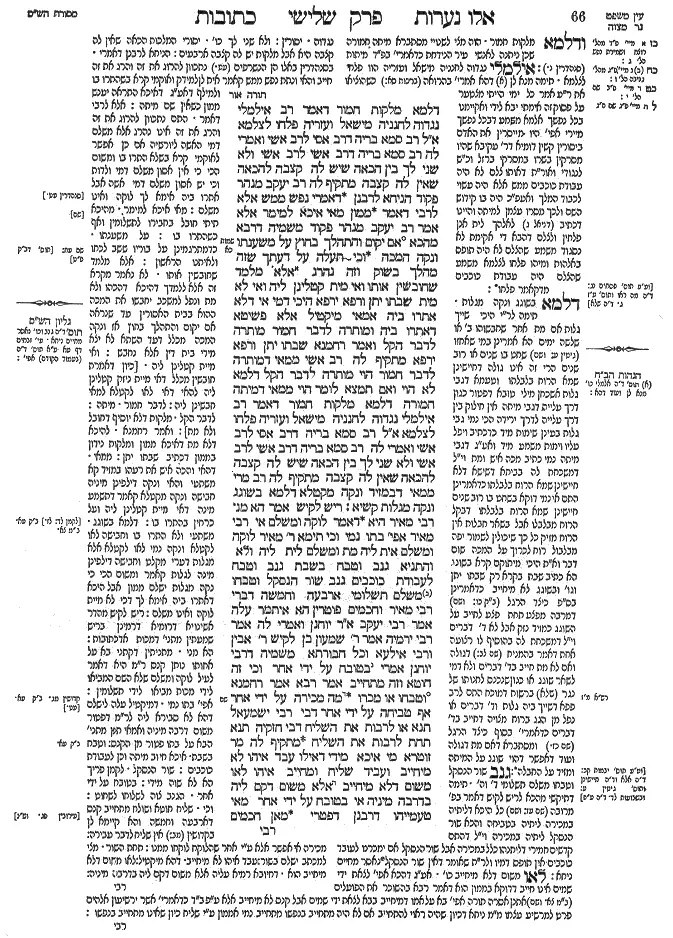
Ketubot 33b - Guemara
דלמא מלקות חמור דאמר רב אילמלי נגדוה לחנניה מישאל ועזריה פלחו לצלמא א"ל רב סמא בריה דרב אסי לרב אשי ואמרי לה רב סמא בריה דרב אשי לרב אשי ולא שני לך בין הכאה שיש לה קצבה להכאה שאין לה קצבה מתקיף לה רב יעקב מנהר פקוד הניחא לרבנן דאמרי נפש ממש אלא לרבי דאמר ממון מאי איכא למימר אלא אמר רב יעקב מנהר פקוד משמיה דרבא מהכא (שמות כא, יט) אם יקום והתהלך בחוץ על משענתו ונקה המכה וכי תעלה על דעתך שזה מהלך בשוק וזה נהרג אלא מלמד שחובשין אותו ואי מית קטלינן ליה ואי לא מית שבתו יתן ורפא ירפא היכי דמי אי דלא אתרו ביה אמאי מיקטיל אלא פשיטא דאתרו ביה ומותרה לדבר חמור מותרה לדבר הקל ואמר רחמנא שבתו יתן ורפא ירפא מתקיף לה רב אשי ממאי דמותרה לדבר חמור הוי מותרה לדבר הקל דלמא לא הוי ואם תמצא לומר הוי ממאי דמיתה חמורה דלמא מלקות חמור דאמר רב אילמלי נגדוה לחנניה מישאל ועזריה פלחו לצלמא א"ל רב סמא בריה דרב אסי לרב אשי ואמרי לה רב סמא בריה דרב אשי לרב אשי ולא שני לך בין הכאה שיש לה קצבה להכאה שאין לה קצבה מתקיף לה רב מרי ממאי דבמזיד ונקה מקטלא דלמא בשוגג ונקה מגלות קשיא:
ריש לקיש אמר הא מני רבי מאיר היא דאמר לוקה ומשלם אי רבי מאיר אפי' בתו נמי וכי תימא ר' מאיר לוקה ומשלם אית ליה מת ומשלם לית ליה ולא והתניא גנב וטבח בשבת גנב וטבח לעבודת כוכבים גנב שור הנסקל וטבחו משלם תשלומי ארבעה וחמשה דברי רבי מאיר וחכמים פוטרין הא איתמר עלה אמר רבי יעקב א"ר יוחנן ואמרי לה אמר רבי ירמיה אמר ר' שמעון בן לקיש ר' אבין ורבי אילעא וכל חבורתא משמיה דרבי יוחנן אמרי בטובח על ידי אחר וכי זה חוטא וזה מתחייב אמר רבא אמר רחמנא (שמות כא, לז) וטבחו או מכרו מה מכירה על ידי אחר אף טביחה על ידי אחר דבי רבי ישמעאל תנא או לרבות את השליח דבי חזקיה תנא תחת לרבות את השליח מתקיף לה מר זוטרא מי איכא מידי דאילו עבד איהו לא מיחייב ועביד שליח ומחייב איהו לאו משום דלא מיחייב אלא משום דקם ליה בדרבה מיניה אי בטובח על ידי אחר מאי טעמייהו דרבנן דפטרי מאן חכמים
Comments from Rashi on Masechet Ketubot Page 33b
נגדוה . יסורין: ולא שני לך כו' . יסורי המלכות הכאה שאין לה קצבה היא אבל מלקות יש לה קצבה ארבעים: הניחא לרבנן דאמרי . בסנהדרין באלו הן הנשרפים (עט.) נתכוון להרוג את זה והרג את זה חייב והאי ונתת נפש ממש קאמר אית לן למידק ואוקמי קרא בשהתרו בו ולמילף דאע"ג דאיכא התראה יענש ממון כשאין שם מיתה: אלא לרבי דאמר . התם נתכוון להרוג את זה והרג את זה אינו נהרג אלא משלם דמי האשה ליורשיה אם כן אפשר לאוקמי קרא בשלא התרו בו ומשום הכי כי אין אסון משלם דמי ולדות וכי יש אסון משלם דמי אשה אבל אתרו ביה אימא לך לוקה ואינו משלם: מאי איכא למימר . מהיכא תיתי חובל בחבירו לתשלומין ואף כשהתרו בו: על משענתו . כדמתרגמינן על בוריו ששב לכחו ולאיתנו הראשון: אלא מלמד שחובשין אותו . לא נאמר מקרא זה אלא ללמדך דהיכא דהכהו ולא מת ונפל למשכב יחבשו את המכה ההוא בבית האסורין עד שנראה אם יקום והתהלך בחוץ אז ונקה המכה מכלל דעד השתא לא יצא מידי בית דין אלא נחבש: ואי מיית קטלינן ליה . [כיון דאמרת חובשין מכלל דאי מיית ניזק קטלינן ליה להאי דאי לאו לקטלא למאי חבשינן ליה: לדבר חמור . מיתה: לדבר הקל . מלקות דלא יוסיף דחובל ולא מת]: ואמר רחמנא . להיכא דלא מת דאיכא ממון ומלקות נידון בממון דכתיב שבתו יתן: ממאי . דהאי והכה איש את רעהו במזיד קא משתעי והאי ונקה דילפינן מיניה חבישה ונקה מקטלא קאמר דתשמע מינה דאי מיית קטלינן ליה ועל כרחין בהתרו בו: דלמא בשוגג . משתעי ולא התרו בו וחבישה לאו לקטלא ונקה נמי לאו לקטלא אלא מגלות דערי מקלט וחבישה דילפינן מינה לגלות קאמר ומשום הכי כי נקה מגלות ישלם ממון אבל היכא דאתרו ביה אימא לך דכי לא מיית לוקה ואינו משלם: ריש לקיש מהדר אשינויא דרומיא דרמינן בריש שמעתין מתני' דמכות אדכתובות: הא מני . מתניתין דקתני בא על אחותו נותן קנס ר"מ היא דאמר לעיל לוקה ומשלם שלא השם מביאו לידי מכות מביאו לידי תשלומין: אפי' בתו נמי . דמיקטיל עלה לישלם דהא לא סבירא ליה לר"מ דפטור משום דרבה מיניה ואמאי תנן מתני' הבא על בתו פטור מן הקנס: הא מני . מתניתין דקתני בא על אחותו נותן קנס ר"מ היא דאמר לעיל לוקה ומשלם שלא השם מביאו לידי מכות מביאו לידי תשלומין: וטבח בשבת . איכא חיוב מיתה וכן לעבודת כוכבים: שור הנסקל . לקמן פריך הא לא שוה מידי: בטובח על ידי אחר . הגנב צוה לשלוחו לשחוט: וכי . שליח חוטא ושולח מתחייב קנס דארבעה וחמשה והא קיימא לן בקדושין (מב:) אין שליח לדבר עבירה: מכירה אי אפשר אלא ע"י אחר שהלוקח לוקחו ממנו: תחת השור . מצי למכתב ישלם בשור: עבד איהו לא מיחייב . דהא מיקטיל: לאו משום דלא מיחייב הוא . דחיובא רמיא עליה אלא משום דקם ליה בדרבה מיניה:
Comments from Tosafot - Ketubot 33b
ודלמא מלקות חמור . הוה מצי לשנויי מסתברא מיתה חמורה שכן ניתנה לאנשי עיר הנידחת כדאמרי' בפ"ד מיתות (סנהדרין נ.): אילמלי נגדוה לחנניה מישאל ועזריה הוו פלחי לצלמא . תימה מנא לן דהא אמרי' בהרואה (ברכות סא:) כשהוציאו את ר"ע אמר כל ימי הייתי מצטער על פסוק זה אימתי יבא לידי ואקיימנו בכל נפשך אלמא משמע דבכל נפשך מיירי אפי' היו מייסרין את האדם ביסורין קשין דומיא דר' עקיבא שהיו מסרקין בשרו במסרקי ברזל וכ"ש לנגודי ואור"ת דאותו צלם לא היה עבודת כוכבים ממש אלא היה עשוי לכבוד המלך ואעפ"כ היה בו קידוש השם ולכך מסרו עצמן למיתה והיינו דכתיב (דניאל ג) לאלהך לית אנן פלחין ולצלם דהבא די אקימת לא נסגוד משמע שהצלם לא היה תופס באלהות ומיהו פלחו לצלמא משמע שהצלם היה עבודת כוכבים מדקאמר פלחו: דלמא בשוגג ונקה מגלות . תימה לר"י היכי שייך גלות אם מת אחר שחבשוהו ב' או שלשה ימים הא אמרינן במי שאחזו (גיטין ע: ושם) שחט בו שנים או רוב שנים הרי זה אינו גולה דחיישינן שמא הרוח בלבלתו וטעמא דגבי גלות אשכחן מילי טובא דפטור כגון דרך עלייה דגבי מיתה אין חילוק בין דרך עלייה לדרך ירידה הכי נמי גבי גלות בעינן שימות מיד כדכתיב ויפל עליו וימות משמע מיד ואע"ג דגבי מיתה נמי כתיב מכה איש ומת וי"ל דמשכחת לה בביתא דשישא דלא חיישינן שמא הרוח בלבלתו כדאמרינן התם אי נמי דוקא בשחט בו רוב שנים חיישינן שמא הרוח בלבלתו דבקל הרוח מבלבלו אבל בשאר חבלות אין הרוח מזיק כל כך שיכולין לשמור יפה מבלבול רוח לכרוך על המכה שום דבר וא"ת היכי מיתוקם קרא בשוגג הא כתיב שבת בקרא רק שבתו יתן וגו' ובשוגג לא מיחייב כדאמרינן בס"פ כיצד הרגל (ב"ק כו: ושם) דמרבה מפצע תחת פצע לחייב על השוגג כמזיד נזק אבל לא ד' דברים וי"ל דמשכחת לה בהוסיף לו רצועה אחת דאמר בהמניח (שם לב:) דגולה ואם לא מת חייב בד' דברים ולא דמי לשאר שוגג או כגון שנכנס לחנותו של נגר (שלא) ברשות דמוכח התם לרב פפא דשייך ביה גלות וד' דברים או נפל מן הגג ברוח מצויה דחייב בד' דברים כדאמרי' בסוף כיצד הרגל (שם כז.) ומסתברא דאם מת דגולה ועוד דאפשר דהוי שוגג על המיתה ומזיד על החבלה: גנב שור הנסקל וטבחו משלם תשלומי ד' וה' . תימה דתיקשי מהכא לריש לקיש דאמר בפ' מרובה (שם עז: ושם) כל היכא דליתיה במכירה ליתיה בטביחה והכא שור הנסקל ליתיה במכירה וי"ל דהתם קדשים חמירי דליתנהו כלל במכירה אבל שור הנסקל אם ימכרנו לעובד כוכבים אין תופס דמיו ולר"ת שאומר דאין שור הנסקל נאסר מחיים ניחא: לאו משום דלא מיחייב כו' . אע"ג דהכא אפי' לצאת ידי שמים אינו חייב דדוקא בממון הוא דאמר רבא בהשוכר את הפועלים (ב"מ צא. ושם) אתנן אסרה תורה אפי' בא על אמו דמיחייב בבא לצאת ידי שמים אבל קנס לא מיחייב אלא ע"פ ב"ד כדאמרי' אשר ירשיעון אלהים פרט למרשיע עצמו מ"מ ניחא דכיון שהיה ראוי להתחייב אם לא היה מתחייב בנפשו מתחייב נמי אממון ע"י שליח כיון שאינו מתחייב בנפשו:
Ketubot 33b - Mishnah translated into english
Perhaps the punishment of lashes is more severe, as Rav said: Had they flogged Hananiah, Mishael, and Azariah (see Daniel, chapter 3) instead of casting them into the fiery furnace, these three would have been induced to worship the graven image. Apparently, the punishment of lashes is more severe than death. Rav Samma, son of Rav Asi, said to Rav Ashi, and some say Rav Samma, son of Rav Ashi, said to Rav Ashi: And is there no difference to you between flogging that has a limit, e.g., forty lashes by Torah law, which is a less severe punishment, and flogging that does not have a limit, i.e., flogging administered to induce compliance, which is more severe?
With regard to the basic proof from the case of the two men quarreling, Rav Ya’akov from Nehar Pekod strongly objects to this. This works out well according to the opinion of the Rabbis, who said that the verse “And you shall give a soul for a soul” (Exodus 21:23) is referring to an actual life, and that if he caused the woman’s death he is executed. However, according to Rabbi Yehuda HaNasi, who said that if he did not intend to injure the woman he is not liable to be executed and instead pays money as indemnity for causing her death, what can be said? According to that opinion, there was no forewarning for lashes at all, and the only liability is payment for injuring another.
Rather, Rav Ya’akov from Nehar Pekod said in the name of Rava that the halakha that one pays and is not flogged is derived from here. With regard to one who struck another with a stone or his fist and did not kill him but caused him to be bedridden, it is written: “If he rises and walks outside with his staff, he who struck him is absolved” (Exodus 21:19). And could it enter your mind that this victim is walking in the marketplace and that aggressor is executed as a murderer? Rather, the verse teaches that one imprisons the aggressor while the injured party recuperates, and if he dies due to the blow he received, we kill him. And if he does not die and recovers, the aggressor’s punishment is based on the verse “His loss of livelihood he shall give, and he shall cause him to be thoroughly healed” (Exodus 21:19).
The Gemara elaborates: What are the circumstances? If the witnesses did not forewarn him, why is the offender killed if the victim dies? Rather, obviously it is a case where the witnesses forewarned him, and one who is forewarned for a severe matter, such as the potential death penalty, is also forewarned for the lesser matter of injuring another, for which he is liable to be flogged, and nevertheless the Merciful One states: “His loss of livelihood he shall give, and he shall cause him to be thoroughly healed.” Apparently, despite his liability to be flogged, he pays and is not flogged.
Rav Ashi strongly objects to this proof: First of all, with regard to your initial assumption, from where do you ascertain that one who is forewarned with regard to a severe matter is forewarned with regard to a lesser matter? Perhaps he is not considered forewarned with regard to the lesser matter. Furthermore, even if you say that one is in fact forewarned with regard to a lesser matter, from where do you ascertain that the death penalty is a more severe punishment than lashes? Perhaps the punishment of lashes is more severe, as Rav said: Had they flogged Hananiah, Mishael, and Azariah, instead of casting them into the fiery furnace, they would have been induced to worship the graven image. Apparently, the punishment of lashes is more severe than death.
Rav Samma, son of Rav Asi, said to Rav Ashi, and some say Rav Samma, son of Rav Ashi, said to Rav Ashi: And is there no difference to you between flogging that has a limit, e.g., forty lashes by Torah law, which is a less severe punishment, and flogging that does not have a limit, administered to induce compliance, which is more severe?
Rav Mari strongly objects to this proof that one pays and is not flogged: From where do you ascertain that this is referring to one who struck another intentionally, and that the verse “He who struck him shall be absolved” means that he shall be absolved of the death penalty? Perhaps the verse is referring to one who struck another unwittingly, and the verse means that he shall be absolved of exile? In that case, there would be no forewarning. Therefore, no proof may be cited from here that one who injures another pays and is not flogged. The Gemara concludes: This is difficult, and no proof may be cited from here.
§ The Gemara cites another resolution of the apparent contradiction between the mishna here, which obligates one who rapes his sister to pay a fine, and the mishna in Makkot, which rules him liable to be flogged. Reish Lakish said: In accordance with whose opinion is this mishna taught? It is in accordance with the opinion of Rabbi Meir, who said: One is flogged and pays. The Gemara asks: If the mishna is in accordance with the opinion of Rabbi Meir, even if one raped his daughter he should also be obligated to pay the fine. However, the mishna lists only those who raped women for whom one is liable to be punished for violating a prohibition or liable to receive karet, not those for whom one is liable to receive court-imposed execution.
And lest you say that Rabbi Meir is of the opinion that one is flogged and pays, but is not of the opinion that one dies by execution and pays; and isn’t he of the opinion that one who is executed pays? But isn’t it taught in a baraita: If one stole an animal and slaughtered it on Shabbat, or stole it and slaughtered it for idolatry, or stole an ox that was sentenced to be stoned, from which one may derive no benefit and is therefore worthless, and slaughtered it, he pays the owner a payment of four or five times the principal, as he would in any case of stealing and slaughtering an animal? This is the statement of Rabbi Meir. And the Rabbis exempt him from payment because he is liable to receive the death penalty for slaughtering on Shabbat or for idolatry. Apparently, Rabbi Meir maintains that one is obligated to pay even when he is liable to receive the death penalty.
The Gemara refutes this: Wasn’t it stated concerning this baraita that Rabbi Ya’akov said that Rabbi Yoḥanan said, and some say that Rabbi Yirmeya said that Rabbi Shimon ben Lakish said, that Rabbi Avin and Rabbi Ile’a and the entire group said in the name of Rabbi Yoḥanan: That case is referring to one who slaughters by means of another? The thief himself did not slaughter the animal; rather, it was his agent. Consequently, the thief pays because the capital crime was committed by his agent. Therefore, this source is unrelated to Rabbi Meir’s opinion with regard to the question of whether one is executed and pays.
The Gemara analyzes Rabbi Yoḥanan’s explanation: And does this agent sin and that thief is liable to pay four and five times the principal? This violates the principle: There is no agent for matters of transgression. The Gemara explains that this is a halakha unique to this case. Rava said that the Merciful One states: “If a man steal an ox or a sheep and slaughter it or sell it” (Exodus 21:37). Based on the juxtaposition of slaughter and sale, Rava continues: Just as sale is performed by means of another, as there is no sale without a buyer, so too, one is liable to be punished for slaughter by means of another. Although there is no agent for transgression, here there is a Torah decree that one is liable by means of another.
The Sages of the school of Rabbi Yishmael taught a different source for the halakha that one is liable for slaughter by means of an agent. It is written: “And slaughter it or sell it”; the term “or” comes to include an agent. The Sages of the school of Rabbi Ḥizkiyya taught a different proof from the same verse: “He shall pay…for an ox…for a sheep”; the term “for” comes to include an agent.
Mar Zutra strongly objects to this halakha. Is there any matter with regard to which if one performs it himself, he is not liable, and yet if his agent performs it he is liable? Had he slaughtered the animal himself on Shabbat he would have been exempt from payment. How, then, is he liable if he does so by means of an agent? The Gemara answers: He is exempt not due to the fact that he is not liable for the slaughter; rather, he is exempt due to the fact that he receives the greater of the two punishments, the death penalty, for his desecration of Shabbat. He is liable for both the slaughter and the desecration of Shabbat. In practice, he receives the more severe punishment. However, when he appoints an agent, there is no liability for the desecration of Shabbat, and therefore he must pay for the slaughter.
The Gemara returns to Rabbi Yoḥanan’s explanation of the baraita. If the baraita is referring to the case of one who slaughtered by means of another, what is the rationale for the opinion of the Rabbis, who exempt him from payment? As the thief did not perform a transgression for which he is liable to receive the death penalty, why is he exempt from payment for slaughtering the animal? The Gemara answers: Who are the Rabbis who disagree with Rabbi Meir in this case?
Traduction : The William Davidson digital edition of the Koren Noé Talmud, with commentary by Rabbi Adin Even-Israel Steinsaltz.