 Talmud Bavli
Ketubot 54a : Youtube
Daf TubeYoutube
1 video class :
Ketubot Page 54a
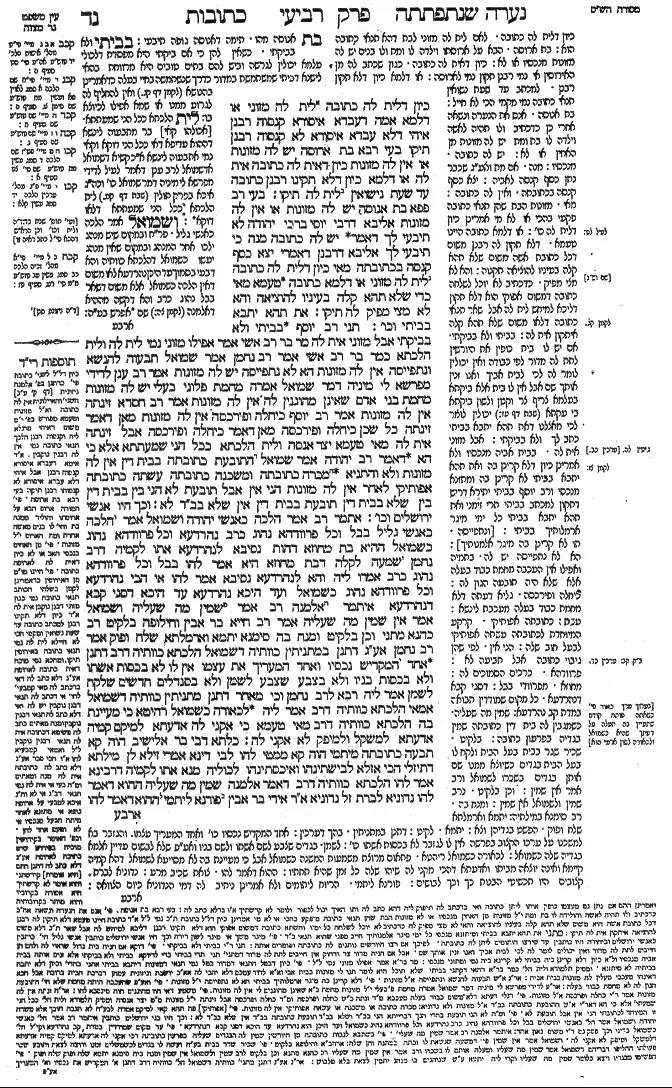
Ketubot 54a - Guemara
כיון דלית לה כתובה לית לה מזוני או דלמא אמה דעבדא איסורא קנסוה רבנן איהי דלא עבדא איסורא לא קנסוה רבנן תיקו בעי רבא בת ארוסה יש לה מזונות או אין לה מזונות כיון דאית לה כתובה אית לה או דלמא כיון דלא תקינו רבנן כתובה עד שעת נישואין לית לה תיקו:
בעי רב פפא בת אנוסה יש לה מזונות או אין לה מזונות אליבא דרבי יוסי ברבי יהודה לא תיבעי לך דאמר יש לה כתובה מנה כי תיבעי לך אליבא דרבנן דאמרי יצא כסף קנסה בכתובתה מאי כיון דלית לה כתובה לית לה מזוני או דלמא כתובה טעמא מאי כדי שלא תהא קלה בעיניו להוציאה והא לא מצי מפיק לה תיקו:
את תהא יתבא בביתי וכו':
תני רב יוסף בביתי ולא בביקתי אבל מזוני אית לה מר בר רב אשי אמר אפילו מזוני נמי לית לה ולית הלכתא כמר בר רב אשי אמר רב נחמן אמר שמואל תבעוה להנשא ונתפייסה אין לה מזונות הא לא נתפייסה יש לה מזונות אמר רב ענן לדידי מפרשא לי מיניה דמר שמואל אמרה מחמת פלוני בעלי יש לה מזונות מחמת בני אדם שאינן מהוגנין לה אין לה מזונות אמר רב חסדא זינתה אין לה מזונות אמר רב יוסף כיחלה ופירכסה אין לה מזונות מאן דאמר זינתה כל שכן כיחלה ופירכסה מאן דאמר כיחלה ופירכסה אבל זינתה אית לה מאי טעמא יצר אנסה ולית הלכתא ככל הני שמעתתא אלא כי הא דאמר רב יהודה אמר שמואל התובעת כתובתה בבית דין אין לה מזונות ולא והתניא מכרה כתובתה ומשכנה כתובתה עשתה כתובתה אפותיקי לאחר אין לה מזונות הני אין אבל תובעת לא הני בין בבית דין בין שלא בבית דין תובעת בבית דין אין שלא בב"ד לא:
וכך היו אנשי ירושלים וכו':
אתמר רב אמר הלכה כאנשי יהודה ושמואל אמר הלכה כאנשי גליל בבל וכל פרוודהא נהוג כרב נהרדעא וכל פרוודהא נהוג כשמואל ההיא בת מחוזא דהות נסיבא לנהרדעא אתו לקמיה דרב נחמן שמעה לקלה דבת מחוזא היא אמר להו בבל וכל פרוודהא נהוג כרב אמרו ליה והא לנהרדעא נסיבא אמר להו אי הכי נהרדעא וכל פרוודהא נהוג כשמואל ועד היכא נהרדעא עד היכא דסגי קבא דנהרדעא איתמר אלמנה רב אמר שמין מה שעליה ושמואל אמר אין שמין מה שעליה אמר רב חייא בר אבין וחילופה בלקיט רב כהנא מתני וכן בלקיט ומנח בה סימנא יתמא וארמלתא שלח ופוק אמר רב נחמן אע"ג דתנן במתניתין כוותיה דשמואל הלכתא כוותיה דרב דתנן אחד המקדיש נכסיו ואחד המעריך את עצמו אין לו לא בכסות אשתו ולא בכסות בניו ולא בצבע שצבע לשמן ולא בסנדלים חדשים שלקח לשמן אמר ליה רבא לרב נחמן וכי מאחר דתנן מתניתין כוותיה דשמואל אמאי הלכתא כוותיה דרב אמר ליה לכאורה כשמואל רהיטא כי מעיינת בה הלכתא כוותיה דרב מאי טעמא כי אקני לה אדעתא למיקם קמיה אדעתא למשקל ולמיפק לא אקני לה:
כלתא דבי בר אלישיב הוה קא תבעה כתובתה מיתמי הוה קא ממטי להו לבי דינא אמרי זילא לן מילתא דתיזלי הכי אזלא לבישתינהו ואיכסתינהו לכוליה מנא אתו לקמיה דרבינא אמר להו הלכתא כוותיה דרב דאמר אלמנה שמין מה שעליה ההוא דאמר להו נדוניא לברת זל נדוניא א"ר אידי בר אבין פורנא ליתמי ההוא דאמר להו
Comments from Rashi on Masechet Ketubot Page 54a
כיון דלית לה כתובה . לאם לית לה מזוני דבת דהא תנאי כתובה הוא: בת ארוסה . הבא על ארוסתו וילדה לו ומת ולו בנים יש לה מזונות מנכסיו או לא: כיון דאית לה כתובה . כגון שכתב לה מן האירוסין אי נמי רבנן תקון נמי לארוסה: או דלמא כיון דלא תקון רבנן . למכתב עד שעת נשואין תנאי כתובה נמי מקמי הכי לא חייל: בת אנוסה . אנס את הנערה ונשאה אחרי כן כדכתיב ולו תהיה לאשה וילדה לו בת ומת יש לה מזונות מן האחין או לא: יש לה כתובה . מנכסיו: מנה . אם מת ואע"ג שכבר נתן כסף קנסה לאביה: יצא כסף קנסה בכתובתה . ואין לה כתובה: מאי . מזונות הבת שהן תנאי כתובה פקעי בהכי או לא מי אמרינן כיון דלית לה כו': או דלמא כתובה היינו טעמא . דלא תקון לה רבנן משום דכל כתובת אשה משום שלא תהא קלה בעיניו להוציאה תקנוה: והא לא מצי מפיק . כדכתיב לא יוכל לשלחה כתובה דמשום אפוקי הוא דלא תקון דליכא למיחש לית לה אבל שאר תנאי כתובה דלאו משום שלא תהא קלה איתקון אית לה: בביתי ולא בביקתי . אם יש לו בית כופין את היורשין לתת לה מדור לפי כבודה ואין יכולין לומר לה לכי לבית אביך ואנו זנין אותך שם אבל אין לו בית אלא ביקתא בעלמא צריף צר וקטן ולשון ביקתא בי עקתא (שבת דף עז:) יכולין לומר לכי מאצלנו דאת תהא יתבא בביתי כתב לך ולא בביקתי: אבל מזוני אית לה . בבית אביה מנכסיו ולא אמרינן כיון דלא קרינן בה ואת תהא יתבא בביתי לא קרינן בה ומתזנא מנכסי ורב יוסף בביתי יתירא דריש דתקון למכתב בביתי תרי זימני ואת תהא יתבא בביתי כל ימי מיגר ארמלותיך בביתי: [ונתפייסה . תו לא קרינן בה מיגר אלמנותיך]: הא לא נתפייסה יש לה . בתמיה ואפילו אין העכבה מחמת כבוד בעלה אלא שלא היה תובעה הגון לה: כיחלה ופירכסה . גליא דעתה דלא מחמת כבוד בעלה מעכבת לינשא: הא לא נתפייסה יש לה . בתמיה ואפילו אין העכבה מחמת כבוד בעלה אלא שלא היה תובעה הגון לה: עשתה כתובתה אפותיקי . קרקע המיוחדת לכתובתה עשתה אפותיקי לבעל חוב שלה: הני אין . לפי שהן גיבוי כתובה אבל תביעה לא: פרוודהא . כרכים הסמוכים לה: מחוזא . מפרוודי בבל: דסגי קבא דנהרדעא . כל מקום שמודדין תבואה במדת קב נהרדעא: שמין מה שעליה . כשמגבין לה בית דין כתובתה שמין בגדיה בפרעון כתובה: בלקיט . שכיר שגר בבית בעל הבית ולקח לו בעל הבית בגדים כשיוצא ממנו שם אותן בגדים בשכרו לשמואל ורב אמר אין שמין: וכן בלקיט . לרב שמין ולשמואל אין שמין: ומנח בה . רב סימנא במילתיה: יתמא וארמלתא שלח ופוק . הפשט בגדיהן וצא: יתמא . לקיט: דתנן במתניתין . בהך דערכין: אחד המקדיש נכסיו כו' ואחד המעריך עצמו . והגזבר בא למשכנו על ערכו הקצוב בפרשה אין לו לגזבר לא בכסות אשתו כו': לשמן . בגדים שצבע לשם אשתו ולשם בניו ואע"פ שלא לבשום עדיין אלמא בגדיה שלה כשמואל: לכאורה כשמואל ריהטא . פתאום מרוצת משמעות המשנה כשמואל אבל כי מעיינת בה לא מסייעא לשמואל דהא קמיה קיימא ואינה יוצאה מביתו ואדעתא דהכי מקני לה שיהו שלה כל זמן שהיא תחתיו: ההוא דאמר להו . צואת שכיב מרע: נדוניא לברת . קצובים היו תכשיטי הבנות כך וכך לבושים: פורנא ליתמי . הריוח ליתומים ולא אמרינן ניתיב לה דמי הנדוניא כיום הצוואה:
Comments from Tosafot - Ketubot 54a
בת אנוסה מהו . תימה דאנוסה גופה תיבעי: בביתי ולא בביקתי . כשאין להן כי אם ביקתי היא מפסדת דלכולי עלמא יכולין לגרשה וביש להם בתים טובים היא מרווחת בהאי לישנא דביתי שמשתמשת במדור כדרך שנשתמשה בחיי בעלה כדאמרינן בהנושא (לקמן כתובות דף קג.) ואין להחליף לה לגרוע ממנו או שמא אפילו לכיוצא בו: לית הלכתא ככל הני שמעתתא . [אכולהו קאי] בר מתבעוה לינשא דההוא עדיפא דאי ככל הני דוקא וקאי נמי אתבעוה לינשא א"כ קשיא דשמואל אדשמואל לרב ענן דאמר לעיל לדידי מפרשא לי מיניה דמר שמואל כו' וכה"ג איכא בפרק תולין (שבת דף קמ.) לית הלכתא ככל הני שמעתתא דלאו דוקא: ושמואל אמר הלכה כאנשי גליל . פר"ח ובמקום שיש מנהג ילכו אחר המנהג ובמקום שאין מנהג יעשו כשמואל דהלכתא כוותיה והא דבעי בסמוך עד היכן נהרדעא לאו משום דאין הלכה כשמואל אלא משום דשאר בבל נהוג כרב והא דקשה מההיא דאלמנה (לקמן כתובות צה:) שם אפרש בע"ה:
Ketubot 54a - Mishnah translated into english
Once again the Gemara explains the sides of the dilemma: Since the Sages penalized the mother and declared that she does not have a marriage contract, the daughter does not have sustenance either, as her sustenance is guaranteed by her mother’s marriage contract. Or perhaps, with regard to her mother, who violated a prohibition, the Sages penalized her by depriving her of her marriage contract, whereas in the case of the daughter, who did not violate a prohibition, the Sages did not penalize her. Once again the Gemara states that the dilemma shall stand unresolved.
Rava raises a dilemma: In the case of the daughter of a betrothed woman, i.e., a man betrothed a woman, fathered a daughter with her, and then died, does the daughter have the right to receive sustenance from his estate, or does she not have the right to receive sustenance? Since the mother has a marriage contract, as in this case the man wrote her a marriage contract after betrothing her, it may be argued that the daughter has the right to receive sustenance. Or perhaps, since the Sages did not enact any requirement for a man to provide his wife with a marriage contract until the time of marriage, the stipulations of the marriage contract do not apply until then, and therefore the daughter of this woman does not have the right to receive sustenance. Again, the Gemara states that the dilemma shall stand unresolved.
Rav Pappa raises a dilemma: With regard to the daughter of a raped woman, i.e., a man raped a young woman, married her, had a child, and died, does she have the right to receive sustenance from her father’s estate or does she not have the right to receive sustenance from his estate? The Gemara comments: According to the opinion of Rabbi Yosei, son of Rabbi Yehuda, do not raise this dilemma, as he said that a raped woman has a marriage contract of one hundred dinars, and therefore she is entitled to the stipulations of a marriage contract, one of which is that if she has a daughter with her husband, the daughter receives sustenance from the husband’s estate.
Rather, let the dilemma be raised according to the opinion of the Rabbis, who say that the money of her fine fulfilled his obligation to provide her with a marriage contract, i.e., since she has already received the fine in compensation for the rape, she is not entitled to further payment in the form of a marriage contract. According to this opinion, what is the halakha?
The Gemara elaborates: It may be argued that since the mother does not have a marriage contract, the daughter does not have the right to receive sustenance from her father’s estate. Or perhaps one should consider the following: What is the reason that the marriage contract was enacted? So that his wife will not be demeaned in his eyes such that he will easily divorce her. And this one, his rape victim, he cannot divorce her by Torah law, as it is stated: “He may not send her away all his days” (Deuteronomy 22:29). It was therefore unnecessary for the Sages to require that he provide the woman with a marriage contract. However, the reasons for the stipulations included in a marriage contract, e.g., that his daughter receives sustenance from his estate, still apply in this case. Consequently, the Sages stipulated that these provisions still be granted. Yet again the Gemara states that the dilemma shall stand unresolved.
§ The mishna taught that one of the stipulations of a marriage contract is: You will sit in my house and be sustained from my property all your days as a widow. Rav Yosef taught: In my house, and not in my hovel [bikati]. If there is no room for her in his house, the heirs are not obligated to allow her to stay there. However, even in this case, she has the right to receive her sustenance from the heirs. Mar bar Rav Ashi said: She does not even have the right to receive her sustenance, as she is entitled to sustenance only when she lives in her husband’s house. If she resides elsewhere, for whatever reason, she does not receive this payment. The Gemara concludes: And the halakha is not in accordance with the opinion of Mar bar Rav Ashi.
§ Rav Naḥman said that Shmuel said: If a man proposed to marry a widow and she agreed, even if she has not yet married him, she no longer has the right to receive sustenance from the heirs of her previous husband. The Gemara comments: It may be inferred from here that if she had not agreed, even if the man had proposed marriage, she still has the right to receive sustenance. Rav Anan said: It was explained to me personally by Mar Shmuel that the halakha varies in different cases. If she said: I will not marry you due to so-and-so, my deceased husband, i.e., she still feels connected to him, she still has the right to receive sustenance from his estate. However, if she refused the offer because the men who approached her are people who are unsuitable for her, she does not have the right to continue to receive sustenance, as she has shown that in principle she is willing to remarry.
Rav Ḥisda said: If she engaged in licentious sexual relations she does not have the right to continue receiving sustenance from his estate, as she is not acting in a manner befitting a widow. Rav Yosef said: If she painted her eyes and dyed her hair she has clearly done so to attract men for the purposes of marriage, and therefore she does not have the right to receive sustenance from her husband’s estate.
The Gemara comments: According to the one who says that a widow who engaged in licentious sexual relations loses her sustenance, all the more so if she painted her eyes and dyed her hair she loses her sustenance, as her intention to marry is evident. However, according to the one who says that if a widow painted her eyes and dyed her hair she forfeits her right to receive sustenance from her husband’s estate, this ruling applies only to that particular situation. However, if she engaged in licentious sexual relations she still has the right to receive sustenance from his estate. What is the reason? Her evil inclination forced her, i.e., she did not make a decision to remarry but merely succumbed to temptation.
The Gemara concludes: And the halakha is not in accordance with all of these statements. Rather, the halakha is, in accordance with that which Rav Yehuda said that Shmuel said: One who claims the payment specified in her marriage contract in court does not have the right to continue receiving sustenance, as she has thereby demonstrated her desire to sever her ties with her late husband.
The Gemara asks: And does she not receive sustenance? But isn’t it taught in a baraita: With regard to one who sold her marriage contract, or used her marriage contract as collateral, or established her marriage contract as designated repayment [apoteiki] for a debt owed to another individual, she does not have the right to receive sustenance from her husband’s estate? The Gemara infers from this baraita: In these cases, yes, she forfeits her right to continue to receive sustenance. However, in the case of a widow who claims her marriage contract, no, she does not lose the right to continue to receive sustenance.
The Gemara answers that this argument is incorrect, and one should make the following inference instead: In these cases listed in the baraita, she forfeits her marriage contract whether she took the action in court or whether she did not do so in court. However, with regard to one who claims her marriage contract, if she issues this claim in court, yes, she loses the right to continue to receive her sustenance, but if her claim was not issued in court, no, she has not forfeited this right.
§ The mishna taught: And the residents of Jerusalem and of the Galilee would write the marriage contract in this manner, i.e., that if the woman is widowed, she may remain in her husband’s house and receive her sustenance from his property throughout her widowhood. Conversely, the residents of Judea would write that she may live in his house and be sustained from his estate until the heirs decide to give her the marriage contract. It was stated that the amora’im argued over this issue. Rav said that the halakha is in accordance with the custom of the residents of Judea, and Shmuel said that the halakha is in accordance with the custom of the residents of the Galilee and Jerusalem.
The Gemara comments: Babylonia and all of its surrounding towns [parvadaha] act in accordance with the opinion of Rav; Neharde’a and all of its towns act in accordance with the opinion of Shmuel. The Gemara relates: There was a certain woman of Meḥoza who was married to a man from Neharde’a. They came before Rav Naḥman to discuss her marriage contract. He heard from her voice that she was from Meḥoza, whose residents had a distinctive accent.
Rav Naḥman said to them: Babylonia and all of its towns act in accordance with the opinion of Rav. They said to him: But she is marrying a resident of Neharde’a. He said to them: If so, Neharde’a and all of its towns act in accordance with the opinion of Shmuel. The Gemara asks: And until where is the boundary of Neharde’a? Up to any place where the kav measurement of Neharde’a is used. The entire area that utilizes the system of Neharde’a measurements is considered part of its surroundings for the purposes of this halakha.
§ It was stated that the amora’im also argued about the halakha of a widow. Rav said: When she receives the payment of her marriage contract, the court appraises the clothes that are upon her and deducts their value from the payment she receives. And Shmuel said that the court does not appraise the clothes that are upon her. Rav Ḥiyya bar Avin said: And the reverse is the case with regard to a hired worker. With regard to a hired laborer who lived with his employer and the latter bought clothes for him, Rav and Shmuel disagreed as to whether these garments are appraised and their value deducted from the worker’s salary when he leaves his employer’s service. However, in this case Rav claims that his clothes are not appraised, whereas Shmuel maintains that they are appraised.
Conversely, Rav Kahana would teach: And likewise with regard to a hired worker, their respective opinions are the same in this case as well. Rav rules that one appraises the garments, while Shmuel claims that one does not. And he would apply a mnemonic device for Rav’s opinion: An orphan and a widow, disrobe and remove them. In other words, Rav maintains that both a widow and a hired worker, dubbed an orphan due to his typical poverty, should disrobe, as it were, when the court evaluates the payment to which they are entitled.
Rav Naḥman said: Even though we learned in a mishna in accordance with the opinion of Shmuel, the halakha is in accordance with the opinion of Rav. As we learned in a mishna (Arakhin 24a): With regard to both one who consecrates his property and one who valuates himself by donating his fixed value to the Temple, the Temple treasurer has the right to take neither his wife’s clothing, nor his children’s clothing, nor new dyed clothing that he dyed specially for them, even if they have yet to wear them, nor new sandals that he bought for them. This mishna is apparently in accordance with the opinion of Shmuel that a woman’s garments are not considered her husband’s property.
Rava said to Rav Naḥman: Once we have learned a mishna in accordance with the opinion of Shmuel, why is the halakha in accordance with the opinion of Rav? He said to him: It would seem [likhora] that this mishna agrees with the opinion of Shmuel when it is skimmed through and read superficially. However, when you examine it you will see that the halakha is in fact in accordance with the opinion of Rav.
What is the reason for this? When he bought her these clothes he did so with the intention that she should stand before him and wear them when she is with him. He did not buy them for her with the intention that she should take them and leave him. The reason for the mishna’s ruling is in fact that the husband acquires the clothes on behalf of his wife, but this applies only if she is living with him. Consequently, if she is living with him, the treasurer has no right to them. However, if she leaves him, she has no right to them, in accordance with the opinion of Rav.
§ The Gemara relates: The daughter-in-law of the house of the son of Elyashiv was claiming payment of her marriage contract from the orphans, and she was in the process of bringing them to the court. The orphans said to her: It is demeaning for us that you should go dressed in this manner, in house clothes. We would rather you come in more suitable attire. She went and dressed and covered herself with all of her clothes. They came before Ravina, who said to them: The halakha is in accordance with the opinion of Rav, who said that with regard to a widow, the court appraises the clothes that are upon her. Therefore, the court takes everything she is wearing into account in the calculation of her marriage contract payment.
The Gemara relates another incident: A certain person said to his heirs, in his will: Give a dowry to my daughter. There was an established custom for the amount of money spent on a dowry, including clothing and jewelry. In the meantime, the cost of a dowry depreciated, i.e., all these items could be acquired with less money. The question arose concerning the difference between the amount the father wished to give her when he wrote the will and the sum they paid in practice. Rav Idi bar Avin said: The profit [purna], i.e., this difference in price, goes to the male orphans, not to the daughter.
The Gemara cites a related incident: A certain person said to his heirs, in his will:
Traduction : The William Davidson digital edition of the Koren Noé Talmud, with commentary by Rabbi Adin Even-Israel Steinsaltz.