 Talmud Bavli
Ketubot 103a : Youtube
Daf TubeYoutube
1 video class :
Ketubot Page 103a
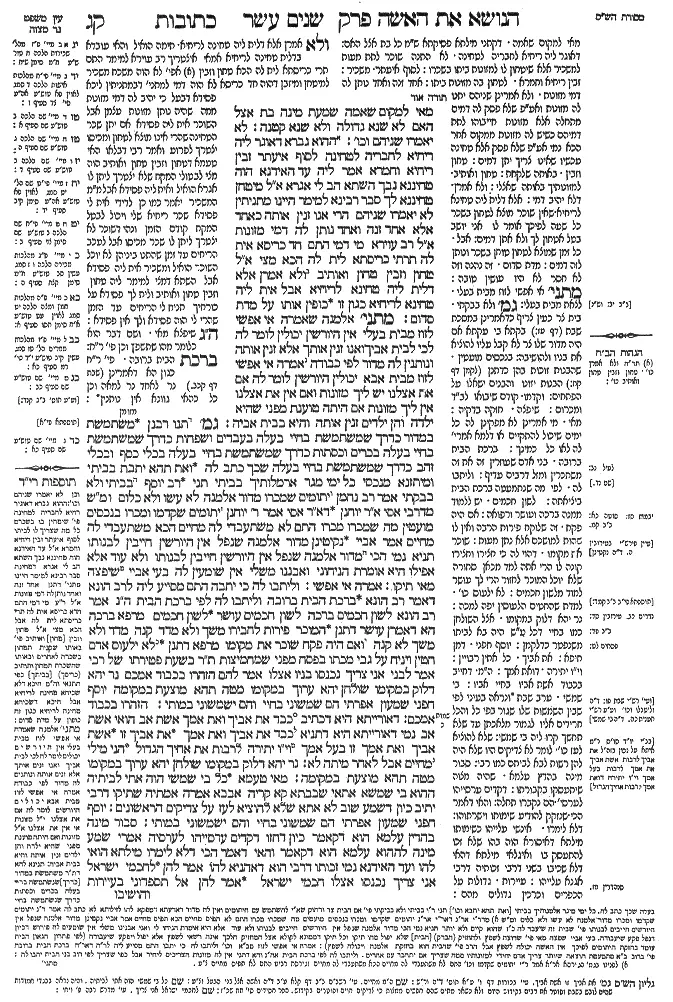
Ketubot 103a - Guemara
מאי למקום שאמה שמעת מינה בת אצל האם לא שנא גדולה ולא שנא קטנה:
לא יאמרו שניהם וכו':
ההוא גברא דאוגר ליה ריחיא לחבריה לטחינה לסוף איעתר זבין ריחיא וחמרא אמר ליה עד האידנא הוה טחיננא גבך השתא הב לי אגרא א"ל מיטחן טחיננא לך סבר רבינא למימר היינו מתניתין לא יאמרו שניהם הרי אנו זנין אותה כאחד אלא אחד זנה ואחד נותן לה דמי מזונות א"ל רב עוירא מי דמי התם חד כריסא אית לה תרתי כריסתא לית לה הכא מצי א"ל טחון וזבין טחון ואותיב ולא אמרן אלא דלית ליה טחינא לריחיא אבל אית ליה טחינא לריחיא כגון זו כופין אותו על מדת סדום:
מתני׳ אלמנה שאמרה אי אפשי לזוז מבית בעלי אין היורשין יכולין לומר לה לכי לבית אביך ואנו זנין אותך אלא זנין אותה ונותנין לה מדור לפי כבודה אמרה אי אפשי לזוז מבית אבא יכולין היורשין לומר לה אם את אצלנו יש ליך מזונות ואם אין את אצלנו אין ליך מזונות אם היתה טוענת מפני שהיא ילדה והן ילדים זנין אותה והיא בבית אביה:
גמ׳ תנו רבנן משתמשת במדור כדרך שמשתמשת בחיי בעלה בעבדים ושפחות כדרך שמשתמשת בחיי בעלה בכרים וכסתות כדרך שמשתמשת בחיי בעלה בכלי כסף ובכלי זהב כדרך שמשתמשת בחיי בעלה שכך כתב לה ואת תהא יתבת בביתי ומיתזנא מנכסי כל ימי מגר ארמלותיך בביתי תני רב יוסף בביתי ולא בבקתי אמר רב נחמן יתומים שמכרו מדור אלמנה לא עשו ולא כלום ומ"ש מדרבי אסי א"ר יוחנן דא"ר אסי אמר ר' יוחנן יתומים שקדמו ומכרו בנכסים מועטין מה שמכרו מכרו התם לא משתעבדי לה מחיים הכא משתעבדי לה מחיים אמר אביי נקיטינן מדור אלמנה שנפל אין היורשין חייבין לבנותו תניא נמי הכי מדור אלמנה שנפל אין היורשין חייבין לבנותו ולא עוד אלא אפילו היא אומרת הניחוני ואבננו משלי אין שומעין לה בעי אביי שיפצה מאי תיקו:
אמרה אי אפשי:
וליתבו לה כי יתבה התם מסייע ליה לרב הונא דאמר רב הונא ברכת הבית ברובה וליתבו לה לפי ברכת הבית ה"נ אמר רב הונא לשון חכמים ברכה לשון חכמים עושר לשון חכמים מרפא ברכה הא דאמרן עושר דתנן המוכר פירות לחבירו משך ולא מדד קנה מדד ולא משך לא קנה ואם היה פקח שוכר את מקומו מרפא דתנן לא ילעוס אדם חטין ויניח על גבי מכתו בפסח מפני שמחמיצות ת"ר בשעת פטירתו של רבי אמר לבני אני צריך נכנסו בניו אצלו אמר להם הזהרו בכבוד אמכם נר יהא דלוק במקומו שולחן יהא ערוך במקומו מטה תהא מוצעת במקומה יוסף חפני שמעון אפרתי הם שמשוני בחיי והם ישמשוני במותי:
הזהרו בכבוד אמכם:
דאורייתא היא דכתיב (שמות כ, יא) כבד את אביך ואת אמך אשת אב הואי אשת אב נמי דאורייתא היא דתניא כבד את אביך ואת אמך את אביך זו אשת אביך ואת אמך זו בעל אמך וי"ו יתירה לרבות את אחיך הגדול הני מילי מחיים אבל לאחר מיתה לא:
נר יהא דלוק במקומו שולחן יהא ערוך במקומו מטה תהא מוצעת במקומה:
מאי טעמא כל בי שמשי הוה אתי לביתיה ההוא בי שמשא אתאי שבבתא קא קריה אבבא אמרה אמתיה שתיקו דרבי יתיב כיון דשמע שוב לא אתא שלא להוציא לעז על צדיקים הראשונים:
יוסף חפני שמעון אפרתי הם שמשוני בחיי והם ישמשוני במותי:
סבור מינה בהדין עלמא הוא דקאמר כיון דחזו דקדים ערסייהו לערסיה אמרי שמע מינה לההוא עלמא הוא דקאמר והאי דאמר הכי דלא לימרו מילתא הואי להו ועד האידנא נמי זכותו דרבי הוא דאהניא להו אמר להן לחכמי ישראל אני צריך נכנסו אצלו חכמי ישראל אמר להן אל תספדוני בעיירות
Comments from Rashi on Masechet Ketubot Page 103a
מאי למקום שאמה . דקתני מילתא פסיקתא ש"מ כל בת אצל האם: דאוגר ליה ריחיא לחבריה לטחינה . לא התנה שוכר לתת מעות למשכיר אלא שיטחון לו למזונות ביתו בשכרו: לסוף איעתר . משכיר: זבין ריחיא וחמרא . לטחון בה מזונות ביתו: אחד זנה ואחד נותן לה דמי מזונות . ולא אמרינן שניהם יתנו לה מזונות ואע"פ שלא פסק לה דמים מתחלה אלא מזונות חייבוהו לתת דמיהם כשיש לה מזונות ממקום אחר הכא נמי אע"פ שלא פסק אלא טחינה עכשיו שאינו צריך יתן דמים: טחון וזבין . באותה שלקחת: טחון ואותיב . למזונותיך באותה שאצלי: ולא אמרן . דלא יהיב דמי: אלא דלית ליה טחינא לריחיא . שאין שוכר מוצא לטחון בשכר כל שעה לפיכך אומר לו אני יושב בטל אטחון לך ולא אתן דמים: אבל . כל זמן שמוצא לטחון טוחן בשכר ונותן לזה דמים: מדת סדום . זה נהנה וזה לא חסר לא היו עושין טובה: מתני' אי אפשי לזוז מבית בעלי . לצאת מבית בעלי: גמ' ולא בבקתי . בית צר כעין צריף כדאמרינן במסכת שבת (דף עז:) בקתא בי עקתא אם היה מדור שלו צר לא קבל עליו להוציא את בניו ולהושיבה: בנכסים מועטין . שהבנות זוכות בהן כדתנן (לקמן כתובות דף קח:) הבנות יזונו והבנים ישאלו על הפתחים: וקדמו . קודם שיבואו לב"ד ומכרום: שיפצה . חזקה בדקיה: מאי . מי אמרינן לא מפקינן לה כל ימים שיכול להתקיים או דלמא אמרי' לה לאו כל כמינך: ברכת הבית ברובה . בני אדם שעוזרין זה את זה משתכרין ומזל דרבים עדיף: וליתבו לה . לפי מה שנתמעטה ברכת הבית ביציאתה: לשון חכמים . יש ללמוד ממנה ברכה ועושר ורפואה: אם היה פקח . זה שלוקח פירות הרבה ואין לו שהות למושכם אלא נתן מעות: שוכר את מקומו . דהוי לה כי חצירו וחצירו קונה לו הרי אתה למד מכאן סחורה שלא יוכל המוכר לחזור הרי לך עושר למוד מלשון חכמים: לא ילעוס כו' . למדת שהחטים הלעוסין יפה למכה: נר יהא דלוק במקומו . אצל השולחן כמו בחיי דכל ע"ש היה בא לביתו משנפטר כדלקמן: יוסף חפני . דמן חיפא: את אביך . כל אתין רבויין: וי"ו יתירה . דואת אמך: ה"מ . דחייב בכבוד אשת אביו בחיי אביו: בי שמשי . ערב שבת ונראה בעיני לפי שבין השמשות שלו שגור בפי כל והכל חרידים אליו לגמור מלאכתן עד שלא תחשך קרו ליה בי שמשי: שלא להוציא לעז כו' . לומר לא צדיקים היו שלא היה להן רשות לבא לביתם כמו רבי: סבור מינה בהדין עלמא . שהיה מצוה שיתעסקו בקבורתו: דקדים ערסייהו לערסי' . הם נקברו תחלה: והאי דאמר הכי . שנזקק להודיע שימותו וישרתוהו: דלא לימרו . אינשי עלייהו כשימותו מילתא דאיסורא הוה בהו שלא זכו להתעסק בו ואיגלאי מילתא דהאי דלא שכיבו בשני דרבי זכותיה דרבי אגנא עלייהו: עיירות . גדולות על הכפרים וכרכין גדולים מהם:
Comments from Tosafot - Ketubot 103a
ולא אמרן אלא דלית ליה טחינה לריחיא . תימה הואיל והאי עובדא בדלית טחינה לריחיא אמאי איצטריך רב עוירא למימר התם תרי כריסתא לית לה הכא טחון וזבין אפי' לא הוה משכח משכיר למיטחן ומיזבן דהוה חד כריסא לא הוה דמי למתני' דבמתניתין ליכא פסידא דבעל כי יהיב לה דמי מזונות ממה שהיה נותן מזונות עצמן אבל השוכר אית ליה פסידא אם יתן שכר הטחינה שהרי אינו מוצא לטחון ומכיסו יצטרך לפרוע ואמר רבי דבלאו האי טעמא דטחון וזבין טחון ואותיב הוה מצי לבטולי המקח שלא יצטרך ליתן לו אגרא הואיל ואית ליה פסידא אבל מ"מ המשכיר יאמר כמו כן לדידי אית לי פסידא שכר ריחיא שלי ויכול לבטל המקח קודם הזמן ונהי דשוכר לא יצטרך ליתן לו שכר מכיסו אבל לעכב הריחים עד זמן שהתנו ביניהן לא יוכל השוכר הואיל ומשכיר אית ליה פסידא אבל השתא דמצי למימר ליה טחון וזבין טחון ואותיב ולית לך פסידא על כורחיך תניח לי הריחים עד הזמן שהרי לי הוה פסידא ולך אין פסידא: ה"ג שיפצא מאי . ושם דבר הוא כלומר מהו שתשפץ וכן פי' ר"ח: ברכת הבית ברובה . פי' ר"ח כגון הא דאמרינן (שבת דף קכב.) נר לאחד נר למאה וכן כל כהאי גוונא אין נותנין:
Ketubot 103a - Mishnah translated into english
What is the purpose of emphasizing: To the place where her mother lives? Conclude from here that a daughter lives with her mother; it is no different if she is an adult woman, and it is no different if she is a minor girl.
§ It was taught in the mishna that if two men are obligated to support this girl, both of them may not jointly say that they will be partners in her support. Rather, each one fulfills his obligation independently.
The Gemara relates that there was a certain man who rented out a millstone to another for the price of grinding, i.e., the one who rented the millstone was to pay the cost of the rental by grinding whatever the owner needed to be ground. In the end, the owner of the millstone became rich, and he purchased another millstone and a donkey, and he no longer required the services of the renter to grind things for him.
The owner of the millstone said to the renter: Until now I would have what I needed ground by you, and the service that you provided was in place of payment for the rental of the millstone. Now, since I no longer require this service, give me payment for the millstone. The renter said back to him: I will grind for you because that is what I agreed to, but I did not agree to have to pay money.
Ravina thought to say that this is the same as the mishna that states that both of them may not jointly say: We will sustain the girl as one in a partnership. Rather, one sustains her, providing her with food, while the other gives her the monetary value of the sustenance. In that case, although the original condition was to provide the girl with support in the form of food, when circumstances changed, the previous husband became obligated to pay her support in the form of money. So too here, due to the change in circumstances, the renter should pay the owner of the millstone with money.
Rav Avira said to Ravina: Are the two cases comparable? There, in the case of the girl, she has only one stomach; she does not have two stomachs. Therefore, it is impossible for both of them to support her with food. Here, in the case of the millstone, the renter is able to say to him: Grind and sell, grind and store for later use, i.e., the owner of the millstone can use his new millstone to grind for others at a profit, and at the same time the renter will continue grinding the owner’s grain as per their agreement. Therefore, the renter is not obligated to change the terms of the original agreement.
The Gemara notes: We said this only in a case where the renter does not have any other grinding to do with the millstone and without the grinding that the renter does for the owner the mill will remain inoperative. However, if he has other grinding to do with the millstone, i.e., instead of grinding the owner’s grain he can grind the grain of others for a fee and thereby pay money for his rental, in a case such as this one forces him to cease his conduct characteristic of Sodom and to pay his rental fee in the form of money.
MISHNA: In the case of a widow who said: I do not want to move from my husband’s house, but instead I wish to remain there, the heirs are not able to say to her: Go to your father’s house and we will sustain you. Rather, they sustain her in her husband’s house and they give her living quarters befitting her dignity.
However, if she said: I do not want to move from my father’s house, and you should bring me my support there, the heirs are able to say to her: If you are living with us, you will have sustenance from us, but if you are not living with us, you will not have sustenance from us.
If she argued that she does not wish to live in her deceased husband’s house because she is young, and they, the heirs, are also young, and it is improper for them to be living in the same house together, then they sustain her and she stays in her father’s house.
GEMARA: The Sages taught: A widow that remains in her husband’s house uses the living quarters in the same manner that she would use them in her husband’s lifetime. She uses the slaves and the maidservants in the same manner that she would use them in her husband’s lifetime, the pillows and the sheets in the same manner that she would use them in her husband’s lifetime, and the silver utensils and gold utensils in the same manner that she would use them in her husband’s lifetime. She maintains all the rights she had during her husband’s lifetime because this is what he wrote to her in the text of the marriage contract: And you will reside in my house and be sustained from my property all the days that you live in my house as a widow.
Rav Yosef taught: The husband stipulated in the marriage contract: You will reside in my house, with the implication: And not in my hut. Therefore, if the house is too small, she cannot obligate the heirs to allow her to live in the house with them.
Rav Naḥman said: Orphans who sold the living quarters of a widow did not do anything, i.e., the sale is invalid.
The Gemara asks: And in what way is this case different from that which Rabbi Asi said that Rabbi Yoḥanan said? As Rabbi Asi said that Rabbi Yoḥanan said: With regard to orphans who preemptively sold from the small quantity of property left to them by their father before the court appropriated it for the purpose of providing for female children, who do not inherit, what they sold is sold, even though they acted improperly. Why, then, is the sale of a widow’s living quarters invalid?
The Gemara answers: There, in the case of orphans selling property that according to halakha should be retained in order to support the orphaned daughters, the property is not mortgaged to the orphaned daughters from the lifetime of their father, since the lien on the property arising from the obligation to provide support for the daughters occurs only after the father’s death. Here, in the case of the widow’s living quarters, the property is mortgaged to her from the lifetime of her husband, who was obligated even while he was alive to provide her with a place to live.
Abaye said: We hold on the authority of tradition that in the case of a widow’s living quarters that collapsed, the heirs are not obligated to rebuild it, since they are obligated to maintain her in the residence that was mortgaged to her and are not required to provide her with a place to live.
This is also taught in a baraita: In the case of a widow’s living quarters that collapsed, the heirs are not obligated to rebuild it. And not only this, but even if she says: Leave me be and I will rebuild it from my own funds, one does not listen to her, and the heirs do not have to let her rebuild it.
Abaye raised a dilemma: If she repaired the house, what is the halakha? Is it as though the house collapsed and was rebuilt, in which case she no longer has rights to it, or may she stay in the house as long as it remains standing? The Gemara concludes: The dilemma shall stand unresolved.
§ We learned in the mishna: If she said: I do not want to move from my father’s house and you should bring me my support there, the heirs are not obligated to support her.
The Gemara asks: And why is this so? They should give her support just as they would if she were living there, i.e., in her husband’s house. The Gemara answers: This supports the view of Rav Huna, as Rav Huna said: The blessing of the house is in its abundance of residents. This means that the amount of blessing in a home is proportionate to the number of people who live there. When there are many people living together in one home, the expenses per capita are decreased. The heirs can say to her that if she stays with them in the house, the expense of her upkeep will be less than if she lives on her own.
The Gemara asks: And they should give her the support in her father’s house according to the blessing of the house, i.e., according to the amount they would be required to pay if she lived with them. The Gemara answers: Indeed, the intent of the mishna is that they may pay her this amount, not that they may entirely avoid supporting her.
Rav Huna said: The language of the Sages teaches blessing, the language of the Sages teaches wealth, and the language of the Sages teaches healing. One can learn important lessons about these matters from the manner in which the Sages formulated their halakhic rulings. How is this so? With regard to blessing, it is that which we said above about the blessings of the home.
The language of the Sages teaches about wealth, as we learned in a mishna (Bava Batra 84b): One who sells produce to another, if the buyer pulled the produce as an act of acquisition but did not measure it, he has acquired the produce. If he measured the produce but did not pull it, he has not acquired it. And if the buyer was perspicacious and wanted to ensure that the seller would not back out of the deal, he would rent the place where the produce was located, and he would thereby acquire the produce immediately from the time he measures it. This mishna teaches good counsel in money-related matters.
The language of the Sages teaches about healing, as we learned in a mishna (Pesaḥim 39b): A person should not chew wheat and then place it on his wound during Passover because the wheat will become leavened as a result. This comment of the Sages indicates that chewed wheat is beneficial for treating a wound.
§ The Sages taught: At the time of the passing of Rabbi Yehuda HaNasi, he said: I need my sons. His sons entered his room. He said to them as a last will and testament: Be careful with the honor of your mother. He said further: My lamp should be lit in its usual place, my table should be set in its usual place, and the bed should be arranged in its usual place. Yosef Ḥeifani and Shimon Efrati; they served me during my lifetime and they will serve me in my death.
The Gemara clarifies the various requests that he made of his sons: Be careful with the honor of your mother. The Gemara asks: Why would he need to say this? After all, this is required by Torah law, as it is written: “Honor your father and your mother” (Exodus 20:11)? The Gemara answers: She was their father’s wife. She was not their mother, but their stepmother, and he therefore needed to caution them concerning her honor.
The Gemara asks: Honoring a father’s wife is also required by Torah law, as it is taught in a baraita: Honor your father [et avikha] and your mother [ve’et immekha]. The preposition et in the phrase: Your father; this teaches that you must honor your father’s wife. Similarly, the preposition et in the phrase: And your mother; this teaches that you must honor your mother’s husband. And the extra letter vav, which is appended as a prefix in the phrase “ve’et immekha” is included in order to add your older brother to those who must be honored.
The Gemara answers: This halakha, that one is obligated by Torah law to respect his father’s wife, applies only during his father’s lifetime. While the father is alive, out of respect for him, his wife must also be treated with respect. However, following his death, no, there is no longer any obligation to honor a stepmother. It was for this reason that Rabbi Yehuda HaNasi had to caution his sons in this matter.
Rabbi Yehuda HaNasi commanded his sons: My lamp should be lit in its usual place, my table should be set in its usual place, and the bed should be arranged in its usual place. The Gemara asks: What is the reason he made these requests? The Gemara explains: Every Shabbat eve, even after his passing, Rabbi Yehuda HaNasi would come to his house as he had done during his lifetime, and he therefore wished for everything to be set up as usual.
The Gemara relates the following incident: It happened on a certain Shabbat eve that a neighbor came by and called and knocked at the door. His maidservant said to her: Be quiet, for Rabbi Yehuda HaNasi is sitting. When he heard his maidservant reveal his presence to the neighbor, he did not come again, so as not to cast aspersions on earlier righteous individuals who did not appear to their families following their death.
The Gemara elaborates on Rabbi Yehuda HaNasi’s statement: Yosef Ḥeifani and Shimon Efrati, they served me during my lifetime and they will serve me in my death. It was understood from this statement that Rabbi Yehuda HaNasi was speaking of this world, that these two should serve him in his death and administer his burial. However, when they saw that their biers preceded his bier, i.e., they died before him, they said: Conclude from here that he was speaking of that world. They will attend to him in the World-to-Come.
And the reason he said this was so that people should not say: There was something wrong with them, and until now, too, it was the merit of Rabbi Yehuda HaNasi that benefited them and prevented them from dying due to their sins. Now that Rabbi Yehuda HaNasi is dying, his merit no longer protects them. Rabbi Yehuda HaNasi therefore clarified that the reason for their deaths was in order to enable them to escort him in death as in life.
§ Rabbi Yehuda HaNasi said further to his attendants: I need the Sages of Israel. The Sages of Israel entered his room. He said to them: Do not eulogize me in the small towns
Traduction : The William Davidson digital edition of the Koren Noé Talmud, with commentary by Rabbi Adin Even-Israel Steinsaltz.