 Talmud Bavli
The learning on the whole site is dedicated : L'ilui Nishmat Nissim ben Barukh Malka
The learning on the whole site is dedicated : L'ilui Nishmat Ledicia bat David Banoun
The learning on the whole site is dedicated : L'ilui Nishmat Yaakov ben Myriam
Sanhedrin 106b : Youtube
Daf TubeYoutube
2 video classes :
Sanhedrin Page 106b
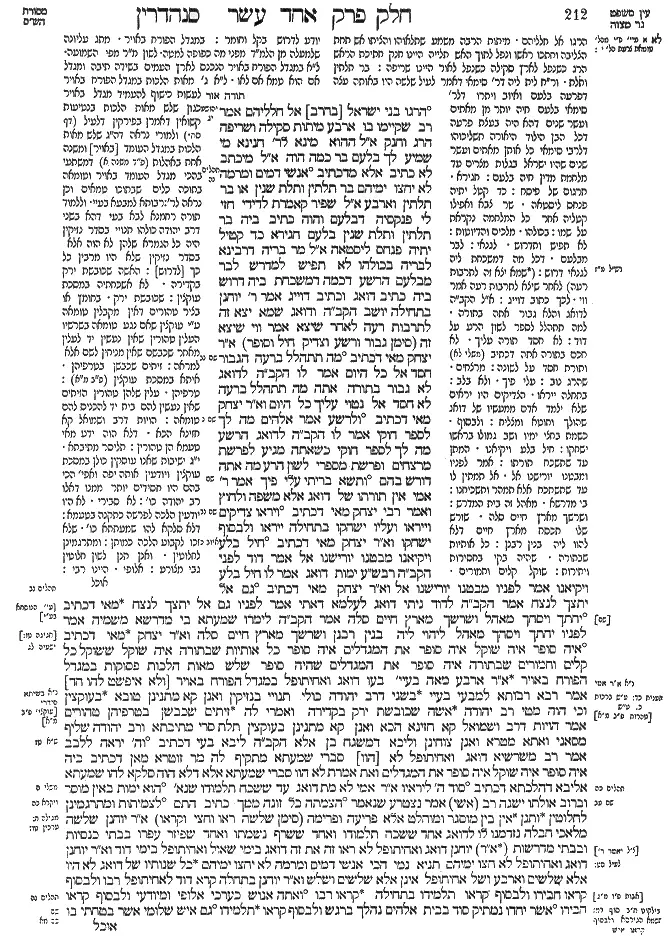
Sanhedrin 106b - Guemara
(יהושע יג, כב) הרגו בני ישראל [בחרב] אל חלליהם אמר רב שקיימו בו ארבע מיתות סקילה ושריפה הרג וחנק א"ל ההוא מינא לר' חנינא מי שמיע לך בלעם בר כמה הוה א"ל מיכתב לא כתיב אלא מדכתיב (תהלים נה, כד) אנשי דמים ומרמה לא יחצו ימיהם בר תלתין ותלת שנין או בר תלתין וארבע א"ל שפיר קאמרת לדידי חזי לי פנקסיה דבלעם והוה כתיב ביה בר תלתין ותלת שנין בלעם חגירא כד קטיל יתיה פנחס ליסטאה א"ל מר בריה דרבינא לבריה בכולהו לא תפיש למדרש לבר מבלעם הרשע דכמה דמשכחת ביה דרוש ביה כתיב דואג וכתיב דוייג אמר ר' יוחנן בתחילה יושב הקב"ה ודואג שמא יצא זה לתרבות רעה לאחר שיצא אמר ווי שיצא זה (סימן גבור ורשע וצדיק חיל וסופר) א"ר יצחק מאי דכתיב (תהלים נב, ג) מה תתהלל ברעה הגבור חסד אל כל היום אמר לו הקב"ה לדואג לא גבור בתורה אתה מה תתהלל ברעה לא חסד אל נטוי עליך כל היום וא"ר יצחק מאי דכתיב (תהלים נ, טז) ולרשע אמר אלהים מה לך לספר חוקי אמר לו הקב"ה לדואג הרשע מה לך לספר חוקי כשאתה מגיע לפרשת מרצחים ופרשת מספרי לשון הרע מה אתה דורש בהם (תהלים נ, טז) ותשא בריתי עלי פיך אמר ר' אמי אין תורתו של דואג אלא משפה ולחוץ ואמר רבי יצחק מאי דכתיב (תהלים נב, ח) ויראו צדיקים וייראו ועליו ישחקו בתחילה ייראו ולבסוף ישחקו וא"ר יצחק מאי דכתיב (איוב כ, טו) חיל בלע ויקיאנו מבטנו יורישנו אל אמר דוד לפני הקב"ה רבש"ע ימות דואג אמר לו חיל בלע ויקיאנו אמר לפניו מבטנו יורישנו אל וא"ר יצחק מאי דכתיב (תהלים נב, ז) גם אל יתצך לנצח אמר הקב"ה לדוד ניתי דואג לעלמא דאתי אמר לפניו גם אל יתצך לנצח מאי דכתיב (תהלים נב, ז) יחתך ויסחך מאהל ושרשך מארץ חיים סלה אמר הקב"ה לימרו שמעתא בי מדרשא משמיה אמר לפניו יחתך ויסחך מאהל ליהוי ליה בנין רבנן ושרשך מארץ חיים סלה וא"ר יצחק מאי דכתיב (ישעיהו לג, יח) איה סופר איה שוקל איה סופר את המגדלים איה סופר כל אותיות שבתורה איה שוקל ששוקל כל קלים וחמורים שבתורה איה סופר את המגדלים שהיה סופר שלש מאות הלכות פסוקות במגדל הפורח באויר א"ר ארבע מאה בעיי' בעו דואג ואחיתופל במגדל הפורח באויר [ולא איפשט להו חד] אמר רבא רבותא למבעי בעיי בשני דרב יהודה כולי תנויי בנזיקין ואנן קא מתנינן טובא בעוקצין וכי הוה מטי רב יהודה אשה שכובשת ירק בקדירה ואמרי לה זיתים שכבשן בטרפיהן טהורים אמר הויות דרב ושמואל קא חזינא הכא ואנן קא מתנינן בעוקצין תלת סרי מתיבתא ורב יהודה שליף מסאני ואתא מטרא ואנן צוחינן וליכא דמשגח בן אלא הקב"ה ליבא בעי דכתיב (שמואל א טז, ז) וה' יראה ללבב אמר רב משרשיא דואג ואחיתופל לא [הוו] סברי שמעתא מתקיף לה מר זוטרא מאן דכתיב ביה איה סופר איה שוקל איה סופר את המגדלים ואת אמרת לא הוו סברי שמעתא אלא דלא הוה סלקא להו שמעתא אליבא דהלכתא דכתיב (תהלים כה, יד) סוד ה' ליראיו א"ר אמי לא מת דואג עד ששכח תלמודו שנא' (משלי ה, כג) הוא ימות באין מוסר וברוב אולתו ישגה רב (אשי) אמר נצטרע שנאמר (תהלים עג, כז) הצמתה כל זונה ממך כתיב התם (ויקרא כה, ל) לצמיתות ומתרגמינן לחלוטין ותנן אין בין מוסגר ומוחלט אלא פריעה ופרימה (סימן שלשה ראו וחצי וקראו) א"ר יוחנן שלשה מלאכי חבלה נזדמנו לו לדואג אחד ששכח תלמודו ואחד ששרף נשמתו ואחד שפיזר עפרו בבתי כנסיות ובבתי מדרשות (א"ר) יוחנן דואג ואחיתופל לא ראו זה את זה דואג בימי שאול ואחיתופל בימי דוד וא"ר יוחנן דואג ואחיתופל לא חצו ימיהם תניא נמי הכי אנשי דמים ומרמה לא יחצו ימיהם כל שנותיו של דואג לא היו אלא שלשים וארבע ושל אחיתופל אינן אלא שלשים ושלש וא"ר יוחנן בתחלה קרא דוד לאחיתופל רבו ולבסוף קראו חבירו ולבסוף קראו תלמידו בתחילה קראו רבו (תהלים נה, יד) ואתה אנוש כערכי אלופי ומיודעי ולבסוף קראו חבירו (תהלים נה, טו) אשר יחדו נמתיק סוד בבית אלהים נהלך ברגש ולבסוף קראו תלמידו (תהלים מא, י) גם איש שלומי אשר בטחתי בו
Comments from Rashi on Masechet Sanhedrin Page 106b
הרגו אל חלליהם . מיתות הרבה משמע שתלאוהו והציתו אש תחת הצליבה וחתכו ראשו ונפל לתוך האש תלייה היינו חנק חתיכת הראש הרג כשנפל לארץ סקילה כשנפל לאור היינו שריפה: בר תלתין ותלת . ור"ח לית ליה דר' סימאי דאמר לעיל (עמוד א) שלשה היו באותה עצה דפרעה בלעם ואיוב ויתרו דלר' סימאי בלעם חיה יותר מן מאתים ועשר שנים דהא היה בעצת פרעה דכל הבן הילוד היאורה תשליכוהו דלרבי סימאי כל אותן מאתים ועשר שנים שהיו ישראל בגלות מצרים עד מלחמת מדין חיה בלעם: חגירא . תרגום של פיסח: כד קטל יתיה פנחס ליסטאה . שר צבא ואפילו קטליה אחר כל המלחמה נקראת על שמו: בכולהו . מלכים והדיוטות: לא תפיש ותדרוש . לגנאי: לבר מבלעם . דכל מה דמשכחת ליה לגנאי דרוש: (שמא יצא זה לתרבות רעה) לאחר שיצא לתרבות רעה אמר ווי . לכך כתוב דוייג: א"ל הקב"ה לדואג והלא גבור אתה בתורה . למה תתהלל לספר לשון הרע על דוד: לא חסד תורה עליך . לא חכם בתורה אתה דכתיב (משלי לא) ותורת חסד על לשונה: מרצחים . שהרג נוב: עלי פיך . ולא בלב: בתחלה ייראו . הצדיקים היו יראים שלא ילמד אדם ממעשיו של דואג שהולך וחוטא ומצליח: ולבסוף . כשמת בחצי ימיו ושב גמולו בראשו ישחקו: חיל בלע ויקיאנו . המתן עד שתשכח תורתו: אמר לפניו ומבטנו יורישנו אל . אל תמתין לו עד שתשתכח אלא תמהר ותשכיחנו: בי מדרשא . מאהל זה בית המדרש: ושרשך מארץ חיים סלה . שורש שלו תכסח מארץ חיים דלא להוו ליה בנין רבנן: כל אותיות שבתורה . שהיה בקי בחסירות ויתירות: שוקל קלים וחמורים . יודע לדרוש בקל וחומר: במגדל הפורח באויר . מתג עליונה שלמעלה מן הלמ"ד מפני מה כפופה למטה. לשון מ"ר מפי השמועה. ל"א במגדל הפורח באויר הנכנס לארץ העמים בשידה תיבה ומגדל אם הוא טמא אם לאו. ל"א ג' מאות הלכות במגדל הפורח באויר לעשות כישוף להעמיד מגדל באויר כגון שלש מאות הלכות בנטיעות קשואין דאמרן בפירקין דלעיל (סנהדרין דף סח.) ולמורי נראה דה"ג שלש מאות הלכות במגדל העומד [באויר] ומשנה אחת באהלות (פ"ד משנה א) דמשתעי בהכי מגדל העומד באויר וטומאה בתוכה כלים שבתוכו טמאים וכן נראה לר': רבותא למבעא בעיי . וללמוד תורה רחמנא לבא בעי דהא בשני דרב יהודה כולהו תנויי בסדר נזיקין היה כל הגמרא שלהן לא הוה אלא בסדר נזיקין שלא היו מרבין כל כך [לדרוש]: האשה שכובשת ירק בקדירה . לא אשכחתיה במסכת עוקצין: שכובשת ירק . בחומץ או בציר טהורים דאין מקבלין טומאה ע"י עוקצין שאם נגע טומאה בשרשיו העלין טהורין שאין נעשין יד לעלין מאחר שכבשם שאין מניחין לשם אלא למראה: זיתים שכבשן בטרפיהן . איתא במסכת עוקצין (פ"ב מ"א): טרפיהן . עלין שלהן טהורין הזיתים שאין נעשין להם בית יד להכניס להם טומאה: הויות דרב ושמואל קא חזינא הכא . דלא הוה ידע מאי טעמא הן טהורין: תליסר מתיבתא . י"ג ישיבות שאנו עוסקין כולן במסכת עוקצין ויודעין אותה יפה ואפי' הכי בהם היו חסידים יותר ממנו דאלו רב יהודה כו': לא סבירי . לא היו יודעין הלכה לפרשה כתקנה בטעמא: דלא סלקא להו שמעתתא כו' . שלא זכו לקבוע הלכה כמותן: ומתרגמינן לחלוטין . ואנן תנן לשון חלוטין גבי מצורע: אלופי . היינו רבי:
Sanhedrin 106b - Mishnah translated into english
With regard to the latter part of the verse: “And Balaam, son of Beor, the diviner, did the children of Israel slay with the sword among the rest of their slain” (Joshua 13:22), Rav says: It means that they accomplished in him all four means of court-imposed executions: Stoning, and burning, beheading, and strangulation.
A certain heretic said to Rabbi Ḥanina: Have you heard how old Balaam was when he died? Rabbi Ḥanina said to him: It is not written explicitly in the Torah. But from the fact that it is written: “Bloody and deceitful men shall not live half their days” (Psalms 55:24), this indicates that he was thirty-three or thirty-four years old, less than half the standard seventy-year lifespan. The heretic said to him: You have spoken well, I myself saw the notebook of Balaam and it was written therein: Balaam the lame was thirty-three years old when Pinehas the highwayman killed him.
Mar, son of Ravina, said to his son: With regard to all of those enumerated as not having a share in the World-to-Come, do not extensively interpret verses homiletically in order to denigrate them, except with regard to Balaam the wicked, as any negative element that you discover in his regard, continue to interpret homiletically concerning him, as it is appropriate to attribute wickedness to one so wicked.
§ It is written in one verse: “Doeg the Edomite” (I Samuel 22:9), and it is written in another verse: “And the king said to Doyeig” (I Samuel 22:18). Rabbi Yoḥanan says in explaining the discrepancy: Initially, the Holy One, Blessed be He, sat and was concerned [doeg] that perhaps this person would emerge to undertake an evil path. After he emerged on that path, God said: Alas [vai], that person has emerged to undertake an evil path.
The Gemara cites a mnemonic for the statements of Rabbi Yitzḥak that follow: Mighty, wicked, and righteous, riches, and counter.
Rabbi Yitzḥak says: What is the meaning of that which is written: “Why boast of your evil mighty one? The mercy of God endures continually” (Psalms 52:3)? The Holy One, Blessed be He, said to Doeg: Aren’t you mighty in Torah? Why do you boast of evil? Isn’t God’s mercy extended over you continually when you engage in His Torah?
And Rabbi Yitzḥak says: What is the meaning of that which is written: “But to the wicked, God says: What have you to do to declare My statutes, and that you have taken My covenant in your mouth” (Psalms 50:16)? The Holy One, Blessed be He, said to Doeg the wicked: Why do you speak of My statutes and My Torah? When you reach the Torah portion of murderers and the Torah portion of slanderers, how do you teach them? You have violated both. With regard to the end of that verse: “And that you have taken My covenant in your mouth” (Psalms 50:16), Rabbi Ami says: Doeg’s Torah is only insincere lip service, as it is in his mouth but not in his heart. He does not have a profound understanding of the Torah and does not commit himself to the performance of its mitzvot.
And Rabbi Yitzḥak says: What is the meaning of that which is written: “And the righteous shall see, and fear, and shall laugh at him” (Psalms 52:8)? Initially, they will fear Doeg due to his success, and ultimately they will laugh when they witness his downfall.
And Rabbi Yitzḥak says: What is the meaning of that which is written: “He has swallowed riches and he shall vomit them again; God shall cast them out of his belly” (Job 20:15)? David said before the Holy One, Blessed be He: Master of the Universe, Doeg shall die. God said to him: “He has swallowed riches and he shall vomit them again.” He is filled with Torah and wisdom; wait until he forgets what he has learned. David said before Him: “God shall cast them out of his belly.” God can remove his Torah knowledge from him before he will forget it on his own.
And Rabbi Yitzḥak says: What is the meaning of that which is written: “God shall likewise destroy you forever” (Psalms 52:7)? The Holy One, Blessed be He, said to David: Let Doeg enter the World-to-Come. David said before Him: “God shall likewise destroy you forever,” i.e., let Doeg not have eternal life. What is the meaning of that which is written: “He shall pluck you away, and pluck you from your tent, and root you out from the land of the living. Selah” (Psalms 52:7)? The Holy One, Blessed be He, said to David: At least let them state a halakha in the study hall in his name. David said before Him: “He shall pluck you away, and pluck you from your tent,” i.e., let him be completely removed from the tents of Torah. God said to him: Let him have sons who are Sages. David said: “And root you out from the land of the living. Selah,” i.e., let Doeg be entirely uprooted.
And Rabbi Yitzḥak says: What is the meaning of that which is written: “Where is he that counts; where is he that weighs; where is he that counts the towers [migdalim]” (Isaiah 33:18)? Where is he that counts all the letters of the Torah? Where is he that weighs, who considers all the elements of a fortiori inferences in the Torah? Where is he who counts the towers? This is Doeg, who would count three hundred halakhic conclusions with regard to the purity of a cupboard [migdal] that floats in the air [avir].
Rabbi Yehuda HaNasi says: Doeg and Ahithophel raised four hundred dilemmas with regard to the purity of a cupboard that floats in the air, and they did not resolve even one, an indication of their great knowledge. Rava says: Is it greatness to raise dilemmas? That is not a barometer of greatness, as in the years of Rav Yehuda all of their Torah study was confined to the order of Nezikin, and we study much more than that, and are expert even in tractate Okatzin, the final tractate in the difficult order of Teharot.
Moreover, when Rav Yehuda would encounter the mishna in tractate Okatzin that discusses the extent to which the stems of various fruits and vegetables are considered an integral part of the produce in terms of contracting ritual impurity, where the mishna discusses the halakha concerning a woman who pickles a vegetable in a pot, and some say when he would reach the mishna (Okatzin 2:1): Olives pickled with their leaves are pure, because after pickling, it is no longer possible to lift the fruit by its leaves, so they are no longer considered part of the fruit; he would find it difficult to understand. He would say: Those are the discussions between Rav and Shmuel that we see here. And we, by contrast, teach tractate Okatzin in thirteen academies.
But nevertheless, when Rav Yehuda would remove one of his shoes the rain would immediately fall, whereas we cry out and no one notices us. Rather, the Holy One, Blessed be He, seeks the heart, and the barometer of greatness is devotion of the heart and not the amount of Torah that one studies, as it is written: “But the Lord looks on the heart” (I Samuel 16:7).
Rav Mesharshiyya says: Doeg and Ahithophel did not comprehend halakhic discussions. Mar Zutra objects to this statement: These are people with regard to whom it is written: “Where is he that counts; where is he that weighs; where is he that counts the towers” (Isaiah 33:18), and you say that they did not comprehend halakhic discussions? Rather, Doeg and Ahithophel would not conclude halakhic discussions in accordance with halakhic rulings, as it is written: “The secret of the Lord is with those who fear Him” (Psalms 25:14). Since they did not fear God, they did not arrive at halakhic conclusions despite their keen intellect.
Rabbi Ami says: Doeg died only when he forgot what he learned, as it is stated: “He shall die for want of instruction, and in his folly he shall go astray” (Proverbs 5:23). Rav Ashi says: He was afflicted with leprosy before his death, as it is stated: “Those that go far from You shall perish; You destroy [hitzmatta] all those who go astray from You” (Psalms 73:27).
Where is the allusion to leprosy in this verse? It is written there: “And the land shall not be sold in perpetuity [litzmitut]” (Leviticus 25:23), and we translate it into Aramaic as: Laḥalutin. And we learned in a mishna with regard to lepers (Megilla 8b): The difference between a quarantined leper, i.e., one examined by a priest who found his symptoms to be inconclusive, and who must therefore remain in isolation for a period of up to two weeks to see if conclusive symptoms develop; and a confirmed [muḥlat] leper, i.e., one whose symptoms were conclusive and the priest declared him a confirmed leper, is only with regard to letting the hair on one’s head grow and rending one’s garments. The derivation is based on the etymological similarity between hitzmatta and litzmitut; the translation of litzmitut as laḥalutin, and the etymological similarity between laḥalutin and muḥlat.
The Gemara cites a mnemonic for the halakhot that follow: Three, saw, and half, and called him.
Rabbi Yoḥanan says: Three angels of destruction encountered Doeg: One who caused him to forget his Torah knowledge, one who burned his soul, and one who dispersed the ashes of his soul in synagogues and in study halls to be trampled beneath the feet of the righteous.
Rabbi Yoḥanan says: Doeg and Ahithophel did not see one another, as both died at a young age. Doeg lived in the days of Saul, and Ahithophel lived in the days of David, toward the end of David’s life.
And Rabbi Yoḥanan says: Doeg and Ahithophel did not reach half of their allotted days, as they died before the age of thirty-five, half of the standard lifetime mentioned in the verse: “The days of our years are seventy years” (Psalms 90:10). This is also taught in a baraita: “Bloody and deceitful men shall not live half their days” (Psalms 55:24); all the years of Doeg were only thirty-four, and the years of Ahithophel were only thirty-three.
And Rabbi Yoḥanan says: Initially, David called Ahithophel his teacher, and eventually, he called him his colleague, and ultimately, he called him his student. Initially, David called Ahithophel his teacher, as it is stated: “But it was you, a man my equal, my master [alufi], and my familiar friend” (Psalms 55:14); a teacher is known as aluf as he trains [me’alef ] his students. And eventually, he called him his colleague, as it is stated: “We took sweet counsel together, and walked to the house of God with the throng” (Psalms 55:15); the term together indicates that they were equals. And ultimately, he called him his student, as it is stated: “Even my own familiar friend, in whom I trusted,
Traduction : The William Davidson digital edition of the Koren Noé Talmud, with commentary by Rabbi Adin Even-Israel Steinsaltz.