 Talmud Bavli
The learning on the whole site is dedicated : L'ilui Nishmat Yaakov ben Myriam
The learning on the whole site is dedicated : L'ilui Nishmat Jacques Isaac Ben Amram Loubaton
The learning on the whole site is dedicated : L'ilui Nishmat Yechayahou ben Moche
Sanhedrin 88a : Youtube
Daf TubeYoutube
2 video classes :
Sanhedrin Page 88a
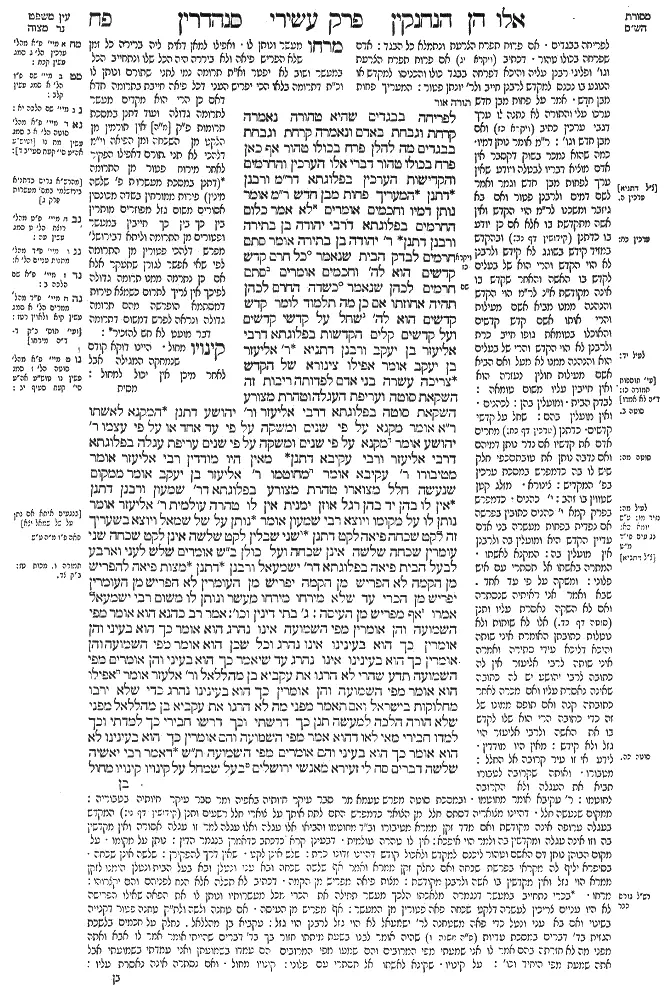
Sanhedrin 88a - Guemara
לפריחה בבגדים שהיא טהורה נאמרה קרחת וגבחת באדם ונאמרה קרחת וגבחת בבגדים מה להלן פרח בכולו טהור אף כאן פרח בכולו טהור דברי אלו הערכין והחרמים והקדישות הערכין בפלוגתא דר"מ ורבנן דתנן המעריך פחות מבן חדש ר"מ אומר נותן דמיו וחכמים אומרים לא אמר כלום החרמים בפלוגתא דרבי יהודה בן בתירה ורבנן דתנן ר' יהודה בן בתירה אומר סתם חרמים לבדק הבית שנאמר (ויקרא כז, כח) כל חרם קדש קדשים הוא לה' וחכמים אומרים סתם חרמים לכהן שנאמר (ויקרא כז, כא) כשדה החרם לכהן תהיה אחוזתו אם כן מה תלמוד לומר קדש קדשים הוא לה' שחל על קדשי קדשים ועל קדשים קלים הקדשות בפלוגתא דרבי אליעזר בן יעקב ורבנן דתניא ר' אליעזר בן יעקב אומר אפילו צינורא של הקדש צריכה עשרה בני אדם לפדותה ריבות זה השקאת סוטה ועריפת העגלה וטהרת מצורע השקאת סוטה בפלוגתא דרבי אליעזר ור' יהושע דתנן המקנא לאשתו ר"א אומר מקנא על פי שנים ומשקה על פי עד אחד או על פי עצמו ר' יהושע אומר מקנא על פי שנים ומשקה על פי שנים עריפת עגלה בפלוגתא דרבי אליעזר ורבי עקיבא דתנן מאין היו מודדין רבי אליעזר אומר מטיבורו ר' עקיבא אומר מחוטמו ר' אליעזר בן יעקב אומר ממקום שנעשה חלל מצוארו טהרת מצורע בפלוגתא דר' שמעון ורבנן דתנן אין לו בהן יד בהן רגל אוזן ימנית אין לו טהרה עולמית ר' אליעזר אומר נותן לו על מקומו ויוצא רבי שמעון אומר נותן על של שמאל ויוצא בשעריך זה לקט שכחה פיאה לקט דתנן שני שבלין לקט שלשה אינן לקט שכחה שני עומרין שכחה שלשה אינן שכחה ועל כולן ב"ש אומרים שלש לעני וארבע לבעל הבית פיאה בפלוגתא דר' ישמעאל ורבנן דתנן מצות פיאה להפריש מן הקמה לא הפריש מן הקמה יפריש מן העומרין לא הפריש מן העומרין יפריש מן הכרי עד שלא מירחו מירחו מעשר ונותן לו משום רבי ישמעאל אמרו אף מפריש מן העיסה:
ג' בתי דינין וכו':
אמר רב כהנא הוא אומר מפי השמועה והן אומרין מפי השמועה אינו נהרג הוא אומר כך הוא בעיני והן אומרין כך הוא בעינינו אינו נהרג וכל שכן הוא אומר מפי השמועה והן אומרין כך הוא בעינינו אינו נהרג עד שיאמר כך הוא בעיני והן אומרים מפי השמועה תדע שהרי לא הרגו את עקביא בן מהללאל ור' אלעזר אומר אפילו הוא אומר מפי השמועה והן אומרין כך הוא בעינינו נהרג כדי שלא ירבו מחלוקות בישראל ואם תאמר מפני מה לא הרגו את עקביא בן מהללאל מפני שלא הורה הלכה למעשה תנן כך דרשתי וכך דרשו חבירי כך למדתי וכך למדו חבירי מאי לאו דהוא אמר מפי השמועה והם אומרין כך הוא בעינינו לא הוא אומר כך הוא בעיני והם אומרים מפי השמועה ת"ש דאמר רבי יאשיה שלשה דברים סח לי זעירא מאנשי ירושלים בעל שמחל על קינויו קינויו מחול
Comments from Rashi on Masechet Sanhedrin Page 88a
לפריחה בבגדים . אם פרוח תפרח הצרעת ונתמלא כל הבגד: אדם שפרחה בכולו טהור . דכתיב (ויקרא יג) אם פרוח תפרח הצרעת וגו' ופליגי רבנן עליה והיכא דפרחה בבגד כולו והכניסו למקדש או הנוגע בו נכנס למקדש לרבנן חייב ולר' יונתן פטור: המעריך פחות מבן חדש . אמר על פחות מבן חדש ערכו עלי והתורה לא נתנה לו ערך דגבי ערכין כתיב (ויקרא כז) ואם מבן חדש וגו': ר"מ אומר נותן דמיו . כמה שהוא נמכר בשוק דקסבר אין אדם מוציא דבריו לבטלה ויודע שאין ערך לפחות מבן חדש וגמר ואמר לשם דמים ולרבנן פטור ואם בא גיזבר ומשכנו לר"מ הוי הקדש ואין אשה מתקדשת בו אלא אם כן יודע בו כדתנן (קידישין דף נב:) ובהקדש במזיד קידש בשוגג לא קידש ולרבנן לא הוי הקדש והרי הוא של בעלים לקדש בו האשה והאחר שקדש בו אינה מקודשת א"נ לר"מ הוי הקדש והנהנה ממנו מביא אשם מעילות והרי אותו אשם קדש קדשים והאוכלו בטומאת גופו חייב כרת ולרבנן לא הוי הקדש והרי של בעלים הוא והנהנה ממנו לא מעל ואם הביא אשם מעילות חולין לעזרה הוא ואין חייבין עליו משום טומאה: לבדק הבית . ומועלין בהן: לכהנים . ואין מועלין בהם: שחל על קדשי קדשים . כדתנן (ערבין דף כח:) מחרים אדם את קדשיו אם נדר נותן דמיהם ואם נדבה נותן את טובתם כפי חלק שיש לו בה כדמפרש במסכת ערכין בפ' המקדיש: צינורא . מזלג קטן שטווין בו זהב: י' כהנים . כדמפרש בפרק קמא י' כהנים כתובין בפרשה אם נפדית בפחות מעשרה בני אדם עדיין הקדש היא ומועלין בה ולרבנן אין מועלין בה: המקנא לאשתו . המתרה באשתו אל תסתרי עם איש פלוני: ומשקה על פי עד אחד . שבא ואמר אני ראיתיה שנסתרה ואם לא השקה נאסרת עליו ותנן (סוטה דף כד.) אלו לא שותות ולא נוטלות כתובתן האומרת איני שותה והיכא דליכא עידי סתירה ואמרה איני שותה לרבי אליעזר אין לה כתובה לרבי יהושע יש לה כתובה שאינה נאסרת עליו ואם מכרה לאחר כתובתה קנה ואם תופס ממונו של זה כדי כתובה הרי הוא שלו לקדש בו את האשה ולרבי אליעזר הוי גזל ולא קידש: מאין היו מודדין . לידע אי זו עיר קרובה אל החלל: מטבורו . ואותה שקרובה לטבורו תביא את העגלה ולא הקרובה לחוטמו: ר' עקיבא אומר מחוטמו . ובמסכת סוטה מפרש טעמא מר סבר עיקר חיותיה באפיה ומר סבר עיקר חיותיה בטבוריה: ממקום שנעשה חלל . דהיינו מצואריה דסתם חלל מן הצואר כדמפרש התם לתת אותך על צוארי חלל רשעים ותנן (קידושין דף נו:) המקדש בעגלה ערופה אינה מקודשת ואם מדד זקן ממרא מטיבורו וב"ד מחוטמו והביאו אלו עגלה ואלו עגלה למר זו עגלה אסורה ואין מקדשין בה וזו אינה עגלה ומקדשין בה ולמר הוי איפכא: אין לו טהרה עולמית . דבעינן קרא כדכתב כדאמרן בנגמר הדין: נותן על מקומו . על . מקום הבוהן נותן דם האשם וטהור ליכנס למקדש ולאכול קודש דהיינו זדונו כרת: שלש אינן לקט . שאין דרך להפקירן: שלשה אינן שכחה . בסיפרא יליף לה מקראי בפרשת שכחה ואם נחלק זקן ממרא ואמר אף שלשה שכחה ובא עני ונטלן ובא בעל הבית ונטלן הימנו לזקן ממרא הוי גזל ואין מקדשין בו אשה ולרבנן מקודשת: מצות פיאה מפריש מן הקמה . דכתיב לא תכלה אלא הנח לפניהם והם יקצרוהו: מרחו . בכרי נתחייב במעשר דנגמרה מלאכתו הלכך מעשר תחילה את הכרי מכל מעשרותיו ונותן לו את הפאה שאילו הפרישה לא היו עניים צריכין לעשרה דלקט שכחה פאה פטורין מן המעשר: אף מפריש מן העיסה . אם טחנה ולשה ולת"ק טחנה פטור דקנייה בשינוי ואם בא עני ונטל כדי פאה משטחנה לר' ישמעאל לא הוי גזל לרבנן הוי גזל: עקביא בן מהללאל . נחלק על חכמים בלשכת הגזית בד' דברים במסכת עדיות (פ"ה משנה ו) שהיה אומר לבנו בשעת מיתתו חזור בך בד' דברים שהייתי אומר אמר לו אבא ואתה מפני מה לא חזרתה בהם אמר לו אני שמעתי מפי המרובים והם שמעו מפי המרובים הם עמדו בשמועתן ואני עמדתי בשמועתי אבל אתה שמעת מפי היחיד וכו': על קינויו . שקינא לאשתו אל תסתרי עם פלוני: קינויו מחול . ואם נסתרה אינה נאסרת עליו:
Comments from Tosafot - Sanhedrin 88a
מרחו מעשר ונותן לו . ואפילו למאן דאית ליה ברירה כל זמן שלא הפריש פיאה ולא ביררה היה הכל שלו ונתחייב הכל במעשר ושוב לא יפטר וא"ת תרומה נמי לתני שתורם ונותן לו וכ"ת דתרומה בלאו הכי יפריש העני דכל פיאה חייבת בתרומה חדא דאם כן הרי הוא מקדים מעשר לתרומה גדולה ועוד דתנן במסכת תרומות פ"ק [מ"ה] אין תורמין מן הלקט מן השכחה ומן הפיאה וי"מ דלהכי לא תני תורם דאפילו הפקיר לאחר מירוח פטור מן התרומה (דתנן במסכת מעשרות פ' שלשה מינין) פירות ממורחין בשדה מכונסין אסורים משום גזל מפוזרים מותרין בין כך בין כך חייבין במעשר ופטורים מן התרומה וליתא דבירושל' מפרש דלהכי פטורין מן התרומה לפי שאי אפשר לגורן שתעקר. אלא אם כן נתרמה ממנו תרומה גדולה לפיכך אין צריך לתרום כשמצא פירות דמסתמא הופרשה מהם תרומה גדולה ונראה לפרש דמשום דתרומה דבר מועט לא חש להזכיר: קינויו מחול . היינו דוקא קודם שנמחקה המגילה אבל לאחר מיכן אין יכול למחול:
Sanhedrin 88a - Mishnah translated into english
with regard to a case where there is a spread of leprosy in garments that culminates with the garment’s being completely covered with leprous marks that the garment is pure, just as it is with regard to leprosy of a person?
Karaḥat and gabbaḥat are stated with regard to leprosy of a person (see Leviticus 13:42), in the sense of baldness on the back of one’s head and forehead, and karaḥat and gabbaḥat are stated with regard to leprosy of garments (see Leviticus 13:55), in the sense of the newer and the older sections of the garment. Just as there, with regard to leprosy of a person, if the leprosy spread to his entire body he is pure, so too here, with regard to leprosy of garments, if the leprosy spread to the entire garment it is pure. The Rabbis disagree and hold that even if the leprosy spreads, the garment remains impure. Therefore, if one touches the garment throughout which the leprosy spread and enters the Temple, according to the Rabbis, he is liable to receive karet, while according to Rabbi Yonatan ben Avtolemos, he is not liable.
“Matters of”; these are the valuations, and the dedications, and the consecrations. The Gemara elaborates: In the case of valuations, the dispute concerning such a prohibition is with regard to the issue that is the subject of the dispute between Rabbi Meir and the Rabbis, as we learned in a baraita: In the case of one who valuates a child less than one month old, for whom the Torah does not specify a value, Rabbi Meir says: He gives the monetary value of the child, as it is apparent that his intent was to give a donation, not a valuation. And the Rabbis say: He did not say anything. If the money is consecrated and one betrothed a woman with it, she is not betrothed, and one who engages in intercourse with her is liable to receive karet.
In the case of dedications, the dispute concerning such a prohibition is with regard to the issue that is the subject of the dispute between Rabbi Yehuda ben Beteira and the Rabbis, as we learned in a mishna (Arakhin 28b): Rabbi Yehuda ben Beteira says: Dedications dedicated without specification of their purpose are designated for Temple maintenance, as it is stated: “Every dedicated item is most sacred unto the Lord” (Leviticus 27:28).
And the Rabbis say: Dedications dedicated without specification of their purpose are designated for the priest, as it is stated with regard to one who consecrated a field and did not redeem it: “As a field dedicated; to the priest shall be its possession” (Leviticus 27:21). If so, why must the verse state: “Every dedicated item is most sacred unto the Lord”? It is to teach that dedication takes effect on offerings of the most sacred order and offerings of lesser sanctity. According to the Rabbis, the property is not consecrated, and if a woman is betrothed with that property, the betrothal takes effect, and one who engages in intercourse with her is liable to receive karet. According to Rabbi Yehuda ben Beteira, the property is consecrated and he is not liable.
In the case of consecrations, the dispute concerning such a prohibition is with regard to the issue that is the subject of the dispute between Rabbi Eliezer ben Ya’akov and the Rabbis, as it is taught in a baraita: Rabbi Eliezer ben Ya’akov says: Even a small fork that is consecrated property requires a court consisting of ten people in order to redeem it. The Rabbis say: A court of three judges is sufficient. According to Rabbi Eliezer ben Ya’akov, if it is redeemed before a court of three, the property remains consecrated. According to the Rabbis, the property is not consecrated, and if a woman is betrothed with that property, the betrothal takes effect, and one who engages in intercourse with her is liable to receive karet. According to Rabbi Eliezer ben Ya’akov, the property is consecrated and he is not liable.
“Disputes”; this is the giving of the bitter waters to a sota to drink, and the heifer whose neck is broken, and the purification of a leper. In the case of giving the bitter waters to a sota to drink, the dispute concerning such a prohibition is with regard to the issue that is the subject of the dispute between Rabbi Eliezer and Rabbi Yehoshua, as we learned in a mishna (Sota 2a): With regard to one who issues a warning to his wife not to seclude herself with a particular man, Rabbi Eliezer says: He issues a warning to her based on the presence of two witnesses; only then is the warning effective. And the husband gives her the bitter waters based on the testimony of one witness who saw the seclusion, or even based on his own testimony.
Rabbi Yehoshua says: He both issues a warning to her based on the presence of two witnesses and gives her the bitter waters to drink based on the testimony of two witnesses to the seclusion. If the seclusion took place in the presence of one witness, according to Rabbi Eliezer, she is a sota and not entitled to receive payment of her marriage contract. According to Rabbi Yehoshua, she is not a sota and she is entitled to receive payment of her marriage contract. The difference is whether the money of her marriage contract is hers. According to Rabbi Eliezer, if she gave that money to another who betrothed a woman with it, it is a betrothal with stolen property and the woman is not betrothed. According to Rabbi Yehoshua, the betrothal would not take effect.
In the case of the heifer whose neck is broken, the dispute concerning such a prohibition is with regard to the issue that is the subject of the dispute between Rabbi Eliezer and Rabbi Akiva, as we learned in a mishna (Sota 45b): From where on the body of the murder victim would they measure the distance to determine which city is closest? Rabbi Eliezer says: From his navel. Rabbi Akiva says: From his nose. Rabbi Eliezer ben Ya’akov says: From the place where he became a slain person, which is from his neck. According to all of these tanna’im, if the corpse was measured from a place on the body other than the place prescribed, the heifer is not consecrated for its purpose. According to Rabbi Akiva, if the measurement was taken from his navel, the heifer is not consecrated for its purpose, while according to Rabbi Eliezer, it is consecrated for its purpose. This has clear ramifications with regard to a situation in which one attempts to betroth a woman with that heifer.
In the case of the purification of a leper, the dispute concerning such a prohibition is with regard to the issue that is the subject of the dispute between Rabbi Shimon and the Rabbis, as we learned in a mishna (Nega’im 14:9): If a leper does not have a thumb, or a big toe, or a right ear upon which the Torah says that blood and oil must be placed as part of the purification process for a leper, he has no possibility of purification forever. Rabbi Eliezer says: The priest places the blood and oil for him on its place, i.e., where those body parts would have been if they were intact, and he fulfills his obligation. Rabbi Shimon says: The priest places the blood and oil on his left thumb, toe, and ear, and he fulfills his obligation. Both Rabbi Eliezer and Rabbi Shimon maintain that it is possible to purify such a leper, who would then not be liable to be punished with karet if he were to enter the Temple. The Rabbis, who maintain that such a leper has no possibility of purification, hold that if he enters the Temple he is liable to be punished with karet.
“In your gates”; this is gleanings, forgotten sheaves, and produce in the corner of the field [pe’a]. In the case of gleanings, the dispute concerning such a prohibition is as we learned in a mishna (Pe’a 6:5): Two stalks that were not cut with the sheaves and are then found in a field by a poor person are gleanings and belong to the poor person. Three stalks are not gleanings and the owner of the field can take them, if he chooses. In the case of forgotten sheaves, the same mishna teaches that if he forgot two sheaves, they are forgotten sheaves and belong to the poor, whereas three or more bundles are not forgotten sheaves and belong to the owner of the field.
And with regard to all of them, Beit Shammai say: If there are three, it belongs to the poor person, and if there are four, it belongs to the owner. According to Beit Hillel, if a poor person took three stalks or sheaves, they do not belong to him, and if he betrothed a woman with them, the betrothal does not take effect. According to Beit Shammai, she is betrothed.
In the case of pe’a, the dispute concerning such a prohibition is with regard to the issue that is the subject of the dispute between Rabbi Yishmael and the Rabbis, as we learned in a baraita: The mitzva of pe’a is to designate it from the standing grain still growing from the ground. If he did not designate it from the standing grain, but reaped the entire field, he designates a portion from the sheaves as pe’a. If he did not designate it from the sheaves, he designates it from the pile where one places the kernels after threshing, before he smooths the pile, at which point the produce is considered grain from which one is obligated to take terumot and tithes. If he already smoothed the pile before designating the pe’a, he tithes the grain in the pile and then gives the pe’a to the poor. If he ground the kernels into flour, he no longer designates pe’a.
In the name of Rabbi Yishmael they said: One designates pe’a even from the dough. If a poor person takes pe’a from the dough and betroths a woman with the dough, according to the Rabbis the betrothal does not take effect, while according to Rabbi Yishmael, she is betrothed.
§ The mishna teaches: There were three courts there in Jerusalem. The mishna then details the procedure followed when a rebellious elder appeared before these courts. Rav Kahana says: If the rebellious elder says his ruling on the basis of the tradition he received from his teacher, and the members of the court say their ruling on the basis of the tradition they received from their teachers, the rebellious elder is not executed, because there is a legitimate basis for his ruling.
If the rebellious elder says: This is the correct understanding in my eyes, and does not claim that his ruling is based on tradition, and the members of the court say: This is the correct understanding in our eyes, he is not executed. And all the more so if he says his ruling on the basis of the tradition, and the members of the court say: This is the correct understanding in our eyes, he is not executed. He is not executed unless he flouts tradition on the basis of his understanding and says: This is the correct understanding in my eyes, and the members of the court say their ruling on the basis of the tradition. Know that this is so, as Akavya ben Mahalalel was not executed despite the fact that he ruled contrary to the consensus ruling of his contemporaries, because he based his ruling on a tradition that he received.
And Rabbi Elazar says: Even if the rebellious elder says his ruling on the basis of the tradition, and the members of the court say: This is the correct understanding in our eyes, he is executed, so that discord will not proliferate among Israel and to ensure that there will be a standard halakhic ruling. And if you say: For what reason was Akavya ben Mahalalel not executed? It is due to the fact that he did not issue his ruling as practical halakha; he merely claimed that his understanding was correct in theory, which is always permitted.
We learned in the mishna that the rebellious elder says: This is what I interpreted and that is what my colleagues interpreted; this is what I taught and that is what my colleagues taught. The Gemara asks: What, is it not including a case where he says his ruling on the basis of the tradition, and the members of the court say: This is the correct understanding in our eyes? The Gemara rejects this: No, the reference is to a case where he says: This is the correct understanding in my eyes, and the members of the court say their ruling on the basis of the tradition.
Come and hear proof from that which Rabbi Yoshiya says: There are three matters that Zeira, one of the residents of Jerusalem, said to me: The first is that in the case of a husband who, after warning his wife not to enter into seclusion with a certain man, retracted his warning, his warning is retracted, and if she enters into seclusion with that man, she is not rendered forbidden to her husband.
Traduction : The William Davidson digital edition of the Koren Noé Talmud, with commentary by Rabbi Adin Even-Israel Steinsaltz.