 Talmud Bavli
The learning on the whole site is dedicated : L'ilui Nishmat רינה בת לדיסיה
The learning on the whole site is dedicated : L'ilui Nishmat Amram ben Itshak Loubaton
The learning on the whole site is dedicated : L'ilui Nishmat אסתר בת חיים
Sanhedrin 113a : Youtube
Daf TubeYoutube
2 video classes :
Sanhedrin Page 113a
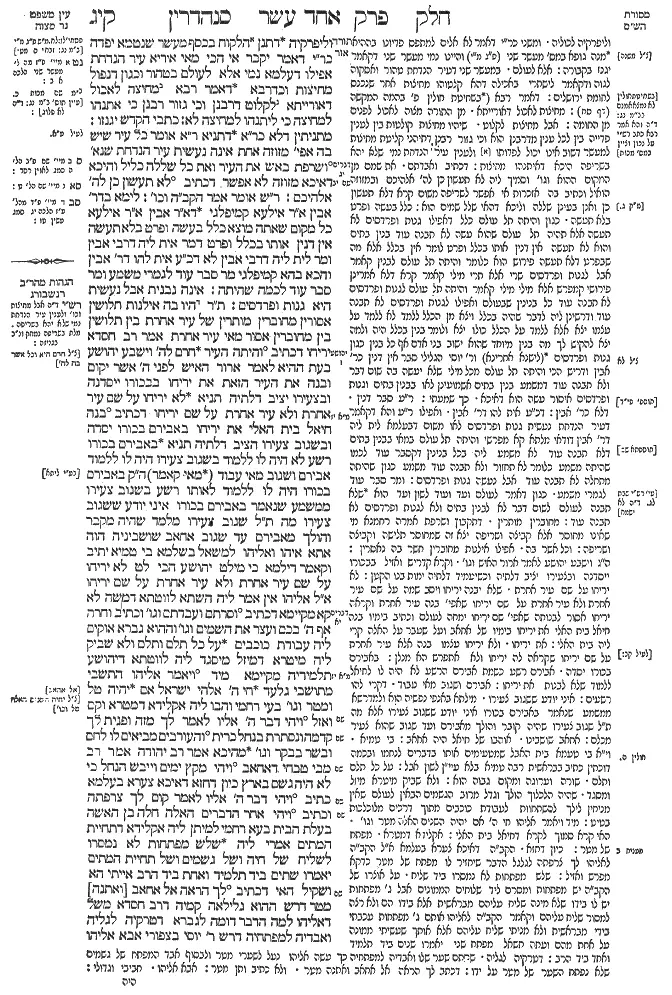
Sanhedrin 113a - Guemara
וליפרקיה דתנן הלקוח בכסף מעשר שנטמא יפדה כר"י דאמר יקבר אי הכי מאי איריא עיר הנדחת אפילו דעלמא נמי אלא לעולם בטהור וכגון דנפול מחיצות וכדרבא דאמר רבא מחיצה לאכול דאורייתא לקלוט דרבנן וכי גזור רבנן כי אתנהו למחיצה כי ליתנהו למחיצה לא:
כתבי הקדש יגנזו:
מתניתין דלא כר"א דתניא ר"א אומר כל עיר שיש בה אפי' מזוזה אחת אינה נעשית עיר הנדחת שנא' (דברים יג, יז) ושרפת באש את העיר ואת כל שללה כליל והיכא דאיכא מזוזה לא אפשר דכתיב (דברים יב, ד) לא תעשון כן לה' אלהיכם:
ר"ש אומר אמר הקב"ה וכו':
לימא בדר' אבין א"ר אילעא קמיפלגי דא"ר אבין א"ר אילעא כל מקום שאתה מוצא כלל בעשה ופרט בלא תעשה אין דנין אותו בכלל ופרט דמר אית ליה דרבי אבין ומר לית ליה דרבי אבין לא דכ"ע אית להו דר' אבין והכא בהא קמיפלגי מר סבר עוד לגמרי משמע ומר סבר עוד לכמה שהיתה אינה נבנית אבל נעשית היא גנות ופרדסים:
ת"ר היו בה אילנות תלושין אסורין מחוברין מותרין של עיר אחרת בין תלושין בין מחוברין אסור מאי עיר אחרת אמר רב חסדא יריחו דכתיב (יהושע ו, יז) והיתה העיר חרם לה' וישבע יהושע בעת ההיא לאמר ארור האיש לפני ה' אשר יקום ובנה את העיר הזאת את יריחו בבכורו ייסדנה ובצעירו יציב דלתיה תניא לא יריחו על שם עיר אחרת ולא עיר אחרת על שם יריחו דכתיב (מלכים א טז, לד) בנה חיאל בית האלי את יריחו באבירם בכורו יסדה ובשגוב צעירו הציב דלתיה תניא באבירם בכורו רשע לא היה לו ללמוד בשגוב צעירו היה לו ללמוד אבירם ושגוב מאי עבוד (מאי קאמר) ה"ק באבירם בכורו היה לו ללמוד לאותו רשע בשגוב צעירו ממשמע שנאמר באבירם בכורו איני יודע ששגוב צעירו מה ת"ל שגוב צעירו מלמד שהיה מקבר והולך מאבירם עד שגוב אחאב שושביניה הוה אתא איהו ואליהו למשאל בשלמא בי טמיא יתיב וקאמר דילמא כי מילט יהושע הכי לט לא יריחו על שם עיר אחרת ולא עיר אחרת על שם יריחו א"ל אליהו אין אמר ליה השתא לווטתא דמשה לא קא מקיימא דכתיב (דברים יא, טז) וסרתם ועבדתם וגו' וכתיב וחרה אף ה' בכם ועצר את השמים וגו' וההוא גברא אוקים ליה עבודת כוכבים על כל תלם ותלם ולא שביק ליה מיטרא דמיזל מיסגד ליה לווטתא דיהושע תלמידיה מקיימא מיד (מלכים א יז, יג) ויאמר אליהו התשבי מתושבי גלעד חי ה' אלהי ישראל אם יהיה טל ומטר וגו' בעי רחמי והבו ליה אקלידא דמטרא וקם ואזל (מלכים א יז, ב) ויהי דבר ה' אליו לאמר לך מזה ופנית לך קדמה ונסתרת בנחל כרית (מלכים א יז, ו) והעורבים מביאים לו לחם ובשר בבקר וגו' מהיכא אמר רב יהודה אמר רב מבי טבחי דאחאב (מלכים א יז, ז) ויהי מקץ ימים וייבש הנחל כי לא היה גשם בארץ כיון דחזא דאיכא צערא בעלמא כתיב (מלכים א יז, ב) ויהי דבר ה' אליו לאמר קום לך צרפתה וכתיב (מלכים א יז, יז) ויהי אחר הדברים האלה חלה בן האשה בעלת הבית בעא רחמי למיתן ליה אקלידא דתחיית המתים אמרי ליה שלש מפתחות לא נמסרו לשליח של חיה ושל גשמים ושל תחיית המתים יאמרו שתים ביד תלמיד ואחת ביד הרב אייתי הא ושקיל האי דכתיב (מלכים א יח, א) לך הראה אל אחאב [ואתנה] מטר דרש ההוא גלילאה קמיה דרב חסדא משל דאליהו למה הדבר דומה לגברא דטרקיה לגליה ואבדיה למפתחיה דרש ר' יוסי בצפורי אבא אליהו
Comments from Rashi on Masechet Sanhedrin Page 113a
וליפרקיה לכוליה . ומשני כר"י דאמר לא אלים למתפס פדיונו בההיא מנה גופא במס' מעשר שני (פ"ג מ"י) והיינו נמי מעשר שני דקאמר יגנז בקבורה: אלא לעולם . במעשר שני דעיר הנדחת טהור ואסקוה לגוה ודקאמר לישתרי באכילה דהא קלטוהו מחיצות אחר שנכנס לחומת ירושלים: דאמר רבא בשחיטת חולין פ' בהמה המקשה (דף סח): מחיצות לאכול דאורייתא . מן התורה מצוה לאכול לפנים מן החומה: אבל מחיצות לקלוט . שיהיו מחיצות קולטות בין לענין פדייה בין לכל ענין מדרבנן הוא וכי גזור רבנן דתיהני קליטת מחיצות למעשר דשוב אינו יכול לפדותו ולענין עיר הנדחת נמי שלא יהא בשריפה היכא דאיתנהו מחיצות: דכתיב ואבדתם . את שמם מן המקום ההוא וגו' וסמיך ליה לא תעשון כן לה' אלהיכם ובמזוזה הואיל וכתיב בה אזכרות אי אפשר לשריפה משום קרא דלא תעשון כן ואנן בעינן שללה וליכא דהאי שלל שמים הוא: כלל בעשה ופרט בלא תעשה . כגון והיתה תל עולם כלל דאפילו גנות ופרדסים לא תעשה אלא תהיה תל עולם שהוא עשה לא תבנה עוד בנין בתים והוא לא תעשה אין דנין אותו בכלל ופרט לומר אין בכלל אלא מה שבפרט דלא תעשה פירוש הוא כלומר והיתה תל עולם לבנין קאמר אבל לגנות ופרדסים שרי אלא תרי מילי קאמר קרא דלא אמרינן פירושי קמפרש אלא מילי מילי קאמר והיתה תל עולם לגנות ופרדסים לא תבנה עוד כל בנינין שבעולם ואפילו לגנות ופרדסים לא תבנה עוד ודרשינן ליה לדבר שהיה בכלל ויצא מן הכלל ללמד לא ללמד על עצמו יצא אלא ללמד על הכלל כולו יצא ולומר בנין בכלל היה ולמה יצא להקיש לך מה בנין מיוחד שהוא ישוב בני אדם אף כל בנין כגון גנות ופרדסים (לישנא אחרינא) ור' יוסי הגלילי סבר אין דנין כר' אבין ודריש הכי והיתה תל עולם מכל מילי שלא יעשה בה שום דבר ולא תבנה עוד דמשמע בנין בתים אשמועינן לאו בבנין בתים וגנות ופרדסים איסור עשה הוא דאיכא. כך שמעתי: ר"ע סבר דנין . דלא כר' אבין: דכ"ע אית להו דר' אבין . ואפילו ר"ע והא דקאמר דעיר הנדחת נעשית גנות ופרדסים לאו משום דבעלמא לית ליה דר' אבין דודאי מלתא קא מפרשי והיתה תל עולם במאי בבנין בתים דלא תבנה עוד לא משמע ליה בכל בנינין דקסבר עוד לכמו שהיתה משמע כלומר לא תחזור ולא תבנה עוד משמע כגון שהיתה מתחלה לא תבנה עוד אבל נעשה גנות ופרדסים: ומר סבר עוד לגמרי משמע . כגון דאמר לעולם ועד ועוד לשון ועד הוא שלא תבנה לעולם לשום דבר לא לבנין בתים ולא לגנות ופרדסים לא תבנה עוד: מחוברין מותרין . דתקבוץ ושרפת אמרה רחמנא מי שאינו מחוסר אלא קביצה ושריפה יצא זה שמחוסר תלישה וקביצה ושריפה: וכל אשר בה . אפילו אילנות מחוברין אשר בה נאסרין: ה"ג וישבע יהושע לאמר ארור האיש וגו' . וקרא קדריש ואזיל בבכורו ייסדנה ובצעירו יציב דלתיה וכשיעמיד דלתיה ימות בנו הקטן: לא יריחו על שם עיר אחרת . שלא יבנה יריחו ויסב שמה על שם עיר אחרת ולא עיר אחרת על שם יריחו שאפי' בנה עיר אחרת וקראה יריחו אסור לבנותה שאפי' שם יריחו ימחה לעולם וכתיב בימיו בנה חיאל בית האלי את יריחו בימיו של אחאב ועל שעבר על האלה קרי ליה בית האלי: את יריחו . ולא יריחו עצמו בנה אלא עיר אחרת על שם יריחו שקראה לה יריחו ולא אתפרש הא מנלן: באבירם בכורו יסדה . אבירם רשע כשמת אבירם הרשע לא היה לו לחיאל ללמוד שלא לבנות את יריחו: אבירם ושגוב מאי עבוד . דקרי להו רשעים: איני יודע ששגוב לעירו . מילתא באנפי נפשיה הוא ולמדרשא ממשמע שנאמר באבירם בכורו איני יודע ששגוב צעירו אלא מה ת"ל שגוב צעירו שהיה קובר והולך מאבירם ועד שגוב שהוא צעיר מכלם: אחאב שושבינו . אוהבו של חיאל היה אחאב: בי טמיא . וי"א בי טעמא בית האבל שמטעימים אותו בדברים לנחמו ובכמה דוכתין כתיב בבראשית רבה טמיא בלא עיי"ן לשון אבל: על כל תלם ותלם . שורה וערוגה ומקום גבוה הוא: ולא שביק מיטרא מיזל ומסגד . שהיה הלכלוך הולך וגדל מרוב הגשמים הבאין לעולם שאין מניחין לילך להשתחוות לעבודת כוכבים מתוך דרכים מלוכלכות בטיט: מיד ויאמר אליהו חי ה' אם יהיה השנים האלה מטר וגו' . האי קרא סמוך לקרא דחיאל בית האלי: אקלידא דמטרא . מפתח של מטר: כיון דחזא . הקב"ה דאיכא צערא בעלמא א"ל הקב"ה לאליהו לך צרפתה לגלגל הדבר שיחזיר לו מפתח של מטר כדקא מפרש ואזיל: שלש מפתחות לא נמסרו ביד שליח . על אוצרו של הקב"ה יש מפתחות ומסרם ליד שלוחים הממונים אבל ג' מפתחות יש לו בידו שלא מינה שליח עליהם מבראשית אלא בידו הם ולא רצה למסור שליח עליהם וקאמר הקב"ה לאליהו אותם ג' מפתחות עכבתי בידי מבראשית ולא מניתי שליח עליהם אלא אותך שעשיתי ממונה על אחת מהם ועתה תשאל מפתח שני יאמרו שנים ביד תלמיד ואחד ביד הרב: דכתב לך הראה אל אחאב ואתנה מטר . ולא כתיב ותן מטר: דטרקיה לגליה . שסתם שער שלו ואבדיה למפתחיה כך עשה אליהו נעל לשערי מטר ולבסוף אבד המפתח של גשמים שלא נפתח השער של מטר על ידו: אבא אליהו . חביבי וגדולי:
Sanhedrin 113a - Mishnah translated into english
The Gemara challenges: And let him redeem that which was purchased with second-tithe money and became ritually impure, as we learned in a mishna (Ma’aser Sheni 3:10): An item that is purchased with second-tithe money and that became ritually impure shall be redeemed. The Gemara answers: The mishna is in accordance with the opinion of Rabbi Yehuda, who says: An item that is purchased with second-tithe money and that became ritually impure shall be buried, and it may no longer be redeemed. The Gemara asks: If so, and the mishna is referring to an item purchased with second-tithe money that became ritually impure, why did the mishna cite this halakha specifically in the case of an idolatrous city? The same would hold true even in cities in general as well, as in Rabbi Yehuda’s opinion, the halakha there too is that the item is buried.
Rather, actually, the case in the mishna is with regard to pure second-tithe produce of an idolatrous city that was taken into Jerusalem, and it is a case where the walls of Jerusalem then fell. And this halakha is in accordance with the opinion of Rava, as Rava says: The capacity of the wall of Jerusalem to enable one to partake of second-tithe produce is by Torah law. By contrast, the capacity of the wall of Jerusalem to admit second-tithe produce, in the sense that once it enters Jerusalem the produce assumes the status of the property of the Most High and may no longer be redeemed, is by rabbinic law. And the case where the Sages issue the decree that entry into Jerusalem admits the produce is where the wall is intact; however, in a case where the wall is not intact, no, the Sages did not issue a decree, and the second tithe remains the spoils of the idolatrous city.
§ The mishna teaches: Sacred scrolls must be interred. The Gemara comments: The halakha cited in the mishna is not in accordance with the opinion of Rabbi Eliezer, as it is taught in a baraita that Rabbi Eliezer says: Any city in which there is even one mezuza is not rendered an idolatrous city, as it is stated: “And you shall burn it with fire, both the city and all its spoils, entirely for the Lord your God” (Deuteronomy 13:17). And in a city where there is a mezuza it is not possible to burn all its spoils, as it is written: “You shall not do so to the Lord your God” (Deuteronomy 12:4), from which it is derived that it is prohibited to destroy any item upon which the name of God appears.
The mishna teaches that Rabbi Shimon says: The Holy One, Blessed be He, says: If you implement judgment on an idolatrous city, I ascribe you credit as though you have sacrificed an entirely burnt offering before Me, and Rabbi Akiva and Rabbi Yosei HaGelili disagree as to whether one may convert the ruins of the idolatrous city into gardens and orchards. The Gemara posits: Let us say that it is with regard to the statement that Rabbi Avin says that Rabbi Ile’a says that these tanna’im disagree, as Rabbi Avin says that Rabbi Ile’a says: Anywhere that you find a generalization formulated as a positive mitzva followed by a detail formulated as a prohibition, one does not deduce from it that the generalization includes only the detail based on the hermeneutical principle of a generalization and a detail; rather, one interprets them as two independent halakhot.
On that basis, say that the dispute is that one Sage, Rabbi Yosei HaGelili, is of the opinion that the ruling is in accordance with the opinion of Rabbi Avin, and one Sage, Rabbi Akiva, is of the opinion that the ruling is not in accordance with the opinion of Rabbi Avin. Rabbi Yosei HaGelili holds that the positive mitzva: “And it shall be a heap forever,” and the succeeding prohibition: “It shall not be built again” (Deuteronomy 13:17), are independent mitzvot. The result is that the city must remain a heap and may not be converted into gardens and orchards. Rabbi Akiva employs the hermeneutical principle and deduces that the generalization “and it shall be a heap forever” means only that “it shall not be built again,” but converting the ruins of the idolatrous city into gardens and orchards is permitted.
The Gemara rejects this: No, everyone is of the opinion that the ruling is in accordance with the opinion of Rabbi Avin, and here, they disagree about this: One Sage, Rabbi Yosei HaGelili, holds that the term “again” indicates that it is entirely prohibited to rebuild it at all. And one Sage, Rabbi Akiva, holds that the term “again” indicates that it is not built to be as it was, but it may be converted into gardens and orchards.
§ The Sages taught in a baraita: In a case where there were trees in the city, if they are detached from the ground, they are forbidden and must be burned as the spoils of an idolatrous city; if they are attached to the ground they are permitted, i.e., they are not destroyed. By contrast, trees of another city, whether detached or attached, are forbidden. The Gemara asks: To what is the baraita referring with the phrase: Another city? Rav Ḥisda says: The reference is to Jericho, as it is written: “And the city shall be devoted, it and all that is in it, to the Lord…And Joshua charged them at that time by oath, saying: Cursed be the man before the Lord, that rises up to build this city Jericho; he shall lay its foundation with his firstborn, and with his youngest son shall he set up the gates of it” (Joshua 6:17, 26).
It is taught in a baraita that this includes a prohibition not to build Jericho even after changing its name to the name of another city, and not to build another city after giving it the name of Jericho, as it is written: “Hiel the Bethelite built Jericho; with Abiram, his firstborn, he laid its foundation, and with his young son Segub set up its gates” (I Kings 16:34).
It is taught in a baraita: From the death of Abiram, his firstborn, the wicked, it was not incumbent upon him to learn not to build Jericho, as Abiram’s death could be attributed to chance. But with the death of Segub his young son, it was incumbent upon him to learn that it was due to Joshua’s curse that they died.
The Gemara asks: What did Abiram and Segub do that they are characterized as wicked, and what is the baraita saying? The Gemara answers that this is what the baraita is saying: From the death of Abiram, his firstborn, that wicked man Hiel should have learned about the cause of the death of Segub his young son. By inference from that which is stated: “With Abiram, his firstborn,” do I not know that Segub was his young son? Rather, what is the meaning when the verse states: “His young son Segub”? It teaches that he gradually buried all his sons from Abiram through Segub, and he should have suspected that Joshua’s curse caused the deaths.
Ahab was Hiel’s close friend and groomsman. He and Elijah came to inquire about Hiel’s welfare in the house of mourning [bei tamya]. Hiel sat and said: Perhaps when Joshua cursed, this is what he cursed: Not to build Jericho even after changing its name to the name of another city, and not to build another city after giving it the name of Jericho. Elijah said to him: Yes, that is the curse. Ahab said to Elijah: Now the curse of Moses is not fulfilled, as it is written: “And you go astray and worship other gods,” and it is written: “Then the Lord’s anger will flare against you, and He will close the heavens, and there will be no rain” (Deuteronomy 11:16–17). And that man, referring to himself, established an object of idol worship on each and every furrow in the kingdom of Israel, and the rain is so plentiful that it does not allow him to go and worship it; will the curse of his student, Joshua, be fulfilled?
The verse relates Elijah’s reaction: Immediately: “And Elijah the Tishbite, who was of the inhabitants of Gilead, said to Ahab: As the Lord God of Israel lives, before whom I stand, there shall not be dew or rain these years, but according to my word” (I Kings 17:1). Elijah prayed for mercy and they gave him the key to rainfall enabling him to dictate when it would rain, and he arose and went.
It is written about Elijah: “And the word of the Lord came to him, saying: Go from here, and turn eastward, and hide yourself by Wadi Cherith…And the ravens brought him bread and meat in the morning” (I Kings 17:2–3, 6). The Gemara asks: From where did they bring him bread and meat? Rabbi Yehuda says that Rav says: They brought it from the slaughterhouse of Ahab. And it is written: “And it came to pass after some days, that the wadi dried up, because there was no rain in the land” (I Kings 17:7). Since God saw that there is suffering in the world and Elijah was insensitive to it, it is written: “And the word of the Lord came to him, saying: Arise, go to Zarephath” (I Kings 17:8–9), to initiate a chain of events that would lead Elijah to return the key to rainfall to God.
And it is written: “And it came to pass after these matters, that the son of the woman, the mistress of the house, became sick” (I Kings 17:17). Elijah prayed for mercy, for God to give him the key to the resurrection of the dead. They said to him from Heaven: Three keys were not typically passed to an agent: The key to a woman in childbirth, the key to rainfall, and the key to the resurrection of the dead. You already have the key to rainfall; do you also request the key to the resurrection of the dead? People will say: Two keys are in the possession of the student and one key is in the possession of the Master. Bring Me this key to rainfall, and take this key to the resurrection of the dead. Due to Elijah’s request, he was forced to revoke his oath, as it is written: “Go, appear before Ahab; and I will give rain” (I Kings 18:1).
A certain Galilean taught before Rav Ḥisda: There is a parable for the actions of Elijah; to what is this matter comparable? It is comparable to a man who slammed his door and lost his key. Elijah first prevented the rain from falling, and then no longer had possession of the key to enable it to fall again.
Rabbi Yosei of Tzippori taught: Father Elijah, a deferential and affectionate characterization for Elijah the prophet,
Traduction : The William Davidson digital edition of the Koren Noé Talmud, with commentary by Rabbi Adin Even-Israel Steinsaltz.