 Talmud Bavli
The learning on the whole site is dedicated : L'ilui Nishmat Ledicia bat David Banoun
The learning on the whole site is dedicated : L'ilui Nishmat יוסף בן מושה
The learning on the whole site is dedicated : L'ilui Nishmat רינה בת לדיסיה
Sanhedrin 43a : Youtube
Daf TubeYoutube
2 video classes :
Sanhedrin Page 43a
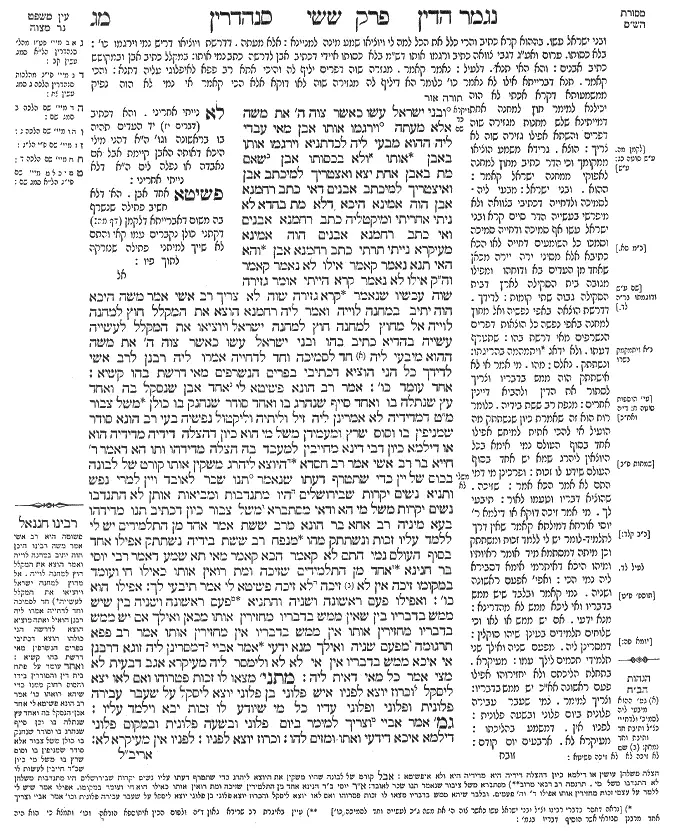
Sanhedrin 43a - Guemara
(ויקרא כד, כג) ובני ישראל עשו כאשר צוה ה' את משה אלא מעתה (ויקרא כד, כג) וירגמו אותו אבן מאי עבדי ליה ההוא מבעי ליה לכדתניא וירגמו אותו באבן אותו ולא בכסותו אבן שאם מת באבן אחת יצא ואצטריך למיכתב אבן ואיצטריך למיכתב אבנים דאי כתב רחמנא אבן הוה אמינא היכא דלא מת בחדא לא ניתי אחריתי ומיקטליה כתב רחמנא אבנים ואי כתב רחמנא אבנים הוה אמינא מעיקרא נייתי תרתי כתב רחמנא אבן והא האי תנא נאמר קאמר אילו לא נאמר קאמר וה"ק אילו לא נאמר קרא הייתי אומר גזירה שוה עכשיו שנאמר קרא גזירה שוה לא צריך רב אשי אמר משה היכא הוה יתיב במחנה לוייה ואמר ליה רחמנא הוצא את המקלל חוץ למחנה לוייה אל מחוץ למחנה חוץ למחנה ישראל ויוציאו את המקלל לעשייה עשייה בהדיא כתיב בהו ובני ישראל עשו כאשר צוה ה' את משה ההוא מיבעי ליה חד לסמיכה וחד לדחייה אמרו ליה רבנן לרב אשי לדידך כל הני הוציא דכתיבי בפרים הנשרפים מאי דרשת בהו קשיא:
אחד עומד כו':
אמר רב הונא פשיטא לי אחד אבן שנסקל בה ואחד עץ שנתלה בו ואחד סייף שנהרג בו ואחד סודר שנחנק בו כולן משל צבור מ"ט דמדידיה לא אמרינן ליה זיל וליתיה וליקטול נפשיה בעי רב הונא סודר שמניפין בו וסוס שרץ ומעמידן משל מי הוא כיון דהצלה דידיה מדידיה הוא או דילמא כיון דבי דינא מחייבין למעבד בה הצלה מדידהו ותו הא דאמר ר' חייא בר רב אשי אמר רב חסדא היוצא ליהרג משקין אותו קורט של לבונה בכוס של יין כדי שתטרף דעתו שנאמר (משלי לא, ו) תנו שכר לאובד ויין למרי נפש ותניא נשים יקרות שבירושלים היו מתנדבות ומביאות אותן לא התנדבו נשים יקרות משל מי הא ודאי מסתברא משל צבור כיון דכתיב תנו מדידהו בעא מיניה רב אחא בר הונא מרב ששת אמר אחד מן התלמידים יש לי ללמד עליו זכות ונשתתק מהו מנפח רב ששת בידיה נשתתק אפילו אחד בסוף העולם נמי התם לא קאמר הכא קאמר מאי תא שמע דאמר רבי יוסי בר חנינא אחד מן התלמידים שזיכה ומת רואין אותו כאילו חי ועומד במקומו זיכה אין לא זיכה לא זיכה פשיטא לי אמר תיבעי לך:
אפילו הוא כו':
ואפילו פעם ראשונה ושניה והתניא פעם ראשונה ושניה בין שיש ממש בדבריו בין שאין ממש בדבריו מחזירין אותו מכאן ואילך אם יש ממש בדבריו מחזירין אותו אין ממש בדבריו אין מחזירין אותו אמר רב פפא תרגומה מפעם שניה ואילך מנא ידעי אמר אביי דמסרינן ליה זוגא דרבנן אי איכא ממש בדבריו אין אי לא לא ולימסר ליה מעיקרא אגב דבעית לא מצי אמר כל מאי דאית ליה:
מתני׳ מצאו לו זכות פטרוהו ואם לאו יצא ליסקל וכרוז יוצא לפניו איש פלוני בן פלוני יוצא ליסקל על שעבר עבירה פלונית ופלוני ופלוני עדיו כל מי שיודע לו זכות יבא וילמד עליו:
גמ׳ אמר אביי וצריך למימר ביום פלוני ובשעה פלונית ובמקום פלוני דילמא איכא דידעי ואתו ומזים להו:
וכרוז יוצא לפניו לפניו אין מעיקרא לא והתניא בערב הפסח תלאוהו לישו והכרוז יוצא לפניו מ' יום ישו יוצא ליסקל על שכישף והסית והדיח את ישראל כל מי שיודע לו זכות יבא וילמד עליו ולא מצאו לו זכות ותלאוהו בערב הפסח אמר עולא ותסברא בר הפוכי זכות הוא מסית הוא ורחמנא אמר (דברים יג, ט) לא תחמול ולא תכסה עליו אלא שאני ישו דקרוב למלכות הוה ת"ר חמשה תלמידים היו לו לישו מתאי נקאי נצר ובוני ותודה אתיוהו למתי אמר להו מתי יהרג הכתיב (תהלים מב, ג) מתי אבוא ואראה פני אלהים אמרו לו אין מתי יהרג דכתיב (שם מא, ו) מתי ימות ואבד שמו אתיוהו לנקאי אמר להו נקאי יהרג הכתיב (שמות כג, ז) ונקי וצדיק אל תהרוג אמרו לו אין נקאי יהרג דכתיב (תהלים י, ח) במסתרים יהרג נקי אתיוהו לנצר אמר נצר יהרג הכתיב (ישעיה יא, א) ונצר משרשיו יפרה אמרו לו אין נצר יהרג דכתיב (שם יד, יט) ואתה השלכת מקברך כנצר נתעב אתיוהו לבוני אמר אמר בוני יהרג הכתיב (שמות ד, כב) בני בכורי ישראל אמרו לי' אין בוני יהרג דכתיב (שם, כג) הנה אנכי הורג את בנך בכורך אתיוהו לתודה אמר תודה יהרג הכתיב (תהלים ק, א) מזמור לתודה אמרו לו אין תודה יהרג דכתיב (שם נ, כג) זובח תודה יכבדנני
Comments from Rashi on Masechet Sanhedrin Page 43a
ובני ישראל עשו . בההוא קרא כתיב והרי כלל את הכל למה לי ויוציאו שמע מינה למניינא: אלא מעתה . דדרשת ויוציאו דריש נמי וירגמו כו': בלא כסותו . ערום ואע"ג דגבי צוואה כתיב ורגמו אותו דש"מ בלא כסותו איידי דכתיב אבן לדרשה כתב נמי אותו: במקלל כתיב אבן ובמקושש כתיב אבנים: והא האי תנא . דלעיל: נאמר קאמר . מגזרה שוה דפרים יליף לה והיכי אתא רב פפא לאיפלוגי עליה דתנא: והכי קאמר . תנא דברייתא אילו לא נאמר כו' כלומר הא דיליף לה מגזירה שוה לאו דוקא אלא הכי קאמר אי נמי לא הוה נפיק ממשמעותא דקרא אכתי לא הוה יכילנא למימר חוץ למחנה אחת דמייתינא שלש מחנות מגזירה שוה דפרים והשתא אפילו גזירה שוה לא צריך: הוצא . גרידא משמע הוציאו ממקומך וכי הדר כתיב מחוץ למחנה לאפוקי ממחנה ישראל קאמר: ההוא . ובני ישראל: מבעי ליה . לסמיכה ולדחייה דכתיבי בצוואה ולא מיפרשי בעשייה הדר סיים קרא ובני ישראל עשו אף סמיכה ודחייה סמיכה וסמכו כל השומעים דחייה לאו הכא כתיבא אלא מסיני ירה יירה מכאן שאחד מן העדים בא ודוחהו ומפילו מגובה בית הסקילה לארץ דבית הסקילה גבוה שתי קומות: לדידך . דדרשת הוצאה באפי נפשיה ואל מחוץ למחנה באפי נפשה כל הוצאות דפרים הנשרפים מאי דרשת בהו: שתטרף דעתו . ולא ידאג ויתמהמה בהריגתו: ונשתתק . נאלם: מהו . מי אמר אי לא אישתתק הוה ממש בדבריו וצריך לסתור את הדין ולהביא דיינין אחרים: מנפח רב ששת בידיה . כלומר רוח הוא זה שאמרת כיון שנשתתק מה הועיל אי להכי אתית למיחש אפילו אחד בסוף העולם נמי אימא בכל היוצאין ליהרג שמא יש אחד בסוף העולם שידע לו זכות: ופרכינן מי דמי התם לא אמר הכא אמר: שזיכה . שהוציא דבריו וטעמו לאור: תיבעי לך . מי אמר זיכה דוקא או דילמא ר' יוסי אורחא דמילתא קאמר שאין דרך לתלמיד לומר יש לי ללמד זכות ומשתתק וכן מיתה דמסתמא מיד אומר ראיותיו ומיהו היכא דאיתרמי אימא דסבירא ליה נמי הכי: ואפי' אפעם ראשונה ושניה . נמי קאמר ובלבד שיש ממש בדבריו ואי ליכא ממש לא מהדרינא: מנא ידעי . אם יש ממש או לאו וכי שלוחים תלמידים בעינן שיהו סוקלין: דמסרינן ליה . מפעם שניה ואילך שני תלמידי חכמים לילך עמו: מעיקרא . בתחלת הליכתם ולא יחזירוהו אפילו פעם ראשונה אא"כ יש ממש בדבריו: וצריך למימר . נמי שעבר עבירה פלונית ביום פלוני ובשעה פלונית: לפניו אין . דמשמע בהליכתו: מעיקרא לא . ארבעים יום קודם: [הוספה מחסרונות הש"ס: יהרג נקי . רוצח הוא נקי זה וראוי ליהרג שהרג במסתרים. ותשובה בעלמא הוא מפני האומות שקרוב למלכות היה והיו צריכים להשיב על כל ראיות של הבל שלהם: זובח תודה יכבדנני . מי שיהרוג תודה יכבדנני:]
Comments from Tosafot - Sanhedrin 43a
לא נייתי אחריני . והא דכתיב (דברים יז) יד העדים תהיה בו בראשונה וגו' ה"א דהני מילי היכא דאותה האבן קיימת אבל אם נאבדה או נפלה לים ה"א דלא נייתי אחריני: פשיטא אחד אבן . הא דלא חשיב פתילה שנשרף בה משום דאברייתא דלקמן (סנהדרין דף מה:) דקתני כולן נקברים עמו קאי והתם לא שייך למיתני פתילה שנזרקה לתוך פיו:
Sanhedrin 43a - Mishnah translated into english
“And the children of Israel did as the Lord commanded Moses.”
The Gemara asks: If that is so, what do they do with the words in the verse: “And they stoned him with a stone”? These words appear to be superfluous, as even without them we would know that God’s instructions to stone the blasphemer were implemented. What then do they serve to teach? The Gemara answers: That phrase is necessary for that which is taught in a baraita: The verse states: “And they stoned him with a stone.” The word “him” teaches that they stoned him alone, while he was naked, but not while he was in his clothing. The verse uses the singular term “stone [aven]” rather than the plural term stones [avanim] to teach that if the condemned man died after being struck with one stone, the court has fulfilled its obligation.
The Gemara notes: And it was necessary to write with regard to the blasphemer that “they stoned him with a stone,” in the singular, and it was necessary to write with regard to the man who gathered sticks on Shabbat that “they stoned him with stones” (Numbers 15:36), in the plural. As, had the Merciful One written only “stone,” I would say that where the condemned man did not die after being struck with one stone, they do not bring other stones and kill him with them. Therefore, the Merciful One writes “stones.” And had the Merciful One written only “stones,” I would say that from the outset they should bring two or more stones. Therefore, the Merciful One writes “stone.”
The Gemara raises an objection to Rav Pappa’s derivation: But this tanna of the baraita cited above said: It is stated here and it is stated elsewhere, thereby basing his derivation on a verbal analogy between the verse concerning the blasphemer and the verse concerning the bulls brought as sin-offerings that are burned. How, then, can Rav Pappa, an amora, disagree and derive the halakha directly from the verse dealing with the blasphemer? The Gemara answers: According to Rav Pappa, the tanna of the baraita said: Had it not been stated, and this is what he is saying: Had a verse not been stated from which it can be directly derived that the condemned man is stoned outside all three camps, I would have said that this can be learned by way of a verbal analogy. But now that such a verse has been stated, the verbal analogy is not needed.
Rav Ashi said: The location of the place of stoning can be directly derived from the verse discussing the blasphemer but in a slightly different manner. Where was Moses sitting when the matter of the blasphemer was brought before him? In the Levite camp. And the Merciful One said to him: “Take out him who has cursed” (Leviticus 24:14), indicating that he should be taken outside the Levite camp into the Israelite camp. And God continued in that verse: “Outside the camp,” which is an additional command that he should be removed even further, to outside the Israelite camp. And the later verse, which says: “And they brought him that had cursed out of the camp…and the children of Israel did as the Lord commanded Moses” (Leviticus 24:23), teaches us about the implementation of God’s instructions, i.e., that the children of Israel did in fact carry out His command.
The Gemara raises an objection: The implementation of God’s instructions is written explicitly in this context, as it is stated in the continuation of the verse: “And the children of Israel did as the Lord commanded Moses.” The Gemara answers: That verse is necessary to teach us that not only was the condemned man taken outside the three camps and stoned, but the rest of God’s instructions were also fulfilled. These instructions relate to the placing of the witnesses’ hands upon the head of the condemned man, as it is stated: “And let all that heard him place their hands upon his head” (Leviticus 24:14), and to the witnesses’ pushing of the condemned man from a platform the height of two stories.
The Sages said to Rav Ashi: According to you, that the expression “take out” by itself means outside the camp, and “outside the camp” means outside an additional camp, what do you learn from all those instances of “take out” that are written with regard to the bulls brought as sin-offerings that are burned? According to your explanation, there are many superfluous phrases in the verses. The Gemara comments: Indeed, this is difficult with regard to the opinion of Rav Ashi.
§ The mishna teaches that one man stands at the entrance to the court, with cloths in his hand, ready to signal to the court agents leading the condemned man to his execution that some doubt has been raised with respect to the latter’s guilt. Rav Huna says: It is obvious to me that the stone with which the condemned man is stoned and the tree on which his corpse is hung after his execution, or the sword with which he is killed, or the scarf with which he is strangled, all of these come from the property of the community. What is the reason for this? We do not tell the condemned man to go and bring these items from his own property and effectively kill himself.
Rav Huna raised a dilemma: With regard to the cloth that is waved and the horse that races off after the court agents to stop the latter from carrying out the execution, from whose property do they come, that of the condemned man or that of the community? The Gemara explains the two sides of the dilemma: Since they are needed to save the man being led to his execution, these items should be taken from his property. Or perhaps, since the court is obligated to take all possible measures to save him from death, they should be taken from them, i.e., the community.
And furthermore, another question is raised along similar lines: With regard to that which Rav Ḥiyya bar Ashi says that Rav Ḥisda says: The court gives one who is being led out to be killed a grain [koret] of frankincense in a cup of wine in order to confuse his mind and thereby minimize his suffering from the fear of his impending death, as it is stated: “Give strong drink to him that is ready to perish, and wine to the bitter in soul” (Proverbs 31:6). And it is taught in a baraita: The prominent women of Jerusalem would donate this drink and bring it to those being led out to be killed. The question is: If these prominent women did not donate this drink, from whom is it taken? The Gemara answers: With regard to this question, it is certainly reasonable that this drink should be taken from the community, as it is written: “Give [tenu] strong drink,” in the plural, indicating that it should come from them, the community.
§ Rav Aḥa bar Huna asked Rav Sheshet: If one of the students sitting before the judges said: I can teach a reason to acquit him, and he became mute and cannot explain himself, what is the halakha in such a case? Does the court take heed of his words, or do they disregard him? Rav Sheshet waved his hands in scorn and said: If the student became mute, the court certainly does not pay attention to him, as were the court to concern themselves with what he said, they would have to be concerned even that perhaps there is someone at the end of the world who can propose an argument in the condemned man’s favor. The Gemara rejects this argument: The cases are not similar. There, no one said that he had a reason to acquit the condemned man. Here, the student already said that he had a reason to acquit the condemned man. The question, therefore, is appropriate. What is the halakha in such a case?
The Gemara suggests: Come and hear an answer: As Rabbi Yosei bar Ḥanina says: In a case where there was one of the students who argued to acquit the defendant and then died, the court views him as if he were alive and standing in his place and voting to acquit the defendant. The implication is that if he argued to acquit the defendant and explained his reasoning, yes, the court counts his vote as if he were still alive. But if he did not actually argue to acquit the defendant, but only said that he wished to propose such an argument, his vote is not counted as though he were still alive.
The Gemara rejects this proof: If the student argued to acquit the defendant, it is obvious to me that he should be counted among those favoring acquittal. But if he only says that he wishes to propose such an argument, let the dilemma be raised whether or not he should be regarded as having presented a convincing argument in favor of acquittal. The question is left unresolved.
The mishna teaches: And even if he, the condemned man himself, says: I can teach a reason to acquit myself, he is returned to the courthouse even four or five times, provided that there is substance to his words. The Gemara asks: And is the halakha that there must be substance to his words even the first and second time that the condemned man says that he can teach a reason to acquit himself? But isn’t it taught in a baraita: The first and second times that he says that he can teach a reason to acquit himself, they return him to the courthouse and consider whether there is substance to his statement or there is no substance to his statement. From this point forward, if there is substance to his statement they return him to the courthouse, but if there is no substance to his statement, they do not return him. This appears to contradict the mishna.
Rav Pappa said: Explain that the mishna’s ruling applies only from after the second time forward, that from that point on we examine whether there is substance to his words.
The Gemara asks: How do we know whether or not there is substance to his words? Abaye said: If the condemned man has already been returned twice to the courthouse, we send a pair of rabbis with him to evaluate his claim. If they find that there is substance to his statement, yes, he is returned once again to the courthouse; if not, he is not returned.
The Gemara asks: But why not send a pair of rabbis with him from the outset, even the first time, and have them make an initial assessment of his claim? The Gemara answers: Since a man facing execution is frightened by the thought of his impending death, he is not able to say all that he has to say, and perhaps out of fear he will be confused and not provide a substantial reason to overturn his verdict. Therefore, the first two times he is returned to the courthouse without an initial examination of his arguments. Once he has already been returned on two occasions, the court allows for no further delay, and they send two rabbis to evaluate his claim before returning him a third time.
MISHNA: If, after the condemned man is returned to the courthouse, the judges find a reason to acquit him, they acquit him and release him immediately. But if they do not find a reason to acquit him, he goes out to be stoned. And a crier goes out before him and publicly proclaims: So-and-so, son of so-and-so, is going out to be stoned because he committed such and such a transgression. And so-and-so and so-and-so are his witnesses. Anyone who knows of a reason to acquit him should come forward and teach it on his behalf.
GEMARA: Abaye says: And the crier must also publicly proclaim that the transgression was committed on such and such a day, at such and such an hour, and at such and such a place, as perhaps there are those who know that the witnesses could not have been in that place at that time, and they will come forward and render the witnesses conspiring witnesses.
The mishna teaches that a crier goes out before the condemned man. This indicates that it is only before him, i.e., while he is being led to his execution, that yes, the crier goes out, but from the outset, before the accused is convicted, he does not go out. The Gemara raises a difficulty: But isn’t it taught in a baraita: On Passover Eve they hung the corpse of Jesus the Nazarene after they killed him by way of stoning. And a crier went out before him for forty days, publicly proclaiming: Jesus the Nazarene is going out to be stoned because he practiced sorcery, incited people to idol worship, and led the Jewish people astray. Anyone who knows of a reason to acquit him should come forward and teach it on his behalf. And the court did not find a reason to acquit him, and so they stoned him and hung his corpse on Passover eve.
Ulla said: And how can you understand this proof? Was Jesus the Nazarene worthy of conducting a search for a reason to acquit him? He was an inciter to idol worship, and the Merciful One states with regard to an inciter to idol worship: “Neither shall you spare, neither shall you conceal him” (Deuteronomy 13:9). Rather, Jesus was different, as he had close ties with the government, and the gentile authorities were interested in his acquittal. Consequently, the court gave him every opportunity to clear himself, so that it could not be claimed that he was falsely convicted.
Apropos the trial of Jesus, the Gemara cites another baraita, where the Sages taught: Jesus the Nazarene had five disciples: Mattai, Nakai, Netzer, Buni, and Toda. They brought Mattai in to stand trial. Mattai said to the judges: Shall Mattai be executed? But isn’t it written: “When [matai] shall I come and appear before God?” (Psalms 42:3). Mattai claimed that this verse alludes to the fact he is righteous. They said to him: Yes, Mattai shall be executed, as it is written: “When [matai] shall he die, and his name perish?” (Psalms 41:6).
Then they brought Nakai in to stand trial. Nakai said to the judges: Shall Nakai be executed? But isn’t it written: “And the innocent [naki] and righteous you shall not slay” (Exodus 23:7)? They said to him: Yes, Nakai shall be executed, as it is written: “In secret places he kills the innocent [naki]” (Psalms 10:8).
Then they brought Netzer in to stand trial. He said to the judges: Shall Netzer be executed? But isn’t it written: “And a branch [netzer] shall grow out of his roots” (Isaiah 11:1)? They said to him: Yes, Netzer shall be executed, as it is written: “But you are cast out of your grave like an abhorred branch [netzer]” (Isaiah 14:19).
Then they brought Buni in to stand trial. Buni said to the judges: Shall Buni be executed? But isn’t it written: “My firstborn son [beni] is Israel” (Exodus 4:22)? They said to him: Yes, Buni shall be executed, as it is written: “Behold, I shall kill your firstborn son [binkha]” (Exodus 4:23).
Then they brought Toda in to stand trial. Toda said to the judges: Shall Toda be executed? But isn’t it written: “A psalm of thanksgiving [toda]” (Psalms 100:1)? They said to him: Yes, Toda shall be executed, as it is written: “Whoever slaughters a thanks-offering [toda] honors Me” (Psalms 50:23).
Traduction : The William Davidson digital edition of the Koren Noé Talmud, with commentary by Rabbi Adin Even-Israel Steinsaltz.