 Talmud Bavli
The learning on the whole site is dedicated : L'ilui Nishmat אליעזר בן רחל
The learning on the whole site is dedicated : L'ilui Nishmat Nissim ben Barukh Malka
The learning on the whole site is dedicated : L'ilui Nishmat Jamila bat Chlomo Abensour
Sanhedrin 78a : Youtube
Daf TubeYoutube
2 video classes :
Sanhedrin Page 78a
Sanhedrin 78a - Guemara
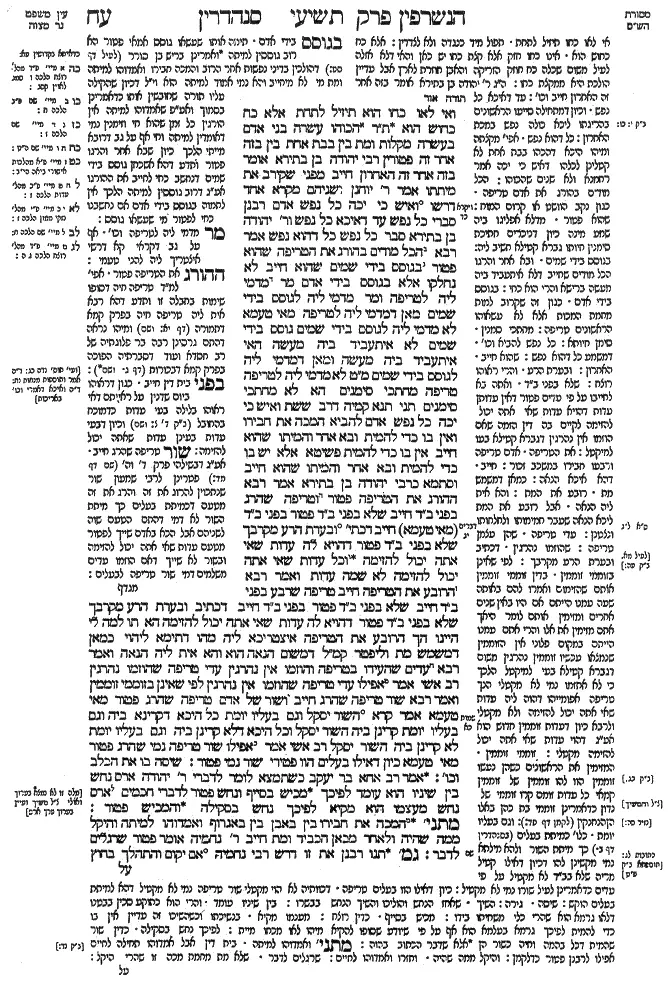
ואי לאו כחו הוא תיזיל לתחת אלא כח כחוש הוא ת"ר הכוהו עשרה בני אדם בעשרה מקלות ומת בין בבת אחת בין בזה אחר זה פטורין רבי יהודה בן בתירא אומר בזה אחר זה האחרון חייב מפני שקירב את מיתתו אמר ר' יוחנן ושניהם מקרא אחד דרשו (ויקרא כד, יז) ואיש כי יכה כל נפש אדם רבנן סברי כל נפש עד דאיכא כל נפש ור' יהודה בן בתירא סבר כל נפש כל דהוא נפש אמר רבא הכל מודים בהורג את הטריפה שהוא פטור בגוסס בידי שמים שהוא חייב לא נחלקו אלא בגוסס בידי אדם מר מדמי ליה לטריפה ומר מדמי ליה לגוסס בידי שמים מאן דמדמי ליה לטריפה מאי טעמא לא מדמי ליה לגוסס בידי שמים גוסס בידי שמים לא איתעביד ביה מעשה האי איתעביד ביה מעשה ומאן דמדמי ליה לגוסס בידי שמים מ"ט לא מדמי ליה לטריפה טריפה מחתכי סימנים הא לא מחתכי סימנים תני תנא קמיה דרב ששת ואיש כי יכה כל נפש אדם להביא המכה את חבירו ואין בו כדי להמית ובא אחר והמיתו שהוא חייב אין בו כדי להמית פשיטא אלא יש בו כדי להמית ובא אחר והמיתו שהוא חייב וסתמא כרבי יהודה בן בתירא אמר רבא ההורג את הטריפה פטור וטריפה שהרג בפני ב"ד חייב שלא בפני ב"ד פטור בפני ב"ד (מאי טעמא) חייב דכתי' (דברים יג, ו) ובערת הרע מקרבך שלא בפני ב"ד פטור דהויא לה עדות שאי אתה יכול להזימה וכל עדות שאי אתה יכול להזימה לא שמה עדות ואמר רבא הרובע את הטריפה חייב טריפה שרבע בפני ב"ד חייב שלא בפני ב"ד פטור בפני ב"ד חייב דכתיב ובערת הרע מקרבך שלא בפני ב"ד פטור דהויא לה עדות שאי אתה יכול להזימה הא תו למה לי היינו הך הרובע את הטריפה איצטריכא ליה מהו דתימא ליהוי כמאן דמשמש מת וליפטר קמ"ל דמשום הנאה הוא והא אית ליה הנאה ואמר רבא עדים שהעידו בטריפה והוזמו אין נהרגין עדי טריפה שהוזמו נהרגין רב אשי אמר אפילו עדי טריפה שהוזמו אין נהרגין לפי שאינן בזוממי זוממין ואמר רבא שור טריפה שהרג חייב ושור של אדם טריפה שהרג פטור מאי טעמא אמר קרא (שמות כא, כט) השור יסקל וגם בעליו יומת כל היכא דקרינא ביה וגם בעליו יומת קרינן ביה השור יסקל וכל היכא דלא קרינן ביה וגם בעליו יומת לא קרינן ביה השור יסקל רב אשי אמר אפילו שור טריפה נמי שהרג פטור מאי טעמא כיון דאילו בעלים הוו פטירי שור נמי פטור:
שיסה בו את הכלב וכו':
אמר רב אחא בר יעקב כשתמצא לומר לדברי ר' יהודה ארס נחש בין שיניו הוא עומד לפיכך מכיש בסייף ונחש פטור לדברי חכמים ארס נחש מעצמו הוא מקיא לפיכך נחש בסקילה והמכיש פטור:
מתני׳ המכה את חבירו בין באבן בין באגרוף ואמדוהו למיתה והיקל ממה שהיה ולאחר מכאן הכביד ומת חייב ר' נחמיה אומר פטור שרגלים לדבר:
גמ׳ תנו רבנן את זו דרש רבי נחמיה (שמות כא, יט) אם יקום והתהלך בחוץ
Comments from Rashi on Masechet Sanhedrin Page 78a
אי לאו כחו תיזיל לתחת . תפול מיד כנגדה ולא לצדדין: אלא כח כחוש הוא . אינו כחו חזק אלא קצת כחו יש כאן והאי דלא אזלה לעיל משום שכלה כח חוזק הזריקה והאבן חוזרת לארץ אבל עדיין הולכת היא ממקצת כחו: ה"ג ר' יהודה בן בתירא אומר בזה אחר זה האחרון חייב וכו': עד דאיכא כל נפש . וכיון דמתחילה סייעו הראשונים בהריגתו ליכא כולה נפש במכת האחרון: כל דהוא נפש . אפי' מקצתה ומיהו היכא דהכהו בבת אחת לא קטלינן לכלהו דאיש כי יכה אמר רחמנא ולא שנים שהכוהו: הכל מודים בהורג את אדם טריפה . כגון נקב הוושט או קרום המוח: שהוא פטור . מדלא אפליגו ביה שמע מינה כיון דניכרים חתיכת סימנין חיותו גברא קטילא חשיב ליה: בגוסס בידי שמים . ובא אחר והרגו הכל מודים שחייב דלא איתעביד ביה מעשה ברישא והרי הוא כחי: בגוסס בידי אדם . כגון זה שקרוב למות מחמת המכות אלא לא עשאוהו הראשונים טריפה: מחתכי סמנין . סימן חיותא: כל נפש להביא וכו' . דמשמע כל דהוא נפש: שהוא חייב . האחרון: ובערת הרע . והרי ראוהו רוצח: שלא בפני ב"ד . ואתה בא לחייבו על פי עדים פטור דאין עדותן עדות דהויא עדות שאי אתה יכול להזימה לקיים בה דין הזמה שאם הוזמו אין נהרגין דגברא קטילא בעו למיקטל: את הטריפה . אדם טריפה ורבעו חבירו במשכב זכור: חייב . דהא איכא הנאה: כמאן דמשמש מת . רובע את המת: והא אית ליה הנאה . אבל רובע את המת ליכא הנאה שעבר חמימותו ולחלחותו ונצטנן: עדי טריפה . שהן עצמן טריפה: שהוזמו נהרגין . דכתיב ובערת הרע מקרבך: לפי שאינן בזוממי זוממין . בדין זוממי זוממין אותם שהזימום ואמרו להם באותה שעה עמנו הייתם אם היו באין שנים אחרים ומזימין אותם לומר היאך אתם מזימין את אלו והרי אתם עמנו הייתם במקום פלוני אין הזוממין שנמצאו עכשיו זוממין נהרגין משום דגברא קטילא בעי למיקטל הלכך כי לא אתזמו נמי לא מקטלי הנך טריפה אפומייהו דהוה ליה עדות שאי אתה יכול להזימה ולא מקטלי ולרבא כיון דעדות זוממין חדוש הוא אע"ג דהוי עדות שאי אתה יכול להזימה מקטלי: זוממי זוממין . המזימין את הראשונים כשהן נעשו זוממין הוו להו זוממין של זוממין קמאי כל עדות זומם קרו זוממי של נדון כדאמרינן זוממי בת כהן באלו הן הנחנקין (לקמן סנהדרין דף פד:): וגם בעליו יומת . כלו' כמיתת בעלים (בסנהדרין דף ב.) כך מיתת השור ולהא מילתא נמי מקשינן להו דכיון דאילו קטיל מריה שלא בב"ד לא מקטיל על פי עדים כדאמרינן לעיל שורו נמי לא מקטיל: כיון דאילו הוו בעלים טריפה . דכוותיה לא הוי מקטלי שור טריפה נמי לא מקטיל דהא למיתת בעלים הוקש: שיסה . גירה: השיך . שאחז הנחש והוליכו והשיך הנחש בבשרו: בין שיניו עומד . והרי הוא כתוקע סכין בבטנו דלאו גרמא הוא שהרי כלי משחיתו בידו: מכיש בסייף . כדין רוצח: מעצמו מקיא . בנשיכתו וכשהשיכו זה עדיין אין בו כדי להמית לפיכך גרמא בעלמא הוא אף על פי שיודע שסופו להקיא מיהו לאו מכחו מיית: לפיכך נחש בסקילה . כדין שור שהמית דכל בהמה וחיה כשור הן אלא שדבר הכתוב בהוה: מתני' ואמדוהו למיתה . בית דין אבל אמדוהו תחילה לחיים אפילו לרבנן פטור כדלקמן: והיקל ממה שהיה . וחזרו ואמדוהו לחיים: שרגלים לדבר . שלא מת מחמת מכה זו שהרי היקל:
Comments from Tosafot - Sanhedrin 78a
בגוסס בידי אדם . תימה אותו שעשאו גוסס אמאי פטור הא רוב גוססין למיתה ואמרינן בריש בן סורר (לעיל סנהדרין דף סט:) דהולכין בדיני נפשות אחר הרוב והמכה חבירו ואמדוהו למיתה ומת מי לא מיחייב והא נמי אמוד למיתה הוא וי"ל דכיון שהקילה עליו תורה שחובשין אותו כדאמרינן בסמוך ואע"פ שאמדוהו למיתה אין הורגין כל זמן שהוא חי וזימנין נמי דאומדין למיתה וחי אף על גב דרובא מייתי הלכך כיון שבא אחר והרגו פטור ותדע דהא אשכחן גוסס בידי שמים דנחשב כחי לחייב את ההורגו אע"ג דרוב גוססין למיתה הלכך אין לתמוה בגוסס בידי אדם אם נחשבנו כחי לפטור מי שעשאו גוסס: מר מדמי ליה לטריפה וכו' . אף על גב דקראי קא דרשי איצטריך ליה להני טעמי: ההורג את הטריפה פטור . אפי' למ"ד טריפה חיה דסופו שימות בחבלה זו ותדע דהא רבא אית ליה טריפה חיה בפרק קמא דתמורה (דף יא: ושם) ומיהו נראה דהתם גרסינן רבה בר פלוגתיה של רב חסדא ועוד דסברתיה הפוכה בפרק קמא דבכורות (דף ג. ושם): בפני בית דין חייב . כגון דראוהו ביום שדנין על ראייתם דאי ראוהו בלילה בעי עדות כדמוכח בהחובל (ב"ק ד' צ: ושם) וכיון דבעי עדות בעינן עדות שאתה יכול להזימה: שור טריפה שהרג חייב . אע"ג דבשילהי פרק ד' וה' (שם דף מד:) פטרינן לרבי שמעון שור שנתכוין להרוג את זה והרג את זה מטעם דכמיתת בעלים כך מיתת השור לא דמי דהתם הטעם שוה לשניהם אבל הכא באדם שייך לפטור מטעם עדות שאי אתה יכול להזימה ובשור לא שייך דאם הוזמו עדים משלמים דמי שור טריפה לבעלים:
Sanhedrin 78a - Mishnah translated into english
Rav Pappa answered: And were it not for the force of his action, the stone would go down and not to the side. Rather, although it is a weak force, the force of his action is a partial cause of the damage caused by the stone going to the side; therefore, he is liable.
The Sages taught: If ten people struck an individual with ten sticks and as a result of the beating he died, whether they beat him simultaneously, or whether they beat him one after the other, they are exempt from liability for killing him, as two people are not liable for an action that they performed together. Rabbi Yehuda ben Beteira says: If they struck him one after the other, the one who struck him last is liable, because he hastened his death.
Rabbi Yoḥanan says: And both Rabbis, i.e., the first tanna and Rabbi Yehuda ben Beteira, interpreted the same verse in drawing their halakhic conclusion. The verse states: “And a man who strikes any soul mortally, he shall be put to death” (Leviticus 24:17). The Rabbis hold that “any soul” means that one is liable for murder only when there is an entire soul, i.e., when the murderer alone is responsible for taking the entire life of the victim. And Rabbi Yehuda ben Beteira holds that “any soul” means that one is liable for murder for taking any soul, even if the victim had already been beaten and was close to death.
§ Rava says: All concede that in the case of one who kills one who has a wound that will cause him to die within twelve months [tereifa] he is exempt from liability, as in a certain sense the legal status of the victim is that of a dead person. All concede in a case where one kills an individual dying from an illness caused at the hand of Heaven that he is liable, as no other individual took action contributing to his death, and the murderer alone took his remaining soul. They disagree only in a case where one kills an individual dying from injury caused at the hand of a person. One Sage, the Rabbis, likens this case to the case of a tereifa, and therefore rules that the one who kills him is exempt. And one Sage, Rabbi Yehuda, likens this case to the case of an individual dying from an illness caused at the hand of Heaven, and therefore rules that the one who kills him is liable.
The Gemara asks: As for the one who likens this case to the case of a tereifa, what is the reason that he does not liken it to the case of an individual dying from an illness caused at the hand of Heaven? The Gemara answers: In the case of an individual dying from an illness caused at the hand of Heaven, no action was performed by a person to kill him, whereas in this case of an individual dying from injury caused at the hand of a person, an action was performed by an individual to kill him. Therefore, it is a case of two people who performed an action together, and they are not liable.
The Gemara asks: And as for the one who likens this case to the case of an individual dying from an illness caused at the hand of Heaven, what is the reason that he does not liken it to a tereifa? The Gemara answers: In the case of a tereifa, his status is like that of one whose organs, the trachea and the esophagus, are cut, who is considered to be slaughtered. The status of this individual dying from injury caused at the hand of a person is not like that of one whose organs, the trachea and the esophagus, are cut, as there is no particular defect; rather, he is like one suffering from general frailty, like any frail or elderly individual.
A tanna taught a baraita before Rav Sheshet: The verse that states: “And a man who strikes any soul mortally, he shall be put to death” (Leviticus 24:17), serves to include the case of one who strikes another and it is a blow in which there is not sufficient force to kill, and then another individual comes and kills him; the verse teaches that the second individual is liable.
The Gemara challenges: If the first individual struck him with a blow in which there is not sufficient force to kill, this halakha is obvious, as the first did not perform an act of killing at all, and it is only the second who killed him. Rather, emend the baraita to teach: The verse serves to include the case of one who strikes another and it is a blow in which there is sufficient force to kill, and then another individual comes and kills him; the verse teaches that the second individual is liable. And this unattributed baraita is in accordance with the opinion of Rabbi Yehuda ben Beteira, who holds that one who completes the killing of an individual is liable to be executed as a murderer.
Rava says: One who kills a tereifa is exempt as it is as though he killed a dead person. And as for a tereifa who kills another individual, if he killed him before the judges in court, he is liable to be executed. If the killing was not before the judges in court, he is exempt.
The Gemara explains: In the case of a tereifa who killed before the court, what is the reason that he is liable? He is liable, as it is written: “And you shall eradicate the evil from your midst” (Deuteronomy 13:6), from which it is derived that there is a mitzva for the court to eradicate evil that it witnesses firsthand. In the case where the killing was not before the judges in court, he is exempt, as any testimony against the tereifa is testimony that you cannot render conspiratory testimony. Even if the witnesses testifying that the tereifa committed murder are found to be conspiring witnesses, they cannot be executed, as they conspired to kill a tereifa. And any testimony that you cannot render conspiratory testimony is not characterized as testimony, and is not accepted in court.
And Rava says: One who sodomizes a male who is a tereifa is liable to be executed for committing an act of sodomy. And as for a tereifa who sodomizes a male, if he does so before the judges in court, he is liable to be executed. If the act of sodomy was not before a court, he is exempt. The Gemara explains: If he committed an act of sodomy before the court, he is liable, as it is written: “And you shall eradicate the evil from your midst.” If the act of sodomy was not before a court, he is exempt, as any testimony against a tereifa is testimony that you cannot render conspiratory testimony.
The Gemara asks: Why do I also need this ruling? This case of sodomy is identical to that case of murder; why then does Rava cite two cases with regard to capital transgressions involving a tereifa? The Gemara answers: It was necessary for him to mention the case of one who sodomizes a tereifa, as there is a novel element introduced in that halakha. Lest you say: Let the status of one who sodomizes a male who is a tereifa be like one who engages in necrophilia, and let him be exempt from execution. To counter this, Rava teaches us that his liability is due to the pleasure that he experiences, and this man who sodomizes a tereifa has pleasure, as, although the legal status of a tereifa is that of a dead person in certain senses, he is, in fact, alive.
And Rava says: Witnesses who testified with regard to a tereifa that he committed a capital transgression, and then they were rendered conspiring witnesses are not executed, as they conspired to kill one whose status is that of a dead person. Witnesses who are themselves tereifa who were rendered conspiring witnesses are executed. Rav Ashi says: Even witnesses who are themselves tereifa who were rendered conspiring witnesses are not executed, due to the fact that they are not susceptible to a situation where witnesses who rendered them conspiring witnesses can themselves be rendered conspiring witnesses. Witnesses who render the witnesses who are themselves tereifa conspiring witnesses who then are rendered conspiring witnesses are not executed, because they sought to kill a tereifa, whose status is that of a dead person. Therefore, their testimony is testimony that you cannot render conspiratory testimony and is disregarded.
And Rava says: An ox that is a tereifa that killed an individual is liable to be executed, like any animal that kills a person. And an ox belonging to a person who is a tereifa that killed an individual is exempt. What is the reason for this halakha? It is as the verse states: “The ox shall be stoned and its owner shall also be put to death” (Exodus 21:29). Based on the juxtaposition between the owner and his ox it is derived: Anywhere that we can read concerning the situation: “And its owner shall also be put to death,” we read, i.e., apply, concerning it: “The ox shall be stoned.” And anywhere that we cannot read concerning it: “And its owner shall also be put to death,” we do not read concerning it: “The ox shall be stoned.” Since the owner of the ox cannot be executed, as he is a tereifa, his ox is also not liable to be stoned.
Rav Ashi says: Even an ox that is a tereifa that killed an individual is exempt. What is the reason for this halakha? Based on the juxtaposition between the ox and the owner, since if the owner were a tereifa he would be exempt, an ox that is a tereifa that killed an individual is also exempt.
§ The mishna teaches: If one set a dog against an individual and the dog killed him, or if one set a snake against an individual and the snake killed him, the one who set the dog or the snake is exempt from punishment. If he imbedded the snake’s fangs into another person and caused the snake to bite him and kill him, Rabbi Yehuda deems him liable to be executed, and the Rabbis exempt him. Rav Aḥa bar Ya’akov says: When you analyze the matter you will find that according to the statement of Rabbi Yehuda, venom of a snake stands within its fangs, and in this case the entire action is performed by the individual who imbeds the fang in the other person’s skin. The snake is passive. Therefore, the one who causes the snake to bite is liable to be executed by beheading with a sword as a murderer, and the snake is exempt.
According to the statement of the Rabbis, venom of a snake is discharged by the snake itself. The snake directly causes the death, while the individual who imbeds the fang is merely an indirect cause. Consequently, the snake is executed by stoning, and the one who caused the snake to bite is exempt from execution.
MISHNA: In the case of one who strikes another, whether he does so with a stone or with his fist, and the doctors assessed his condition, estimating that it would lead to death, and then his condition eased from what it was, and the doctors revised their prognosis and predicted that he would live, and thereafter his condition worsened and he died, the assailant is liable to be executed as a murderer. Rabbi Neḥemya says: He is exempt, as there is a basis for the matter of assuming that he is not liable. Since the victim’s condition eased in the interim, a cause other than the blow struck by the assailant ultimately caused his death.
GEMARA: The Sages taught: Rabbi Neḥemya interpreted this verse in arriving at his ruling. It is written: “If he rises and walks outside
Traduction : The William Davidson digital edition of the Koren Noé Talmud, with commentary by Rabbi Adin Even-Israel Steinsaltz.