 Talmud Bavli
Sanhedrin 52a : Youtube
Daf TubeYoutube
2 video classes :
Sanhedrin Page 52a
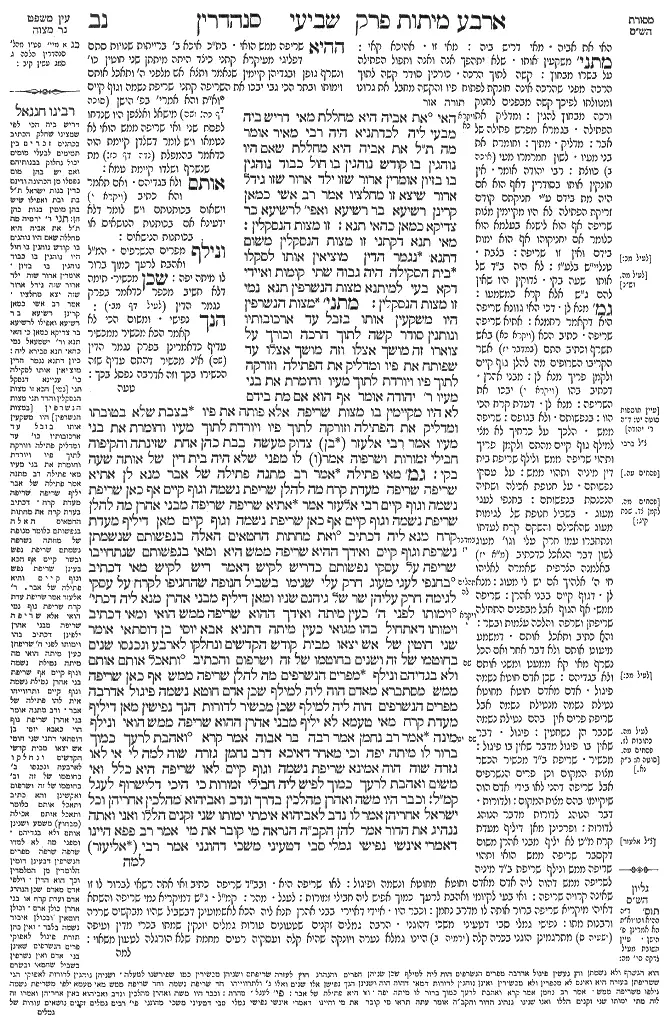
Sanhedrin 52a - Guemara
האי (ויקרא כא, ט) את אביה היא מחללת מאי דריש ביה מבעי ליה לכדתניא היה רבי מאיר אומר מה ת"ל את אביה היא מחללת שאם היו נוהגין בו קודש נוהגין בו חול כבוד נוהגין בו בזיון אומרין ארור שזו ילד ארור שזו גידל ארור שיצא זו מחלציו אמר רב אשי כמאן קרינן רשיעא בר רשיעא ואפי' לרשיעא בר צדיקא כמאן כהאי תנא:
זו מצות הנסקלין:
מאי תנא דקתני זו מצות הנסקלין משום דתנא נגמר הדין מוציאין אותו לסקלו בית הסקילה היה גבוה שתי קומות ואיידי דקא בעי למיתנא מצות הנשרפין תנא נמי זו מצות הנסקלין:
מתני׳ מצות הנשרפין היו משקעין אותו בזבל עד ארכובותיו ונותנין סודר קשה לתוך הרכה וכורך על צוארו זה מושך אצלו וזה מושך אצלו עד שפותח את פיו ומדליק את הפתילה וזורקה לתוך פיו ויורדת לתוך מעיו וחומרת את בני מעיו ר' יהודה אומר אף הוא אם מת בידם לא היו מקיימין בו מצות שריפה אלא פותח את פיו בצבת שלא בטובתו ומדליק את הפתילה וזורקה לתוך פיו ויורדת לתוך מעיו וחומרת את בני מעיו אמר רבי אלעזר (בן) צדוק מעשה בבת כהן אחת שזינתה והקיפוה חבילי זמורות ושרפוה אמר לו מפני שלא היה בית דין של אותה שעה בקי:
גמ׳ מאי פתילה אמר רב מתנה פתילה של אבר מנא לן אתיא שריפה שריפה מעדת קרח מה להלן שריפת נשמה וגוף קיים אף כאן שריפת נשמה וגוף קיים רבי אלעזר אמר אתיא שריפה שריפה מבני אהרן מה להלן שריפת נשמה וגוף קיים אף כאן שריפת נשמה וגוף קיים מאן דיליף מעדת קרח מנא ליה דכתיב (במדבר יז, ג) ואת מחתות החטאים האלה בנפשותם שנשמתן נשרפת וגוף קיים ואידך ההיא שריפה ממש היא ומאי בנפשותם שנתחייבו שריפה על עסקי נפשותם כדריש לקיש דאמר ריש לקיש מאי דכתיב (תהלים לה, טז) בחנפי לעגי מעוג חרק עלי שנימו בשביל חנופה שהחניפו לקרח על עסקי לגימה חרק עליהן שר של גיהנם שניו ומאן דיליף מבני אהרן מנא ליה דכתי' (ויקרא י, ב) וימותו לפני ה' כעין מיתה ואידך ההוא שריפה ממש הואי ומאי דכתיב וימותו דאתחיל בהו מגואי כעין מיתה דתניא אבא יוסי בן דוסתאי אומר שני חוטין של אש יצאו מבית קודש הקדשים ונחלקו לארבע ונכנסו שנים בחוטמו של זה ושנים בחוטמו של זה ושרפום והכתיב (ויקרא י, ב) ותאכל אותם אותם ולא בגדיהם ונילף מפרים הנשרפים מה להלן שריפה ממש אף כאן שריפה ממש מסתברא מאדם הוה ליה למילף שכן אדם חוטא נשמה פיגול אדרבה מפרים הנשרפים הוה ליה למילף שכן מכשיר לדורות הנך נפישין מאן דיליף מעדת קרח מאי טעמא לא יליף מבני אהרן ההוא שריפה ממש הואי ונילף מינה אמר רב נחמן אמר רבה בר אבוה אמר קרא (ויקרא יט, יח) ואהבת לרעך כמוך ברור לו מיתה יפה וכי מאחר דאיכא דרב נחמן גזרה שוה למה לי אי לאו גזרה שוה הוה אמינא שריפת נשמה וגוף קיים לאו שריפה היא כלל ואי משום ואהבת לרעך כמוך לפיש ליה חבילי זמורות כי היכי דלישרוף לעגל קמ"ל:
וכבר היו משה ואהרן מהלכין בדרך ונדב ואביהוא מהלכין אחריהן וכל ישראל אחריהן אמר לו נדב לאביהוא אימתי ימותו שני זקנים הללו ואני ואתה ננהיג את הדור אמר להן הקב"ה הנראה מי קובר את מי אמר רב פפא היינו דאמרי אינשי נפישי גמלי סבי דטעיני משכי דהוגני אמר רבי (אליעזר)
Comments from Rashi on Masechet Sanhedrin Page 52a
האי את אביה . מאי דריש ביה: מאי זו . אהיכא קאי: מתני' משקעין אותו . שלא יתהפך אנה ואנה ותפול הפתילה על בשרו מבחוץ: קשה לתוך הרכה . כורכין סודר קשה לתוך הרכה מפני שהרכה אינה חונקת לפתוח פיו והקשה מחבל את גרונו ומנוולתו לפיכך קשה מבפנים לחנוק ורכה מבחוץ להגין: ומדליק את הפתילה . בגמרא מפרש פתילה של אבר: מדליק . מתיך: וחומרת את בני מעיו . לשון חמרמרו מעי (איכה ב) כווצת: רבי יהודה אומר . אין חונקין אותו בסודרין דאף הוא אם היה מת בידם ע"י חניקתם קודם זריקת הפתילה לא היו מקיימין מצות שריפה אף הוא לישנא בעלמא הוא כלומר אם יחניקוהו אף הוא ימות בידם ואין זו שריפה: בצבת . טנליי"ש בלע"ז: לא היה ב"ד של אותו שעה בקי . צדוקין היו שאין להם ג"ש אלא קרא כמשמעו: גמ' מנא לן . דכי האי גוונא שריפה היא דקאמר רחמנא: אתיא שריפה שריפה . כתיב הכא (ויקרא כא) באש תשרף וכתיב התם (במדבר יז) אשר הקריבו השרופים מה להלן גוף קיים ולקמן פריך מנא לן: מבני אהרן . דכתיב בהו (ויקרא י) יבכו את השריפה: מנא לן . דעדת קרח הכי הוו: בנפשותם . ולא בגופם: שריפה ממש . הלכך על כרחיך לא מצי למילף גוף קיים מהתם ולקמן פריך ותהוי שריפה ממש ולילף שריפת בית דין מיניה ותהוי ממש: על עסקי נפשותם . על חנופת אכילה ושתיה הנכנסת בנפשותם: בחנפי לעגי מעוג . בשביל חנופת של לגימות מעוג שהאכילם והשקם קרח לעדתו ונתחברו עמו חרק עלי וגו' מעוג לשון דבר הנאכל כדכתיב (מלכים א יז) באלמנה הצרפית שאמרה לאליהו חי ה' אלהיך אם יש לי מעוג: מנא לן . דגוף קיים בבני אהרן: שריפה ממש . אף הגוף אבל מבפנים התחילה שריפתן ושרפה והלכה עצמות ובשר: והא כתיב ותאכל אותם . דמשמע מיעוט אותם ולא דבר אחר ואם הכל נשרף מאי קא ממעט ומשני אותם ולא בגדיהם: שכן אדם חוטא נשמה פיגול . אדם מאדם חוטא מחוטא נטילת נשמה מנטילת נשמה אבל שריפת פרים אין בהם נטילת נשמה שכבר הן נשחטין: פיגול . דבר שאין בו פיגול מדבר שאין בו פיגול: מכשיר . שריפת ב"ד מכשיר הכשר מצות המקום וכן פרים הנשרפים אבל שריפה דהני לאו בידי אדם הוה שיקיימו בהם מצות המקום: ולדורות . דבר הנוהג לדורות מדבר הנוהג לדורות: ופרכינן מאן דיליף מעדת קרח מ"ט לא יליף מבני אהרן משום דקסבר שריפה ממש הואי ותהוי שריפה ממש ונילף שריפת ב"ד מיניה לשריפה ממש דהוה ליה אדם מאדם וחוטא מחוטא ונשמה ופיגול: לאו שריפה היא . ובב"ד שריפה כתיב ואי אתה רשאי לברור לו זו שאינה קרויה שריפה: ואי בעי לקיומי ואהבת לרעך כמוך אפיש ליה חבילי זמורות: לעגל . מהר: קמ"ל . ג"ש דמיקריא נמי שריפה והשתא דאיהי מיקריא שריפה ברור אותה לו מדרב נחמן: וכבר היו . איידי דאיירי בבני אהרן תנא ליה הכא לאשמועינן דבשביל שהיו מבקשים שררה ורבנות מתו: נפישי גמלי סבי דטעיני משכי דהוגני . הרבה גמלים זקנים שטעונים עורות גמלים יונקין שמתו בכרי מדין ועיפה (ישעיהו ס) מתרגמינן הוגני בכרה קלה (ירמיהו ב) היינו גמלא נערה ויונקה שהיא קלה ועסקיה רעים מחמת שלא הורגלה לטעון משאוי:
Comments from Tosafot - Sanhedrin 52a
ההיא שריפה ממש הואי . בת"כ איכא ב' ברייתות שנויות סתם דפליגי מעיקרא קתני כיצד היתה מיתתן שני חוטין כו' ונשרף גופן ובגדיהן קיימין שנאמר ותצא אש מלפני ה' ותאכל אותם וימותו ובתר הכי גבי יבכו את השריפה קתני שריפת נשמה וגוף קיים וא"ת והא אמרי' בפ' הישן (סוכה דף כה: ושם) מישאל ואלצפן היו שנדחו לפסח שני ואי שריפה ממש הואי לא נטמאו ויש לומר דשלדן קיימת הוה כדאמר בהמפלת (נדה דף כז:) מת שנשרף ושלדו קיימת טמא: אותם ולא בגדיהם . ואם תאמר והא כתיב (ויקרא י) וישאום בכותנותם ויש לומר דלא ידעינא אם בכותנות הנושאים או בכותנות הנישאים: ונילף מפרים הנשרפים . המ"ל ואהבת לרעך כמוך ברור לו מיתה יפה: שכן מכשיר . תימה דלא חשיב מכפר כדאמר בפרק נגמר הדין (לעיל סנהדרין דף מב.): הנך נפישי . ומשום הכי לא קאמר הכא מכשיר ממכשיר עדיף כדאמרינן בפרק נגמר הדין (שם) א"נ מכשיר דהתם עדיף שזה הכשירו בכך וזה אדרבה נפסל בכך:
Sanhedrin 52a - Mishnah translated into english
what does he derive from this verse: “She profanes her father” (Leviticus 21:9), if he does not employ the term “her father” for a verbal analogy concerning a young betrothed woman who committed adultery, as Rabbi Akiva does?
The Gemara answers: He requires it for that which is taught in a baraita: Rabbi Meir would say: Why must the verse state: “She profanes her father”? To teach that if initially they would treat her father in a sacred manner, now they treat him in a profane manner. If previously they would treat him with honor, they now treat him with degradation. They say: Cursed is the one who bore this daughter, cursed is the one who raised this daughter, cursed is the one from whose loins this daughter emerged.
Rav Ashi says: In accordance with whose opinion do we call even a wicked person who is the son of a righteous person: A wicked person, the son of a wicked person? In accordance with whose opinion is it? It is in accordance with the opinion of this tanna, Rabbi Meir, who says that a sinful daughter profanes her father, and he too is treated with disgrace.
§ The mishna teaches: This describes the mitzva of those who are stoned, i.e., the process of execution by stoning. The Gemara asks: What was taught in the mishna with regard to which it teaches now: This describes the mitzva of those who are stoned?
The Gemara answers: The Mishna states this because it teaches in the previous chapter (42b): When the trial has ended in a guilty verdict and the condemned man has been sentenced to stoning, he is taken out to be stoned. And it continues (45a): The place of stoning from which the condemned party is pushed to his death is a platform twice the height of an ordinary person. And since the Mishna wants to teach in the next mishna: The mitzva of those who are burned, and it will then proceed to describe the processes involved in carrying out the other forms of execution, it also teaches in this mishna: This describes the mitzva of those who are stoned, in order to summarize what was taught up to this point.
MISHNA: The mitzva of those who are burned, i.e., the process of execution by burning, is carried out in the following manner: The executioners submerge the condemned one in dung up to his knees so he cannot move, and they place a rough scarf within a soft one, so his throat will not be wounded, and wrap these scarves around his neck. This one, i.e., one of the witnesses, pulls the scarf toward himself, and that one, the other witness, pulls it toward himself, until the condemned one is forced to open his mouth, as he is choking. And another person then lights the wick and throws it into his mouth, and it goes down into his intestines and burns his intestines and he dies.
Rabbi Yehuda says: But if this one who is condemned to death by burning accidentally died at their hands by strangulation, they have not fulfilled the mitzva of execution by burning for this person. Rather, the process is carried out in the following manner: One opens the mouth of the condemned person with prongs, against his will, and one lights the wick and throws it into his mouth, and it goes down into his intestines and burns his intestines and he dies.
Rabbi Elazar ben Tzadok said: An incident occurred with regard to a certain priest’s daughter who committed adultery, and they wrapped her in bundles of branches and burned her, contrary to the process described in the mishna. The Sages said to him: That court did not act properly; they did so because the court at that time was not proficient in halakha.
GEMARA: What kind of wick is the mishna referring to? Rav Mattana says: A wick of lead, i.e., a long, thin piece of lead in the shape of a wick, which is melted and poured down into the intestines.
From where do we derive that burning means this kind of death? It is derived from a verbal analogy between the burning that is described in the context of capital punishment (see Leviticus 21:9) and the burning described with regard to the assembly of Korah, when they were burned by God (see Numbers 17:4). Just as there, with regard to the assembly of Korah, they were killed by the burning of the soul within the body, but the body itself remained intact, so too here, the condemned one is executed by the burning of the soul, but the body remains intact. He is not executed by means of the burning of the body with wood, as in that case the body would be consumed.
Rabbi Elazar says that there is a different source for this method of burning: It is derived from a verbal analogy between the burning that is described in this context and the burning that is described with regard to the deaths of Nadav and Avihu, the sons of Aaron (see Leviticus 10:6). Just as there, Nadav and Avihu were killed by the burning of the soul, but the body remained intact, so too here, the execution is carried out by the burning of the soul, but the body remains intact.
The Gemara asks: From where does the one who derives that burning means this kind of death from the assembly of Korah derive that their bodies were not burned? The Gemara answers: He derives it from that which is written: “And the firepans of these men who have sinned with their souls” (Numbers 17:3), which indicates that only their souls were burned, but their bodies were intact.
The Gemara asks: And how does the other Sage, who does not derive that burning means this kind of death from here, interpret the deaths of the assembly of Korah? The Gemara answers: That burning was actual burning of their bodies. And what is the meaning of the term: “With their souls”? It means that they were deemed liable to be killed by burning due to matters of sustaining their souls, i.e., they sinned because Korah helped them fulfill their bodily desires, and consequently they followed him.
This latter explanation is in accordance with the statement of Reish Lakish. As Reish Lakish says: What is the meaning of that which is written: “With the flattering mockeries of spitefulness [maog] they gnash at me with their teeth” (Psalms 35:16)? It means that because of the flattery of those people who flattered Korah over matters of eating, i.e., because of the food and drink that he would give them, the minister of Gehenna gnashed his teeth over them, as they eventually sinned and fell into his hands. The word maog is interpreted homiletically here as alluding to uga, cake.
The Gemara asks: And from where does the one who derives that burning means this kind of death from the sons of Aaron derive that their bodies were not burned? The Gemara answers: He derives it from that which is written: “And fire came out from before the Lord, and devoured them, and they died before the Lord” (Leviticus 10:2). The term “and they died” indicates that it was similar to a natural death, in which the body remains intact.
The Gemara asks: And how does the other Sage, who does not derive that burning means this kind of death from here, interpret the death of the sons of Aaron? The Gemara answers: That burning was actual burning. And in that case, what is the meaning of that which is written: “And they died”? It means that the fire started from within them, and therefore it was similar to a natural death, which occurs within the person. As it is taught in a baraita: Abba Yosei ben Dostai says: Two threads of fire came out of the Holy of Holies and split into four, and two entered the nostrils of this one, and the other two entered the nostrils of that one, and the threads of fire burned them.
The Gemara asks: But isn’t it written: “And devoured them [vatokhal otam]”? The usage of the expanded term “vatokhal otam,” instead of the terser vatokhlem, indicates a limitation, i.e., only they were consumed, to the exclusion of their bodies. The Gemara answers: The verse means that the fire devoured “them,” but not their clothes.
The Gemara asks: And let us derive the correct method of execution by burning from the halakha of the bull offerings that are burned. Just as there, the reference is to actual burning, so too here, perhaps there should be actual burning.
The Gemara answers: It stands to reason that one should derive the halakha with regard to capital punishment from the death of a person, i.e., either from the assembly of Korah or the sons of Aaron, as they share common elements: They deal with a person, a sinner, and a soul that is taken through burning, i.e., the person dies as a result of the burning. Furthermore, the halakha of an offering that was sacrificed with the intent to consume it after its designated time [piggul], is not relevant in either case, whereas it is relevant to bull offerings that are burned.
The Gemara asks: On the contrary, one should derive the halakha with regard to capital punishment from the bull offerings that are burned, as both enable the fulfillment of a mitzva, whereas the deaths of the assembly of Korah and the sons of Aaron were not mitzvot. Furthermore, both of these are fixed halakhot for all future generations, whereas the deaths of the assembly of Korah and the sons of Aaron were onetime incidents.
The Gemara answers: Those elements that are shared by capital punishment and the deaths of the assembly of Korah and the sons of Aaron are more numerous than the elements that are shared by capital punishment and the bulls that are burned. Therefore, the halakha is derived from the assembly of Korah and the sons of Aaron.
The Gemara asks: With regard to the one who derives this halakha from the assembly of Korah, what is the reason he does not derive it from the sons of Aaron? Because in his opinion that was actual burning. But if this is the case, let us derive from the death of the sons of Aaron that execution by burning should be performed with actual burning; why does he derive from the assembly of Korah that hot lead should be used?
Rav Naḥman says that Rabba bar Avuh says: The verse states: “And you shall love your neighbor as yourself” (Leviticus 19:18), which teaches that even with regard to a condemned prisoner one should select a good, i.e., a compassionate, death for him. The method of burning described in the mishna is certainly faster and less painful than the burning of the entire body.
The Gemara asks: And since there is the halakha of Rav Naḥman, why do I need the verbal analogy? Even without this proof execution by burning would have been performed with hot lead, as it is a less painful form of death.
The Gemara answers: Were it not for the verbal analogy, I would say that a death that includes the burning of the soul, but the body itself remains intact, is not burning at all, and that it does not fulfill the mitzva of execution by burning. And if it is necessary to alleviate the condemned one’s pain due to the halakha of “And you shall love your neighbor as yourself” (Leviticus 19:18), let the court increase for him the bundles of branches, so that he will burn quicker. Therefore, the verbal analogy teaches us that even internal burning is regarded as burning, and once this has been established it is taken into consideration that he must be executed in the least painful way.
Apropos the deaths of Nadav and Avihu, an aggadic midrash on this subject is quoted: And it had already happened that Moses and Aaron were walking on their way, and Nadav and Avihu were walking behind them, and the entire Jewish people were walking behind them. Nadav said to Avihu: When will it happen that these two old men will die and you and I will lead the generation, as we are their heirs? The Holy One, Blessed be He, said to them: We shall see who buries whom. Rav Pappa says: This explains the adage that people say: Many are the old camels that are loaded with the skins of young camels.
Rabbi Eliezer says:
Traduction : The William Davidson digital edition of the Koren Noé Talmud, with commentary by Rabbi Adin Even-Israel Steinsaltz.
Sanhedrin 52a : Significance
Next step
Finished studying Sanhedrin 52a? Carry on with the rest of the tractate.
Study Sanhedrin 52bFrequently asked questions: Sanhedrin 52a
Where is Sanhedrin 52a in tractate Sanhedrin?
Sanhedrin 52a is page 101 of 224 in tractate Sanhedrin (Seder Nezikin).
When is daf 52 of Sanhedrin studied in Daf Yomi?
Daf Yomi covers one daf a day, both sides. Daf 52 of Sanhedrin will be studied on July 11, 2032.
Is there a video class on Sanhedrin 52a?
Yes, by Daf Tube, Rabbi Dr. Moshe Weisblum. These classes were published on YouTube by their authors and are gathered on this site.
What is tractate Sanhedrin about?
The Masechet Sanhedrin is the fourth tractate of the Seder Nezikin. The Gemara Sanhedrin is the study of the laws relating to the civil and criminal courts, the king, the High Priest. The different capital punishments by fire, sword, strangulation... As well as the consequences for the souls of criminals during the resurrection of the dead.The Sanhedrin tractate is a gemara which contains 11 chapters.
Your study is also dedicated to them
- L'ilui Nishmat יוסף בן מושה
- L'ilui Nishmat Reuven ben Rivka SEBBAG
- L'ilui Nishmat Jamila bat Chlomo Abensour