 Talmud Bavli
The learning on the whole site is dedicated : L'ilui Nishmat Jamila bat Chlomo Abensour
The learning on the whole site is dedicated : L'ilui Nishmat Nissim ben Barukh Malka
The learning on the whole site is dedicated : L'ilui Nishmat Yaakov ben Myriam
Sanhedrin 56a : Youtube
Daf TubeYoutube
2 video classes :
Sanhedrin Page 56a
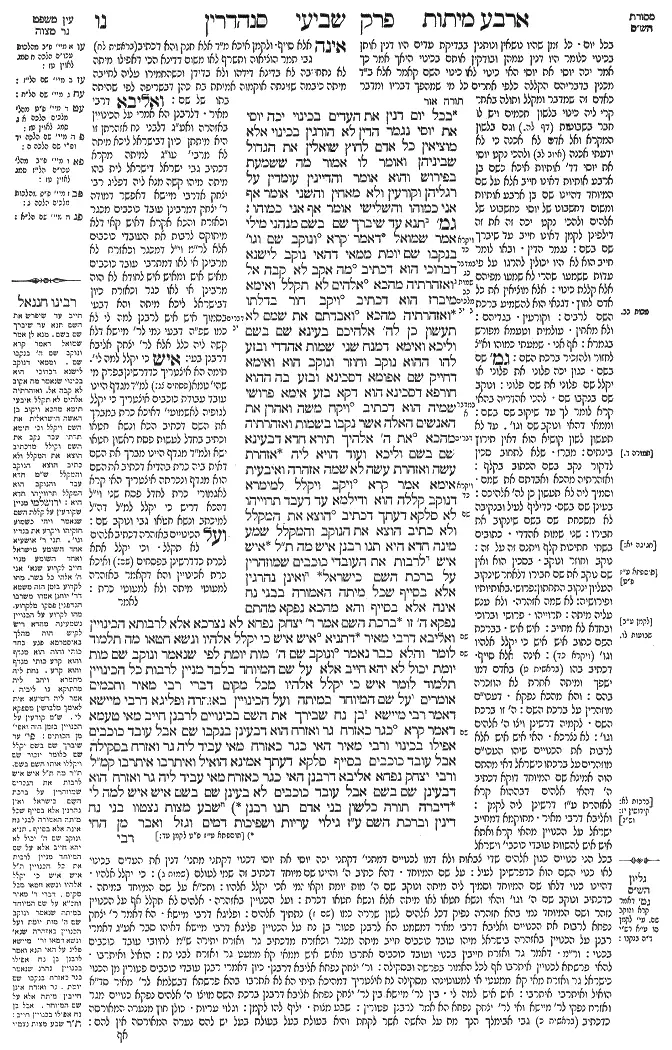
Sanhedrin 56a - Guemara
בכל יום דנין את העדים בכינוי יכה יוסי את יוסי נגמר הדין לא הורגין בכינוי אלא מוציאין כל אדם לחוץ שואלין את הגדול שביניהן ואומר לו אמור מה ששמעת בפירוש והוא אומר והדיינין עומדין על רגליהן וקורעין ולא מאחין והשני אומר אף אני כמוהו והשלישי אומר אף אני כמוהו:
גמ׳ תנא עד שיברך שם בשם מנהני מילי אמר שמואל דאמר קרא (ויקרא כד, טז) ונוקב שם וגו' בנקבו שם יומת ממאי דהאי נוקב לישנא דברוכי הוא דכתיב (במדבר כג, ח) מה אקב לא קבה אל ואזהרתיה מהכא (שמות כב, כז) אלהים לא תקלל ואימא מיברז הוא דכתיב (מלכים ב יב, י) ויקב חור בדלתו ואזהרתיה מהכא (דברים יב, ג) ואבדתם את שמם לא תעשון כן לה' אלהיכם בעינא שם בשם וליכא ואימא דמנח שני שמות אהדדי ובזע להו ההוא נוקב וחוזר ונוקב הוא ואימא דחייק שם אפומא דסכינא ובזע בה ההוא חורפא דסכינא הוא דקא בזע אימא פרושי שמיה הוא דכתיב (במדבר א, יז) ויקח משה ואהרן את האנשים האלה אשר נקבו בשמות ואזהרתיה מהכא (דברים ו, יג) את ה' אלהיך תירא חדא דבעינא שם בשם וליכא ועוד הויא ליה אזהרת עשה ואזהרת עשה לא שמה אזהרה ואיבעית אימא אמר קרא (ויקרא כד, יא) ויקב ויקלל למימרא דנוקב קללה הוא ודילמא עד דעבד תרוייהו לא סלקא דעתך דכתיב (ויקרא כד, יד) הוצא את המקלל ולא כתיב הוצא את הנוקב והמקלל שמע מינה חדא היא תנו רבנן איש מה ת"ל איש איש לרבות את העובדי כוכבים שמוזהרין על ברכת השם כישראל ואינן נהרגין אלא בסייף שכל מיתה האמורה בבני נח אינה אלא בסייף והא מהכא נפקא מהתם נפקא ה' זו ברכת השם אמר ר' יצחק נפחא לא נצרכא אלא לרבותא הכינויין ואליבא דרבי מאיר דתניא (ויקרא כד, טו) איש איש כי יקלל אלהיו ונשא חטאו מה תלמוד לומר והלא כבר נאמר (ויקרא כד, טז) ונוקב שם ה' מות יומת לפי שנאמר ונוקב שם מות יומת יכול לא יהא חייב אלא על שם המיוחד בלבד מניין לרבות כל הכינויין תלמוד לומר איש כי יקלל אלהיו מכל מקום דברי רבי מאיר וחכמים אומרים על שם המיוחד במיתה ועל הכינויין באזהרה ופליגא דרבי מיישא דאמר רבי מיישא בן נח שבירך את השם בכינויים לרבנן חייב מאי טעמא דאמר קרא (ויקרא כד, טז) כגר כאזרח גר ואזרח הוא דבעינן בנקבו שם אבל עובד כוכבים אפילו בכינוי ורבי מאיר האי כגר כאזרח מאי עביד ליה גר ואזרח בסקילה אבל עובד כוכבים בסייף סלקא דעתך אמינא הואיל ואיתרבו איתרבו קמ"ל ורבי יצחק נפחא אליבא דרבנן האי כגר כאזרח מאי עביד ליה גר ואזרח הוא דבעינן שם בשם אבל עובד כוכבים לא בעינן שם בשם איש איש למה לי דיברה תורה כלשון בני אדם תנו רבנן שבע מצות נצטוו בני נח דינין וברכת השם ע"ז גילוי עריות ושפיכות דמים וגזל ואבר מן החי
Comments from Rashi on Masechet Sanhedrin Page 56a
בכל יום . כל זמן שהיו נושאין ונותנין בבדיקת עדים היו דנין אותן בכינוי כלומר היו דנין עמהן ובודקין אותם בכינוי היאך אמר כך אמר יכה יוסי את יוסי האי כינוי לאו כינוי השם קאמר אלא ב"ד מכנין בדבריהם הקללה כלפי אחרים כל מי שמהפך דבריו ומדבר כאדם זה שמדבר ומקלל ותולה באחר קרי ליה כינוי בלשון חכמים ויש לו חבר בשבועות (דף לה.) וגם בלשון המקרא ואל אדם לא אכנה כי לא ידעתי אכנה (איוב לב) ולהכי נקט יוסי את יוסי דד' אותיות איכא כשם בן ארבע אותיות דאינו חייב אלא על שם המיוחד דהיינו שם בן ארבע אותיות ומשום דחשבונו של יוסי כחשבונו של אלהים ולהכי נקט יכה זה את זה דילפינן לקמן דאינו חייב עד שיברך שם בשם: נגמר הדין . ובאו לומר חייב הוא לא היו יכולין להרגו על פי עדות ששמעו שהרי לא שמעו מפיהם אלא קללת כינוי: אלא מוציאין את כל אדם לחוץ . דגנאי הוא להשמיע ברכת השם לרבים: וקורעין . בגדיהם: ולא מאחין . עולמית וטעמא מפורש בגמרא: אף אני . שמעתי כמוהו וא"צ לחזור ולהזכיר ברכת השם: גמ' שם בשם . כגון יכה פלוני את פלוני או יקלל שם פלוני את שם פלוני: ונוקב שם בנקבו שם . להכי אהדריה בהאי קרא לומר לך עד שיקוב שם בשם: וממאי דהאי ונוקב שם וגו' . עד לא תעשון לשון קושיא הוא דאין תירוץ בינתים: מברז . שלא לתחוב סכין לדקור נקב בשם הכתוב בקלף: ואזהרתיה מהכא ואבדתם את שמם . וסמיך ליה לא תעשון כן לה' אלהיכם: בענין שם בשם . כדיליף לעיל ובנקיבה לא משכחת שם בשם שינקוב את חבירו: שני שמות אהדדי . כתובים בשתי חתיכות קלף ויתנם זה על זה: נוקב וחוזר ונוקב . בסכין הוא ואין שם נוקב את שם חבירו דלאחר שינקוב העליון ינקוב התחתון: פרושי . באותיותיו ופירושיה: לא שמה אזהרה . ולא ענש עליה מיתה: תרוייהו . פרושי וברוכי ובחדא לא מחייב: איש איש . בברכת השם כתוב איש איש כי יקלל אלהיו וגו' (ויקרא כד): אינה אלא סייף . דכתיב בהו (בראשית ט) באדם דמו ישפך ומיתה אחרת לא הוזכרה בהם: והא מהכא נפקא . דעכו"ם מוזהרין על ברכת השם: ה' זו ברכת השם . לקמיה דרשינן ויצו ה' אלהים וגו': לא נצרכא . האי איש איש אלא לרבות את הכנויים שיהו העכו"ם מוזהרים על ברכתו כישראל דאי מהתם הוה אמינא שם המיוחד דוקא דכתיב ה' דהאי אלהים דבההוא קרא לאזהרת ע"ז דרשינן ליה לקמן: ואליבא דרבי מאיר . מתוקמא דמחייב ישראל על הכנויין מהאי קרא ואתא איש איש להשוות עובדי כוכבי' וישראל בכל הני כנויים כגון אלהים שדי צבאות ולא דמו לכנויים דמתני' דקתני יכה יוסי את יוסי דכנוי דקתני מתני' דנין את העדים בכינוי לאו כנוי השם הוא כדפרשינן לעיל: על שם המיוחד . דהא כתיב ה' והיינו שם מיוחד דכתיב זה שמי לעולם (שמות ג): כי יקלל אלהיו . דהיינו כנוי דלאו שם המיוחד וסמיך ליה מיתה ונוקב שם ה' מות יומת וקאי נמי אכי יקלל אלהיו: וחכ"א על שם המיוחד במיתה . כדכתיב ונוקב שם ה' וגו' והאי ונשא חטאו לאו מיתה אלא ונשא חטאו דכרת: ועל הכנויין באזהרה . אלהים לא תקלל אף על הכנויין נזהר ושם המיוחד נמי בהא אזהרה נפיק דכל אלהים לשון שררה כמו (שם ז) נתתיך אלהים: ופליגא דרבי מיישא . הא דאמר ר' יצחק נפחא לרבות את הכנויים ואליבא דרבי מאיר דמשמע הא לרבנן פטור בן נח על הכנויין פליגא דרבי מיישא דאיהו סבר אע"ג דאמרי רבנן על הכנויין באזהרה בישראל מיהו עובד כוכבים חייב מיתה מכגר וכאזרח מדכתיב גר ואזרח יתירה ש"מ לחיובי עובד כוכבים בכנוי: ור"מ . דאמר גר ואזרח חייבין בכנוי ועובד כוכבים אתרבו מאיש איש ממאי קא ממעט גר ואזרח לבני נח: הואיל ואיתרבו . להאי פרשתא לכנויין איתרבו אף לכל האמור בפרשה ובסקילה: ור' יצחק נפחא אליבא דרבנן . כיון דאמרי רבנן עובדי כוכבים פטורין מן הכנוי כישראל גר ואזרח מאי קא ממעטי אי למעוטינהו מסקילה לא איצטריך דמהיכא תיתי הא לא אתרבו בהא פרשתא דבשלמא לר' מאיר סד"א הואיל ואיתרבי איתרבי: איש איש למה לי . בין לר' מיישא בין לר' יצחק נפחא אליבא דרבנן ברכת השם מויצו ה' אלהים נפקא כנויים מגר ואזרח נפקי לר' מיישא ואי לר' יצחק נפחא הא אמר לרבנן פטורין: שבע מצות . יליף להו לקמן: וגלוי עריות . כולן חוץ מנערה המאורסה כדכתיב (בראשית כ) גבי אבימלך הנך מת על האשה אשר לקחת והיא בעולת בעל בעולת בעל יש להם נערה המאורסה אין להם:
Comments from Tosafot - Sanhedrin 56a
אינה אלא סייף . ולקמן איכא מ"ד אלא חנק והא דכתיב (בראשית לח) גבי תמר הוציאוה ותשרף לאו משום דדינא הכי דאפילו מיתה לא נתחייבה לא בדינא דידהו ולא בדידן וכשהחמירו עליה לחייבה מיתה כיבמה שזינתה אוקמוה אמיתת בת כהן דבשריפה לפי שהיתה בתו של שם: ואליבא דרבי מאיר . דלרבנן הא אמרי על הכינויין באזהרה ואע"ג דלבני נח אזהרתן זו היא מיתתן כיון דבישראל ליכא מיתה לא מרבי' עו"ג למיתה מקרא דכתיב גבי ישראל דישראל לית בהו מיתה מיהו קשה מנא ליה דפליג רבי יצחק אדרבי מיישא דאפשר דמודה ר' יצחק דמרבינן עובד כוכבים מכגר וכאזרח והכא אקרא דאיש קאי דלא מיתוקם לרבות את העובדי כוכבים אלא לר"מ וי"ל דמכגר וכאזרח לא מרבינן אי לאו דמתרבי עובד כוכבים מאיש איש ומאיש איש לחודא לא הוה מרבינן אי לאו כגר וכאזרח כיון דבישראל ליכא מיתה והא דבעי בסמוך איש איש לרבנן למה לי לא כמו שפ"ה דבעי נמי לר' מיישא דלא קשה ליה כלל אלא לר' יצחק אליבא דרבנן בעי: איש כי יקלל למה לי' . תימה הא איצטריך כדדרשינן בפרק מי שהי' טמא (פסחים צג:) למ"ד מגדף היינו עובד עבודת כוכבים איצטריך כי יקלל לגופיה לאשמועי' דאיכא כרת במברך את השם דכתיב הכא ונשא חטאו וכתיב בחדל לעשות פסח ראשון חטאו ישא ולמ"ד מגדף היינו מברך את השם דאית ביה כרת בהדיא דכתיב את השם הוא מגדף ונכרתה איצטריך האי קרא לאגמורי כרת לחדל פסח שני וי"ל דהכא דריש כי יקלל למ"ל דה"ל למיכתב ונשא חטאו גבי ונוקב שם: ועל הכינויים באזהרה . דכתיב אלהים לא תקלל וכי יקלל אתא לכרת כדדרשינן בפסחים (שם:) ואיכא כרת אכינויין והא דקאמר באזהרה למעוטי מיתה ולא למעוטי כרת:
Sanhedrin 56a - Mishnah translated into english
On every day of a blasphemer’s trial, when the judges judge the witnesses, i.e., interrogate the witnesses, they ask the witnesses to use an appellation for the name of God, so that they do not utter a curse of God’s name. Specifically, the witnesses would say: Let Yosei smite Yosei, as the name Yosei has four letters in Hebrew, as does the Tetragrammaton.
When the judgment is over, and the court votes to deem the defendant guilty, they do not sentence him to death based on the testimony of the witnesses in which they used an appellation for the name of God, without having ever heard the exact wording of the curse. Rather, they remove all the people who are not required to be there from the court, so that the curse is not heard publicly, and the judges interrogate the eldest of the witnesses, and say to him: Say what you heard explicitly. And he says exactly what he heard. And the judges stand on their feet and make a tear in their garments, as an act of mourning for the desecration of the honor of God. And they do not ever fully stitch it back together again.
And the second witness says: I too heard as he did, but he does not repeat the curse explicitly. And the third witness, in the event that there is one, says: I too heard as he did. In this manner, the repetition of the invective sentence is limited to what is absolutely necessary.
GEMARA: The Sage taught in a baraita: A blasphemer is not liable unless he blesses, a euphemism for curses, the name of God with the name of God, e.g., by saying: Let such and such a name strike such and such a name.
The Gemara asks: From where is this matter derived? Shmuel says: It is derived from that which the verse states: “And he who blasphemes [venokev] the name of the Lord shall be put to death; all the congregation shall stone him; the convert as well as the homeborn, when he blasphemes [benokvo] the name, he shall be put to death” (Leviticus 24:16). It is derived from the repetition of the phrase “blasphemes the name” that the reference is to cursing the name of God with the name of God.
The Gemara asks: From where is it derived that this word nokev is a term for blessing, i.e., cursing? The Gemara answers that it is derived from the statement of Balaam, who was sent by Balak to curse the Jewish people: “How shall I curse [ekkov] whom God has not cursed?” (Numbers 23:8). And the prohibition against cursing God is derived from here: “You shall not curse God” (Exodus 22:27).
The Gemara asks: But say that perhaps the meaning of nokev is not cursing, but rather making a hole, as it is written: “And made a hole [vayyikkov] in its lid” (II Kings 12:10). According to this, the word nokev is referring to one who makes a hole and damages the written name of God. And the prohibition against doing so is derived from here: “And you shall destroy their name out of that place. You shall not do so to the Lord your God” (Deuteronomy 12:3–4).
The Gemara answers: It is derived from the repetition of nokev that for one to be liable, it is necessary that his transgression involve the name of God with the name of God, and such a transgression is not possible if the reference is to making a hole.
The Gemara challenges: But say that such a transgression is possible, as one can place two written names of God, one on top of the other, and tear through them at once. The Gemara explains: That would be defined as making a hole and again making a hole, not making a hole in one name by means of another name. The Gemara asks: But say that one can etch the name of God on the point of a knife and cut through another name with it. The Gemara answers: In that case, it is the point of the knife that is cutting, not the name of God.
The Gemara asks: Say that nokev means the utterance of the ineffable name of God. As it is written: “And Moses and Aaron took these men that are pointed out [nikkevu] by name” (Numbers 1:17). And the prohibition to do so is derived from here: “You shall fear the Lord, your God” (Deuteronomy 6:13).
The Gemara answers: One answer is that for one to be liable, it is necessary that his transgression involve the name of God with the name of God, and such a transgression is not possible if the reference is to uttering the ineffable name of God. Furthermore, the prohibition derived from the verse “You shall fear the Lord, your God” is a prohibition stated as a positive mitzva, and a prohibition stated as a positive mitzva is not considered a prohibition.
The Gemara presents an alternative proof that nokev is referring to cursing: And if you wish, say instead that the verse states: “And the son of the Israelite woman blasphemed [vayyikkov] the name and cursed” (Leviticus 24:11). That is to say that the meaning of nokev is to curse.
The Gemara asks: But perhaps this verse does not prove that the meaning of nokev is to curse; rather, it indicates that one is not liable to be executed unless he does both, i.e., both nokev and cursing God? The Gemara answers: This shall not enter your mind, as it is written: “Bring forth the one who cursed…and stone him” (Leviticus 24:14), and it is not written: Bring forth the nokev and one who cursed. Conclude from it that it is one act and not two.
§ The Sages taught in a baraita with regard to the verse: “Anyone who curses his God shall bear his sin” (Leviticus 24:15), that the verse could have stated: One [ish] who curses his God. Why must the verse state: “Anyone [ish ish]”? It is to include the gentiles, who are prohibited from blessing, i.e., cursing, the name of God, just like Jews are. And they are executed for this transgression by the sword alone, as all death penalties stated with regard to the descendants of Noah are by the sword alone.
The Gemara asks: But is this halakha derived from here? Rather, it is derived from there: “And the Lord God commanded the man” (Genesis 2:16), as is stated in a baraita that will soon be quoted at length: “The Lord,” this is referring to the blessing, i.e., cursing, of the name of God. This verse concerns Adam, the first man, and is therefore binding on all of humanity.
Rav Yitzḥak Nappaḥa says: The verse “anyone who curses his God” is necessary only to include gentiles who curse God using the appellations for the name of God, rather than mentioning the ineffable name, and this is in accordance with the opinion of Rabbi Meir.
As it is taught in a baraita: Why must the verse state: “Anyone who curses his God shall bear his sin”? But isn’t it already stated: “And he who blasphemes the name of the Lord shall be put to death” (Leviticus 24:16)? Rather, since it is stated: “And he who blasphemes the name of the Lord shall be put to death,” one might have thought that one will be liable only for cursing the ineffable name of God. From where is it derived that the verse includes one who curses any of the appellations as well? The verse states: “Anyone who curses his God,” to indicate that one is liable to be executed in any case. This is the statement of Rabbi Meir.
And the Rabbis say: For cursing the ineffable name of God, one is punished by death, and for cursing the appellations, one is liable to receive lashes for violating a prohibition.
The Gemara comments: And Rav Yitzḥak Nappaḥa, who holds that according to the Rabbis, gentiles are not liable for cursing appellations for the name of God, disagrees with the opinion of Rav Meyasha. As Rav Meyasha says: A descendant of Noah who blessed God by one of the appellations is liable to be executed even according to the opinion of the Rabbis.
What is the reason? It is because the verse states: “The convert as well as the homeborn, when he blasphemes the name, he shall be put to death” (Leviticus 24:16), from which it is derived that it is only in the case of a convert or a homeborn Jew that we require the condition: “When he blasphemes the name,” i.e., he is liable to be executed only if he curses the ineffable name. But a gentile is liable to be executed even due to merely cursing an appellation.
The Gemara asks: And what does Rabbi Meir do with this part of the verse: “The convert as well as the homeborn”? What does he derive from it? The Gemara answers: Rabbi Meir derives that a convert or a homeborn Jew is liable to be executed by stoning for this transgression, but a gentile is executed by the sword. This exclusion is necessary as otherwise it might enter your mind to say that since gentiles are included in the halakhot of this verse, they are included in all the halakhot of blasphemy. Therefore the verse teaches us that they are not stoned.
The Gemara asks: And what does Rav Yitzḥak Nappaḥa do with this part of the verse: “The convert as well as the homeborn,” according to the opinion of the Rabbis, since Rav Yitzḥak Nappaḥa holds that the Rabbis do not deem either a Jew or a gentile liable for cursing an appellation of God’s name? The Gemara answers: He derives that it is specifically with regard to a convert and a homeborn Jew that we require the condition that he curse a name of God by a name of God; but with regard to a gentile, we do not require that he curse a name of God by a name of God in order for him to be liable.
The Gemara asks: Why do I need the inclusive term “anyone who curses his God,” according to the opinions that do not derive from it that a gentile is liable for cursing an appellation of God’s name? The Gemara answers: No halakha is derived from it; it is not a superfluous term, as the Torah spoke in the language of people.
§ Since the halakhot of the descendants of Noah have been mentioned, a full discussion of the Noahide mitzvot is presented. The Sages taught in a baraita: The descendants of Noah, i.e., all of humanity, were commanded to observe seven mitzvot: The mitzva of establishing courts of judgment; and the prohibition against blessing, i.e., cursing, the name of God; and the prohibition of idol worship; and the prohibition against forbidden sexual relations; and the prohibition of bloodshed; and the prohibition of robbery; and the prohibition against eating a limb from a living animal.
Traduction : The William Davidson digital edition of the Koren Noé Talmud, with commentary by Rabbi Adin Even-Israel Steinsaltz.