 Talmud Bavli
The learning on the whole site is dedicated : L'ilui Nishmat אסתר בת חיים
The learning on the whole site is dedicated : L'ilui Nishmat Yaakov ben Myriam
The learning on the whole site is dedicated : L'ilui Nishmat Ledicia bat David Banoun
Sanhedrin 60a : Youtube
Daf TubeYoutube
2 video classes :
Sanhedrin Page 60a
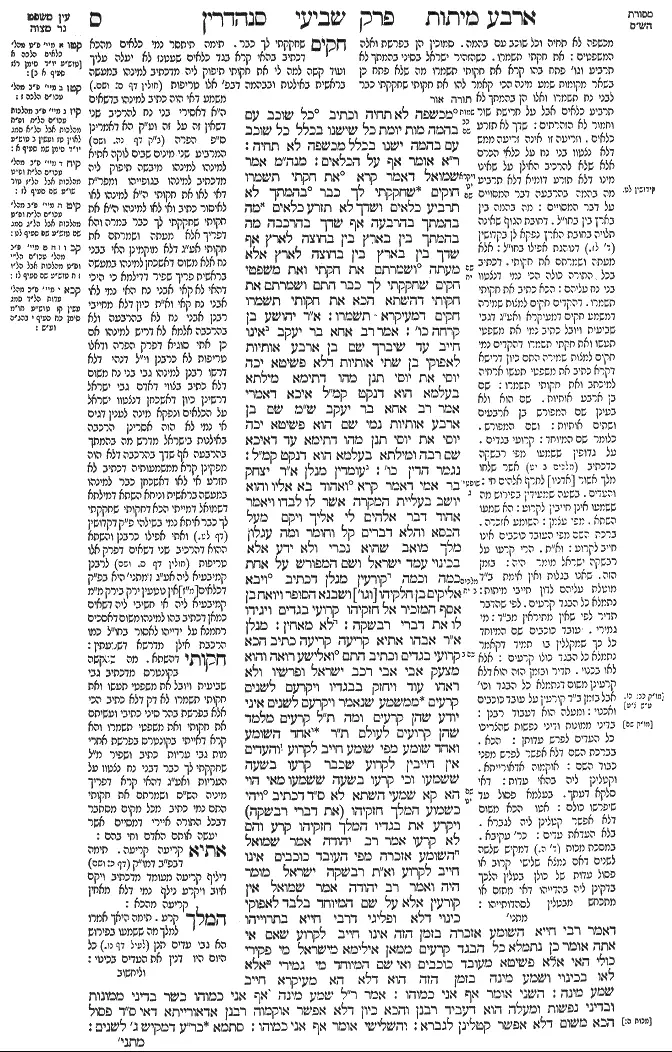
Sanhedrin 60a - Guemara
(שמות כב, יז) מכשפה לא תחיה וכתיב (שמות כב, יח) כל שוכב עם בהמה מות יומת כל שישנו בכלל כל שוכב עם בהמה ישנו בכלל מכשפה לא תחיה:
ר"א אומר אף הכלאים:
מנה"מ אמר שמואל דאמר קרא (ויקרא יט, יט) את חקתי תשמרו חוקים שחקקתי לך כבר (ויקרא יט, יט) בהמתך לא תרביע כלאים ושדך לא תזרע כלאים מה בהמתך בהרבעה אף שדך בהרכבה מה בהמתך בין בארץ בין בחוצה לארץ אף שדך בין בארץ בין בחוצה לארץ אלא מעתה (ויקרא יח, ה) ושמרתם את חקתי ואת משפטי חקים שחקקתי לך כבר התם ושמרתם את חקותי דהשתא הכא את חקותי תשמרו חקים דמעיקרא תשמרו:
א"ר יהושע בן קרחה כו':
אמר רב אחא בר יעקב אינו חייב עד שיברך שם בן ארבע אותיות לאפוקי בן שתי אותיות דלא פשיטא יכה יוסי את יוסי תנן מהו דתימא מילתא בעלמא הוא דנקט קמ"ל איכא דאמרי אמר רב אחא בר יעקב ש"מ שם בן ארבע אותיות נמי שם הוא פשיטא יכה יוסי את יוסי תנן מהו דתימא עד דאיכא שם רבה ומילתא בעלמא הוא דנקט קמ"ל:
נגמר הדין כו':
עומדין מנלן א"ר יצחק בר אמי דאמר קרא (שופטים ג, כ) ואהוד בא אליו והוא יושב בעליית המקרה אשר לו לבדו ויאמר אהוד דבר אלהים לי אליך ויקם מעל הכסא והלא דברים קל וחומר ומה עגלון מלך מואב שהוא נכרי ולא ידע אלא בכינוי עמד ישראל ושם המפורש על אחת כמה וכמה קורעין מנלן דכתיב (מלכים ב יח, לז) ויבא אליקים בן חלקיהו [וגו'] ושבנא הסופר ויואח בן אסף המזכיר אל חזקיהו קרועי בגדים ויגידו לו את דברי רבשקה:
לא מאחין:
מנלן א"ר אבהו אתיא קריעה קריעה כתיב הכא קרועי בגדים וכתיב התם (מלכים ב ב, יב) ואלישע רואה והוא מצעק אבי אבי רכב ישראל ופרשיו ולא ראהו עוד ויחזק בבגדיו ויקרעם לשנים קרעים ממשמע שנאמר ויקרעם לשנים איני יודע שהן קרעים ומה ת"ל קרעים מלמד שהן קרועים לעולם ת"ר אחד השומע ואחד שומע מפי שומע חייב לקרוע והעדים אין חייבין לקרוע שכבר קרעו בשעה ששמעו וכי קרעו בשעה ששמעו מאי הוי הא קא שמעי השתא לא ס"ד דכתיב (מלכים ב יט, א) ויהי כשמוע המלך חזקיהו (את דברי רבשקה) ויקרע את בגדיו המלך חזקיהו קרע והם לא קרעו אמר רב יהודה אמר שמואל השומע אזכרה מפי העובד כוכבים אינו חייב לקרוע וא"ת רבשקה ישראל מומר היה ואמר רב יהודה אמר שמואל אין קורעין אלא על שם המיוחד בלבד לאפוקי כינוי דלא ופליגי דרבי חייא בתרוייהו דאמר רבי חייא השומע אזכרה בזמן הזה אינו חייב לקרוע שאם אי אתה אומר כן נתמלא כל הבגד קרעים ממאן אילימא מישראל מי פקירי כולי האי אלא פשיטא מעובד כוכבים ואי שם המיוחד מי גמירי אלא לאו בכינוי ושמע מינה בזמן הזה הוא דלא הא מעיקרא חייב שמע מינה:
השני אומר אף אני כמוהו:
אמר ר"ל שמע מינה אף אני כמוהו כשר בדיני ממונות ובדיני נפשות ומעלה הוא דעביד רבנן והכא כיון דלא אפשר אוקמוה רבנן אדאורייתא דאי ס"ד פסול הכא משום דלא אפשר קטלינן לגברא:
והשלישי אומר אף אני כמוהו:
סתמא כר"ע דמקיש ג' לשנים:
Comments from Rashi on Masechet Sanhedrin Page 60a
מכשפה לא תחיה וכל שוכב עם בהמה . סמוכין הן בפרשת ואלה המשפטים: את חקתי תשמרו . כשהזהיר ישראל בסיני בהמתך לא תרביע וגו' פתח בהו קרא את חקותי תשמרו מה שלא פתח כן בשאר מקומות שמע מינה הכי קאמר להו את חקותי שחקקתי כבר לבני נח תשמרו ואלו הן בהמתך לא תרביע כלאים אבל על חרישת שור וחמור לא הזהרתים: שדך לא תזרע כלאים . וזריעה זו אינה זריעה ממש דלא נצטוו בני נח על כלאי הכרם אלא שלא להרכיב האילן על שאינו מינו דלא תזרע דומיא דלא תרביע מה בהמה בהרבעה דבר המסויים על דבר המסויים: מה בהמה בין בארץ בין בחו"ל . דחובת הגוף שאינה תלויה בחובת הארץ נפקא לן בקדושין (ד' לז.) דנוהגת אפילו בחו"ל: אלא מעתה ושמרתם את חקותי . דכתיב בכל התורה כולה הכי נמי דנצטוו בני נח עליהם: הכא כתיב את חקותי תשמרו . דהקדים חקים למצות שמירה דמשמע חקים דמעיקרא ואע"ג דגבי שביעית ויובל כתיב נמי את משפטי תעשו ואת חקתי תשמרו דהקדים נמי חקים למצות שמירה התם כיון דרישא דקרא כתיב את משפטי תעשו ארחיה למיכתב ואת חקותי תשמרו: שם בן ארבע אותיות . שם הוא ולא בעינן שם המפורש בן ארבעים ושתים אותיות: ושם המפורש . כלומר שם המיוחד: קרועי בגדים . על גדופין ששמעו מפי רבשקה כדכתיב (מלכים ב יט) אשר שלחו מלך אשור [אדניו] לחרף אלהים חי: והעדים . בשעה שמעידין בפירוש מה ששמעו אינן חייבין לקרוע: הא שמעו השתא . מפי עצמן: השומע אזכרה . ברכת השם מפי העובד כוכבים אינו חייב לקרוע: וא"ת . הרי קרעו על רבשקה ישראל מומר היה: בזמן הזה . שאנו בגלות ואין אימת ב"ד מוטלת עליהם לדון חייבי מיתות: נתמלא כל הבגד קרעים . לפי שהדבר תדיר לפי שאין מתיראין מב"ד: מי גמירי . עובד כוכבים שם המיוחד כל כך שמקללין בו תמיד דקאמר נתמלא כל הבגד כולו קרעים: אלא לאו בכנוי . תדיר ובזמן הזה הוא דלא קרעינן משום דנתמלא כל הבגד וכו' אבל בזמן ב"ד קורעין על עובד כוכבים ואכנוי: ומעלה הוא דעבוד רבנן . בדיני ממונות ודיני נפשות שהצריכו כל העדים לפרש עדותן: הכא . בברכת השם דלא אפשר לפרש מפני כבוד השם: אוקמוה אדאורייתא . וקטלינן ליה בהאי עדות: דאי סלקא דעתך . בעלמא פסול עד שיפרשו כולם: אטו הכא משום דלא אפשר קטלינן ליה לגברא . בלא העדאת עדים: כר' עקיבא . במסכת מכות (ד' ה.) דמקיש שלשה לשנים דאם נמצא שלישי קרוב או פסול עדות של כולן בטלין הלכך בדקינן ליה בהדייהו דאי מתזם או מתכחש מבטלין לסהדותייהו:
Comments from Tosafot - Sanhedrin 60a
חקים שחקקתי לך כבר . תימה תיתסר נמי כלאים מהכא דכתיב בהאי קרא בגד כלאים שעטנז לא יעלה עליך ועוד קשה למה לי. את חקותי תיפוק ליה מדכתיב למינהו במעשה בראשית באילנות ובבהמה דבפ' אלו טריפות (חולין דף ס: ושם.) משמע דאי הוה כתיב למינהו בדשאים ה"א דאסירי בני נח להרכיב שני דשאין זה על זה וע"ק הא דאמרינן ס"פ הפרה (ב"ק דף נה. ושם) המרביע שני מינים שבים לוקה אתיא למינהו למינהו מיבשה תיפוק ליה מדכתיב למינהו בגופייהו ומפר"ת דאי לאו את חקותי ה"א למינהו לאו לאיסור כתיב ואי לאו למינהו ה"א את חקותי שחקקתי לך כבר במרה והא דפריך אלא מעתה ושמרתם את חקותי אע"ג דלא מוקמינן האי בבני נח אלא משום דאשכחן למינהו במעשה בראשית פריך שפיר דדילמא כי היכי דהאי לא קאי אבני נח האי נמי לאו אבני נח קאי וא"ת כיון דלא מחייבי רבנן אבני נח לא בהרבעה ולא בהרכבה אלמא לא דריש למינהו אם כן אתי סוגיא דפרק הפרה ודאלו טריפות לא כרבנן וי"ל דנהי דלא דרשו רבנן למינהו גבי בני נח משום דלא כתיב בצווי דאדם גבי ישראל דרשינן כיון דאשכחן דנצטוו ישראל על הכלאים ונפקא מינה לענין דגים אי נמי לא הוה אסרינן הרכבה באילנות בישראל מדרש מה בהמתך בהרבעה אף שדך בהרכבה דלא הוה מפקינן קרא ממשמעותיה דכתיב לא תזרע אי לאו דאשכחן כבר למינהו במעשה בראשית וניחא השתא דמילתא דשמואל דמייתי הכא דחקותי שחקקתי לך כבר איתא נמי בשילהי פ"ק דקדושין (דף לט.) ואתי אפילו כרבנן והשתא ההוא דהרכיב שני דשאים דפרק אלו טריפות (חולין דף ס. ושם) לרבנן קמיבעיא ליה אע"ג דמתני' היא בפ"ק דכלאים [מ"ז] אין נוטעין ירק בירק מ"מ קמיבעיא ליה אי חשיבי ליה דשאים כמאן דכתיב בהו למינהו משום דאסכים רחמנא על ידייהו לאסור בחו"ל כמו הרכבת אילן מדרשא דשמעתין: חקותי דהשתא . מה שהקשה בקונטרס מדכתיב גבי שביעית ויובל את משפטי תעשו ואת חקותי תשמרו לא דק דלא כתיב הכי אלא בפרשת בהר סיני כתיבי ועשיתם את חקותי ואת משפטי תשמרו והא קרא דאייתי בקונטרס בפרשת אחרי מות גבי עריות כתיב ושפיר מ"ל שחקקתי לך כבר דבני נח נצטוו על העריות ואע"ג דהאי קרא דפריך מיניה הש"ס ושמרתם את חקותי התם נמי כתיב. מכל מקום מסתבר דבכל התורה איירי דמסיים אשר יעשה אותם האדם וחי בהם: אתיא קריעה קריעה . תימה דבפ"ב דמו"ק (דף כ: ושם) דיליף קריעה מעומד מדכתיב ויקם איוב ויקרע נילף נמי דלא מאחין קריעה מהכא: המלך קרע . תימה היאך אמרו למלך מה ששמעו בפירוש הא גבי עדים תנן (לעיל סנהדרין דף נו.) כל היום היו דנין את העדים בכינוי:
Sanhedrin 60a - Mishnah translated into english
“You shall not allow a witch to live” (Exodus 22:17), and it is written in the following verse: “Whoever lies with an animal shall be put to death” (Exodus 22:18). It is derived from here that anyone who is included in the prohibition of: “Whoever lies with an animal,” including gentiles, is included in the command: “You shall not allow a witch to live.”
The baraita teaches that Rabbi Elazar says that descendants of Noah were also commanded about the prohibition of diverse kinds. The Gemara asks: From where are these matters derived? Shmuel says: They are derived from that which the verse states: “My statutes you shall keep. You shall not breed your animal with a diverse kind; you shall not sow your field with two kinds of seed” (Leviticus 19:19). God is saying: Keep the statutes that I have already instituted for you, i.e., mitzvot that were already given to the descendants of Noah, namely, “you shall not breed your animal with a diverse kind; you shall not sow your field with two kinds of seed.”
The Gemara derives the details of this prohibition from the verse: Just as the Noahide prohibition concerning your animal applies with regard to breeding animals of different species, and not with regard to plowing with animals of two different species working together, which is prohibited only for Jews, so too, the Noahide prohibition in your field applies with regard to grafting one species onto another, which is equivalent to breeding, but it is not prohibited for gentiles to sow different seeds together. Furthermore, just as the Noahide prohibition against breeding your animal applies both in Eretz Yisrael and outside Eretz Yisrael, so too, the Noahide prohibition against grafting diverse kinds in your field applies both in Eretz Yisrael and outside Eretz Yisrael.
The Gemara asks: If that is so, that the term “My statutes” is understood as referring to mitzvot that were already given to the descendants of Noah, then the verse: “You shall therefore keep My statutes and My ordinances” (Leviticus 18:5), referring to the entire Torah, should also obligate the descendants of Noah, as it would be referring to: Statutes that I have already instituted for you.
The Gemara answers: There the verse states: “You shall therefore keep My statutes,” indicating only those statutes that I am giving you now, whereas here, in the verse concerning diverse kinds, the wording is “My statutes you shall keep,” meaning statutes that obligate you from the outset you shall keep in the future.
§ After clarifying the halakhot of the descendants of Noah, the Gemara returns to the halakhot stated in the mishna with regard to one who blasphemes. It is stated in the mishna that Rabbi Yehoshua ben Korḥa said that during a blasphemer’s trial, the judges ask the witnesses to use an appellation for the name of God so that they do not utter a curse of God’s name. Specifically, they would use the sentence: Let Yosei smite Yosei, as the name Yosei has four letters in Hebrew, like the Tetragrammaton.
Rav Aḥa bar Ya’akov says: The blasphemer is not liable unless he blesses, i.e., curses, the Tetragrammaton, the four-letter name of God, which is to the exclusion of one who curses the two-letter name of God, spelled yod heh, who is not liable.
The Gemara asks: Isn’t that obvious? We learned in the mishna that the expression used in court is let Yosei smite Yosei, which indicates a four-letter name. The Gemara answers: Lest you say that the tanna mentions this statement as a mere example but does not intend that the witnesses use the four-letter name in particular, Rav Aḥa bar Ya’akov teaches us that one is liable only for cursing the Tetragrammaton.
There are those who say that Rav Aḥa bar Ya’akov says as follows: Conclude from the mishna that the Tetragrammaton is also a name for which one is liable, and he is liable not only for cursing the forty-two-letter name of God.
The Gemara asks: Isn’t that obvious? We learned in the mishna that the expression used in court is let Yosei smite Yosei. The Gemara answers: Lest you say that one is not liable unless there is a grand name that he curses, i.e., the forty-two-letter name, and the tanna mentions this statement as a mere example, Rav Aḥa bar Ya’akov teaches us that one is liable even for cursing the Tetragrammaton, and the name Yosei is mentioned specifically.
§ The mishna teaches: When the judgment is over, and judges need to hear the exact wording of the curse so they can sentence the defendant, the eldest of the witnesses repeats the curse, and the judges rise and make a tear in their clothing.
The Gemara asks: From where do we derive that the judges must stand? Rabbi Yitzḥak bar Ami says: It is derived from that which the verse states about Eglon: “And Ehud came to him, and he was sitting by himself alone in his cool upper chamber. And Ehud said: I have a message from God [Elohim] to you. And he arose out of his seat” (Judges 3:20). And are these matters not inferred a fortiori? And if Eglon, king of Moab, who was a gentile and knew the name of God only by an appellation, stood in honor, all the more so must a Jew stand if he hears the ineffable name.
The mishna teaches that upon hearing the curse the judges each make a tear in their garments. The Gemara asks: From where do we derive this? The Gemara answers that it is derived from that which is written: “Then came Eliakim, son of Hilkiah, who was over the household, and Shebna the scribe, and Joah, son of Asaph, the recorder, to Hezekiah with torn garments, and they told him Rabshakeh’s statement” (II Kings 18:37). Apparently, since they heard the blasphemous statement of Rabshakeh they were obligated to make a tear in their garments.
It is furthermore stated that the judges do not ever fully stitch the tear together again. The Gemara asks: From where do we derive this?
Rabbi Abbahu says: It is derived by means of a verbal analogy between the tearing stated in this regard and the tearing stated with regard to Elijah’s ascendance to heaven. It is written here, with regard to those who heard Rabshakeh’s blasphemy: “With torn garments,” and it is written there: “And Elisha saw it, and he cried: My father, my father, the chariots of Israel and its horsemen. And he saw him no more, and he grabbed hold of his clothes and tore them into two pieces” (II Kings 2:12). From the meaning of that which is stated: “And tore them into two,” do I not know that they are pieces? And why must the verse state: “Pieces”? This teaches that they remain torn forever; they may never be fully stitched back together, but only partially sewn.
The Sages taught: Both one who hears the curse himself and one who hears it from the one who heard it are obligated to make a tear in their garments. But the witnesses are not obligated to make a tear when they testify, as they already made a tear when they heard it from the blasphemer himself.
The Gemara asks: And if they made a tear when they heard the curse, what of it? Aren’t they also hearing the curse now? The Gemara answers: It should not enter your mind that they are obligated to make a tear a second time, as it is written: “And it came to pass, when King Hezekiah heard the statement of Rabshakeh, that he tore his clothes” (II Kings 19:1). It can be inferred that King Hezekiah tore his clothes, but those who reported the blasphemy did not tear their clothes a second time.
§ Rav Yehuda says that Shmuel says: One who hears a mention of God’s name in a blasphemous manner from a gentile is not obligated to make a tear in his garments. And if you object and say that those who heard the blasphemy of Rabshakeh made a tear even though he was a gentile, that is not correct, as Rabshakeh was an apostate Jew.
And Rav Yehuda says that Shmuel says: One makes a tear only for hearing a curse of the ineffable name of God, to the exclusion of hearing a curse of an appellation for the name of God, for which one does not make a tear.
The Gemara notes: And Shmuel disagrees with Rav Ḥiyya with regard to two matters. As Rabbi Ḥiyya says: One who hears a mention of God’s name in a blasphemous context nowadays is not obligated to make a tear, as if you do not say so, the entire garment will be full of tears.
The Gemara clarifies: From whom does one hear these mentions of God’s name about which Rabbi Ḥiyya says that one’s entire garment would be full of tears? If we say that he hears from it a Jew, are Jews irreverent to such an extent that they demean the name of God? Rather, it is obvious that Rabbi Ḥiyya is referring to hearing it from a gentile. And if you say that the reference is to cursing the ineffable name, have the gentiles learned it? They have no knowledge of his name. Rather, is it not referring to cursing by an appellation of God’s name?
And conclude from it that it is specifically nowadays that, according to Rav Ḥiyya, one is not obligated to make a tear in his garment when hearing the curse of a gentile and when hearing a curse of God that referred to God with an appellation, but initially, when the fundamental halakha was practiced, one was obligated to make a tear in these cases, contrary to the opinion of Shmuel. The Gemara affirms: Indeed, conclude from it that this is so.
§ The mishna teaches that after the eldest witness states the exact wording of the curse, the second witness does not repeat it, but he says: I too heard as he did. Reish Lakish says: Conclude from it that saying: I too heard as he did, is valid testimony by Torah law, both in cases of monetary law and in cases of capital law. And the requirement that every witness must relate his testimony separately is a higher standard that the Sages instituted, and here, since it is not possible to fulfill this requirement, as it is not appropriate for a blasphemous statement to be repeated several times, the Sages established the matter according to Torah law and did not require that every witness repeat the curse.
As if it enters your mind that saying: I too heard as he did, is not valid testimony by Torah law, here, in the case of blasphemy, would we execute the man without full testimony because it is not possible to allow the repetition of blasphemy? Clearly, such testimony is valid by Torah law.
The mishna teaches: And the third witness says: I too heard as he did. The Gemara comments: The unattributed tanna of the mishna holds in accordance with the opinion of Rabbi Akiva, who compares three witnesses to two. Rabbi Akiva maintains that just as in a case where there are two witnesses, the disqualification of one disqualifies all of the testimony, so too, even if there are three witnesses, and one of the three is disqualified, all of the testimony is disqualified. Similarly, here too he holds that if there are three witnesses, each of them must testify concerning the curse.
Traduction : The William Davidson digital edition of the Koren Noé Talmud, with commentary by Rabbi Adin Even-Israel Steinsaltz.