 Talmud Bavli
The learning on the whole site is dedicated : L'ilui Nishmat יוסף בן מושה
The learning on the whole site is dedicated : L'ilui Nishmat Margalit bat Ledicia
The learning on the whole site is dedicated : L'ilui Nishmat אסתר בת חיים
Sanhedrin 64a : Youtube
Daf TubeYoutube
2 video classes :
Sanhedrin Page 64a
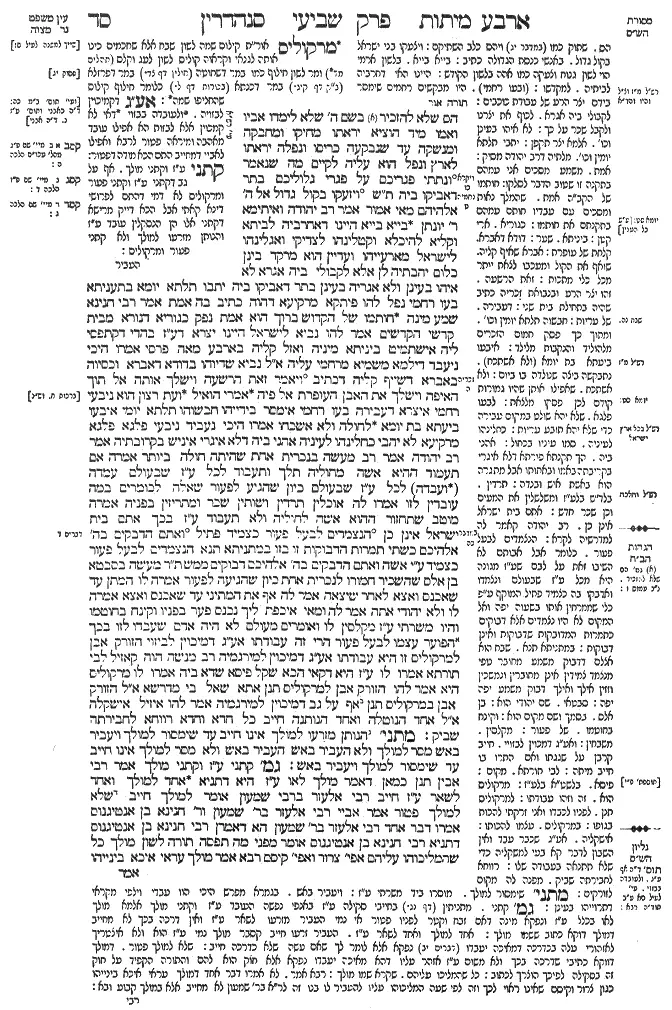
Sanhedrin 64a - Guemara
הס שלא להזכיר בשם ה' שלא לימדו אביו ואמו מיד הוציא יראתו מחיקו ומחבקה ומנשקה עד שנבקעה כריסו ונפלה יראתו לארץ ונפל הוא עליה לקיים מה שנאמר (ויקרא כו, ד) ונתתי פגריכם על פגרי גלוליכם בתר דאביקו ביה ת"ש (נחמיה ט, ד) ויזעקו בקול גדול אל ה' אלהיהם מאי אמור אמר רב יהודה ואיתימא ר' יונתן בייא בייא היינו דאחרביה לביתא וקליא להיכלא וקטלינהו לצדיקי ואגלינהו לישראל מארעייהו ועדיין הוא מרקד בינן כלום יהבתיה לן אלא לקבולי ביה אגרא לא איהו בעינן ולא אגריה בעינן בתר דאביקו ביה יתבו תלתא יומא בתעניתא בעו רחמי נפל להו פיתקא מרקיעא דהוה כתיב בה אמת אמר רבי חנינא שמע מינה חותמו של הקדוש ברוך הוא אמת נפק כגוריא דנורא מבית קדשי הקדשים אמר להו נביא לישראל היינו יצרא דע"ז בהדי דקתפסי ליה אישתמיט ביניתא מיניה ואזל קליה בארבע מאה פרסי אמרו היכי ניעבד דילמא משמיא מרחמי עליה א"ל נביא שדיוהו בדודא דאברא וכסיוה באברא דשייף קליה דכתיב (זכריה ה, ח) ויאמר זאת הרשעה וישלך אותה אל תוך האיפה וישלך את האבן העופרת אל פיה אמרי הואיל ועת רצון הוא ניבעי רחמי איצרא דעבירה בעו רחמי אימסר בידייהו חבשוהו תלתא יומי איבעו ביעתא בת יומא לחולה ולא אשכחו אמרו היכי נעביד ניבעי פלגא פלגא מרקיעא לא יהבי כחלינהו לעיניה אהני ביה דלא איגרי איניש בקרובתיה אמר רב יהודה אמר רב מעשה בנכרית אחת שהיתה חולה ביותר אמרה תעמוד ההיא אשה מחוליה תלך ותעבוד לכל ע"ז שבעולם עמדה (ועבדה) לכל ע"ז שבעולם כיון שהגיע לפעור שאלה לכומרים במה עובדין לזו אמרו לה אוכלין תרדין ושותין שכר ומתריזין בפניה אמרה מוטב שתחזור ההוא אשה לחוליה ולא תעבוד ע"ז בכך אתם בית ישראל אינן כן (במדבר כה, ה) הנצמדים לבעל פעור כצמיד פתיל (דברים ד, ד) ואתם הדבקים בה' אלהיכם כשתי תמרות הדבוקות זו בזו במתניתא תנא הנצמדים לבעל פעור כצמיד ע"י אשה ואתם הדבקים בה' אלהיכם דבוקים ממש ת"ר מעשה בסבטא בן אלס שהשכיר חמורו לנכרית אחת כיון שהגיעה לפעור אמרה לו המתן עד שאכנס ואצא לאחר שיצאה אמר לה אף את המתיני עד שאכנס ואצא אמרה לו ולא יהודי אתה אמר לה ומאי איכפת ליך נכנס פער בפניו וקינח בחוטמו והיו משרתי ע"ז מקלסין לו ואומרים מעולם לא היה אדם שעבדו לזו בכך הפוער עצמו לבעל פעור הרי זה עבודתו אע"ג דמיכוין לביזוי הזורק אבן למרקוליס זו היא עבודתו אע"ג דמיכוין למירגמיה רב מנשה הוה קאזיל לבי תורתא אמרו לו ע"ז היא דקאי הכא שקל פיסא שדא ביה אמרו לו מרקוליס היא אמר להו הזורק אבן למרקוליס תנן אתא שאל בי מדרשא א"ל הזורק אבן במרקוליס תנן אף על גב דמיכוין למירגמיה אמר להו איזיל אישקלה א"ל אחד הנוטלה ואחד הנותנה חייב כל חדא וחדא רווחא לחבירתה שביק:
מתני׳ הנותן מזרעו למולך אינו חייב עד שימסור למולך ויעביר באש מסר למולך ולא העביר באש העביר באש ולא מסר למולך אינו חייב עד שימסור למולך ויעביר באש:
גמ׳ קתני ע"ז וקתני מולך אמר רבי אבין תנן כמאן דאמר מולך לאו ע"ז היא דתניא אחד למולך ואחד לשאר ע"ז חייב רבי אלעזר ברבי שמעון אומר למולך חייב שלא למולך פטור אמר אביי רבי אלעזר בר' שמעון ור' חנינא בן אנטיגנוס אמרו דבר אחד רבי אלעזר בר' שמעון הא דאמרן רבי חנינא בן אנטיגנוס דתניא רבי חנינא בן אנטיגנוס אומר מפני מה תפסה תורה לשון מולך כל שהמליכוהו עליהם אפי' צרור ואפי' קיסם רבא אמר מולך עראי איכא בינייהו
Comments from Rashi on Masechet Sanhedrin Page 64a
הס . שתוק כמו (במדבר יג) ויהס כלב השתיקם: ויצעקו בני ישראל בקול גדול . באנשי כנסת הגדולה כתיב: בייא בייא . בלשון ארמי הוי לשון גנוח וצעקה כמו אהה בלשון הקודש: היינו האי דחרביה לביתיה . למקדשו: לקבולי ביה אגרא . לכוף את יצרנו ולקבל שכר על כך: לא איהו בעינן וכו' . אלמא יצר תקפן: יתבי תלתא יומין וכו' . מלתיה דרב יהודה מסיק: (ובעו רחמי) . היו מבקשים רחמים שימסר בידם יצר הרע של עבודת כוכבים: אמת . משמע מסכים אני עמהם בתקנה זו שטוב הדבר לסלקו: חותמו של הקב"ה אמת . שהמלך נאות ומסכים עם עבדיו חותם עמהם בתקנתם את חותמו: כגוריא . ארי קטן: ביניתא . שער: דודא דאברא . קלחת של עופרת: אברא שאיף קליה . שואף את הקול ומעכבו לצאת יותר מכל כלי מתכות: זאת הרשעה . זהו יצר הרע ובנבואת זכריה כתיב שהיה בתחילת בית שני: דעבירה . של עריות: חבשוה תלתא יומין וכו' . ומתוך כך פסק חמום הזכרים מלהוליד והנקבות מלילד: איבעו ביעתא בת יומא (ולא אשתכח) . נתבקשה ביצה שנולדה בו ביום: ולא אשתכח . שאפילו אותן שהיו גמורות קודם לכן פסקו מלצאת: לבעו פלגא . שלא יהא שולט במקום עבירה כדי שלא יהא תובע עריות: כחלינהו לעיניה . סמו עיניו בכחול: אהני ביה . הך תקנתא פורתא דלא איגרי בקריבתה באמו ובאחותו אבל מתגרה הוא באשת איש ובנדה: תרדין . בלד"ש בלע"ז ומשלשלין את המעים וכן שכר חדש: אתם בית ישראל אינן כן . רב יהודה קאמר לה למדרשיה לקרא: הנצמדים לבעל פעור . כלומר אבל אבותם לא השיבו זאת על לבם שע"ז מגונה היא מכל ע"ז שבעולם ונצמדו ואדבקו בה כצמיד פתיל המוקף ע"פ כלי שממרחין אותו בשעוה יפה ואל המקום לא היו נצמדים אלא דבוקים כתמרות המדובקות שדבוקות ואינן דבוקות: במתניתא תנא . שבח הוא אצלם דדבוק משמע מחובר טפי מנצמד צמידין אינן מחוברין ונמשכין וזזין אילך ואילך דבוק משמע יפה יפה: סבטאי . שם יהודי הוא: בן אלס . בסמך ושם מקום הוא: וקינח בחוטמו . של פעור: מקלסין . משבחין: ואע"ג דמכוין לבזויי . חייב קרבן על שגגתו ואם התרו בו חייב מיתה: לבי תורתא . מקום: פיסא . בלשט"א בלע"ז: מרקוליס הוא . זה וזהו עבודתו: למרקוליס תנן . לפניו לכבדו ואני זרקתי להכות בגופו: במרקוליס . עצמו להכותו: אישקליה . אע"ג שכבר עבד ואין השבון לדבר קא בעי למשקליה כדי שלא תתנאה בעבודה שלו: רווחא לחבירתה שביק . מפנה לה מקום לזורקים: מתני' שימסור למולך . מוסרו ביד משרתי ע"ז: ויעביר באש . בגמרא מפרש היכי הוו עבדי וילפי מקראי דתרוייהו בעינן: גמ' קתני . מתניתין (דף נג.) בחייבי סקילה ע"ז באנפי נפשה העובד ע"ז וקתני מולך אלמא מולך לאו בכלל ע"ז ונפקא מינה דאם זבח וקטר לפניו פטור אי נמי העביר מזרעו לשאר ע"ז ואין דרכה בכך לא מחייב דמולך דוקא כתוב ששמו מולך: אחד למולך ואחד לשאר ע"ז . העביר זרעו חייב קסבר מולך נמי ע"ז הוא ולא איצטריך לאזהורי עלה בכדרכה דמאיכה יעבדו (דברים יב) נפקא אלא לומר לך שאם עשה שלא כדרכה חייב: שלא למולך פטור . דמולך דווקא כתיבי שדרכה בכך ולא משום ע"ז אזהר עליו דהא מאיכה יעבדו נפקא אלא חוק הוא להם והתורה הקפיד על חוק זה בסקילה לפיכך הוצרך לכתוב: כל שהמליכו עליהם . שקרא שמו מולך: רבא אמר . לא אמרו דבר אחד דמולך עראי איכא בינייהו כגון צרור וקיסם שאינו ראוי לכך וזה לפי שעה המליכוהו עליו להעביר לו בנו זה לר"א בר' שמעון לא מחייב אלא במולך קבוע ובא:
Comments from Tosafot - Sanhedrin 64a
אע"ג דקמיכוין לבזויה . ולעובדה בבזוי דאי לא קמכוין אלא לבזות הא אפילו עובד מאהבה ומיראה פטור לרבא ואפילו לאביי דמחייב התם הכא מודה דפטור: מרקוליס . אור"ת קילוס שמה לשון שבח אלא שחכמים כינו אותה לגנאי וקראוה קוליס לשון לעג וקלס (תהלים מד) ומר לשון חילוף כמו במר דשחוטה (חולין דף צד.) במר דפרזלא (ב"ק דף קיג.) במר דכנתא (בכורות דף ל.) כלומר חילוף קילוס שהחליפו שמה: קתני ע"ז וקתני מולך . אף על גב דקתני ע"ז וקתני פעור ומרקוליס לא דמי דהתם לפרושי דינא קאתי אבל הכא דייק מרישא דקתני אלו הן הנסקלין עובד ע"ז והנותן מזרעו למולך ולא קתני פעור ומרקוליס:
Sanhedrin 64a - Mishnah translated into english
Hush, so as not to mention the name of the Lord (see Amos 6:10). The child did not want to even hear the mention of the name of the Lord, which his father and his mother did not teach him.
Immediately, the child removed his god from his bosom and began hugging it and kissing it, until his stomach burst from hunger, and his god fell to the earth and he fell upon it, in fulfillment of that which is stated: “And I shall cast your carcasses upon the carcasses of your idols” (Leviticus 26:30). This incident demonstrates that the Jewish people engaged in idol worship for its own sake. The Gemara answers: This also occurred after the Jewish people became attached to idol worship.
The Gemara suggests: Come and hear another proof, from the verse: “And they cried in a loud voice to the Lord their God” (Nehemiah 9:4). What did they say in that prayer? Rav Yehuda says, and some say it is Rav Yonatan who says: Woe, woe [baya, baya], this evil inclination for idol worship is what destroyed the Temple, and burned the Sanctuary, and murdered the righteous ones, and caused the Jewish people to be exiled from their land. And it still dances among us, i.e., it still affects us. Didn’t You give it to us solely for the purpose of our receiving reward for overcoming it? We do not want it, nor do we not want its reward. Evidently, the Jewish people were drawn to idol worship itself, and they did not worship idols only in order to engage in forbidden sexual relations. The Gemara answers: This also occurred after the Jewish people became attached to idol worship.
The Gemara continues to relate the story of the prayer in the days of Nehemiah: The people fasted for three days and prayed for mercy. In response to their prayer a note fell for them from the heavens in which was written: Truth, indicating that God accepted their request.
The Gemara makes a parenthetical observation. Rabbi Ḥanina says: Conclude from it that the seal of the Holy One, Blessed be He, is truth.
The form of a fiery lion cub came forth from the chamber of the Holy of Holies. Zechariah, the prophet, said to the Jewish people: This is the evil inclination for idol worship. When they caught hold of it one of its hairs fell out, and it let out a shriek of pain that was heard for four hundred parasangs [parsei]. They said: What should we do to kill it? Perhaps Heaven will have mercy upon it if we attempt to kill it, as it will certainly scream even more.
The prophet said to them: Throw it into a container made of lead and cover it with lead, as lead absorbs sound. As it is written: “And he said: This is the evil one. And he cast it down into the midst of the measure, and he cast a stone of lead upon its opening” (Zechariah 5:8). They followed this advice and were freed of the evil inclination for idol worship.
When they saw that the evil inclination for idol worship was delivered into their hands as they requested, the Sages said: Since it is an auspicious time, let us pray for mercy concerning the evil inclination for sin concerning sexual matters. They prayed for mercy, and it was also delivered into their hands.
The Sages imprisoned it for three days. At that time, people searched for a one-day-old fresh egg for the sick but could not find one. Since the inclination to reproduce was quashed, the chickens stopped laying eggs. They said: What should we do? If we pray for half, i.e., that only half its power be annulled, nothing will be achieved, because Heaven does not grant half gifts, only whole gifts. What did they do? They gouged out its eyes, and this was effective in limiting it to the extent that a person is no longer aroused to commit incest with his close relatives.
§ Rav Yehuda says that Rav says: An incident occurred involving a certain gentile woman who was very ill. She said: If that woman, referring to herself, recovers from her illness, she will go and worship every object of idol worship in the world. She recovered from her illness and subsequently worshipped every object of idol worship in the world. When she arrived at Peor she asked the priests: How does one worship this idol? They said to her: One eats spinach, which causes diarrhea, and drinks beer, which also causes diarrhea, and defecates before it. The woman said: Better for that woman, referring to herself, to return to her illness, and not worship an idol in such a manner.
Rav Yehuda adds: You, the house of Israel, are not like that woman who could not bear the repulsiveness of Ba’al-Peor. It is stated with regard to the attitude of the Jewish people toward idol worship: “That have attached themselves [hanitzmadim] to Ba’al-Peor” (Numbers 25:5), indicating a tight attachment, like a tightly bound cover [ketzamid patil] tied firmly onto a vessel. Yet with regard to the attitude of the Jewish people toward God it is stated: “But you who did cleave [hadevekim] to the Lord your God” (Deuteronomy 4:4), i.e., the connection between the Jewish people and God is like two dates that are lightly attached [hadevukot] to one another but are not tightly pressed together.
This comparison was taught in a baraita but with the opposite conclusion: “That have attached themselves [hanitzmadim] to Ba’al-Peor” indicates a connection that is like a bracelet [ketzamid] on a woman’s arm, which is worn loosely. “But you who did cleave to the Lord your God” means they actually adhered to one another, i.e., there was a tight connection.
The Gemara relates another incident with regard to Ba’al-Peor. The Sages taught: There was an incident involving a Jew named Sabbeta ben Alas, who rented out his donkey and his services to a certain gentile woman. He was driving his donkey behind her, and when she arrived at Peor, she said to him: Wait here until I go in and come out. After she came out, he said to her: You too wait for me until I go in and come out. She said to him: Aren’t you Jewish? Why, then, are you worshipping idols? He said to her: And what do you care? He entered and defecated before the idol, and wiped himself with its nostril, as he wanted to demean the idol as much as possible. But he was unsuccessful, as the priests of Peor were praising him and saying: No person has ever worshipped it before with this excellent form of worship. Although he intended to demean Ba’al-Peor, he actually worshipped it.
The halakha is that one who defecates before Ba’al-Peor is obligated to bring a sin-offering to atone for idol worship, as this is its typical form of worship, even if he intends to demean the idol. Likewise, one who throws a stone at Mercury is obligated to bring a sin-offering to atone for idol worship, as this is its typical form of worship, even if he intends to stone it.
The Gemara relates: Rav Menashe was going to a place called Bei Torta. The people there said to him: There is an object of idol worship situated here in this pile of stones. Rav Menashe picked up a stone and threw it at the idol to demean it. They said to him: It is Mercury, and it is worshipped by throwing stones at it. Rav Menashe said to them: We learned in the mishna that one who throws a stone at Mercury as a manner of worship is liable, whereas I intended to demean it.
Rav Menashe went and asked the Sages in the study hall whether his interpretation of the mishna was correct. They said to him: We learned in the mishna that one who throws a stone at Mercury is liable, which implies that he is liable even if he intends to stone it in order to demean it. Rav Menashe said to the Sages: If so, I will go and take back the stone I threw. They said to him: Both one who removes it and one who places it is liable, as each and every one of the stones taken away from Mercury leaves space for another stone. Taking a stone away from Mercury provides a place for other stones to be thrown at it.
MISHNA: One who gives of his offspring to Molekh, for which one is executed by stoning, is not liable unless he hands over his child to the priests of Molekh and passes the child through the fire. If he handed over the child to the priests of Molekh but did not pass him through the fire, or if he passed him through the fire but did not hand him over to the priests of Molekh, he is not liable, unless he hands the child over to the priests of Molekh and passes him through the fire.
GEMARA: The halakhot of one’s liability for idol worship are taught in the mishna above (60b), and the halakhot of one’s liability for the worship of Molekh are taught separately, in this mishna. Therefore, Rabbi Avin says: We learn this mishna according to the opinion of the one who says that the ritual of Molekh is not idol worship but is a form of witchcraft or superstition, as a dispute over this matter is taught in a baraita: Both one who transfers his child to the priests of Molekh and one who transfers his child for the purpose of worshipping other idols are liable. Molekh is cited merely as an example. Rabbi Elazar, son of Rabbi Shimon, says: One who transfers his child to the priests of Molekh is liable, but if he transfers him to another object of idol worship, not to Molekh, he is exempt.
Abaye says: Rabbi Elazar, son of Rabbi Shimon, and Rabbi Ḥanina ben Antigonus said the same thing, i.e., they share the same halakhic opinion. The statement of Rabbi Elazar, son of Rabbi Shimon, is that which we said. Rabbi Ḥanina ben Antigonus shares the same opinion, as it is taught in a baraita that Rabbi Ḥanina ben Antigonus says: For what reason does the Torah use the term Molekh? It is to indicate that if one passes his child through fire in the worship of any object that people enthroned [shehimlikhuhu] over them as their king, referring to it as Molekh, he is liable, even if it is merely a pebble, or even a toothpick. The baraita indicates that one who passes his child through fire in worship of an item that is not referred to as Molekh is not liable, in accordance with the opinion of Rabbi Elazar, son of Rabbi Shimon.
Rava says: They do not share the same opinion, as there is a practical difference between their opinions in a case of a temporary Molekh. According to Rabbi Elazar, son of Rabbi Shimon, one is liable for passing his child through fire only if it is in worship of a permanent Molekh, whereas according to Rabbi Ḥanina ben Antigonus, one is liable for worshipping even a temporary Molekh.
Traduction : The William Davidson digital edition of the Koren Noé Talmud, with commentary by Rabbi Adin Even-Israel Steinsaltz.