 Talmud Bavli
The learning on the whole site is dedicated : L'ilui Nishmat Amram ben Itshak Loubaton
The learning on the whole site is dedicated : L'ilui Nishmat Margalit bat Ledicia
The learning on the whole site is dedicated : L'ilui Nishmat אליעזר בן רחל
Sanhedrin 75a : Youtube
Daf TubeYoutube
2 video classes :
Sanhedrin Page 75a
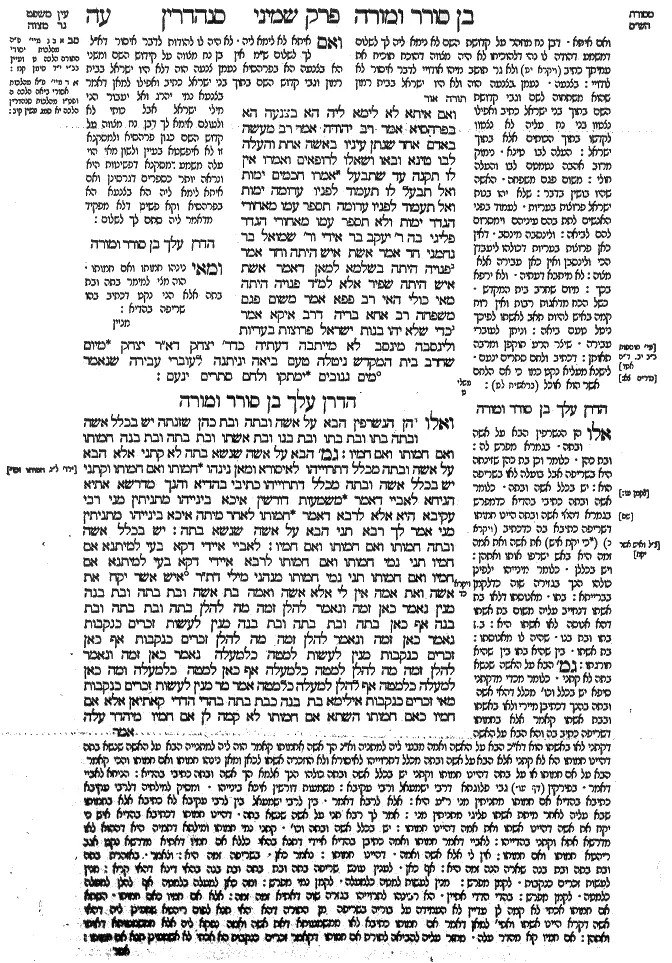
Sanhedrin 75a - Guemara
ואם איתא לא לימא ליה הא בצנעה הא בפרהסיא אמר רב יהודה אמר רב מעשה באדם אחד שנתן עיניו באשה אחת והעלה לבו טינא ובאו ושאלו לרופאים ואמרו אין לו תקנה עד שתבעל אמרו חכמים ימות ואל תבעל לו תעמוד לפניו ערומה ימות ואל תעמוד לפניו ערומה תספר עמו מאחורי הגדר ימות ולא תספר עמו מאחורי הגדר פליגי בה ר' יעקב בר אידי ור' שמואל בר נחמני חד אמר אשת איש היתה וחד אמר פנויה היתה בשלמא למאן דאמר אשת איש היתה שפיר אלא למ"ד פנויה היתה מאי כולי האי רב פפא אמר משום פגם משפחה רב אחא בריה דרב איקא אמר כדי שלא יהו בנות ישראל פרוצות בעריות ולינסבה מינסב לא מייתבה דעתיה כדר' יצחק דא"ר יצחק מיום שחרב בית המקדש ניטלה טעם ביאה וניתנה לעוברי עבירה שנאמר (משלי ט, יז) מים גנובים ימתקו ולחם סתרים ינעם:
הדרן עלך בן סורר ומורה
מתני׳ ואלו הן הנשרפין הבא על אשה ובתה ובת כהן שזנתה יש בכלל אשה ובתה בתו ובת בתו ובת בנו ובת אשתו ובת בתה ובת בנה חמותו ואם חמותו ואם חמיו:
גמ׳ הבא על אשה שנשא בתה לא קתני אלא הבא על אשה ובתה מכלל דתרוייהו לאיסורא ומאן נינהו חמותו ואם חמותו וקתני יש בכלל אשה ובתה מכלל דתרוייהו כתיבי בהדיא והנך מדרשא אתיא הניחא לאביי דאמר משמעות דורשין איכא בינייהו מתניתין מני רבי עקיבא היא אלא לרבא דאמר חמותו לאחר מיתה איכא בינייהו מתניתין מני אמר לך רבא תני הבא על אשה שנשא בתה:
יש בכלל אשה ובתה חמותו ואם חמותו ואם חמיו:
לאביי איידי דקא בעי למיתנא אם חמיו תני נמי חמותו ואם חמותו לרבא איידי דקא בעי למיתנא אם חמיו ואם חמותו תני נמי חמותו מנהני מילי דת"ר (ויקרא כ, יד) איש אשר יקח את אשה ואת אמה אין לי אלא אשה ואמה בת אשה ובת בתה ובת בנה מנין נאמר כאן זמה ונאמר להלן זמה מה להלן בתה ובת בתה ובת בנה אף כאן בתה ובת בתה ובת בנה מנין לעשות זכרים כנקבות נאמר כאן זמה ונאמר להלן זמה מה להלן זכרים כנקבות אף כאן זכרים כנקבות מנין לעשות למטה כלמעלה נאמר כאן זמה ונאמר להלן זמה מה להלן למטה כלמעלה אף כאן למטה כלמעלה ומה כאן למעלה כלמטה אף להלן למעלה כלמטה אמר מר מנין לעשות זכרים כנקבות מאי זכרים כנקבות אילימא בת בנה כבת בתה בהדי הדדי קאתיאן אלא אם חמיו כאם חמותו השתא אם חמותו לא קמה לן אם חמיו מיהדר עלה
Comments from Rashi on Masechet Sanhedrin Page 75a
ואם איתא . דבן נח מוזהר על קדושת השם לא נימא ליה לך לשלום דמשמע דהודה לו נהי דלהוכיחו לא היה מצווה דהוכח תוכיח את עמיתך כתיב (ויקרא יט) ולא גר תושב מיהו אודויי לדבר איסור לא לודויי: בצנעה . נעמן בצנעה הוה ולא היו ישראל בבית רמון שהוא משתחוה לשם וגבי קדושת השם בתוך בני ישראל כתיב ואפילו נצטוו בני נח עליה לא נצטוו לקדשו בתוך הכותים אלא בתוך ישראל: העלה לבו טינא . נימוק מרוב אהבה נטמטם לבו והעלה חולי: משום פגם . משפחת האשה שהיו בושין בדבר: שלא יהו בנות ישראל פרוצות בעריות . לעמוד בפני האנשים לתת בהם עיניהם וימסרום להם לביאה: ולינסבה מינסב . דאין כאן פרוצות בעריות דכולהו ליעבדן הכי ולינסבן ואין כאן עבירה אלא מצוה: לא מיתבא דעתיה . ולא ירפא בכך: מיום שחרב בית המקדש . כשל הכח מדאגות רבות ואין רוח קמה באיש להיות תאב לאשתו לפיכך ניטל טעם ביאה: וניתן לעוברי עבירה . שיצר הרע תוקפן ומרבה תאותן: דכתיב ולחם סתרים ינעם . לישנא מעליא נקט כמו כי אם הלחם אשר הוא אוכל (בראשית לט): מתני' מתני' אלו הן הנשרפין הבא על אשה ובתה . בגמרא מפרש לה: ובת כהן . כלומר וכן בת כהן שזינתה היא בשריפה אבל בועלה לאו בשריפה הוא: יש בכלל אשה ובתה . כלומר אשה ובתה כתיבי בהדיא כדמפרש בגמרא דהאי אשה ובתה היינו חמותו דשריפה כתיבא בה כדכתיב (ויקרא כ) (כי יקח איש) את אשה ואת אמה זמה היא באש ישרפו אותו ואתהן: ויש בכללן . כלומר מינייהו ילפינן כולהו הנך בגזירה שוה כדלקמן בברייתא: בתו . מאנוסתו דלאו בת אשתו דנחייב עליה משום בת אשתו דהא אנוסה לאו אשתו היא: בת בתו ובת בנו . שהיה לו מאנוסתו: בת אשתו . בין שהיא בתו בין שהיא חורגתו: גמ' הבא על האשה שנשא בתה לא קתני . כלומר מכדי מדקתני סיפא יש בכלל וכו' מכלל דהאי אשה ובתה בהנך דכתיבן מיירי ולאו באשתו ובבת אשתו קאמר אלא בחמותו דשריפה כתיב בה והא הבא על האשה דקתני לאו באשתו הוא דא"כ הבא על האשה ואמה מבעי ליה למתניה וא"נ הך אשה אחמותו קאמר הוה ליה למתנייה הבא על האשה שנשא בתה דהיינו חמותו הא לא קתני אלא הבא על אשה ובתה מכלל דתרוייהו לאיסורא ולא הוזכרה אשתו לכאן ומאן נינהו חמותו ואם חמותו והכי קאמר הבא על אם חמותו או על בתה דהיינו חמותו וקתני יש בכלל אשה ובתה כולהו הנך אלמא הך אשה ובתה כתיבי בהדיא: הניחא לאביי דאמר . בפירקין (דף עו:) גבי פלוגתא דרבי ישמעאל ורבי עקיבא: משמעות דורשין איכא בינייהו . ומסיק למילתיה דלרבי עקיבא כתיבא בהדיא אם חמותו מתניתין מני ר"ע היא: אלא לרבא דאמר . בין לרבי ישמעאל בין לרבי עקיבא לא כתיבא אלא בחמותו שבא עליה לאחר מיתת אשתו פליגי מתניתין מני: אמר לך רבא תני על אשה שנשא בתה . דהיינו חמותו דכתיבא בהדיא איש כי יקח את אשה דהיינו אשתו ואת אמה דהיינו חמותו: יש בכלל אשה ובתה וכו' . קתני נמי חמותו ומילתא דתמיה היא דההוא לאו מדרשא אתא וקתני בהדייהו: לאביי . דאמר חמותו ואמה כתיבן בהדיא איידי דתנא בהאי כללא אם חמיו דאתיא מדרשא נקט אגב ריהטא חמותו ואם חמותו: אין לי אלא אשה ואמה . דהיינו חמותו: נאמר כאן . בשריפה זמה היא: ונאמר . באזהרת בתה ובת בתה ובת בנה שארה הנה זמה היא: אף כאן . לענין עונש שריפה בתה ובת בתה ובת בנה בהאי דינא דהאי קרא: מנין לעשות זכרים כנקבות . לקמן מפרש: מנין לעשות למטה כלמעלה . לקמן נמי מפרש: ומה כאן למעלה כלמטה אף להלן למעלה כלמטה . לקמן מפרש: בהדי הדדי אתיין . הא רבינהו לתרוייהו בגזרה שוה דאתיא זמה זמה: אלא אם חמיו כאם חמותו השתא אם חמותו אכתי לא קמה לן . עדיין לא העמידה על בוריה בשריפה מן התורה דהא האי תנא לפום ריהטא שמעינן ליה דהאי אשה דקרא היינו אשתו ואפי' למאן דאמר אם חמותו כתיבא לאו ממשמעותא דאת אשה ואמה נפקא ליה אלא ממשמעותא דאותו ואתהן: אם חמיו קא מהדר עלה . מחזר עליה להביאה לתורת אם חמותו דקאמר זכרים כנקבות הא אכתי לא אשמעינן תנא אם חמותו:
Comments from Tosafot - Sanhedrin 75a
ואם איתא לא לימא ליה . לא היה לו להודות לדבר איסור דא"ל לך לשלום ש"מ אין בן נח מצווה על קידוש השם ומשני הא בצנעה הא בפרהסיא נעמן צנעה הוה דלא היו ישראל בבית רמון וגבי קדוש השם בתוך בני ישראל כתיב ואפילו למאן דאמר בצנעא נמי יהרג ואל יעבור הני מילי ישראל אבל כותי לא ולעולם אימא לך דבן נח מצווה על קדוש השם כגון פרהסיא ולמסקנא זו לא איפשטא בעיין ולשון מאי הוי עלה משמע דמסקנא דפשיטות היא ונראה יותר כספרים דגרסינן ואם איתא לימא ליה הא בצנעא הא בפרהסיא וקא פשיט דלא מפקיד מדאמר ליה סתם לך לשלום: ומאי נינהו חמותו ואם חמותו . הוה מצי למימר בתה ובת בתה אלא הני נקט דכתיב בהו שריפה בהדיא:
Sanhedrin 75a - Mishnah translated into english
And if it is so that a descendant of Noah is commanded about the sanctification of God’s name, he should not have said to him: “Go in peace.” The Gemara answers: This situation, where Elisha permitted Naaman’s conduct, happened in private. When Naaman bowed down in the house of Rimmon, he did not do so in the presence of ten Jews. Whereas that question that was raised is whether or not a descendant of Noah must sanctify God’s name in public, in the presence of ten Jews. Consequently, the question remains without a solution.
§ Apropos the discussion of the obligation to allow oneself to be killed rather than engage in forbidden sexual intercourse, the Gemara notes that Rav Yehuda says that Rav says: There was an incident involving a certain man who set his eyes upon a certain woman and passion rose in his heart, to the point that he became deathly ill. And they came and asked doctors what was to be done with him. And the doctors said: He will have no cure until she engages in sexual intercourse with him. The Sages said: Let him die, and she may not engage in sexual intercourse with him. The doctors said: She should at least stand naked before him. The Sages said: Let him die, and she may not stand naked before him. The doctors suggested: The woman should at least converse with him behind a fence in a secluded area, so that he should derive a small amount of pleasure from the encounter. The Sages insisted: Let him die, and she may not converse with him behind a fence.
The Gemara comments: Rabbi Ya’akov bar Idi and Rabbi Shmuel bar Naḥmani disagree about this issue. One of them says: The woman in question was a married woman, and the other one says: She was unmarried. The Gemara tries to clarify the issue: Granted, according to the one who says that she was a married woman, the matter is properly understood. Since the case involved a severely prohibited forbidden relationship, the Sages did not allow any activity hinting at intimacy. But according to the one who says that she was unmarried, what is the reason for all this opposition? Why did the Sages say that the man must be allowed to die, rather than have the woman do as was requested?
Rav Pappa says: This is due to the potential family flaw, i.e., harm to the family name, as it is not permitted to bring disgrace to the entire family in order to save the lovesick man. Rav Aḥa, son of Rav Ika, says: This is so that the daughters of Israel should not be promiscuous with regard to forbidden sexual relations. Were they to listen to the doctors’ recommendations, Jewish women might lose moral restraint.
The Gemara asks: But if the woman was unmarried, let the man marry her. The Gemara answers: His mind would not have been eased by marriage, in accordance with the statement of Rabbi Yitzḥak. As Rabbi Yitzḥak says: Since the day the Temple was destroyed, sexual pleasure was taken away from those who engage in permitted intercourse and given to transgressors, as it is stated: “Stolen waters are sweet, and bread eaten in secret is pleasant” (Proverbs 9:17). Therefore, the man could have been cured only by engaging in illicit sexual interaction.
MISHNA: And these are the transgressors who are burned in the implementation of the court-imposed death penalty: One who engaged in intercourse with a woman and her daughter, and one who is the daughter of a priest and who committed adultery.
Included in the category of the prohibition of engaging in intercourse with a woman and her daughter and the resulting execution by burning, there are: His daughter, and the daughter of his daughter, and the daughter of his son. Likewise, the following are also included in this category: Intercourse with the daughter of his wife, even though she is not his daughter, and the daughter of her daughter, and the daughter of her son, as well as intercourse with his mother-in-law, and the mother of his mother-in-law, and the mother of his father-in-law. The prohibition and punishment apply both in cases where a man marries a woman and then engages in intercourse with her daughter, and in cases where a man marries a woman and then engages in intercourse with her mother.
GEMARA: The tanna does not teach the case of one who engaged in intercourse with a woman whose daughter he previously married. Rather, the tanna teaches the case of one who engaged in intercourse with a woman and her daughter. By inference, one may conclude that both the woman and her daughter are mentioned in the mishna for the purpose of establishing that there is a prohibition of intercourse with either of them, and when he engages in intercourse with the first of them he is liable to be executed. And who are these women? The reference is to his mother-in-law and the mother of his mother-in-law.
And the tanna teaches: Additional women are included in the category of the prohibition of and the punishment for engaging in intercourse with a woman and her daughter. By inference, one may conclude that with regard to both his mother-in-law and the mother of his mother-in-law, the prohibition and punishment are written explicitly in the Torah, and with regard to those additional women enumerated in the mishna, the prohibition and punishment are derived by means of interpretation.
The Gemara comments: This works out well according to Abaye, who says that with regard to the dispute between Rabbi Yishmael and Rabbi Akiva cited later in the Gemara (76b), the difference between their opinions is only concerning the interpretation of the meaning of the verse, but there is no practical difference between their opinions. According to Abaye, whose opinion is expressed in the mishna? It is the opinion of Rabbi Akiva. Abaye explains that Rabbi Akiva maintains that the prohibition of engaging in intercourse with the mother of one’s mother-in-law is stated explicitly in the Torah.
But according to Rava, who says that the difference between their opinions is with regard to the prohibition of engaging in intercourse with one’s mother-in-law after the death of his wife, whose opinion is expressed in the mishna? The opinion of the tanna of the mishna corresponds neither to the opinion of Rabbi Akiva nor to the opinion of Rabbi Yishmael, as they both maintain that the prohibition of engaging in intercourse with the mother of one’s mother-in-law is not stated explicitly in the Torah. The Gemara answers: Rava could say to you: Emend the mishna and teach: One who engaged in intercourse with a woman whose daughter he previously married.
The mishna teaches: Included in the category of the prohibition of engaging in intercourse with a woman and her daughter and the resulting execution by burning, there are: His mother-in-law, and the mother of his mother-in-law, and the mother of his father-in-law. The Gemara comments: Abaye holds that everyone agrees that the prohibition of engaging in intercourse with one’s mother-in-law is stated explicitly in the Torah, and the tanna enumerates his mother-in-law together with relatives concerning whom the prohibition is derived by means of interpretation. Therefore, according to Abaye, since the tanna seeks to teach that the mother of his father-in-law is included in the prohibition, he teaches the halakha of his mother-in-law and the mother of his mother-in-law as well, despite the fact the prohibition of engaging in intercourse with one’s mother-in-law is stated explicitly in the Torah.
By contrast, Rava holds that the woman and her daughter mentioned in the first clause of the mishna are his wife and his mother-in-law. Therefore, according to Rava, since the tanna seeks to teach that the mother of his father-in-law and the mother of his mother-in-law are included in the prohibition, he teaches the halakha of his mother-in-law in the latter clause as well, despite the fact that it is stated explicitly in the Torah.
§ The mishna enumerates several women with whom intercourse is forbidden who are included in the prohibition of engaging in intercourse with a woman and her daughter, which is punished by execution by burning. The Gemara asks: From where are these matters derived? They are derived as the Sages taught: “And if a man takes a woman and her mother, it is lewdness; they shall be burned with fire both him and them, and there shall be no lewdness among you” (Leviticus 20:14). I have derived only that this punishment applies to one who engages in intercourse with a woman and with her mother. From where is it derived that one who engages in intercourse with the daughter of the woman married to him, or with the daughter of her daughter, or with the daughter of her son, is also liable to be executed by burning?
The baraita continues: Lewdness is stated here, with regard to the punishment: “There shall be no lewdness among you” (Leviticus 20:14), and lewdness is stated there, with regard to the prohibition: “You shall not uncover the nakedness of a woman and her daughter; you shall not take her son’s daughter, or her daughter’s daughter, to uncover her nakedness; they are near kinswomen, it is lewdness” (Leviticus 18:17). It is derived by means of a verbal analogy that just as there the prohibition applies to the woman’s daughter, and the daughter of her daughter, and the daughter of her son, so too here, the punishment of burning applies to one who engages in intercourse with the woman’s daughter, and to the daughter of her daughter, and to the daughter of her son.
The baraita continues: From where is it derived to render the status of males like that of females with regard to this punishment? Lewdness is stated here and lewdness is stated there. Just as there, the Torah renders the status of males like that of female relatives, so too here, the Torah renders the status of males like that of females.
From where is it derived to render the status of relatives below like the status of relatives above? Lewdness is stated here and lewdness is stated there. Just as there, the Torah renders the status of relatives below like that of relatives above, so too here, the Torah renders the status of relatives below like that of relatives above. And just as here, the Torah renders the status of relatives above like that of relatives below, so too there, the Torah renders the status of relatives above like that of relatives below.
The Gemara proceeds to elaborate on the derivations cited in the baraita. The Master says: From where is it derived to render the status of males like that of females? The Gemara asks: What is the meaning of: The status of males like that of females? If we say that it means that one who engages in intercourse with the daughter of the son of his wife is executed by burning like one who engages in intercourse with the daughter of her daughter, the status of the daughter of her son and the daughter of her daughter are derived together in the first clause of the baraita, as both are written explicitly in the prohibition.
Rather, this clause in the baraita means that one who engages in intercourse with the mother of his father-in-law is executed by burning like one who engages in intercourse with the mother of his mother-in-law. The Gemara asks: Now, we have not yet established the halakha of one who engages in intercourse with the mother of his mother-in-law, and the baraita is seeking to derive the halakha of one who engages in intercourse with the mother of his father-in-law from the halakha of the mother of his mother-in-law?
Traduction : The William Davidson digital edition of the Koren Noé Talmud, with commentary by Rabbi Adin Even-Israel Steinsaltz.