 Talmud Bavli
The learning on the whole site is dedicated : L'ilui Nishmat Reuven ben Rivka SEBBAG
The learning on the whole site is dedicated : L'ilui Nishmat אסתר בת חיים
The learning on the whole site is dedicated : L'ilui Nishmat Amram ben Itshak Loubaton
Sanhedrin 4a : Youtube
Daf TubeYoutube
2 video classes :
Sanhedrin Page 4a
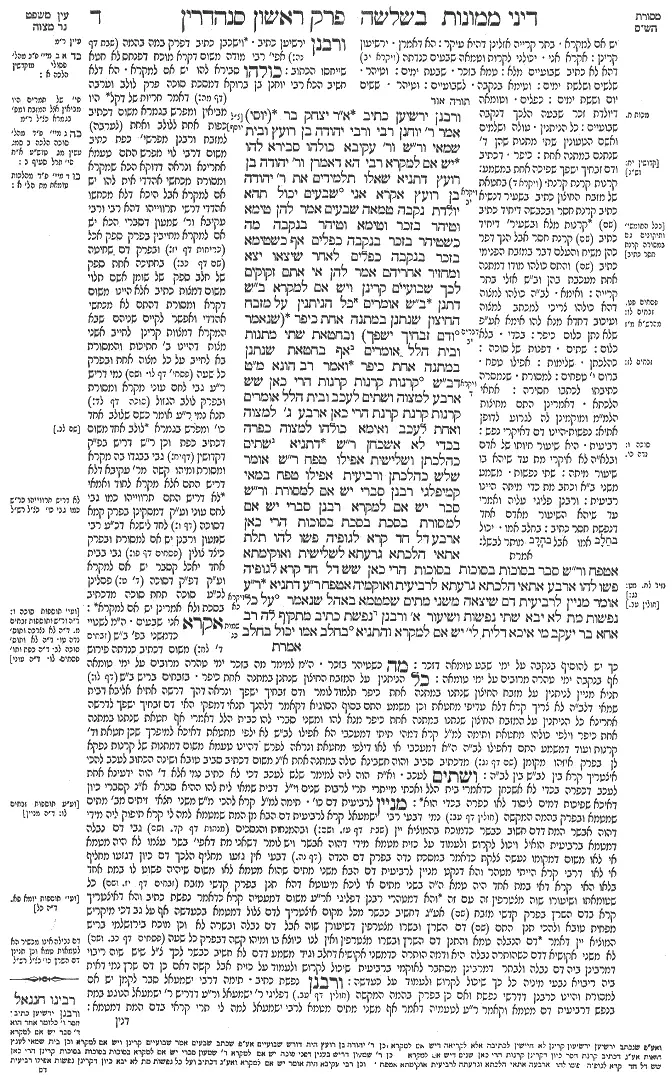
Sanhedrin 4a - Guemara
ורבנן ירשיען כתיב א"ר יצחק בר (יוסי) אמר ר' יוחנן רבי ורבי יהודה בן רועץ ובית שמאי ור"ש ור' עקיבא כולהו סבירא להו יש אם למקרא רבי הא דאמרן ור' יהודה בן רועץ דתניא שאלו תלמידים את ר' יהודה בן רועץ אקרא אני (ויקרא יב, ה) שבעים יכול תהא יולדת נקבה טמאה שבעים אמר להן טימא וטיהר בזכר וטימא וטיהר בנקבה מה כשטיהר בזכר בנקבה כפלים אף כשטימא בזכר בנקבה כפלים לאחר שיצאו יצא ומחזיר אחריהם אמר להן אי אתם זקוקים לכך שבועיים קרינן ויש אם למקרא ב"ש דתנן ב"ש אומרים כל הניתנין על מזבח החיצון שנתנן במתנה אחת כיפר (שנאמר (דברים יב, כז) ודם זבחיך ישפך) ובחטאת שתי מתנות ובית הלל אומרים אף בחטאת שנתנן במתנה אחת כיפר ואמר רב הונא מ"ט דב"ש (ויקרא ד, ז) קרנות קרנות קרנות הרי כאן שש ארבע למצוה ושתים לעכב ובית הלל אומרים קרנות קרנת קרנת הרי כאן ארבע ג' למצוה ואחת לעכב ואימא כולהו למצוה כפרה בכדי לא אשכחן ר"ש דתניא שתים כהלכתן ושלישית אפילו טפח ר"ש אומר שלש כהלכתן ורביעית אפילו טפח במאי קמיפלגי רבנן סברי יש אם למסורת ור"ש סבר יש אם למקרא רבנן סברי יש אם למסורת בסכת בסכת בסוכות הרי כאן ארבע דל חד קרא לגופיה פשו להו תלת אתאי הלכתא גרעתא לשלישית ואוקימתא אטפח ור"ש סבר בסוכות בסוכות בסוכות הרי כאן שש דל חד קרא לגופיה פשו להו ארבע אתאי הלכתא גרעתא לרביעית ואוקמיה אטפח ר"ע דתניא ר"ע אומר מניין לרביעית דם שיצאה משני מתים שמטמא באהל שנאמר (ויקרא כא, יא) על כל נפשות מת לא יבא שתי נפשות ושיעור א' ורבנן נפשת כתיב מתקיף לה רב אחא בר יעקב מי איכא דלית לי' יש אם למקרא והתניא (שמות כג, יט) בחלב אמו יכול בחלב
Comments from Rashi on Masechet Sanhedrin Page 4a
יש אם למקרא . בתר קרייה אזלינן דהיא עיקר: הא דאמרן . ירשיעון קרינן: אקרא אני . יכולני לקרות וטמאה שבעים כנדתה (ויקרא יב) דהא לא כתיב שבועיים מלא: טמא בזכר . שבעת ימים: וטיהר . שלשים ושלשת ימים: וטימא בנקבה . לשבועיים: וטיהר . ששים יום וששת ימים: כפלים . וטומאה דיולדת זכר שבעה הלכך דנקבה שבועיים: כל הניתנין . עולה ושלמים ואשם הטעונין שתי מתנות שהן ד' שנתנם במתנה אחת: כיפר . דכתיב ודם זבחיך ישפך שפיכה אחת במשמע: קרנות קרנת קרנת . (ויקרא ד) בחטאת של מזבח החיצון כתיב בשעיר דנשיא כתיב קרנת חסר ובכבשה דיחיד כתיב (שם) קרנות מלא ובשעיר' דיחיד כתיב (שם) קרנת חסר אבל הנך דפר כהן משיח והעלם דבר במזבח הפנימי כתיב (שם) והתם כולהו מודו דמתנה אחת מעכבת בהן וב"ש אזלי בתר קרייה: ואימא . לב"ה כולהו למצוה דהא כולהו צריכי למכתב למצוה ועיכוב דחדא מנא להו אימא אע"פ שלא נתן כלום כיפר: בכדי . בלא כלום: שתים . דפנות של סוכה: כהלכתן . שלימות: אפילו טפח . ברום י' טפחים: למסורת . שנמסרה כתיבתו לכתבו חסירה: אתאי הלכתא . דאמרינן התם מחיצות הלמ"מ ומוקמינן לה לגרוע לדופן אתיא: נפשות . היינו דם דאיקרי נפש: רביעית . היא שיעור חיותו של אדם ובלא"ה לא איקרי מת עד שיהא בו שיעור מיתה שתי נפשות . משמע משני ב"א וכתב מת כדי מיתה היינו רביעית: ורבנן פליגי עליה ואמרי עד שיהא השיעור מאדם אחד דנפשת חסר כתיב: בחלב אמו . יכול בחֵלֶב אמו אבל בחָלָב מותר לבשל:
Comments from Tosafot - Sanhedrin 4a
ורבנן ירשיען כתיב. וישכבן כתיב דפרק במה בהמה (שבת דף נה:) אפי' רבי מודה משום דקרא מוכח דפנחס לא חטא שייחסו הכתוב: כולהו סבירא להו יש אם למקרא. הא דלא חשיב הכא רבי יוחנן בן ברוקא דמסכת סוכה פרק לולב וערבה (דף מה:) דאמר חריות של דקל היו מביאין ומפרש בגמרא משום דכתיב כפות אחת ללולב ואחת (לערבה) למזבח ורבנן מפרשי' כפת כתיב משום דרבי לוי מפרש התם טעמא אחרינא ונראה דדוקא הכא שמקרא ומסורת מכחשי אהדדי אית להו יש אם למקרא אבל היכא דלא מכחשו אהדדי דרשי תרווייהו דהא רבי ורבי עקיבא ור' שמעון דסברי הכא יש אם למקרא מחייבין בפרק ספק אכל (כריתות דף יז:) ובפרק דם שחיטה (שם דף כב:) בחתיכה אחת ספק של חלב ספק של שומן אשם תלוי משום דמצות כתיב אלא היינו משום דקרא ומסורת דהתם לא מכחשי אהדדי ואפשר לקיים שניהם שבא המקרא דמצוות קרינן לחייב אשני מצות דהיינו ב' חתיכות והמסורת בא לחייב על כל מצוה אחת ובפרק כל שעה (פסחי' דף לו. ושם) נמי דריש ר"ע גבי לחם עוני מקרא ומסורת ובפרק לולב הגזול (סוכה דף לד:) תנא נמי ר"ע אומר כשם שלולב אחד כו' ומפרש בגמרא לולב אחד משום דכתיב כפת וכן ר"ש דריש בפ"ק דקדושין (דף יח:) גבי בבגדו בה מקרא ומסורת ומיהו קשה מר' עקיבא דלא דריש התם אלא מקרא לחוד ואמאי לא דריש התם תרווייהו כמו גבי לחם עוני וע"ק דמסקינן בפרק קמא דסוכה (דף ו:) לחד לישנא דכ"ע רבי שמעון ורבנן יש אם למסורת ובפרק כיצד צולין (פסחים דף פו:) גבי בבית אחד יאכל קסבר יש אם למקרא וע"ק דפ"ק דסוכה (ד' ט:) פסלינן לכ"ע סוכה תחת סוכה מדכתיב בסכת ולא אמרינן יש אם למקרא: אקרא אני שבעים . ה"מ לשנויי כדמשני בפ' ב"ש (זבחים ד' לח:) משום דכתיב כנדתה פירוש כך יש להוסיף בנקבה על ימי שבע טומאה דזכר: מה כשטיהר בזכר . ה"מ למימר מה בזכר ימי טהרה מרובים על ימי טומאה אף בנקבה ימי טהרה מרובים על ימי טומאה: כל הניתנין על המזבח החיצון שנתנן במתנה אחת כיפר . בזבחים בריש ב"ש (דף לו:) תניא מניין לניתנין על מזבח החיצון שנתנו במתנה אחת כיפר תלמוד לומר ודם זבחיך ישפך ונראה דהך דרשה אתיא אליבא דבית שמאי דלב"ה לא צריך קרא דלא עדיפי מחטאת וכן משמע התם בסוף הסוגיא דקאמר דלהנך תנאי דמפקי האי דם זבחיך ישפך לדרשה אחרינא כל הניתנין על המזבח החיצון שנתנו במתנה אחת כיפר מנא להו ומשני סברי להו כבית הלל דאמרי אף חטאת שנתנו במתנה אחת כיפר וילפי כולהו מחטאת ותימה למ"ל קרא דמהי תיתי דמעכבי הא אפילו לב"ש לא ילפי מחטאת דאיכא למיפרך שכן חטאת וד' קרנות ועוד דמשמע התם דאפילו לב"ה ה"א דמעכבי אי לאו דילפי מחטאת ונראה לפרש דהיינו טעמא משום דמתנות של קרנות נפקא לן בפרק איזהו מקומן (שם דף נג:) מדכתיב סביב והוה חשבינא כולה במתנה אחת א"נ משום דכתיב סביב טובא ושינה הכתוב לעכב להכי איצטריך קרא בין לב"ש בין לב"ה: ושתים לעכב . וא"ת הוה ליה למימר שלש לעכב דכי לא כתיב נמי אלא ד' הוה ידעינא אחת לעכב דכפרה בכדי לא אשכחן כדאמרי בית הלל ואכתי מייתרי תרי לרבות שנים וי"ל דבית שמאי לית להו ההיא סברא א"נ קסברי כיון דאיכא שפיכות דמים ליסוד לאו כפרה בכדי הוא: מניין לרביעית דם כו' . תימה למ"ל קרא להכי מ"ש משני חצאי זיתים מב' מתים שמטמא ובפרק בהמה המקשה (חולין דף עב:) נמי דבעי רבי ישמעאל קרא לרביעית דם הבא מן המת שמטמא למה לי קרא תיפוק ליה מידי דהוה אבשר המת דדם חשוב כבשר כדמוכח בהמוציא יין (שבת דף עז. ושם:) ובהמנחות והנסכים (מנחות דף קד. ושם) גבי דם נבלה דמטמא ברביעית הואיל ויכול לקרוש ולעמוד על כזית מטמא מידי דהוה אבשר ויש לומר דשאני מת דאפי' בשר עצמו לא היה מטמא אי לאו משום דמקומו נעשה צלקת כדאמר במסכת נדה בפרק דם הנדה (דף נה.) דבעי אין גזעו מחליף הלכך דם כיון דגזעו מחליף אי לאו דרבי קרא הייתי מטהר והא דנקט מניין לרביעית דם הבא משני מתים שהוא מטמא לאו משום שיהיה פשוט לו במת אחד בלאו האי קרא דאי במת אחד היה טמא ה"ה בשני מתים אי ליכא מיעוטא דהא תנן בפרק קדשי מזבח (זבחים דף יז. ושם) כל שטומאתו ושיעורו שוה מצטרפין זה עם זה והא דמטהרי רבנן דפליגי אר"ע משום דמעטיה קרא כדאמר נפשת כתיב והא דאיצטריך קרא בדם השרץ בפרק קדשי מזבח (שם) אע"ג דחשיב כבשר מכל מקום איצטריך לדם צלול דמטמא בכעדשה אף על גב דכי מיקריש מפחית טובא ולהכי תנן התם (שם) דם השרץ ובשרו מצטרפין דשיעורן שוה אבל דם נבלה ובשרה לא וכן מוכח בירושלמי בריש המוציא יין דאמר דם הנבלה טמא והתנן דם השרץ ובשרו מצטרפין ואין לנו כיוצא בו ומיהו קשה דבפרק כל שעה (פסחים דף כב. ושם) לא משני אקושיא דדם כשהותרה נבלה היא ודמה הותרה כדמשני אקושיא דחלב וגיד משמע דדם לא חשיב כבשר לכך צ"ל שיש שום ריבוי דמרבינן ביה דם נבלה ולבתר דמרבינן מסתבר לאוקמי ברביעית שיכול לקרוש ולעמוד על כזית אבל קשה דאם כן דם שרץ נמי דאית ביה ריבויא נבעי מיניה כל כך שיכול לקרוש ולעמוד על כעדשה: ורבנן נפשת כתיב . תימה דרבי ישמעאל סבר לקמן יש אם למסורת והיינו כרבנן דדרשי נפשת ואם כן בפרק בהמה המקשה (חולין דף עב.) דפליגי ר' ישמעאל ור"ע דדריש ר' ישמעאל הנוגע במת בנפש דרביעית דם מטמא וקאמר ר"ע לטעמיה דאמר אף משני מתים מטמא לרבי ישמעאל למה לי תרי קראי בדם המת דמטמא:
Sanhedrin 4a - Mishnah translated into english
And how would the Rabbis respond to Rabbi Yehuda HaNasi’s proof? They would say that although the term: “Shall condemn” is pronounced as a plural verb, it is written in a way that could also be read in the singular. Consequently, one cannot derive a requirement for more than one judge from there.
§ The dispute between Rabbi Yehuda HaNasi and the Sages is explained as an example of the more general question of whether the written consonantal text or the vocalization of the Torah is authoritative. As Rabbi Yitzḥak bar Yosei says that Rabbi Yoḥanan says: With regard to Rabbi Yehuda HaNasi, Rabbi Yehuda ben Roetz, Beit Shammai, Rabbi Shimon, and Rabbi Akiva, they all hold that the vocalization of the Torah is authoritative, and that the halakha is therefore decided based on the meaning of the word as pronounced, and not on possible alternative readings of the written text.
The Gemara explains the basis for Rabbi Yoḥanan’s assertion with regard to each of the tanna’im that he mentioned: With regard to Rabbi Yehuda HaNasi, the proof is that which we have just said, with regard to the interpretation of the verse: “He whom the court shall condemn” (Exodus 22:8) deriving a requirement for five judges in cases of monetary law based on the vocalized plural pronunciation of the term: “Shall condemn.”
And with regard to Rabbi Yehuda ben Roetz, it is as it is taught in a baraita: His students asked Rabbi Yehuda ben Roetz: The verse states: “But if she gives birth to a female, then she shall be unclean for two weeks, as in her menstrual impurity; and she shall then continue in the blood of purification for sixty-six days” (Leviticus 12:5). Based on the written consonantal text, I can read the amount of time she is impure as: “Seventy [shivim] days,” and not as: “Two weeks [shevuayim].” One might have thought, therefore, that a woman who gives birth to a female should be impure for seventy days.
Rabbi Yehuda ben Roetz said to them: It can be proven that this is not the halakha, as the Torah deemed her impure and deemed her pure when she gave birth to a male, and deemed her impure and deemed her pure when she gave birth to a female. Just as when it deemed her pure for thirty-three days after the initial period of impurity when she gave birth to a male, when she gives birth to a female she is pure for sixty-six days, which is double the amount of time; so too, when it deemed her impure for seven days when she gave birth to a male, when she gives birth to a female she is also impure for double the amount of time. Consequently, the verse must be read according to the vocalized reading: “Two weeks,” and not according to the consonantal text, which could be read: “Seventy.”
After they left, Rabbi Yehuda ben Roetz went out and followed them. He then said to them: You do not need this proof that I gave based on the comparison of the periods of impurity with the periods of purity. Rather, we read the verse as: “Two weeks,” and the vocalization of the Torah is authoritative.
With regard to Beit Shammai, the proof that they also hold that the vocalization of the Torah is authoritative is as we learned in a mishna (Zevaḥim 36b): Beit Shammai say: With regard to all offerings whose blood must be presented on the external altar, once the blood has been presented with one presentation the offering has effected atonement, even if more presentations are ideally required, as it is stated: “And the blood of your offerings shall be poured out against the altar of the Lord your God” (Deuteronomy 12:27). This verse teaches that even with regard to a burnt-offering, which requires multiple presentations of the blood, a single presentation is sufficient to render the offering valid after the fact. But with regard to a sin-offering, it is valid only if there were at least two presentations. And Beit Hillel say: Even with regard to a sin-offering that one presented with one presentation, it has effected atonement after the fact.
And Rav Huna says: What is the reasoning for the opinion of Beit Shammai? The verse states: “And the priest shall take of the blood of the sin-offering with his finger, and put it on the horns of the altar” (Leviticus 4:25); and “The priest shall take of the blood thereof with his finger, and put it on the horns of the altar” (Leviticus 4:30); and again: “The priest shall take of the blood of the sin-offering with his finger, and put it on the horns of the altar” (Leviticus 4:34). As the minimum amount justifying the use of plural, i.e., “horns,” is two, one may conclude that there are six references to the horns of the altar here. Four of them are mentioned for the mitzva, meaning that he should present the blood on all four horns of the altar ab initio, and the other two were mentioned to invalidate the offering if he did not present it on at least two horns.
And Beit Hillel say: The matter should be understood according to the written consonantal text. The word “horns” is written once plene, with a vav, which means that it must be read in the plural; and the other two times the words “horns” and “horns” are written deficient, without a vav, in a way that can be vocalized in the singular. Therefore, there are four references to horns here. Three of these presentations are written to indicate that they are performed only as a mitzva, i.e., they are performed ab initio, but the offering is valid even absent their presentation. And the remaining one, i.e., the fourth presentation, is written to indicate that its absence invalidates the offering, i.e., the offering is not valid if the blood was not presented against at least one horn of the altar. Evidently, Beit Shammai hold the vocalization is authoritative, whereas Beit Hillel hold the consonantal text is authoritative.
The Gemara asks: But according to this explanation of Beit Hillel, why not say that all of them are written for the mitzva and none to invalidate, meaning the blood must be presented on all four horns ab initio, but the offering atones after the fact even if it has not been presented at all? The Gemara rejects this possibility: We have not found anywhere in the Torah an example of an offering in which atonement can be achieved with no presentation of the blood of the offering at all.
With regard to Rabbi Shimon, it is as it is taught in a baraita that records a dispute among the Sages with regard to the number of walls required in a sukka: There must be two walls in their standard sense, completely closing each of those two sides, and a third wall, which, based on a halakha transmitted to Moses from Sinai, may measure even as little as one handbreadth. Rabbi Shimon says that there must be three walls in their standard sense, and a fourth one that can measure even one handbreadth. The Gemara asks: With regard to what principle do they disagree? The Gemara answers: The Rabbis hold that the tradition of the manner in which the verses in the Torah are written is authoritative, and Rabbi Shimon holds that the vocalization of the Torah is authoritative.
The Gemara explains: The Rabbis hold that the tradition of the manner in which the verses are written is authoritative. The Torah states: “You shall reside in sukkot” (Leviticus 23:42) spelled deficient, without the letter vav, in a way that can be read in the singular. And later in that verse it also states: “All that are homeborn in Israel shall reside in sukkot” spelled the same way. And in the next verse it states: “So that your future generations will know that I caused the children of Israel to reside in sukkot,” this time spelled plene, with a vav, which means it must be plural. Therefore, there are four walls here. Remove one verse, which is needed to teach the mitzva to sit in a sukka itself, and three walls remain. The halakha transmitted to Moses from Sinai, which says that one of the walls may be incomplete, comes and reduces the third and establishes it as a minimum of one handbreadth.
And Rabbi Shimon holds that the vocalization is authoritative. Since the verses state: “You shall reside in sukkot,” and: “All that are homeborn in Israel shall reside in sukkot,” and: “So that your future generations will know that I caused the children of Israel to reside in sukkot,” all of which are pronounced as plural nouns, there are six walls here. Remove one verse to teach the mitzva of sukka itself, and four walls remain. The halakha transmitted to Moses from Sinai then comes and reduces the fourth wall, and establishes it at a minimum of one handbreadth. Consequently, it is clear that Rabbi Shimon also holds that the vocalization is authoritative.
With regard to Rabbi Akiva, it is as it is taught in a baraita: It is known that a quarter-log of blood that came from a corpse imparts ritual impurity in a tent. And Rabbi Akiva says: From where is it derived that a quarter-log of blood that came out of two separate corpses also imparts ritual impurity in a tent? As it is stated with regard to a priest: “He shall not come upon any dead bodies” (Leviticus 21:11). The word “bodies” is pronounced as a plural word, and since the Torah teaches elsewhere that: “The blood is the life” (Deuteronomy 12:23), this indicates that impurity can be imparted by one measure of blood that came from two bodies. And the Rabbis say: The word “bodies” is written deficient, without a vav, so that it can also be read as a singular word, indicating that a quarter-log of blood imparts impurity in a tent only if it came from a single corpse.
Rav Aḥa bar Ya’akov objects to Rabbi Yoḥanan’s assertion that all of the above disputes are based on the question of whether the traditional consonantal text or the vocalized text of the Torah is authoritative: Is there a Sage who does not accept the principle that the vocalization of the Torah is authoritative? But isn’t it taught in a baraita: The verse states: “You shall not cook a young goat in its mother’s milk [baḥalev]” (Exodus 23:19). One might have thought the verse should be read as prohibiting the cooking of the young goat in the fat [beḥelev] of the mother, and there is no prohibition against cooking the meat with milk.
Traduction : The William Davidson digital edition of the Koren Noé Talmud, with commentary by Rabbi Adin Even-Israel Steinsaltz.