 Talmud Bavli
The learning on the whole site is dedicated : L'ilui Nishmat Nissim ben Barukh Malka
The learning on the whole site is dedicated : L'ilui Nishmat Amram ben Itshak Loubaton
The learning on the whole site is dedicated : L'ilui Nishmat Jamila bat Chlomo Abensour
Sanhedrin 22a : Youtube
Daf TubeYoutube
2 video classes :
Sanhedrin Page 22a
Sanhedrin 22a - Guemara
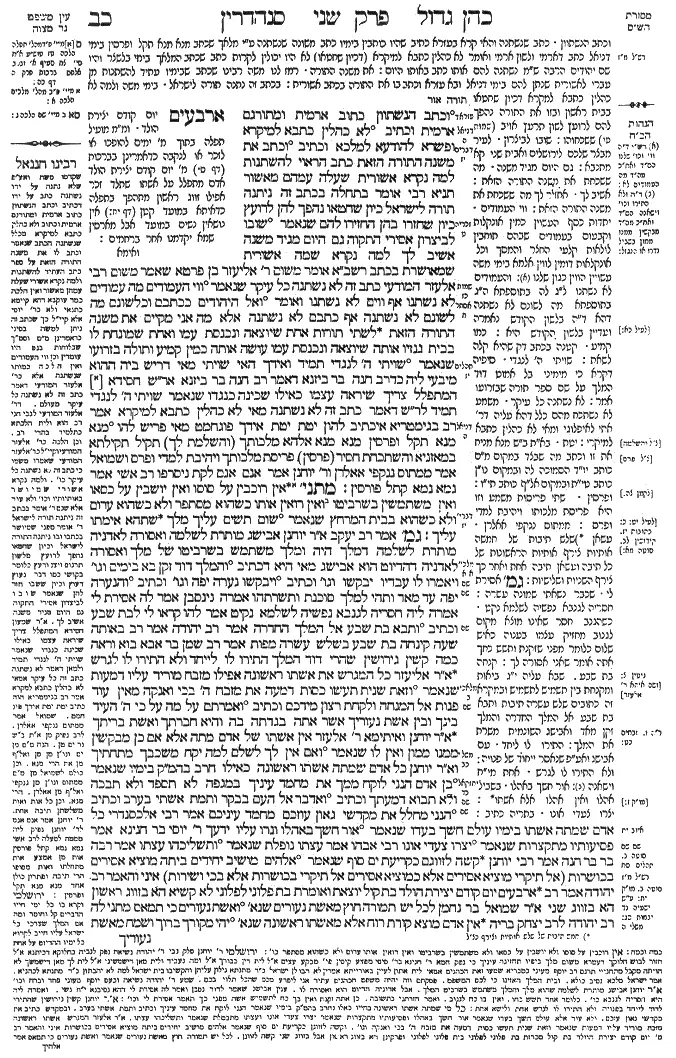
(עזרא ד, ז) וכתב הנשתוון כתוב ארמית ומתורגם ארמית וכתיב (דניאל ה, ח) לא כהלין כתבא למיקרא ופשרא להודעא למלכא וכתיב (דברים יז, יח) וכתב את משנה התורה הזאת כתב הראוי להשתנות למה נקרא אשורית שעלה עמהם מאשור תניא רבי אומר בתחלה בכתב זה ניתנה תורה לישראל כיון שחטאו נהפך להן לרועץ כיון שחזרו בהן החזירו להם שנאמר (זכריה ט, יב) שובו לביצרון אסירי התקוה גם היום מגיד משנה אשיב לך למה נקרא שמה אשורית שמאושרת בכתב רשב"א אומר משום ר' אליעזר בן פרטא שאמר משום רבי אלעזר המודעי כתב זה לא נשתנה כל עיקר שנאמר (שמות כז, י) ווי העמודים מה עמודים לא נשתנו אף ווים לא נשתנו ואומר (אסתר ח, ט) ואל היהודים ככתבם וכלשונם מה לשונם לא נשתנה אף כתבם לא נשתנה אלא מה אני מקיים את משנה התורה הזאת לשתי תורות אחת שיוצאה ונכנסת עמו ואחת שמונחת לו בבית גנזיו אותה שיוצאה ונכנסת עמו עושה אותה כמין קמיע ותולה בזרועו שנאמר (תהלים טז, ח) שויתי ה' לנגדי תמיד ואידך האי שויתי מאי דריש ביה ההוא מיבעי ליה כדרב חנה בר ביזנא דאמר רב חנה בר ביזנא אר"ש חסידא המתפלל צריך שיראה עצמו כאילו שכינה כנגדו שנאמר שויתי ה' לנגדי תמיד לר"ש דאמר כתב זה לא נשתנה מאי לא כהלין כתבא למיקרא אמר רב בגימטריא איכתיב להון יטת יטת אידך פוגחמט מאי פריש להו (דניאל ה, כה) מנא מנא תקל ופרסין מנא מנא אלהא מלכותך (והשלמת לך) תקיל תקילתא במאזניא והשתכחת חסיר (פרסין) פריסת מלכותך ויהיבת למדי ופרס ושמואל אמר ממתוס ננקפי אאלרן ור' יוחנן אמר אנם אנם לקת ניסרפו רב אשי אמר נמא נמא קתל פורסין:
מתני׳ אין רוכבין על סוסו ואין יושבין על כסאו ואין משתמשין בשרביטו ואין רואין אותו כשהוא מסתפר ולא כשהוא ערום ולא כשהוא בבית המרחץ שנאמר (דברים יז, טו) שום תשים עליך מלך שתהא אימתו עליך:
גמ׳ אמר רב יעקב א"ר יוחנן אבישג מותרת לשלמה ואסורה לאדניה מותרת לשלמה דמלך היה ומלך משתמש בשרביטו של מלך ואסורה לאדניה דהדיוט הוא אבישג מאי היא דכתיב (מלכים א א, א) והמלך דוד זקן בא בימים וגו' ויאמרו לו עבדיו יבקשו וגו' וכתיב (מלכים א א, ג) ויבקשו נערה יפה וגו' וכתיב (מלכים א א, ד) והנערה יפה עד מאד ותהי למלך סוכנת ותשרתהו אמרה נינסבן אמר לה אסירת לי אמרה ליה חסריה לגנבא נפשיה לשלמא נקיט אמר להו קראו לי לבת שבע וכתיב (מלכים א א, טו) ותבא בת שבע אל המלך החדרה אמר רב יהודה אמר רב באותה שעה קינחה בת שבע בשלש עשרה מפות אמר רב שמן בר אבא בוא וראה כמה קשין גירושין שהרי דוד המלך התירו לו לייחד ולא התירו לו לגרש א"ר אליעזר כל המגרש את אשתו ראשונה אפילו מזבח מוריד עליו דמעות שנאמר (מלאכי ב, יג) וזאת שנית תעשו כסות דמעה את מזבח ה' בכי ואנקה מאין עוד פנות אל המנחה ולקחת רצון מידכם וכתיב (מלאכי ב, יד) ואמרתם על מה על כי ה' העיד בינך ובין אשת נעוריך אשר אתה בגדתה בה והיא חברתך ואשת בריתך א"ר יוחנן ואיתימא ר' אלעזר אין אשתו של אדם מתה אלא אם כן מבקשין ממנו ממון ואין לו שנאמר (משלי כב, כז) ואם אין לך לשלם למה יקח משכבך מתחתיך וא"ר יוחנן כל אדם שמתה אשתו ראשונה כאילו חרב בהמ"ק בימיו שנאמר (יחזקאל כד, טז) בן אדם הנני לוקח ממך את מחמד עיניך במגפה לא תספד ולא תבכה ולא תבוא דמעתך וכתיב (יחזקאל כד, יח) ואדבר אל העם בבקר ותמת אשתי בערב וכתיב (יחזקאל כד, כא) הנני מחלל את מקדשי גאון עוזכם מחמד עיניכם אמר רבי אלכסנדרי כל אדם שמתה אשתו בימיו עולם חשך בעדו שנאמר (איוב יח, ו) אור חשך באהלו ונרו עליו ידעך ר' יוסי בר חנינא אמר פסיעותיו מתקצרות שנאמר (איוב יח, ז) יצרו צעדי אונו רבי אבהו אמר עצתו נופלת שנאמר (איוב יח, ז) ותשליכהו עצתו אמר רבה בר בר חנה אמר רבי יוחנן קשה לזווגם כקריעת ים סוף שנאמר (תהלים סח, ז) אלהים מושיב יחידים ביתה מוציא אסירים בכושרות (אל תיקרי מוציא אסירים אלא כמוציא אסירים אל תיקרי בכושרות אלא בכי ושירות) איני והאמר רב יהודה אמר רב ארבעים יום קודם יצירת הולד בת קול יוצאת ואומרת בת פלוני לפלוני לא קשיא הא בזווג ראשון הא בזווג שני א"ר שמואל בר נחמן לכל יש תמורה חוץ מאשת נעורים שנא' (ישעיהו נד, ו) ואשת נעורים כי תמאס מתני לה רב יהודה לרב יצחק בריה אין אדם מוצא קורת רוח אלא מאשתו ראשונה שנא' (משלי ה, יח) יהי מקורך ברוך ושמח מאשת
Comments from Rashi on Masechet Sanhedrin Page 22a
וכתב הנשתוון . כתב שנשתנה והאי קרא בעזרא כתיב שהיו כותבין בימיו כתב משונה שנשתנה ע"י מלאך שכתב מנא מנא תקל ופרסין בימי דניאל כתב דארמי ולשון ארמי ואומר לא כהלין כתבא למיקרא (דכיון שחטאו) לא היו יכולין לקרות כתב שכתב המלאך בימי בלשצר והיו שם יהודים הרבה ש"מ נשתנה להם אותו כתב באותו היום: את משנה התורה . רמז לנו משה רבינו שכתב שבימיו עתיד להשתנות מן עברי לאשורית שנתן להם בימי דניאל ובא עזרא וכתב בו את התורה בכתב אשורית: בכתב זה נתנה תורה לישראל . בימי משה ולמה לא כהלין כתבא למקרא דכיון שחטאו בבית ראשון ובזו את התורה נהפך להם לרועץ לשון תרעץ אויב (שמות טו) ששכחוהו: שובו לביצרון . לעיר מבצר שלכם לירושלים ואבית שני קא מתנבא: גם היום מגיד משנה . מה ששכחת את משנה התורה הזאת: אשיב לך . אחזיר לך מה ששכחת את משנה התורה הזאת: ווי העמודים . יתדות כסף העשוין כמין אונקלות וקבעום בעמודים שבהם תוחבין לולאות קלעי החצר והמסך וכל אונקלאות דומין לווין אלמא בימי משה עשויין הווין כגון שלנו: והעמודים לא נשתנו ל"ג לה בתוספתא ה"ג בתוספתא מה לשונם לא נשתנה דהא ד"ה בלשון הקודש נאמרה ועדיין בלשון הקודש היא: כמו קמיע . קטנה בכתב דק שהיא קלה לשאת: שויתי ה' לנגדי . סיפיה דקרא כי מימיני בל אמוט דוד המלך על שם ספר תורה שבזרועו אמר: לא נשתנה כל עיקר . משמע לא נשתכח מהם כלל דהא עליה דר' אתי לאיפלוגי ומאי לא כהלין כתבא למיקרי: יטת . בא"ת ב"ש מנא מניח את זו וכתב מה שבצד במקום מ"ם כותב יו"ד הסמוכה לה ובמקום נו"ן כותב טי"ת ובמקום אל"ף כותב תי"ו: ופרסין . שתי פריסות משמע וזו היא פריסת מלכותו ויהיבת למדי ופרס: ממתוס ננקפי אאלרן . עשאן שלש תיבות של חמשה אותיות צירף אותיות הראשונות של כל תיבה ועשאן תיבה אחת ואחר כך צירף השניות ושלישיות: גמ' אסירת לי . שכבר נשאתי שמונה עשרה: חסריה לגנבא נפשיה לשלמא נקט . כשהגנב חסר שאינו מוצא מקום לגנוב מחזיק עצמו בענוה כאיש שלום כלומר מפני שזקנת ותשש כחך אתה אומר שאני אסורה לך: קנחה בת שבע . שבא עליה י"ג ביאות ומקנחת בין תשמיש לתשמיש ובמקרא זה כתובים שלש עשרה תיבות ותבא בת שבע אל המלך החדרה והמלך זקן מאד ואבישג השונמית משרת את המלך: התירו לו ליחד . עם אבישג ואע"פ שנאסר ייחוד של פנויה: ולא התירו לו לגרש . אחת מי"ח וישאנה: אור חשך באהלו . בשביל אהלו ואין אהלו אלא אשתו: יצרו צעדי אונו . בתריה כתיב:
Comments from Tosafot - Sanhedrin 22a
ארבעים יום קודם יצירת הולד . ומ"מ מועיל תפלה בתוך מ' ימים להופכו או לזכר או לנקבה כדאמרינן בברכות (דף ס.) מ' יום קודם יצירת הולד אדם מתפלל על אשתו שתלד זכר אפילו זווג ראשון מתהפך בתפלה כדאיתא במועד קטן (דף יח:) אין נושאין נשים במועד אבל מארסין שמא יקדמנו אחר ברחמים:
Sanhedrin 22a - Mishnah translated into english
“And the writing of the letter [hannishtevan] was written in the Aramaic script, and set forth in the Aramaic tongue” (Ezra 4:7). The term “hannishtevan” is similar to the word nishtana, meaning changed, alluding to the fact that the script had been changed. And it is written with regard to the writing on the wall of Belshazzar’s palace: “Then came in all the king’s wise men. But they could not read the writing, nor make known to the king the interpretation” (Daniel 5:8), and the reason they could not read it is that it was written in the new script that Ezra would transmit. And it is written: “That he shall write for himself a second [mishne] Torah” (Deuteronomy 17:18), where “second [mishne]” teaches that it is written in a script that is apt to be changed [lehishtannot].
The baraita continues: Why is this script called Ashurit? Because it ascended with the Jewish people from Ashur when they returned from their exile in Babylonia.
It is taught in a baraita (Tosefta 4:5): Rabbi Yehuda HaNasi says: Initially, the Torah was given to the Jewish people in this script, Ashurit, which is in use today. Once the Jewish people sinned, it turned into an impairment for them and they began writing with a different script, Libona’a. Once they repented, the first script was returned to them, and they resumed writing with Ashurit script, as it is stated: “Return to the stronghold, you prisoners of hope; even today do I declare that I will render double [mishne] unto you” (Zechariah 9:12), meaning that God restored to the Jewish people this script that had been changed [nishtanna].
The baraita continues: If this script predates the exile to Babylonia, why is it called Ashurit? Because it is meusheret, beautiful and straight, in script.
The baraita continues: Rabbi Shimon ben Elazar says in the name of Rabbi Eliezer ben Perata, who said in the name of Rabbi Elazar HaModa’i: This script did not change at all, as it is stated with regard to the construction of the Tabernacle: “The hooks of [vavei] the poles” (Exodus 27:10). This teaches that just as the poles were not changed, so too, the hooks [vavim] were not changed. The letter vav in Ashurit script has the shape of a hook. Evidently, this is why the term for hook in the Torah is vav. And the verse states: “And to the Jews according to their script and according to their language” (Esther 8:9). This teaches that just as their language was not changed over the generations but remained Hebrew, so too, their script was not changed.
The baraita continues: But if the script was in fact not changed, how do I realize the meaning of the phrase “a second [mishne] Torah” (Deuteronomy 17:18)? This serves to teach the halakha concerning the two Torah scrolls that the king writes, one that goes out and comes in with him, and one that is placed in his treasury. With regard to the one that goes out and comes in with him, he makes it very small, like an amulet, and he hangs it on his arm. As it is stated by King David: “I have set the Lord always before me; He is at my right hand, that I shall not be moved” (Psalms 16:8). This verse alludes to the two Torah scrolls, one that is before him and one that is in his right hand.
The Gemara asks: And with regard to the other Sage, i.e., Rabbi Yehuda HaNasi, who does not hold that the king must write and affix the second scroll to his arm, what does he expound from that verse: “I have set” (Psalms 16:8)? The Gemara responds: He requires that verse in accordance with the statement of Rav Ḥana bar Bizna, as Rav Ḥana bar Bizna says that Rabbi Shimon Ḥasida says: One who prays needs to see himself as if the Divine Presence is opposite him, as it is stated: “I have set the Lord always before me” (Psalms 16:8).
The Gemara asks: According to Rabbi Shimon, who says that this script was not changed at all, what is the reason “they could not read the writing” (Daniel 5:8)? Rav says: Because it was written for them in the obscure code of gimatriyya. It was written: Yod, tet, tav; yod, tet, tav; alef, yod, dalet, khaf; peh, vav, gimmel, ḥet, mem, tet. These letters correspond with: Mem, nun, alef; mem, nun, alef; tav, kuf, lamed; vav, peh, reish, samekh, yod, nun; this is based on the exchange of letters known as at bash, or the exchanging of a letter with its counterpart in the opposite place in the alphabet, e.g., alef, the first letter, for tav, the last letter.
What did Daniel explain to them? The letters stand for the terms: “Mene mene tekel ufarsin” (Daniel 5:25). He then explained the meaning: “Mene”: God has numbered [mena] the days of your kingdom and brought it to an end. “Tekel”: You are weighed [tekilta] on the scale and are found lacking. “Parsin”: Your kingdom is divided [perisat] and given to the Medes and Persians” (Daniel 5:26–28).
And Shmuel says: The writing used the correct letters for those terms, but instead of being written in order, the four words, mene mene tekel ufarsin were written vertically and were therefore meant to be read from the top down. If read in the usual way, from right to left, it says: “Mamtos nankafei a’alran.” And Rabbi Yoḥanan says: Each word was written backward, so that read right to left, they spelled, Anem anem leket nisrapu. Rav Ashi says: They were written with the first two letters of each word reversed: Nema nema ketal pursin.
MISHNA: One may not ride on the king’s horse, and one may not sit on his throne, and one may not use his scepter, and one may not see him when he is having his hair cut, nor when he is naked, nor when he is in the bathhouse, as it is stated: “You shall set a king over you” (Deuteronomy 17:15), meaning, ensure that his fear should be upon you. All of these actions would lessen one’s fear of and reverence for the king.
GEMARA: Rav Ya’akov says that Rabbi Yoḥanan says: Abishag the Shunammite was permitted to Solomon but forbidden to Adonijah, who in fact wanted to marry her. She was permitted to Solomon, as he was a king, and a king may use the scepter of a king. Abishag’s status was similar to the king’s scepter, as she had been designated to serve King David. She was forbidden to Adonijah, as he was an ordinary person, not a king.
The Gemara clarifies: The story of Abishag, what is it? As it is written: “Now King David was old and stricken in years…and his servants said to him, let there be sought…a young virgin…and let her lie in your bosom, that my lord the king may get heat” (I Kings 1:1–2); and it is written: “So they sought for a beautiful maiden…and found Abishag” (I Kings 1:1–3); and it is written: “And the maiden was very beautiful and she became a companion to the king and ministered to him, but the king did not know her” (I Kings 1:1–4). Abishag said to King David: Marry me. King David said to her: You are forbidden to me, as I already have eighteen wives.
Abishag said to him: When the thief is lacking what to steal, he makes himself like a man of peace. In other words, she was saying that since King David was physically unable to engage in intercourse, he devised an excuse not to marry her. King David said to his attendants: Call Bathsheba to me. And it is written: “And Bathsheba went in to the king into the chamber; now the king was very old and Abishag the Shunammite ministered to the king” (I Kings 1:15). Rav Yehuda says that Rav says: At that time, Bathsheba wiped herself with thirteen cloths, corresponding to the number of words in the verse, indicating that she engaged in intercourse with King David thirteen times.
Rav Shemen bar Abba says: Come and see how severe a matter divorce is, as they rendered it permitted for King David to be secluded with Abishag without marrying her, but they did not render it permitted for him to divorce one of his wives to enable him to marry Abishag.
§ Rabbi Eliezer says: Concerning anyone who divorces his first wife, even the altar sheds tears about him, as it is stated: “And further, this you should do: Cover the altar of the Lord with tears, with weeping and sighing, from His no longer showing regard to the offering, nor receiving it with goodwill from your hand” (Malachi 2:13), and it is written: “Yet you say: Why? Because the Lord has been witness between you and the wife of your youth, against whom you have dealt treacherously, though she is your companion and the wife of your covenant” (Malachi 2:14).
Rabbi Yoḥanan, and some say Rabbi Elazar, says: A man’s wife does not die unless his creditors ask him for money that he owes and he does not have it, as it is stated: “If you do not have with what to pay, why should he take away your bed from under you?” (Proverbs 22:27). The bed mentioned in the verse alludes to one’s wife.
And Rabbi Yoḥanan says: For any man whose first wife dies, it is as if the Temple were destroyed in his days, as it is stated: “Son of man, behold, I take away from you the desire of your eyes with a stroke; yet neither shall you make lamentation nor weep, neither shall your tears run down” (Ezekiel 24:16). And it is written: “So I spoke to the people in the morning and in the evening my wife died” (Ezekiel 24:18). And it is written in the continuation of the same passage: “Behold I will profane My Sanctuary, the pride of your power, the desire of your eyes” (Ezekiel 24:21), illustrating that a man’s wife is as precious to him as the Temple is for the entire Jewish nation.
Rabbi Alexandri says: For any man whose wife dies in his days, the world is dark for him, as it is stated: “The light shall be dark in his tent and his lamp over him shall be put out” (Job 18:6), since the word tent is commonly employed as a metonym for a wife. Rabbi Yosei bar Ḥanina says: His steps get shorter, as it is stated: “The steps of his strength shall be constrained” (Job 18:7). Rabbi Abbahu says: His counsel falls, as it is stated: “And his own counsel shall cast him down” (Job 18:7).
Rabba bar bar Ḥana says that Rabbi Yoḥanan says: It is as difficult to match a couple as the splitting of the Red Sea, as it is stated: “God makes the solitary dwell in a house; He brings out prisoners into prosperity” (Psalms 68:7). Do not read the verse as “brings out prisoners”; rather, read it as: Like bringing out prisoners. Accordingly, the act described in the first clause of the verse, God’s causing the solitary to dwell in a house, i.e., to marry, is compared to the act described in the next clause in the verse, i.e., bringing out prisoners. And do not read the verse as “into prosperity [bakkosharot]”; rather, read it as: Crying and singing [bekhi veshirot], which alludes to the splitting of the Red Sea, when there was both crying and singing.
The Gemara asks: Is that so that it is this difficult to find a match? But doesn’t Rav Yehuda say that Rav says: Forty days before the formation of the fetus a Divine Voice emerges and states: The daughter of so-and-so shall be the wife of so-and-so? Why should matching them be so difficult, since they are prepared for this from before their birth? The Gemara responds: This is not difficult. This latter statement, about predestined matches, is stated with regard to the first match; that former statement, about the difficulty of matchmaking, is stated with regard to the second match.
Rabbi Shmuel bar Naḥman says: For everything that is lost there is a substitute, except for one’s wife from youth who dies, as it is stated: “And a wife from youth, can she be rejected?” (Isaiah 54:6). Rav Yehuda taught Rav Yitzḥak, his son: A man finds calmness of spirit only from his first wife, as it is stated: “Let your fountain be blessed and have joy with the wife of
Traduction : The William Davidson digital edition of the Koren Noé Talmud, with commentary by Rabbi Adin Even-Israel Steinsaltz.