 Talmud Bavli
The learning on the whole site is dedicated : L'ilui Nishmat Rav Chlomo Ben Jamilla
The learning on the whole site is dedicated : L'ilui Nishmat Avraham Ben Simha
The learning on the whole site is dedicated : L'ilui Nishmat Jacques Isaac Ben Amram Loubaton
Sanhedrin 24a : Youtube
Daf TubeYoutube
2 video classes :
Sanhedrin Page 24a
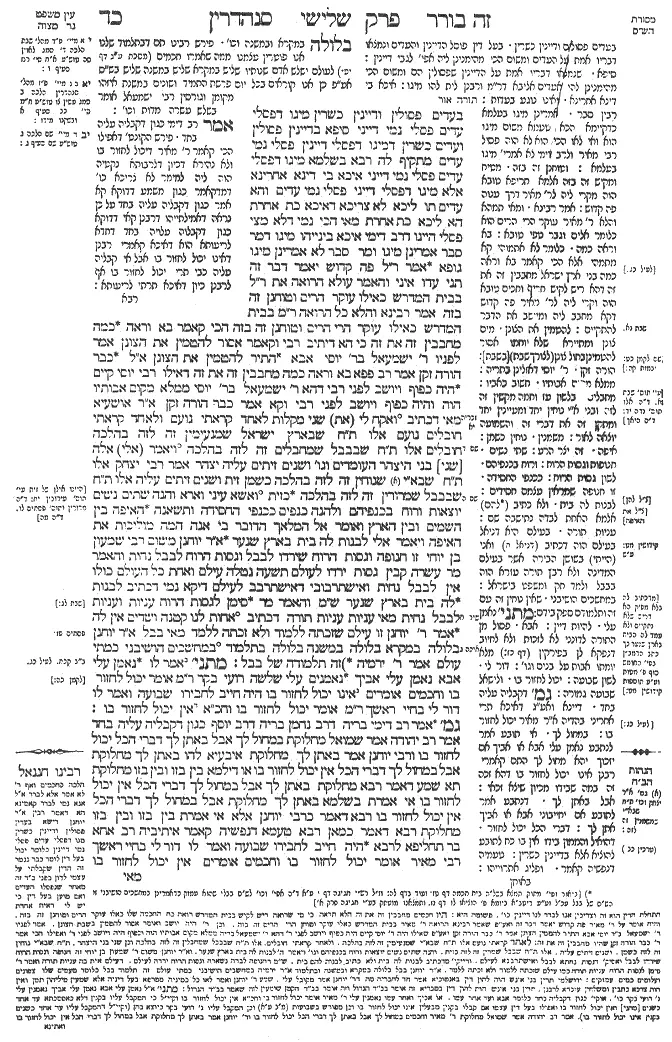
Sanhedrin 24a - Guemara
בעדים פסולין ודיינין כשרין מיגו דפסלי עדים פסלי נמי דייני סיפא בדיינין פסולין ועדים כשרין דמיגו דפסלי דיינין פסלי נמי עדים מתקיף לה רבא בשלמא מיגו דפסלי עדים פסלי נמי דייני איכא בי דינא אחרינא אלא מיגו דפסלי דייני פסלי נמי עדים והא עדים תו ליכא לא צריכא דאיכא כת אחרת הא ליכא כת אחרת מאי הכי נמי דלא מצי פסלי היינו דרב דימי איכא בינייהו מיגו דמר סבר אמרינן מיגו ומר סבר לא אמרינן מיגו גופא אמר ר"ל פה קדוש יאמר דבר זה תני עדו איני והאמר עולא הרואה את ר"ל בבית המדרש כאילו עוקר הרים וטוחנן זה בזה אמר רבינא והלא כל הרואה ר"מ בבית המדרש כאילו עוקר הרי הרים וטוחנן זה בזה הכי קאמר בא וראה כמה מחבבין זה את זה כי הא דיתיב רבי וקאמר אסור להטמין את הצונן אמר לפניו ר' ישמעאל בר' יוסי אבא התיר להטמין את הצונן א"ל כבר הורה זקן אמר רב פפא בא וראה כמה מחבבין זה את זה דאילו רבי יוסי קיים היה כפוף ויושב לפני רבי דהא ר' ישמעאל בר' יוסי ממלא מקום אבותיו הוה והיה כפוף ויושב לפני רבי וקא אמר כבר הורה זקן א"ר אושעיא מאי דכתיב (זכריה יא, ז) ואקח לי (את) שני מקלות לאחד קראתי נועם ולאחד קראתי חובלים נועם אלו ת"ח שבארץ ישראל שמנעימין זה לזה בהלכה חובלים אלו ת"ח שבבבל שמחבלים זה לזה בהלכה (זכריה יא, יג) ויאמר (אלי) אלה [שני] בני היצהר העומדים וגו' ושנים זיתים עליה יצהר אמר רבי יצחק אלו ת"ח שבא"י שנוחין זה לזה בהלכה כשמן זית ושנים זיתים עליה אלו ת"ח שבבבל שמרורין זה לזה בהלכה כזית (זכריה ה, ט) ואשא עיני וארא והנה שתים נשים יוצאות ורוח בכנפיהם ולהנה כנפים ככנפי החסידה ותשאנה האיפה בין השמים ובין הארץ ואומר אל המלאך הדובר בי אנה המה מוליכות את האיפה ויאמר אלי לבנות לה בית בארץ שנער א"ר יוחנן משום רבי שמעון בן יוחי זו חנופה וגסות הרוח שירדו לבבל וגסות הרוח לבבל נחית והאמר מר עשרה קבין גסות ירדו לעולם תשעה נטלה עילם ואחת כל העולם כולו אין לבבל נחית ואישתרבובי דאישתרבב לעילם דיקא נמי דכתיב לבנות לה בית בארץ שנער ש"מ והאמר מר סימן לגסות הרוח עניות ועניות לבבל נחית מאי עניות עניות תורה דכתיב (שיר השירים ח, ח) אחות לנו קטנה ושדים אין לה אמר ר' יוחנן זו עילם שזכתה ללמוד ולא זכתה ללמד מאי בבל א"ר יוחנן בלולה במקרא בלולה במשנה בלולה בתלמוד (איכה ג, ו) במחשכים הושיבני כמתי עולם אמר ר' ירמיה זה תלמודה של בבל:
מתני׳ אמר לו נאמן עלי אבא נאמן עלי אביך נאמנים עלי שלשה רועי בקר ר"מ אומר יכול לחזור בו וחכמים אומרים אינו יכול לחזור בו היה חייב לחבירו שבועה ואמר לו דור לי בחיי ראשך ר"מ אומר יכול לחזור בו וחכ"א אין יכול לחזור בו:
גמ׳ אמר רב דימי בריה דרב נחמן בריה דרב יוסף כגון דקבליה עליה בחד אמר רב יהודה אמר שמואל מחלוקת במחול לך אבל באתן לך דברי הכל יכול לחזור בו ורבי יוחנן אמר באתן לך מחלוקת איבעיא להו באתן לך מחלוקת אבל במחול לך דברי הכל אין יכול לחזור בו או דילמא בין בזו ובין בזו מחלוקת תא שמע דאמר רבא מחלוקת באתן לך אבל במחול לך דברי הכל אין יכול לחזור בו אי אמרת בשלמא באתן לך מחלוקת אבל במחול לך דברי הכל אין יכול לחזור בו רבא דאמר כרבי יוחנן אלא אי אמרת בין בזו ובין בזו מחלוקת רבא דאמר כמאן רבא טעמא דנפשיה קאמר איתיביה רב אחא בר תחליפא לרבא היה חייב לחבירו שבועה ואמר לו דור לי בחיי ראשך רבי מאיר אומר יכול לחזור בו וחכמים אומרים אין יכול לחזור בו
Comments from Rashi on Masechet Sanhedrin Page 24a
בעדים פסולים ודיינין כשרין . בעל דין פוסל הדיינין והעדים ונמצאו דבריו אמת על העדים ומשום הכי מהימנינן ליה אפי' לגבי דיינין: סיפא . שנמצאו דבריו אמת על הדיינין שפסולין הם ומשום הכי מהימנינן להו אעדים אליבא דר"מ ורבנן לית להו מיגו: איכא בי דינא אחרינא . ואינו נוגע בעדות: רבין סבר . אמרינן מיגו בעלמא כדקיימא הכא טעמא משום מיגו הוא ואי לאו הכי הוא לא הוה פסיל רבי מאיר ולרב דימי לא אמרי' מיגו בעלמא: וטוחנן זה בזה . מטיח ומקיש זה בזה אלמא חריפא טובא הוה מקרי ליה לר' מאיר דרך ענוה פה קדוש: אמר רבינא . ומאי תמהא והלא ר' מאיר עוקר הרי הרים הוא כלומר אלים וגבר טפי טובא: בא וראה כמה . כלומר לא אתמוהי קא מתמהי אלא הכי קאמר בא וראה כמה בני ארץ ישראל מחבבין זה את זה דהא ריש לקיש חריף וחכים טובא הוה וקרי ליה לר' מאיר פה קדוש דקא מחבב ליה ומיישב את הדבר להתקיים: להטמין את הצונן . מים צונן ומתיירא שלא יוחמו אסור להטמינן בחול צונן (לצורך שבת) [בשבת]: הורה זקן . ר' יוסי דאזלינן בתריה: ממלא מקום אבותיו . חשוב כאביו: מחבלים . בלשון עז וחמה מקשין זה לזה ובני א"י נוחין יחד ומעיינין יחד ומתקן זה את דברי זה והשמועה יוצאה לאור: משמנין . נוחין כשמן: איפה . זה יצר הרע: שתי נשים . חנופות וגסות הרוח: ורוח בכנפיהם . לשון גסות הרוח: ככנפי החסידה . זו חנופה שמראין עצמם חסידים: לבנות לה בית . ולא כתיב (להם) אלמא האחת לבדה נתישבה שם: עניות תורה . בעילם היא דניאל בעילם הוה דכתיב (דניאל ח) ואני (הייתי) בשושן הבירה אשר בעילם המדינה ולא רבץ תורה עזרא הוה בבבל ולמד חק ומשפט בישראל: במחשכים הושיבני . שאין נוחין זה עם זה ותלמודם ספק בידם: מתני' נאמן עלי . להיות דיין: אבא . פסול מן התורה לדונני לא לזכות ולא לחיוב דנפקא לן בפירקין (דף כז:) מלא יומתו אבות על בנים וגו': דור לי . לשון שבועה: יכול לחזור בו . ולישאל שבועה גמורה: גמ' דקבליה עליה בחד . דיינא ואע"ג דאיכא תרי אחריני בהדיה א"ר מאיר יכול לחזור בו: במחול לך . אי תובע אמר לנתבע נאמן עלי אבא או אביך אם יזכוך יהא מחול לך התם קאמרי רבנן אינו יכול לחזור בו דהא זכה זה במה שבידו מכיון שיצא זכאי: אבל באתן לך . דנתבע אמר לתובע אם יחייבוני אבא או אביך אתן לך: דברי הכל יכול לחזור . דהואיל והממון בידו אין בו כח לתובע להוציא אלא בדיינין כשרין: טעמיה דנפשיה קאמר . ופליג אתרוייהו:
Comments from Tosafot - Sanhedrin 24a
בלולה במקרא ובמשנה וכו' . פירש רבינו תם דבתלמוד שלנו אנו פוטרין עצמנו ממה שאמרו חכמים (מסכת ע"ג דף יט.) לעולם ישלש אדם שנותיו שליש במקרא שליש במשנה שליש בש"ס אע"פ כן אנו קוראים בכל יום פרשת התמיד ושונים במשנת איזהו מקומן וגורסין רבי ישמעאל אומר בשלש עשרה מדות וכו': אמר רב דימי כגון דקבליה עליה בחד . פירש הקונט' דאפילו הכי קאמר ר' מאיר דיכול לחזור בו ולא נהירא דכיון דלרבותא נקטיה הוה ליה למימר לא צריכא כו' דמדקאמר כגון משמע דדוקא קא אמר כגון דקבליה עליה בחד על כן נראה דאמילתייהו דרבנן קאי דדוקא כגון דקבלוה עלויה בחד דחדא לריעותא הוא דאיכא קאמרי רבנן דאינו יכול לחזור בו אבל אי קבליה עליה כבי תרי יכול לחזור בו אף לרבנן כיון דאיכא תרתי לריעותא:
Sanhedrin 24a - Mishnah translated into english
is stated with regard to a case of disqualified witnesses and fit judges, i.e., the litigant claims that both the witnesses and the judges are disqualified and proves his claim only with regard to the witnesses. Rabbi Meir holds that since the witnesses are disqualified the judges are also disqualified, as the litigant’s entire claim is deemed credible. The latter clause, where Rabbi Meir rules that a litigant can disqualify witnesses, is stated with regard to a case of disqualified judges and fit witnesses, i.e., the litigant proves his claim only with regard to the judges. Since the judges are disqualified the witnesses were also disqualified.
Rava objects to this interpretation: Granted, in the former clause, it is reasonable that since the witnesses are disqualified the judges are also disqualified, as, since there is the option of going to another court, disqualifying these specific judges has no irreversible effect on the outcome of the case. But in the latter case, how can Rabbi Meir hold that since the judges are disqualified, the witnesses are also disqualified without proof? This disqualification nullifies the entire case, as there are no more witnesses.
The Gemara answers: No, the mishna is not referring to a case where there are no other witnesses. The dispute between Rabbi Meir and the Rabbis is necessary only in a case where there is another set of witnesses, which the litigant did not disqualify. Since disqualifying this set will not predetermine the outcome, the litigant’s claim that these witnesses are disqualified is accepted.
The Gemara asks: But if there is no other set of witnesses, what is the halakha? Is it indeed true that the litigant cannot disqualify them? If so, this is identical to Rav Dimi’s interpretation that the mishna is referring to a case where there are two sets of witnesses.
The Gemara answers: There is a practical difference between them with regard to the principle that since [miggo] one of the litigant’s claims is found to be correct, it can be assumed that other claims of his are correct as well. As one Sage, Ravin, holds that according to Rabbi Meir, we say miggo, i.e., this principle should be followed, and one Sage, Rav Dimi, holds that we do not say miggo, but rather the litigant is required to prove every claim he makes.
§ The Gemara returns to discuss the matter itself: Reish Lakish says: Would a holy mouth, i.e., that of Rabbi Meir, say this strange statement, that a litigant can prevent a witness from testifying against him? Rather, emend the text of the mishna and teach: His witness, in the singular, meaning that a litigant can disqualify only a witness who testifies alone.
The Gemara asks: Is that so? Was it in character for Reish Lakish to speak of Rabbi Meir with such reverence when disagreeing with his ruling? But doesn’t Ulla say: When one sees Reish Lakish studying Torah in the study hall it is as though he is uprooting mountains and grinding them into each other? Reish Lakish was evidently very sharp in his analyses.
Ravina said in response: What is the difficulty? But is it not so that when anyone sees Rabbi Meir studying Torah in the study hall, it is as though he is uprooting the highest of mountains and grinding them into each other? Rabbi Meir was a greater scholar than Reish Lakish, so it was fitting for Reish Lakish to speak of him with reverence.
The Gemara answers: The question: Is that so, was not stated to raise a difficulty; rather, this is what he is saying, i.e., this is what the Gemara was noting: Come and see how much the Sages love each other. Although Reish Lakish was himself very sharp and a great Torah scholar, he spoke of Rabbi Meir with reverence.
The Gemara cites another example of Torah scholars who spoke of each other with reverence. It is like that incident where Rabbi Yehuda HaNasi sat and said: It is prohibited to insulate cold food on Shabbat to keep it cold, as this may lead one to insulate hot food on Shabbat to keep it hot. Rabbi Yishmael, son of Rabbi Yosei, said before him: My father ruled that it is permitted to insulate cold food on Shabbat. There is no concern that this will lead one to insulate hot food on Shabbat. Rabbi Yehuda HaNasi subsequently said to those who asked him about this issue: I retract my previous statement; the elder, Rabbi Yosei, has already issued a ruling on this topic, and I defer to his ruling.
Rav Pappa says: Come and see how much they loved each other. As, had Rabbi Yosei still been alive, he would have been subordinate to and sitting before Rabbi Yehuda HaNasi as his student, as Rabbi Yishmael, son of Rabbi Yosei, was his fathers’ replacement, i.e., he was as great a Torah scholar as his forebears, and he was subordinate to and sitting before Rabbi Yehuda HaNasi as his student. And, nevertheless, Rabbi Yehuda HaNasi said: The elder has already issued a ruling on this topic, and he deferred to Rabbi Yosei’s ruling.
This demonstrates what Rabbi Oshaya says: What is the meaning of that which is written: “And I took for myself two staves; the one I called Graciousness, and the other I called Binders” (Zechariah 11:7)? “Graciousness”; these are the Torah scholars in Eretz Yisrael, who are gracious to one another in discussions of halakha. They treat each other with honor and love, as demonstrated in the statements of Reish Lakish and Rabbi Yehuda HaNasi. “Binders [ḥovelim]”; these are the Torah scholars in Babylonia, who injure [shemeḥabbelim] each other in discussions of halakha, i.e., they speak harshly to each other when they disagree.
Similarly, it is stated: “Then he said to me: These are the two anointed ones, that stand by the Lord of the whole earth” (Zechariah 4:14), and it is stated: “And two olive trees by it, one upon the right side of the bowl, and the other upon its left side” (Zechariah 4:3). With regard to the expression “anointed ones,” Rabbi Yitzḥak says: These are the Torah scholars in Eretz Yisrael, who are pleasant to each other in discussions of halakha like olive oil, which is not bitter. The verse “and two olive trees by it” should be interpreted as follows: These are the Torah scholars in Babylonia, who are bitter to each other in discussions of halakha like an olive.
The Gemara interprets another verse in Zechariah: “Then I lifted my eyes and saw, and behold there came forth two women, and the wind was in their wings, for they had wings like the wings of a stork. And they lifted up the measure between the earth and the heaven. Then I said to the angel that spoke with me: To where do they take the measure? And he said to me: To build her a house in the land of Shinar” (Zechariah 5:9–11). Rabbi Yoḥanan says in the name of Rabbi Shimon ben Yoḥai: This measure refers to flattery and arrogance that descended to Babylonia, i.e., Shinar.
The Gemara asks: And did arrogance descend to Babylonia? But doesn’t the Master say: Ten kav of arrogance descended to the world; Eilam took nine and all the rest of the world in its entirety took one?
The Gemara answers: Yes, it descended to Babylonia, and it made its way to Eilam. The language of the verse is also precise, as it is written: “To build her a house in the land of Shinar,” which indicates that the original intention was to build a house in Babylonia, but it was not built there. The Gemara comments: Conclude from it that arrogance did not remain in Babylonia.
The Gemara asks: But doesn’t the Master say: A sign of arrogance is poverty? And poverty descended to Babylonia, not to Eilam. The Gemara answers: To what kind of poverty is this referring? It is poverty with regard to Torah, which was characteristic of Eilam. As it is written: “We have a little sister, and she has no breasts” (Song of Songs 8:8), and Rabbi Yoḥanan says: This refers to Eilam, whose inhabitants merited to learn Torah but did not merit to teach it. They did not produce Torah scholars capable of imparting their wisdom to others.
The Gemara asks: What is the homiletic interpretation of the word Babylonia? Rabbi Yoḥanan says, as a tribute to the Jewish community of Babylonia and its Torah scholars: It means mixed with Bible, mixed with Mishna, and mixed with Talmud. Other Sages had a different opinion of the Torah in Babylonia: With regard to the verse: “He has made me dwell in dark places, as those that have been long dead” (Lamentations 3:6), Rabbi Yirmeya says: This is the Talmud of Babylonia, which is not as clear as the Talmud of Eretz Yisrael.
MISHNA: If one litigant says to the other: My father is trusted to adjudicate for me, or: Your father is trusted to adjudicate for me, or: Three cattle herders, who are not proficient in halakha, are trusted to adjudicate for me, all of whom are disqualified from serving as judges, Rabbi Meir says: The one who made the offer can retract it, and the Rabbis say: He cannot retract it, but must accept their verdict.
Similarly, one who was obligated by Torah law to take an oath to another, which is done while grasping a sacred object, and the latter said to him: Instead of taking an oath, merely vow to me by the life of your head that what you claim is true, Rabbi Meir says: The one who made the offer can retract it, and demand that the other litigant take an oath, as he is obligated to do by Torah law. And the Rabbis say: He cannot retract his offer. Once he has agreed to accept a vow, which is of less severity than an oath, he cannot retract his agreement.
GEMARA: Rav Dimi, son of Rav Naḥman, son of Rav Yosef, says: The case of a litigant who accepts his father or the father of the other litigant as a judge is referring to where the litigant accepted this relative upon himself as one of the judges in a court of three, where the other two judges are fit. It is not referring to where he accepted him as the sole judge.
Rav Yehuda says that Shmuel says: The dispute between Rabbi Meir and the Rabbis is with regard to a case where the claimant had said to the defendant: The money I claim you owe me is forgiven you if my father or your father rules as judge to that effect, and the claimant subsequently wishes to retract his offer. But in a case where it is the defendant who said: I will give you what you claim if that is the ruling of this judge, everyone agrees that he can retract his offer. And Rabbi Yoḥanan says: The dispute is with regard to a case where the defendant said: I will give you what you claim if that is the ruling of this judge.
A dilemma was raised before the Sages with regard to the opinion of Rabbi Yoḥanan: Is the dispute only with regard to a case where the defendant says: I will give you, but in a case where the claimant says: The money I claim you owe me is forgiven you, everyone agrees that he cannot retract his offer? Or perhaps Rabbi Yoḥanan maintains that the dispute is both with regard to this case and with regard to that case?
The Gemara suggests: Come and hear a resolution from that which Rava says: The dispute is with regard to a case where the defendant says: I will give you, but in a case where the claimant says: The money I claim you owe me is forgiven you, everyone agrees that he cannot retract his offer.
Granted, this makes sense if you say that according to Rabbi Yoḥanan too, the dispute is with regard to a case where the defendant says: I will give you, but in a case where the claimant says: The money I claim you owe me is forgiven you, everyone agrees that he cannot retract his offer; this means that Rava is stating the halakha in accordance with the opinion of Rabbi Yoḥanan. But if you say that according to Rabbi Yoḥanan the dispute is both with regard to this case and with regard to that case, then in accordance with whose opinion is Rava stating the halakha? His statement is in accordance with neither Shmuel’s opinion nor Rabbi Yoḥanan’s opinion.
The Gemara rejects this: Perhaps Rava is stating his own explanation of the dispute.
Rav Aḥa bar Taḥlifa raised an objection to the opinion of Rava from the latter clause in the mishna: With regard to one who was obligated by Torah law to take an oath to another, and the latter said to him: Vow to me by the life of your head that what you claim is true, Rabbi Meir says: The one who made the offer can retract it; and the Rabbis say: He cannot retract his offer.
Traduction : The William Davidson digital edition of the Koren Noé Talmud, with commentary by Rabbi Adin Even-Israel Steinsaltz.