 Talmud Bavli
The learning on the whole site is dedicated : L'ilui Nishmat אסתר בת חיים
The learning on the whole site is dedicated : L'ilui Nishmat Yechayahou ben Moche
The learning on the whole site is dedicated : L'ilui Nishmat Jacques Isaac Ben Amram Loubaton
Sanhedrin 90a : Youtube
Daf TubeYoutube
2 video classes :
Sanhedrin Page 90a
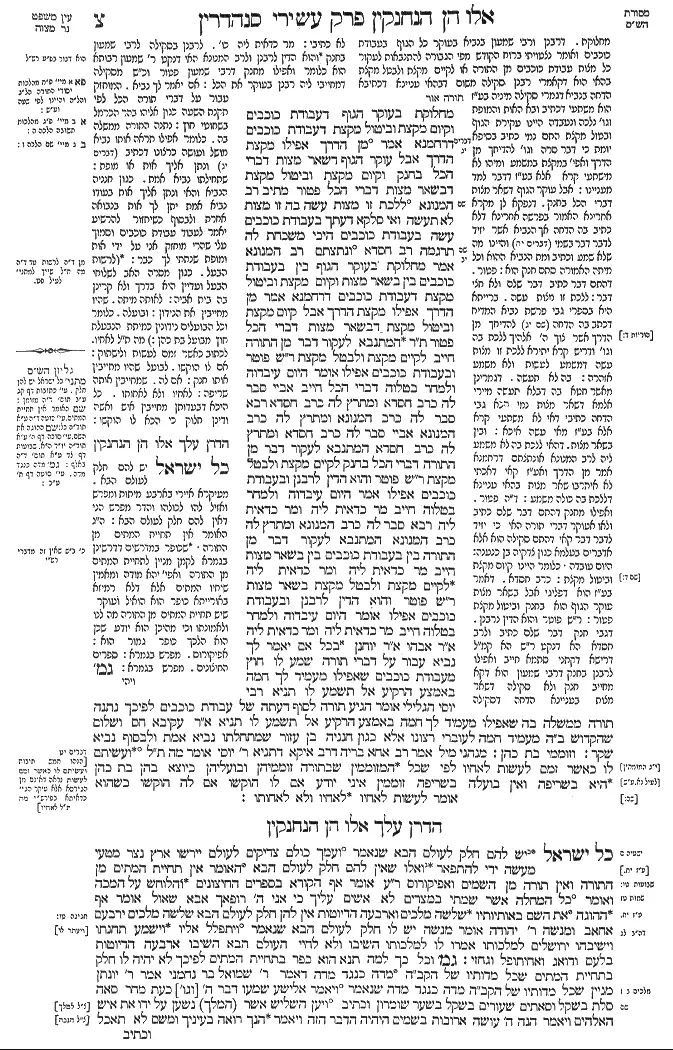
Sanhedrin 90a - Guemara
מחלוקת בעוקר הגוף דעבודת כוכבים וקיום מקצת וביטול מקצת דעבודת כוכבים דרחמנא אמר (דברים יג, ו) מן הדרך אפילו מקצת הדרך אבל עוקר הגוף דשאר מצות דברי הכל בחנק וקיום מקצת וביטול מקצת דבשאר מצות דברי הכל פטור מתיב רב המנונא (דברים יג, ו) ללכת זו מצות עשה בה זו מצות לא תעשה ואי סלקא דעתך בעבודת כוכבים עשה בעבודת כוכבים היכי משכחת לה תרגמה רב חסדא (דברים יב, ג) ונתצתם רב המנונא אמר מחלוקת בעוקר הגוף בין בעבודת כוכבים בין בשאר מצות וקיום מקצת וביטול מקצת דעבודת כוכבים דרחמנא אמר מן הדרך אפילו מקצת הדרך אבל קיום מקצת וביטול מקצת דבשאר מצות דברי הכל פטור ת"ר המתנבא לעקור דבר מן התורה חייב לקיים מקצת ולבטל מקצת ר"ש פוטר ובעבודת כוכבים אפילו אומר היום עיבדוה ולמחר בטלוה דברי הכל חייב אביי סבר לה כרב חסדא ומתרץ לה כרב חסדא רבא סבר לה כרב המנונא ומתרץ לה כרב המנונא אביי סבר לה כרב חסדא ומתרץ לה כרב חסדא המתנבא לעקור דבר מן התורה דברי הכל בחנק לקיים מקצת ולבטל מקצת ר"ש פוטר והוא הדין לרבנן ובעבודת כוכבים אפילו אמר היום עיבדוה ולמחר בטלוה חייב מר כדאית ליה ומר כדאית ליה רבא סבר לה כרב המנונא ומתרץ לה כרב המנונא המתנבא לעקור דבר מן התורה בין בעבודת כוכבים בין בשאר מצות חייב מר כדאית ליה ומר כדאית ליה לקיים מקצת ולבטל מקצת בשאר מצות ר"ש פוטר והוא הדין לרבנן ובעבודת כוכבים אפילו אומר היום עיבדוה ולמחר בטלוה חייב מר כדאית ליה ומר כדאית ליה א"ר אבהו א"ר יוחנן בכל אם יאמר לך נביא עבור על דברי תורה שמע לו חוץ מעבודת כוכבים שאפילו מעמיד לך חמה באמצע הרקיע אל תשמע לו תניא רבי יוסי הגלילי אומר הגיע תורה לסוף דעתה של עבודת כוכבים לפיכך נתנה תורה ממשלה בה שאפילו מעמיד לך חמה באמצע הרקיע אל תשמע לו תניא א"ר עקיבא חס ושלום שהקדוש ב"ה מעמיד חמה לעוברי רצונו אלא כגון חנניה בן עזור שמתחלתו נביא אמת ולבסוף נביא שקר:
וזוממי בת כהן:
מנהני מילי אמר רב אחא בריה דרב איקא דתניא ר' יוסי אומר מה ת"ל (דברים יט, יט) ועשיתם לו כאשר זמם לעשות לאחיו לפי שכל המזוממין שבתורה זוממיהן ובועליהן כיוצא בהן בת כהן היא בשריפה ואין בועלה בשריפה זוממין איני יודע אם לו הוקשו אם לה הוקשו כשהוא אומר לעשות לאחיו לאחיו ולא לאחותו:
הדרן עלך אלו הן הנחנקין
מתני׳ כל ישראל יש להם חלק לעולם הבא שנאמר (ישעיהו ס, כא) ועמך כולם צדיקים לעולם יירשו ארץ נצר מטעי מעשה ידי להתפאר ואלו שאין להם חלק לעולם הבא האומר אין תחיית המתים מן התורה ואין תורה מן השמים ואפיקורוס ר"ע אומר אף הקורא בספרים החיצונים והלוחש על המכה ואומר (שמות טו, כו) כל המחלה אשר שמתי במצרים לא אשים עליך כי אני ה' רופאך אבא שאול אומר אף ההוגה את השם באותיותיו שלשה מלכים וארבעה הדיוטות אין להן חלק לעולם הבא שלשה מלכים ירבעם אחאב ומנשה ר' יהודה אומר מנשה יש לו חלק לעולם הבא שנאמר (דברי הימים ב לג, יג) ויתפלל אליו וישמע תחנתו וישיבהו ירושלים למלכותו אמרו לו למלכותו השיבו ולא לחיי העולם הבא השיבו ארבעה הדיוטות בלעם ודואג ואחיתופל וגחזי:
גמ׳ וכל כך למה תנא הוא כפר בתחיית המתים לפיכך לא יהיה לו חלק בתחיית המתים שכל מדותיו של הקב"ה מדה כנגד מדה דאמר ר' שמואל בר נחמני אמר ר' יונתן מניין שכל מדותיו של הקב"ה מדה כנגד מדה שנאמר (מלכים ב ז, א) ויאמר אלישע שמעו דבר ה' [וגו'] כעת מחר סאה סלת בשקל וסאתים שעורים בשקל בשער שומרון וכתיב (מלכים ב ז, ב) ויען השליש אשר (המלך) נשען על ידו את איש האלהים ויאמר הנה ה' עושה ארובות בשמים היהיה הדבר הזה ויאמר הנך רואה בעיניך ומשם לא תאכל
Comments from Rashi on Masechet Sanhedrin Page 90a
מחלוקת . דרבנן ורבי שמעון בנביא בעוקר כל הגוף בעבודת כוכבים ואומר נצטויתי ברוח הקודש מפי הגבורה להתנבאות לעקור כל מצות עבודת כוכבים מן התורה או לקיים מקצת ולבטל מקצת בהאי הוא דקאמרי רבנן סקילה משום דבהאי עניינא דכתיבא הדחה בנביא דגמרי סקילה מיניה בע"ז הוא משתעי דכתיב ובא האות והמופת וגו' נלכה ונעבדה היינו עקירת הגוף ובטול מקצת התם נמי כתיב בסיפא יומת כי דבר סרה וגו' להדיחך מן הדרך ואפי' במקצת במשמע ומיהו לא מישתעי קרא אלא בע"ז דדבר למד מעניינו: אבל עוקר הגוף דשאר מצות דברי הכל בחנק . דנפקא לן מקרא אחרינא האמור בפרשה אחרינא דלא כתיב בה הדחה אך הנביא אשר יזיד לדבר דבר בשמי (דברים יח) והיינו מה שלא שמע וכתיב ומת הנביא ההוא וכל מיתה האמורה סתם חנק הוא: פטור . דהתם דבר כתיב דבר שלם ולא חצי דבר: ללכת זו מצות עשה . ברייתא היא בספרי גבי פרשת נביא המדיח דכתב בה הדחה (שם יג) להדיחך מן הדרך אשר צוך ה' אלהיך ללכת בה וגו' ודריש קרא יתירא ללכת זו מצות עשה דמשמע לעשות ולא משמע אזהרה: בה לא תעשה . דגמרינן מאשר חטא בה דבלא תעשה מיירי אלמא דשאר מצות נמי הכא גבי הדחה כתיבי דאי לא משתעי קרא אלא בע"ז מאי עשה איכא: ובין בשאר מצות . דהאי ללכת בה לא משמע ליה לרב המנונא אונתצתם דרחמנא אמר מן הדרך ואע"ז קאי דאכתי לא איתרבו שאר מצות בהאי עניינא דללכת בה כולה משמע: ד"ה פטור . ואפילו מחנק דהתם דבר שלם כתיב ולאו אעוקר דברי תורה האי כי יזיד לדבר דבר קאי דהתם סקילה הוא אלא אדברים בעלמא כגון צדקיה בן כנענה: היום עובדה . כלומר היינו קיום מקצת וביטול מקצת: כרב חסדא . דאמר בע"ז הוא דפליגי אבל בשאר מצות עוקר הגוף הוא בחנק וביטול מקצת פטור: ר"ש פוטר והוא הדין לרבנן . דגבי חנק דבר שלם כתיב ולרב חסדא הא דנקט ר"ש הא קמ"ל דרישא דקתני סתמא חייב ואפילו לרבנן בחנק דרבי שמעון הוא דקא מחייב חנק ולא סקילה דשאר מצות בעניינא הדחה דסקילה לא כתיבי: מר כדאית ליה כו' . לרבנן בסקילה לרבי שמעון בחנק והוא הדין לרבנן ולרב המנונא האי דנקט ר' שמעון רבותא הוא כלומר ואפילו מחנק דרבי שמעון פטור וכ"ש מסקילה דמחייבי ליה רבנן בעוקר את הכל: אם יאמר לך נביא . המוחזק עבור על דברי תורה הכל לפי תקנת השעה כגון אליהו בהר הכרמל בשחוטי חוץ: נתנה התורה ממשלה בה . כלומר אפילו תראה אותו נביא מושל ועושה כרצונו דכתיב (דברים יג) ונתן אליך אות או מופת: שתחילתו נביא אמת . כגון חנניה הנביא והאי ונתן אליך אות בעודו נביא אמת יתן לך אות בנבואה אחרת ולבסוף כשיחזור להרשיע יאמר לעבוד עבודת כוכבים וסמוך עלי שהרי מוחזק אני על ידי אות ומופת שנתתי לך כבר: (לרשות הבעל . כגון מסרה האב לשלוחי הבעל ועדיין היא בדרך ולא קרינן בה בית אביה: לאותה מיתה . שהיו מחייבין את הנידון: ובועלה . כלומר וכל הבועלים נידונין כמיתת הנבעלת חוץ מבועל בת כהן:) מה ת"ל לאחיו . לכתוב כאשר זמם לעשות ולישתוק: אם לו הוקשו . לבועל שהיו מחייבין אותו חנק: אם לה . שמחייבין אותה שריפה: לאחיו ולא לאחותו . כל היכא דבעדותן מחייבין איש ואשה ודינן חלוק כי הכא לו הוקשו: מתני' כל ישראל יש להם חלק לעולם הבא . מעיקרא איירי בארבע מיתות ומפרש ואזיל להו לכולהו והדר מפרש הני דאין להם חלק לעולם הבא: ה"ג האומר אין תחיית המתים מן התורה . שכופר במדרשים דדרשינן בגמרא לקמן מניין לתחיית המתים מן התורה ואפי' יהא מודה ומאמין שיחיו המתים אלא דלא רמיזא באורייתא כופר הוא הואיל ועוקר שיש תחיית המתים מן התורה מה לנו ולאמונתו וכי מהיכן הוא יודע שכן הוא הלכך כופר גמור הוא: אפיקורוס . מפרש בגמרא: ספרים החיצונים . מפרש בגמרא:
Sanhedrin 90a - Mishnah translated into english
The dispute is with regard to a prophet who prophesies to abolish the essence of the prohibition of idol worship, or a prophet who espouses fulfillment of part of the prohibition and nullification of part of the prohibition of idol worship, asserting that idol worship is permitted in certain circumstances, as the Merciful One says: “And that prophet…shall be put to death; because he has spoken perversion against the Lord…to divert you from the way on which the Lord your God commanded you to walk” (Deuteronomy 13:6). It may be inferred from this verse: If he diverts you even from part of the way. In these cases, Rabbi Shimon holds that he is executed by strangulation, and the Rabbis hold that he is executed by stoning.
But if a prophet abolishes the essence of the rest of the mitzvot, everyone agrees that he is executed by strangulation. And if the prophet espouses fulfillment of part and nullification of part of other mitzvot, everyone agrees that he is exempt from punishment. If a true prophet espouses temporary nullification of a specific mitzva, one must heed his words.
Rav Hamnuna raises an objection from a baraita that interprets the phrase in the verse “to divert you from the way on which the Lord your God commanded you to walk.” “To walk”; this is a reference to a positive mitzva. “On which”; this is a reference to a prohibition. And if it enters your mind that the verse is stated with regard to idol worship, how can you find a positive mitzva relating to idol worship? The Gemara answers: Rav Ḥisda interpreted that the positive mitzva referred to in the verse is: “And you shall smash their altars, and break their pillars, and burn their asherim in fire; and you shall hew down the graven images of their gods; and you shall destroy their name from that place” (Deuteronomy 12:3). A prophet is liable to receive the death penalty if he abolishes this mitzva.
Although his objection was resolved, Rav Hamnuna suggests an alternative explanation of the dispute and says: The dispute is with regard to a prophet who prophesies to abolish the essence of a mitzva, whether it is with regard to idol worship or with regard to the rest of the mitzvot; or a prophet who espouses fulfillment of part of the prohibition and nullification of part of the prohibition of idol worship. This is as the Merciful One says: “From the way,” from which it may be inferred: If he diverts you from even part of the way. In these cases, Rabbi Shimon holds that he is executed by strangulation, and the Rabbis hold that he is executed by stoning.
But if the prophet espouses fulfillment of part and nullification of part of other mitzvot, everyone agrees that he is exempt from punishment, as that is within the prophet’s mandate.
The Sages taught: In the case of one who prophesies to abolish a matter from the Torah, he is deemed a false prophet and is liable to be executed by strangulation. If he prophesies to fulfill part or to nullify part of a matter in the Torah, Rabbi Shimon deems him exempt from execution. And with regard to idol worship, even if he says: Worship it today and tomorrow nullify it, everyone agrees that he is liable.
The Gemara comments: Abaye holds in accordance with the opinion of Rav Ḥisda and explains the baraita in accordance with the opinion of Rav Ḥisda. Rava holds in accordance with the opinion of Rav Hamnuna and explains the baraita in accordance with the opinion of Rav Hamnuna.
The Gemara elaborates: Abaye holds in accordance with the opinion of Rav Ḥisda and explains the baraita in accordance with the opinion of Rav Ḥisda. In the case of one who prophesies to abolish a matter from the Torah, everyone agrees that he is executed by strangulation. If he prophesies to fulfill part or to nullify part of a Torah law, Rabbi Shimon deems him exempt from execution, and the same is true of the Rabbis, who also hold that he is exempt. And with regard to idol worship, even if he says: Worship it today and nullify it tomorrow, everyone agrees that he is liable to be executed. What form of death penalty is imposed? One Sage, the Rabbis, rules in accordance with what he holds, i.e., stoning, and one Sage, Rabbi Shimon, rules in accordance with what he holds, i.e., strangulation.
Rava holds in accordance with the opinion of Rav Hamnuna and explains the baraita in accordance with the opinion of Rav Hamnuna. In the case of one who prophesies to abolish a matter from the Torah, whether it is with regard to idol worship or with regard to the rest of the mitzvot, he is liable to be executed. What form of death penalty is imposed? One Sage, the Rabbis, rules in accordance with what he holds, i.e., stoning, and one Sage, Rabbi Shimon, rules in accordance with what he holds, i.e., strangulation. If he prophesies to fulfill part or to nullify part of a Torah law other than idol worship, Rabbi Shimon deems him exempt from execution, and the same is true of the Rabbis, who also hold that he is exempt. And with regard to idol worship, even if he says: Worship it today and nullify it tomorrow, everyone agrees that he is liable to be executed. What form of death penalty is imposed? One Sage, the Rabbis, rules in accordance with what he holds, i.e., stoning, and one Sage, Rabbi Shimon, rules in accordance with what he holds, i.e., strangulation.
Rabbi Abbahu says that Rabbi Yoḥanan says, in summary: With regard to all mitzvot, if a prophet will say to you: Violate matters of Torah on a provisional basis, heed him, except for idol worship, as even if he establishes that he is a bona fide prophet and stops the sun for you in the middle of the sky, do not heed him. It is taught in a baraita that Rabbi Yosei HaGelili says: The Torah ascertained the depth of the mentality of idol worship, the danger that it presents, and the lure of its ideology. Therefore, the Torah ascribed the false prophet with dominion in its regard, recognizing that a false prophet could perform wonders on the basis of idol worship. Therefore, even if the false prophet stops the sun for you in the middle of the sky, do not heed him.
It is taught in a baraita that Rabbi Akiva says: Heaven forfend that the Holy One, Blessed be He, would stop the sun for those who violate His will. A false prophet could never perform an actual miracle. Rather, this warning is relevant only in the case of a prophet, for example, Hananiah, son of Azzur, whose origin was as a true prophet, at which point he could perform miracles; and ultimately, he was a false prophet. Therefore, although he had already been established as a true prophet, once he espouses idol worship, it is clear that he is a false prophet.
§ The mishna teaches: And conspiring witnesses who testified that the daughter of a priest and her paramour committed adultery are executed by strangulation. The Gemara asks: From where are these matters derived? Rav Aḥa, son of Rav Ika, says: It is derived as it is taught in a baraita that Rabbi Yosei says: What is the meaning when the verse states with regard to conspiring witnesses: “And you shall do to him as he conspired to do to his brother” (Deuteronomy 19:19)? The verse is formulated in this manner due to the fact that in all cases involving those rendered conspiring witnesses who are mentioned in the Torah, e.g., forbidden relatives, the sentences of their conspiring witnesses and their paramours are similar to their own sentences, and the witnesses are executed by strangulation.
The baraita continues: The daughter of a priest is an exception, as she is executed by burning if she commits adultery, and her paramour is not executed by burning. With regard to conspiring witnesses who testified that they committed adultery, I do not know if the witnesses are likened to the paramour or if they are likened to the daughter of the priest, in terms of punishment. When the verse states with regard to conspiring witnesses: “As he conspired to do to his brother,” one infers: As he conspired to do to his brother, but not as he conspired to do to his sister. The execution of the conspiring witnesses is likened to the execution of the paramour, who is executed by strangulation, and is not likened to the execution of the daughter of the priest, who is executed by burning.
MISHNA: All of the Jewish people, even sinners and those who are liable to be executed with a court-imposed death penalty, have a share in the World-to-Come, as it is stated: “And your people also shall be all righteous, they shall inherit the land forever; the branch of My planting, the work of My hands, for My name to be glorified” (Isaiah 60:21). And these are the exceptions, the people who have no share in the World-to-Come, even when they fulfilled many mitzvot: One who says: There is no resurrection of the dead derived from the Torah, and one who says: The Torah did not originate from Heaven, and an epikoros, who treats Torah scholars and the Torah that they teach with contempt.
Rabbi Akiva says: Also included in the exceptions are one who reads external literature, and one who whispers invocations over a wound and says as an invocation for healing: “Every illness that I placed upon Egypt I will not place upon you, for I am the Lord, your Healer” (Exodus 15:26). By doing so, he shows contempt for the sanctity of the name of God and therefore has no share in the World-to-Come. Abba Shaul says: Also included in the exceptions is one who pronounces the ineffable name of God as it is written, with its letters.
Three prominent kings mentioned in the Bible and four prominent commoners who are described in the Bible as men of great wisdom have no share in the World-to-Come. The three kings are: Jeroboam, son of Nebat, and Ahab, both of whom were kings of Israel, and Manasseh, king of Judea. Rabbi Yehuda says: Manasseh has a share in the World-to-Come, as it is stated concerning Manasseh: “And he prayed to Him, and He received his entreaty, and heard his supplication and brought him back to Jerusalem unto his kingdom” (II Chronicles 33:13), indicating that he repented wholeheartedly and effectively. The Rabbis said to Rabbi Yehuda: He regretted his actions, and his repentance was effective to the extent that God restored him to his kingdom, but God did not restore him to his share in life in the World-to-Come. The four commoners are: Balaam, son of Beor; Doeg the Edomite; Ahithophel; and Gehazi.
GEMARA: And why is one punished to that extent for saying that there is no resurrection of the dead derived from the Torah? The Sages taught in a baraita: He denied the resurrection of the dead; therefore he will not have a share in the resurrection of the dead, as all measures dispensed by the Holy One, Blessed be He, to His people are dispensed measure for measure, i.e., the response is commensurate with the action.
This is based on that which Rabbi Shmuel bar Naḥmani says that Rabbi Yonatan says: From where is it derived that all measures dispensed by the Holy One, Blessed be He, are dispensed measure for measure? It is derived from a verse, as it is stated concerning the siege of Jerusalem: “And Elisha said: Hear the word of the Lord; so said the Lord: Tomorrow at this time one se’a of fine flour will be sold for one shekel and two se’a of barley for one shekel in the gate of Samaria” (II Kings 7:1). And it is written: “And the officer on whose hand the king leaned answered the man of God and said: Will the Lord make windows in heaven? Might this thing be? And he said: You shall see it with your eyes, but you shall not eat from there” (II Kings 7:2).
Traduction : The William Davidson digital edition of the Koren Noé Talmud, with commentary by Rabbi Adin Even-Israel Steinsaltz.