 Talmud Bavli
The learning on the whole site is dedicated : L'ilui Nishmat Rav Chlomo Ben Jamilla
The learning on the whole site is dedicated : L'ilui Nishmat יוסף בן מושה
The learning on the whole site is dedicated : L'ilui Nishmat Jamila bat Chlomo Abensour
Sanhedrin 54a : Youtube
Daf TubeYoutube
2 video classes :
Sanhedrin Page 54a
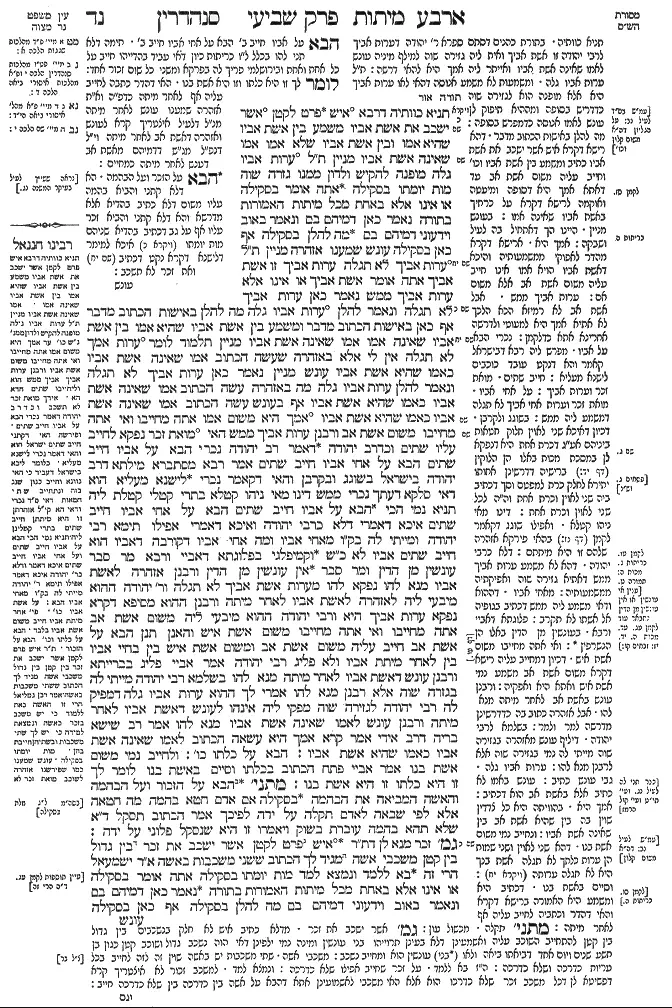
Sanhedrin 54a - Guemara
תניא כוותיה דרבא (ויקרא כ, יא) איש פרט לקטן (ויקרא כ, יא) אשר ישכב את אשת אביו משמע בין אשת אביו שהיא אמו ובין אשת אביו שלא אמו אמו שאינה אשת אביו מניין ת"ל (ויקרא כ, יא) ערות אביו גלה מופנה להקיש ולדון ממנו גזרה שוה מות יומתו בסקילה אתה אומר בסקילה או אינו אלא באחת מכל מיתות האמורות בתורה נאמר כאן דמיהם בם ונאמר באוב וידעוני דמיהם בם מה להלן בסקילה אף כאן בסקילה עונש שמענו אזהרה מניין ת"ל (ויקרא יח, ז) ערות אביך לא תגלה ערות אביך זו אשת אביך אתה אומר אשת אביך או אינו אלא ערות אביך ממש נאמר כאן ערות אביך לא תגלה ונאמר להלן (ויקרא כ, יא) ערות אביו גלה מה להלן באישות הכתוב מדבר אף כאן באישות הכתוב מדבר ומשמע בין אשת אביו שהיא אמו בין אשת אביו שאינה אמו אמו שאינה אשת אביו מניין תלמוד לומר (ויקרא יח, ז) ערות אמך לא תגלה אין לי אלא באזהרה שעשה הכתוב אמו שאינה אשת אביו כאמו שהיא אשת אביו עונש מניין נאמר כאן ערות אביך לא תגלה ונאמר להלן ערות אביו גלה מה באזהרה עשה הכתוב אמו שאינה אשת אביו כאמו שהיא אשת אביו אף בעונש עשה הכתוב אמו שאינה אשת אביו כאמו שהיא אשת אביו (ויקרא יח, ז) אמך היא משום אמו אתה מחייבו ואי אתה מחייבו משום אשת אב ורבנן ערות אביך ממש האי (ויקרא יח, כב) מואת זכר נפקא לחייב עליו שתים וכדרב יהודה דאמר רב יהודה נכרי הבא על אביו חייב שתים הבא על אחי אביו חייב שתים אמר רבא מסתברא מילתא דרב יהודה בישראל בשוגג ובקרבן והאי דקאמר נכרי לישנא מעליא הוא דאי סלקא דעתך נכרי ממש דינו מאי ניהו קטלא בתרי קטלי קטלת ליה תניא נמי הכי הבא על אביו חייב שתים הבא על אחי אביו חייב שתים איכא דאמרי דלא כרבי יהודה ואיכא דאמרי אפילו תימא רבי יהודה ומייתי לה בק"ו מאחי אביו ומה אחי אביו דקורבה דאביו הוא חייב שתים אביו לא כ"ש וקמיפלגי בפלוגתא דאביי ורבא מר סבר עונשין מן הדין ומר סבר אין עונשין מן הדין ורבנן אזהרה לאשת אביו מנא להו נפקא להו מערות אשת אביך לא תגלה ור' יהודה ההוא מיבעי ליה לאזהרה לאשת אביו לאחר מיתה ורבנן ההוא מסיפא דקרא נפקא ערות אביך היא ורבי יהודה ההוא מיבעי ליה משום אשת אב אתה מחייבו ואי אתה מחייבו משום אשת איש והאנן תנן הבא על אשת אב חייב עליה משום אשת אב ומשום אשת איש בין בחיי אביו בין לאחר מיתת אביו ולא פליג רבי יהודה אמר אביי פליג בברייתא ורבנן עונש דאשת אביו לאחר מיתה מנא להו בשלמא רבי יהודה מייתי לה בגזרה שוה אלא רבנן מנא להו אמרי לך ההוא ערות אביו גלה דמפיק לה רבי יהודה לגזירה שוה מפקי ליה אינהו לעונש דאשת אביו לאחר מיתה ורבנן עונש לאמו שאינה אשת אביו מנא להו אמר רב שישא בריה דרב אידי אמר קרא אמך היא עשאה הכתוב לאמו שאינה אשת אביו כאמו שהיא אשת אביו:
הבא על כלתו כו':
ולחייב נמי משום אשת בנו אמר אביי פתח הכתוב בכלתו וסיים באשת בנו לומר לך זו היא כלתו זו היא אשת בנו:
מתני׳ הבא על הזכור ועל הבהמה והאשה המביאה את הבהמה בסקילה אם אדם חטא בהמה מה חטאה אלא לפי שבאה לאדם תקלה על ידה לפיכך אמר הכתוב תסקל ד"א שלא תהא בהמה עוברת בשוק ויאמרו זו היא שנסקל פלוני על ידה:
גמ׳ זכר מנא לן דת"ר (ויקרא כ, יג) איש פרט לקטן אשר ישכב את זכר בין גדול בין קטן משכבי אשה מגיד לך הכתוב ששני משכבות באשה א"ר ישמעאל הרי זה בא ללמד ונמצא למד מות יומתו בסקילה אתה אומר בסקילה או אינו אלא באחת מכל מיתות האמורות בתורה נאמר כאן דמיהם בם ונאמר באוב וידעוני דמיהם בם מה להלן בסקילה אף כאן בסקילה
Comments from Rashi on Masechet Sanhedrin Page 54a
תניא כוותיה . בתורת כהנים דסתם ספרא ר' יהודה דערות אביך לרבי יהודה זו אשת אביך ואית ליה גזירה שוה למילף מיניה עונש לאמו שאינה אשת אביו ואייתר ליה אמך היא להאי דרשה: ת"ל ערות אביו גלה . ומשמעות לא משמע אנוסה דהאי לאו ערות אביך היא אלא מופנה הוא לגזירה שוה כדדריש בסופה ומההיא תיפוק לן עונש לאמו אנוסה כדמפרש בסופה: מה להלן באישות הכתוב מדבר . דהא רישא דקרא איש אשר ישכב את אשת אביו כתיב ומשמע בין אשת אביו וכו' וחייב עליה משום אשת אב עד דאתא אמך היא דסופה ומיעטה ואוקמה לרישא דקרא על כרחיך באשת אביו שאינה אמו: בעונש מניין . היינו הך דאתחיל בה לעיל ושבקה: אמך היא . ארישא דקרא מהדר לאפוקי ממשמעותיה והיכא דאשת אביו הויא אמו אינו חייב עליה משום אשת אב אלא משום אם: ערות אביך ממש . אבל אשת אב לא רמיזא הכא הלכך לא אתיא אמך היא למעוטי ולדרשה אחרינא אתא כדלקמן: נכרי הבא על אביו . מפרש ליה רבא דבישראל קאמר והא דנקט עובד כוכבים לישנא מעליא: חייב שתים . מואת זכר וערות אביך: על אחי אביו . מואת זכר וערות אחי אביך לא תגלה דמשמע ליה ממש: בשוגג ולקרבן . דכיון דאיכא שני לאוין חלוק חטאות ביניהם אע"ג דכרת אחת היא דנפקא לן במסכת מכות באלו הן הלוקין (דף יד:) ברישיה דדרשינן אחותו יתירא לחלק כרת למפטם וסך דכתיב ביה שני לאוין וכרת אחת וה"ה לכל שני לאוין וכרת אחת: דינו מאי ניהו קטלא . ואפילו שוגג דקאמר לקמן (סנהדרין דף נז:) בהאי פירקא אזהרה שלהם זו היא מיתתם: דלא כרבי יהודה . דהא לא משמע ערות אביך ממש דאתיא גזירה שוה ואפיקתיה ממשמעותיה: מאחי אביו . דההוא ודאי משמע ליה ממש דכתיב בגופיה אל אשתו לא תקרב: פלוגתא דאביי ורבא . בעונשין מן הדין באלו הן הנשרפין: ואי אתה מחייבו משום אשת איש . דכיון דמחייב עליה רישא דקרא משום אשת אב משמע נמי אשת איש ואתא היא ואפקיה: ורבנן עונש באשת אב לאחר מיתה מנא להו . אבל אזהרה כתוב בה כדדרשינן מדרשה למר ולמר: בשלמא לרבי יהודה . דיליף עונש מאזהרה בגזירה שוה מייתי לה נמי בגזירה שוה אלא לרבנן מנא להו: ערות אביו גלה . גבי עונש כתיב: עונש באמו לא כתיב אלא באשת אב הוא דכתיב: אמך היא . בהוויתה היא כל צדדין שוין בה בין שהיא אשת אב בין שאינה אשת אביו: ונחייב נמי משום אשת בנו . דהא שני לאוין ושני שמות הן ערות כלתך לא תגלה אשת בנך היא לא תגלה ערותה (ויקרא יח): וסיים באשת בנו . דכתיב היא ומשמע היא האמורה ברישא דקרא והאי דהדר וכתביה לחייב עליה אף לאחר מיתה: מתני' תקלה . מכשול עון: גמ' אשר ישכב את זכר . מדלא כתיב איש לא חלק בנשכבים בין גדול בין קטן להתחייב השוכב עליה ואשמעינן דלא בעינן תרוייהו בני עונשין ומינה נמי ילפינן דאי הוה נשכב גדול ושוכב קטן כגון בן תשע שנים ויום אחד דביאתו ביאה ולאו (בני) עונשין הוא ומחייב נשכב: משכבי אשה . שתי משכבות יש באשה שוין זה לזה לחייב בכל עריות כדרכה ושלא כדרכה: ה"ז בא ללמד . על זכר שחייב אפילו שלא כדרכה: ונמצא למד . למשכב זכור לא איצטריך קרא דפשיטא לן דכל משכב זכר שלא כדרכו הוא אלא האי משכבי לאשמועינן אתא דהבא על אשה בין כדרכה בין שלא כדרכה חייב:
Comments from Tosafot - Sanhedrin 54a
הבא על אביו חייב ב' הבא על אחי אביו חייב ב'. תימה דלא תני להו בכלל ל"ו כריתות כיון דאי עביד בהדייהו חייב על כל אחת ואחת ובירושלמי פריך לה בפרקא ומשני כל שום זכור אחד: לומר לך זו היא כלתו וזו היא אשת בנו . האי דהדר כתבה לחייב עליה אף לאחר מיתה כדפ"ה וא"ת אזהרה שמענו עונש לאחר מיתה מנ"ל דלעיל איצטריך קרא לעונש ואזהרה דאשת אב לאחר מיתה וי"ל דנפ"ל מג"ש דדמיהם מאשת אב דענש לאחר מיתה כמחיים: הבא על הזכר ועל הבהמה . הא דלא קתני והביא בהמה עליו משום דלא כתיב בהדיא אלא מדרשא והא דלא קתני והביא זכר עליו אף על גב דכתיב בהדיא שניהם מות יומתו (ויקרא כ) איכא למימר דלישנא דקרא נקט דכתיב (שם יח) ואת זכר לא תשכב:
Sanhedrin 54a - Mishnah translated into english
§ It is taught in a baraita in accordance with the opinion of Rava: With regard to the verse: “And the man who lies with his father’s wife, he has uncovered his father’s nakedness; both of them shall be put to death, their blood shall be upon them” (Leviticus 20:11), the term: “The man,” excludes a minor.
The phrase “who lies with his father’s wife” indicates that he is liable to receive capital punishment whether she is his father’s wife who is his mother or whether she is his father’s wife who is not his mother. From where is it derived that he is liable in a case where she is his mother who is not his father’s wife? The verse states: “He has uncovered his father’s nakedness.” Although this phrase does not relate directly to the case of one’s mother who is not his father’s wife, the halakha in this case is derived from this phrase as it is free, i.e., the phrase is superfluous in this context, and is evidently included in the verse in order to compare between the two cases and learn a verbal analogy from it, as the baraita will elaborate below.
From the phrase “both of them shall be put to death” it is derived that they are executed by stoning. The baraita asks: Do you say that that they are executed by stoning, or is it rather by one of all the other types of the death penalty that are stated in the Torah? The baraita answers: It is stated here: “Their blood shall be upon them,” and it is stated with regard to a necromancer and a sorcerer: “Their blood shall be upon them” (Leviticus 20:27). Just as there the verse states that a necromancer and a sorcerer are executed by stoning, so too here, with regard to one who engages in intercourse with his father’s wife, the transgressors are executed by stoning.
The baraita asks: We have learned the punishment for one who engages in intercourse with his father’s wife. From where is the prohibition against doing this act derived? The baraita answers: The verse states: “The nakedness of your father and the nakedness of your mother you shall not uncover” (Leviticus 18:7); the phrase “the nakedness of your father” is referring to your father’s wife.
The baraita asks: Do you say that the reference is to your father’s wife, or is it rather referring to the nakedness of your father literally, i.e., to homosexual intercourse with one’s father? The baraita answers: It is stated here: “The nakedness of your father…you shall not uncover,” and it is stated there, in the verse that describes the punishment: “And the man who lies with his father’s wife, he has uncovered his father’s nakedness” (Leviticus 20:11). Just as there, the verse is speaking of marriage, i.e., it is not referring to the father himself but to his wife, so too here, the verse is speaking of marriage, i.e., his father’s wife.
And the verse indicates that one’s father’s wife is forbidden to him whether she is his father’s wife who is his mother or whether she is his father’s wife who is not his mother. From where is it derived that she is forbidden to him in a case where she is his mother who is not his father’s wife? The verse states: “The nakedness of your mother you shall not uncover” (Leviticus 18:7).
The baraita asks: I have derived only with regard to the prohibition that the verse renders the halakha of his mother who is not his father’s wife like that of his mother who is his father’s wife. But with regard to the punishment, from where do I derive that they share the same halakha?
The baraita answers, expounding on the verbal analogy it mentioned earlier: It is stated here, in the verse that describes the prohibition: “The nakedness of your father…you shall not uncover” (Leviticus 18:7), and it is stated there, in the verse that describes the punishment: “He has uncovered his father’s nakedness” (Leviticus 20:11). It is derived from this verbal analogy that just as with regard to the prohibition, the verse renders his mother who is not his father’s wife like his mother who is his father’s wife, i.e., both are forbidden, so too, with regard to the punishment, the verse renders his mother who is not his father’s wife like his mother who is his father’s wife.
It is derived from the phrase: “She is your mother” (Leviticus 18:7), that you render him liable due to the prohibition against engaging in intercourse with his mother, but you do not render him liable due to the prohibition against engaging in intercourse with his father’s wife. The baraita ends here. Since the halakhot in the collection of baraitot where this baraita appears, Torat Kohanim, are in accordance with the opinions of Rabbi Yehuda, the baraita supports the opinion of Rava, who explains the opinion of Rabbi Yehuda in this manner.
The Gemara discusses the baraita, asking: And how do the Rabbis, who disagree with Rabbi Yehuda, interpret the phrase “the nakedness of your father”? The Gemara answers: They hold that this phrase is meant literally, i.e., that it is referring to homosexual intercourse. They do not accept the verbal analogy from which Rabbi Yehuda derives that the reference is to intercourse with one’s father’s wife.
The Gemara asks: Isn’t this prohibition against homosexual intercourse with one’s father derived from the verse: “And you shall not lie with a male as with a woman; it is an abomination” (Leviticus 18:22)? The Gemara answers: The prohibition is stated specifically with regard to one’s father in order to render him liable to bring two sin-offerings for unwittingly engaging in intercourse with his father.
And it is in accordance with the statement of Rav Yehuda, as Rav Yehuda says: A gentile who engages in intercourse with his father is liable for committing two transgressions. Likewise, one who engages in intercourse with his father’s brother is liable for committing two transgressions.
Rava says: It stands to reason that the statement of Rav Yehuda is with regard to a Jew who does this unwittingly. And the statement that he is liable for committing two transgressions concerns his liability to bring an offering, i.e., he is liable to bring two sin-offerings. And even though the fact remains that he said gentile, it is a euphemism, as he did not want to attribute such a sin to a Jew. As if it enters your mind that the reference is literally to a gentile, the statement that he is liable for committing two transgressions is meaningless; what is his punishment for such a transgression? It is death. Could you kill him twice? Rather, it must be referring to a Jew who acted unwittingly.
This halakha is also taught in a baraita: One who engages in intercourse with his father is liable for committing two transgressions. One who engages in intercourse with his father’s brother is liable for committing two transgressions, as it is stated: “You shall not uncover the nakedness of your father’s brother” (Leviticus 18:14).
Some say that this is not in accordance with the opinion of Rabbi Yehuda, as in his opinion there is no special prohibition against homosexual intercourse with one’s father. He interprets the verse: “The nakedness of your father…you shall not uncover” as referring to one’s father’s wife. Accordingly, one who engages in homosexual intercourse with his father or with his father’s brother is liable only due to the general prohibition against homosexual intercourse.
And some say: You may even say that the baraita is in accordance with the opinion of Rabbi Yehuda, and that he derives that there is a specific prohibition against homosexual intercourse with one’s father by an a fortiori inference from the prohibition concerning one’s father’s brother. And the inference is as follows: If for intercourse with one’s father’s brother, who is merely his father’s relative, one is liable for committing two transgressions, for intercourse with his father, is it not clear all the more so that he should be liable for committing two transgressions?
And the Sages who provide these two interpretations of Rabbi Yehuda’s opinion disagree with regard to the issue that is the subject of the dispute between Abaye and Rava. One Sage, he of the second interpretation, holds that one administers punishment based on an a fortiori inference. Even with regard to a prohibition that is derived a fortiori, one who transgresses it is liable. And one Sage, he of the first interpretation, holds that one does not administer punishment based on an a fortiori inference.
The Gemara asks: And with regard to the Rabbis, who disagree with the opinion of Rabbi Yehuda, from where do they derive the prohibition of intercourse with one’s father’s wife? The Gemara answers: They derive it from the verse: “The nakedness of your father’s wife you shall not uncover; it is your father’s nakedness” (Leviticus 18:8).
The Gemara asks: And what does Rabbi Yehuda derive from this verse, since he derives the prohibition from the verse: “The nakedness of your father…you shall not uncover”? The Gemara answers: That verse is necessary for the prohibition of one’s father’s wife after his father’s death; even though his father is dead, his father’s wife remains forbidden to him.
The Gemara asks: And from where do the Rabbis derive that halakha? The Gemara answers: That halakha is derived from the last clause of the verse: “It is your father’s nakedness.”
The Gemara asks: And what does Rabbi Yehuda derive from that clause? The Gemara answers: That clause is necessary to teach the halakha that if one engages in intercourse with his father’s wife, you render him liable due to the prohibition against engaging in intercourse with his father’s wife, but you do not render him liable due to the prohibition against engaging in intercourse with a married woman.
The Gemara asks: But didn’t we learn in the mishna: One who engages in intercourse with his father’s wife is liable to bring two offerings, one due to the fact that she is his father’s wife and one due to the fact that she is a married woman, and he is liable due to the former prohibition both during his father’s lifetime and after his father’s death? The Gemara notes: And Rabbi Yehuda does not dispute this. So how can it be suggested that in Rabbi Yehuda’s opinion, one who engages in intercourse with his father’s wife is not liable for engaging in intercourse with a married woman?
Abaye says: He disputes this ruling in a baraita. Although it is not mentioned in the mishna that Rabbi Yehuda disputes this ruling, it is mentioned in a different source.
The Gemara asks: And as for the Rabbis, from where do they derive the punishment for one who engages in intercourse with his father’s wife after his father’s death? Granted, according to Rabbi Yehuda, it is derived by means of a verbal analogy. But from where do the Rabbis, who do not accept the verbal analogy, derive it?
The Gemara answers: The Rabbis can say to you that it is derived as follows: With regard to that phrase, “he has uncovered his father’s nakedness,” from which Rabbi Yehuda derives a verbal analogy, they derive from it the punishment for one who engages in intercourse with his father’s wife after his father’s death.
The Gemara asks: And as for the Rabbis, from where do they derive the punishment for one who engages in intercourse with his mother who is not his father’s wife? Rav Sheisha, son of Rav Idi, says: The verse states: “She is your mother” (Leviticus 18:7). The verse renders the halakha of his mother who is not his father’s wife like that of his mother who is his father’s wife.
The mishna teaches with regard to one who engages in intercourse with his daughter-in-law that he is liable both due to the fact that she is his daughter-in-law and due to the fact that she is a married woman. The Gemara asks: And let him also be liable due to engaging in intercourse with his son’s wife, as it is stated in the verse: “You shall not uncover the nakedness of your daughter-in-law; she is your son’s wife, you shall not uncover her nakedness” (Leviticus 18:15). Abaye says: The verse begins with his daughter-in-law and ends with his son’s wife, to tell you that these are not two prohibitions; rather, his daughter-in-law [kallato] is his son’s wife. They are one and the same.
MISHNA: A man who engages in intercourse with a male or with an animal, and a woman who engages in intercourse with an animal, are executed by stoning. The animal is likewise stoned to death. The mishna asks: If the person sinned by doing this, how did the animal sin? Rather, because a calamity was caused to a person by it, therefore the verse states that it should be stoned, so that it does not cause another to sin. Alternatively, it is so that this animal will not pass through the marketplace, and those who see it will say: This is the animal because of which so-and-so was stoned, and its existence would shame his memory.
GEMARA: From where do we derive the prohibition and punishment for homosexual intercourse with a male? It is as the Sages taught in a baraita with regard to the verse: “And if a man lies with a male as with a woman, both of them have committed an abomination; they shall be put to death, their blood shall be upon them” (Leviticus 20:13): The word “man” excludes a minor boy. The phrase “lies with a male” is referring to any male, whether he is an adult man or whether he is a minor boy. The phrase “as with a woman [mishkevei isha],” referring to lying with a woman, appears in the plural. The verse teaches you that there are two manners of lying with a woman for which one who engages in intercourse with a woman forbidden to him is punished, vaginal and anal intercourse.
Rabbi Yishmael says: This phrase is written to come to teach about the punishment for homosexual intercourse, and the halakha that one is liable for anal intercourse with a woman who is forbidden to him is found to be derived from it.
The phrase “they shall be put to death” is referring to execution by stoning. Do you say that they are executed by stoning, or is it rather by one of all the other types of death penalty that are stated in the Torah? It is stated here: “Their blood shall be upon them,” and it is stated with regard to a necromancer and a sorcerer: “Their blood shall be upon them” (Leviticus 20:27). Just as there the verse states that a necromancer and a sorcerer are executed by stoning, so too here, they are executed by stoning.
Traduction : The William Davidson digital edition of the Koren Noé Talmud, with commentary by Rabbi Adin Even-Israel Steinsaltz.