 Talmud Bavli
Pesahim 118a : Youtube
Daf TubeYoutube
3 video classes :
Pesahim Page 118a
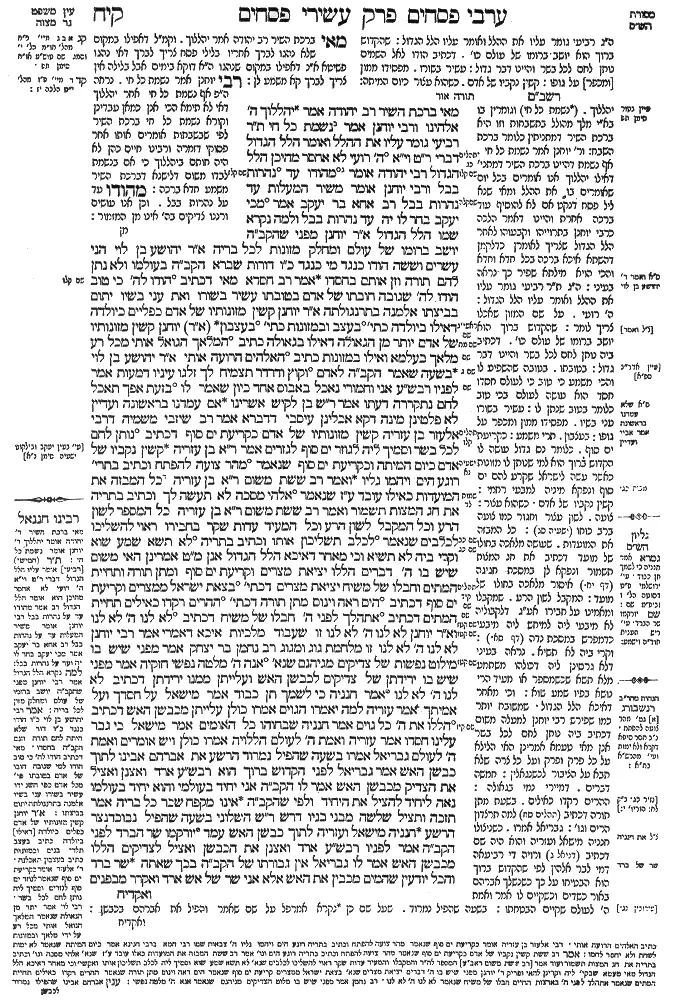
Pesahim 118a - Guemara
מאי ברכת השיר רב יהודה אמר יהללוך ה' אלהינו ורבי יוחנן אמר נשמת כל חי ת"ר רביעי גומר עליו את ההלל ואומר הלל הגדול דברי ר"ט וי"א (תהלים כג, א) ה' רועי לא אחסר מהיכן הלל הגדול רבי יהודה אומר (תהלים קלו, א) מהודו עד (תהלים קלז, א) נהרות בבל ורבי יוחנן אומר משיר המעלות עד נהרות בבל רב אחא בר יעקב אמר (תהלים קלה, ד) מכי יעקב בחר לו יה עד נהרות בבל ולמה נקרא שמו הלל הגדול א"ר יוחנן מפני שהקב"ה יושב ברומו של עולם ומחלק מזונות לכל בריה א"ר יהושע בן לוי הני עשרים וששה הודו כנגד מי כנגד כ"ו דורות שברא הקב"ה בעולמו ולא נתן להם תורה וזן אותם בחסדו אמר רב חסדא מאי דכתיב (תהלים קלו, א) הודו לה' כי טוב הודו לה' שגובה חובתו של אדם בטובתו עשיר בשורו ואת עני בשיו יתום בביצתו אלמנה בתרנגולתה א"ר יוחנן קשין מזונותיו של אדם כפליים כיולדה דאילו ביולדה כתי' (בראשית ג, טז) בעצב ובמזונות כתי' (בראשית ג, יז) בעצבון (א"ר) יוחנן קשין מזונותיו של אדם יותר מן הגאולה דאילו בגאולה כתיב (בראשית מח, טז) המלאך הגואל אותי מכל רע מלאך בעלמא ואילו במזונות כתיב (בראשית מח, טו) האלהים הרועה אותי א"ר יהושע בן לוי בשעה שאמר הקב"ה לאדם (בראשית ג, יח) וקוץ ודרדר תצמיח לך זלגו עיניו דמעות אמר לפניו רבש"ע אני וחמורי נאכל באבוס אחד כיון שאמר לו (בראשית ג, יט) בזעת אפך תאכל לחם נתקררה דעתו אמר ר"ש בן לקיש אשרינו אם עמדנו בראשונה ועדיין לא פלטינן מינה דקא אכלינן עיסבי דדברא אמר רב שיזבי משמיה דרבי אלעזר בן עזריה קשין מזונותיו של אדם כקריעת ים סוף דכתיב (תהלים קלו, כה) נותן לחם לכל בשר וסמיך ליה לגוזר ים סוף לגזרים אמר ר"א בן עזריה קשין נקביו של אדם כיום המיתה וכקריעת ים סוף שנאמר (ישעיהו נא, יד) מהר צועה להפתח וכתיב בתרי' רוגע הים ויהמו גליו ואמר רב ששת משום ר"א בן עזריה כל המבזה את המועדות כאילו עובד ע"ז שנאמר (שמות לד, יז) אלהי מסכה לא תעשה לך וכתיב בתריה את חג המצות תשמור ואמר רב ששת משום ר"א בן עזריה כל המספר לשון הרע וכל המקבל לשון הרע וכל המעיד עדות שקר בחבירו ראוי להשליכו לכלבים שנאמר (שמות כב, ל) לכלב תשליכון אותו וכתיב בתריה (שמות כג, א) לא תשא שמע שוא וקרי ביה לא תשיא וכי מאחר דאיכא הלל הגדול אנן מ"ט אמרינן האי משום שיש בו ה' דברים הללו יציאת מצרים וקריעת ים סוף ומתן תורה ותחיית המתים וחבלו של משיח יציאת מצרים דכתי' (תהלים קיד, א) בצאת ישראל ממצרים וקריעת ים סוף דכתיב (תהלים קיד, ג) הים ראה וינוס מתן תורה דכתי' (תהלים קיד, ד) ההרים רקדו כאילים תחיית המתים דכתיב (תהלים קטז, ט) אתהלך לפני ה' חבלו של משיח דכתיב (תהלים קטו, א) לא לנו ה' לא לנו וא"ר יוחנן לא לנו ה' לא לנו זו שעבוד מלכיות איכא דאמרי אמר רבי יוחנן לא לנו ה' לא לנו זו מלחמת גוג ומגוג רב נחמן בר יצחק אמר מפני שיש בו מילוט נפשות של צדיקים מגיהנם שנא' (תהלים קטז, ד) אנה ה' מלטה נפשי חזקיה אמר מפני שיש בו ירידתן של צדיקים לכבשן האש ועלייתן ממנו ירידתן דכתיב לא לנו ה' לא לנו אמר חנניה כי לשמך תן כבוד אמר מישאל על חסדך ועל אמיתך אמר עזריה למה יאמרו הגוים אמרו כולן עלייתן מכבשן האש דכתיב (תהלים קיז, א) הללו את ה' כל גוים אמר חנניה שבחוהו כל האומים אמר מישאל כי גבר עלינו חסדו אמר עזריה ואמת ה' לעולם הללויה אמרו כולן ויש אומרים ואמת ה' לעולם גבריאל אמרו בשעה שהפיל נמרוד הרשע את אברהם אבינו לתוך כבשן האש אמר גבריאל לפני הקדוש ברוך הוא רבש"ע ארד ואצנן ואציל את הצדיק מכבשן האש אמר לו הקב"ה אני יחיד בעולמי והוא יחיד בעולמו נאה ליחיד להציל את היחיד ולפי שהקב"ה אינו מקפח שכר כל בריה אמר תזכה ותציל שלשה מבני בניו דרש ר"ש השלוני בשעה שהפיל נבוכדנצר הרשע חנניה מישאל ועזריה לתוך כבשן האש עמד יורקמו שר הברד לפני הקב"ה אמר לפניו רבש"ע ארד ואצנן את הכבשן ואציל לצדיקים הללו מכבשן האש אמר לו גבריאל אין גבורתו של הקב"ה בכך שאתה שר ברד והכל יודעין שהמים מכבין את האש אלא אני שר של אש ארד ואקרר מבפנים
Comments from Rashi on Masechet Pesahim Page 118a
ה"ג רביעי גומר עליו את ההלל ואומר עליו הלל הגדול: שהקדוש ברוך הוא יושב ברומו של עולם כו' . דכתיב הודו לאל השמים נותן לחם לכל בשר והיינו דבר גדול: עשיר בשורו . מפסידו ממון [ומכפר] על גופו: קשין נקביו של אדם . כשהוא עצור כיום המיתה:
Comments from Rashbam - Pesahim 118a
יהללוך . (נשמת כל חי) וגומרין בו בא''י מלך מהולל בתשבחות וזו היא ברכת השיר דמתניתין כלומר ברכת השבח: ור' יוחנן אמר נשמת כל חי . אף נשמת דהיינו ברכת השיר דמתני' דאילו יהללוך אנו אומרים בכל יום שאומרים בו את ההלל ומאי שנא ליל פסח דנקט אם לא להוסיף עוד ברכה אחרת והיינו דאמר הלכה כרבי יוחנן בתרוייהו וקבעוהו לאחר הלל הגדול שצריך לאומרן כדלקמן דהשתא איכא ברכה בכל חדא וחדא והכי הויא מילתא שפיר כך נראה בעיני: ה''ג ת''ר רביעי גומר עליו את ההלל ואומר עליו הלל הגדול: ה' רועי . על שם המזון שאכלו צריך לומר: שהקדוש ברוך הוא יושב ברומו של עולם כו' . דכתיב ביה נותן לחם לכל בשר והיינו דבר גדול: בטובתו . בטובה שהשפיע לו והכי משמע כי טוב כי לעולם חסדו חסד הוא עושה לעולם בכי טוב כלומר בטוב שנתן לו: עשיר בשורו עני בשיו . מפסידו ממון ומכפר על גופו: בעצבון . תרי משמע: כקריעת ים סוף . כלומר נס גדול עושה לו הקדוש ברוך הוא למי שנותן לו מזונות כאשר עשה לישראל שקרע להם ים סוף ונפקא מיניה למבעי רחמי: קשין נקביו של אדם . כשהוא עצור: צועה . לשון עצור וחגור כמו צועה ברב כוחו (ישעיה סג): כל המבזה את המועדות . שעושה מלאכה בחולו של מועד דכתיב את חג המצות תשמור ונפקא לן במסכת חגיגה (דף ית.) איסור מלאכה בחולו של מועד: המקבל לשון הרע . שמקבלו ומאמינו על חבירו אע''ג דלקבוליה לא מיבעי ליה למיחש ליה מיבעי כדמפרש במסכת נדה (דף סא.): וקרי ביה לא תשיא . נראה בעיני דלא גרסינן ליה דכולהו משתמע מלא תשא שכשמספר או מעיד הרי נושא בפיו שמע שוא: וכי מאחר דאיכא הלל הגדול . שמשובח יותר כמו שפירש רבי יוחנן למעלה משום דכתיב ביה נותן לחם לכל בשר אנן מאי טעמא אמרינן האי הלילא על כל פרק ופרק ועל כל צרה שלא תבא על הציבור לכשנגאלין: חמשה דברים . דמיירי נמי בגאולה: ההרים רקדו כאילים . בשעת מתן תורה דכתיב (תהלים סח) למה תרצדון הרים וגו': גבריאל אמרו . כשניצולו חנניה מישאל ועזריה והוא היה שם דכתיב (דניאל ג) ורויה די רביעאה דמי לבר אלהין לפי שהקדוש ברוך הוא הבטיחו על כך כשנשלך אברהם באור כשדים וכשקיים לו אמר ואמת ה' לעולם שקיים הבטחתו: בשעה שהפיל נמרוד . שעל שם כן נקרא אמרפל על שם שאמר והפיל את אברהם בכבשן:
Comments from Tosafot - Pesahim 118a
מאי ברכת השיר רב יהודה אמר יהללוך . וקמ"ל דאפילו במקום שלא נהגו לברך אחריו בלילי פסח צריך לברך דאי נהגו פשיטא א"נ דאפילו במקום שנהגו ה"א דוקא בימים אבל בלילה אין צריך לברך קא משמע לן: רבי יוחנן אמר נשמת כל חי . נראה ה"פ אף נשמת כל חי אחר יהללוך דאי לא תימא הכי אנן כמאן עבדינן וקורא נשמת כל חי ברכת השיר לפי שבשבתות אומרים אותו אחר פסוקי דזמרה ורבינו חיים כהן לא היה חותם ביהללוך כי אם בנשמת לבדו משום דלישנא דברכת השיר משמע חדא ברכה: מהודו עד על נהרות בבל . וכן אנו עושים ורננו צדיקים בה' אינו מן המזמור:
Pesahim 118a - Mishnah translated into english
The Gemara asks: What is the blessing of the song mentioned in the mishna? Rav Yehuda said: It is the blessing that begins with: They shall praise You, Lord, our God. And Rabbi Yoḥanan said that one also recites: The breath of all living, a prayer that follows the verses of praise [pesukei dezimra]. The Sages taught in a baraita: With regard to the fourth cup, one completes hallel over it and recites the great hallel; this is the statement of Rabbi Tarfon. And some say that one recites: “The Lord is my shepherd, I shall not want” (Psalms 23:1), in appreciation of the food he ate at the meal.
The Gemara asks: From where does the great hallel begin and where does it end? Rabbi Yehuda says: From “Give thanks” (Psalms 136:1) until “The rivers of Babylon” (Psalms 137:1). And Rabbi Yoḥanan says: From “A song of ascents” (Psalms 134:1) until “The rivers of Babylon.” Rav Aḥa bar Ya’akov said: From “For the Lord has chosen Jacob for Himself” (Psalms 135:4) until “The rivers of Babylon.”
The Gemara asks: And why is this section called the great hallel? Rabbi Yoḥanan said: Because this passage states that the Holy One, Blessed be He, sits in the heights of the universe and dispenses food to every creature. The whole world praises God for His kindness through the great hallel, which includes the verse: “Who gives food to all flesh” (Psalms 136:25).
Rabbi Yehoshua ben Levi said: These twenty-six mentions of the word hodu, give praise, in this hallel (Psalms 136), to what do they correspond? He explains: They correspond to the twenty-six generations that the Holy One, Blessed be He, created in His world, and to whom He did not give the Torah. There were ten generations from Adam to Noah, another ten from Noah to Abraham, and six generations from Abraham to Moses and the revelation at Sinai, i.e., Isaac, Jacob, Levi, Kehat, Amram, and Moses. And why did these generations survive, despite the fact that they did not learn Torah or perform mitzvot? They survived only because God sustained them through His mercy, even though they were undeserving.
Rav Ḥisda said: What is the meaning of that which is written: “Give thanks to the Lord for He is good” (Psalms 136:1)? It means give thanks to the Lord who exacts one’s debt, the punishment for a person’s sins and wickedness, in accordance with the goodness of each individual. God punishes each person based on his means. He punishes a wealthy person by taking his ox, and He punishes a poor person by means of his sheep. He punishes the orphan by taking away his egg, and He punishes the widow by means of her chicken. God punishes each person based on his ability to endure deprivation, and He does not punish people with more than they can handle.
With regard to the praise due to God for sustaining the world, the Gemara cites a statement that Rabbi Yoḥanan said: The task of providing a person’s food is twice as difficult as the suffering endured by a woman in childbirth. While, with regard to a woman in childbirth, it is written: “In pain [be’etzev] you shall bring forth children” (Genesis 3:16), with regard to food, it is written: “In toil [be’itzavon] you shall eat of it, all the days of your life” (Genesis 3:17). Itzavon is a superlative form of etzev, which indicates that it is more difficult to support oneself than to give birth.
And Rabbi Yoḥanan said: The task of providing a person’s food is more difficult than the redemption. While, with regard to the redemption, it is written: “The angel who has redeemed me from all evil” (Genesis 48:16), indicating that a mere angel is sufficient to protect a person from all evil; whereas, with regard to sustenance, it is written: “The God who has been my shepherd all my life long to this day” (Genesis 48:15). This verse implies that only God can help one who is struggling to earn a living.
The Gemara cites a similar statement. Rabbi Yehoshua ben Levi said: When the Holy One, Blessed be He, said to Adam: “Thorns also and thistles shall it bring forth to you, and you shall eat the herb of the field” (Genesis 3:18), his eyes streamed with tears. Adam said before Him: Master of the Universe, will my donkey and I eat from one trough? After God said to him: “In the sweat of your face shall you eat bread” (Genesis 3:19), his mind was settled, assured that if he toils he will be able to eat bread, unlike the donkey.
Rabbi Shimon ben Lakish said: We would have been fortunate had we remained under the first decree and were still able to eat the herbs of the field. And we still have not entirely escaped from this decree, as we sometimes eat the grass of the field, in the form of vegetables and leaves.
Rav Sheizvi said, citing Rabbi Elazar ben Azarya: The task of providing a person’s food is as difficult as the splitting of the Red Sea, as it is written: “He gives food to all flesh, for His mercy endures forever” (Psalms 136:25), and juxtaposed to it is the verse: “To Him who divided the Red Sea in sunder, for His mercy endures forever” (Psalms 136:13). The reiteration of the last part of the verse indicates that the two praises are to a certain extent equivalent.
Likewise, Rabbi Elazar ben Azarya said: A person’s orifices, when he cannot properly relieve himself, are as difficult for him as the day of death and the splitting of the Red Sea, as it is stated: “He who is bent down shall speedily be loosed; and he shall not go down dying into the pit, neither shall his bread fail” (Isaiah 51:14). The phrase “dying into the pit” indicates that the opening of the orifices is similar to a rescue from death. And afterward it is written: “Who stirs up the sea, that its waves roar” (Isaiah 51:15), which compares the previous matter to the splitting of the sea.
After citing a statement of Rabbi Elazar ben Azarya that was transmitted by amora’im, the Gemara quotes additional expositions attributed to him. And Rav Sheshet said, citing Rabbi Elazar ben Azarya: Anyone who disparages the Festivals, it is considered as though he engages in idol worship. This, too, is derived from the juxtaposition of verses, as it is stated: “You shall make yourself no molten gods” (Exodus 34:17), and afterward it is written: “The Festival of matzot you shall keep” (Exodus 34:18), from which it can be inferred that anyone who does not observe the Festivals properly is likened to one who fashions idols.
And Rav Sheshet further said, citing Rabbi Elazar ben Azarya: Anyone who speaks slander, and anyone who accepts and believes the slander he hears, and anyone who testifies falsely about another, it is fitting to throw him to the dogs, as it is stated: “And you shall not eat any flesh that is torn of beasts in the field, you shall cast it to the dogs” (Exodus 22:30), and afterward it is written: “You shall not utter [tisa] a false report; put not your hand with the wicked to be an unrighteous witness” (Exodus 23:1). Uttering rumors is here equated to delivering false testimony. Furthermore, read into the verse as though it stated: Do not cause a false report to be accepted [tasi], i.e., do not lead others to accept your false reports.
The Gemara asks: And since there is the great hallel, which contains the special praise of “Who gives food to all flesh” (Psalms 136:25), as explained above, what is the reason that one also recites this hallel of Psalms 113–118, the section recited on every joyous occasion? The Gemara answers: The reason is because the regular hallel contains these five matters: The remembrance of the exodus from Egypt, the splitting of the Red Sea, the giving of the Torah, the resurrection of the dead, and the pangs of the Messiah. Since it mentions these key concepts, this hallel is also considered important.
The Gemara elaborates: The exodus from Egypt, as it is written: “When Israel came forth out of Egypt, the house of Jacob from a people of strange language” (Psalms 114:1). And the splitting of the Red Sea, as it is written: “The sea saw it and fled; the Jordan turned backward” (Psalms 114:3). The giving of the Torah, as it is written: “The mountains skipped like rams” (Psalms 114:4), which is similar to the description of the giving of the Torah found elsewhere in the books of the Prophets. The resurrection of the dead, as it is written: “I will walk before the Lord in the lands of the living” (Psalms 116:9), which follows the verse: “For you have delivered my soul from death.” After mentioning death, the psalm describes the resurrection in the lands of the living.
The pangs of the Messiah, as it is written: “Not to us, God, not to us, but to Your name give glory” (Psalms 115:1). And Rabbi Yoḥanan said: The verse “Not to us, God, not to us” and the entire psalm, including the verse “Why should the nations say, where now is their God?” (Psalms 115:2), is referring to the era of the enslavement of the kingdoms and the redemption of the Jewish people from their dominion. Some say that Rabbi Yoḥanan said: The verse “Not to us, God, not to us” is referring to the war of Gog and Magog, the catastrophes and wars that will befall the Jewish people in the end of days from which they will be delivered.
Rav Naḥman bar Yitzḥak said: Another reason why one recites hallel of Psalms 113–118 is because it contains a reference to the deliverance of the souls of the righteous from Gehenna, as it is stated: “I beseech you, Lord, deliver my soul” (Psalms 116:4). Ḥizkiya said: Another reason is because it contains the story of the descent of the righteous Hananiah, Mishael, and Azariah into the fiery furnace and their miraculous ascent from it.
Ḥizkiya clarifies his previous statement: Their descent is mentioned in this hallel, as it is written: “Not to us, God, not to us,” a verse that Hananiah recited. Mishael recited: “But to Your name give glory.” Azariah recited: “For Your mercy and for Your truth’s sake.” They all recited together: “Why should the nations say: Where now is their God?”
This hallel also alludes to the ascent of Hananiah, Mishael, and Azariah from the fiery furnace, as it is written: “Praise the Lord, all you nations, laud Him all you peoples. For His mercy is great toward us, and the truth of the Lord endures forever, halleluya” (Psalms 117). Hananiah recited: “Praise the Lord, all you nations,” for the overt miracle performed for them before the nations. Mishael recited: “Laud Him all you peoples.” Azariah recited: “For His mercy is great toward us.” They all recited together: “And the truth of the Lord endures forever, halleluya.”
And some say that the angel Gabriel recited: “And the truth of the Lord endures forever.” This Gemara elaborates: When the evil Nimrod threw our father, Abraham, into the fiery furnace, Gabriel said before the Holy One, Blessed be He: Master of the Universe, I will descend and cool the furnace, and I will thereby save the righteous Abraham from the fiery furnace. The Holy One, Blessed be He, said to him: I am unique in my world and Abraham is still unique in his world. It is fitting for the unique to save the unique. Therefore, God Himself went down and saved him. And as the Holy One, Blessed be He, does not withhold reward from any creature who sought to perform a good deed, He said to Gabriel: You will merit the rescue of three of his descendants under similar circumstances.
Rabbi Shimon HaShiloni taught: When the evil Nebuchadnezzar threw Hananiah, Mishael, and Azariah into the fiery furnace, Yurkamo, the ministering angel of hail, stood before the Holy One, Blessed be He, and said before Him: Master of the Universe, I will go down and cool the fiery furnace, and I will save these righteous ones from the fiery furnace. Gabriel said to him: The strength of the Holy One, Blessed be He, will not be evident in this manner, as you are the minister of hail, and everyone knows that water extinguishes fire. Your action would not be regarded as a great miracle. Rather, I, the ministering angel of fire, will descend, and I will cool the furnace from within,
Traduction : The William Davidson digital edition of the Koren Noé Talmud, with commentary by Rabbi Adin Even-Israel Steinsaltz.