 Talmud Bavli
Pesahim 32a : Youtube
Daf TubeYoutube
3 video classes :
Pesahim Page 32a
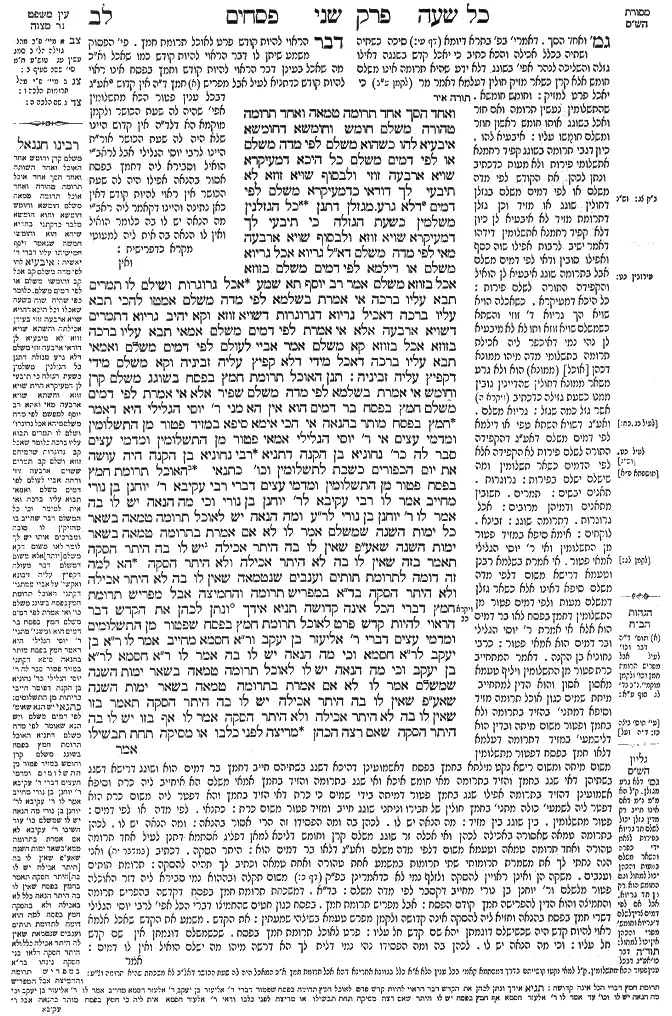
Pesahim 32a - Guemara
ואחד הסך אחד תרומה טמאה ואחד תרומה טהורה משלם חומש וחומשא דחומשא איבעיא להו כשהוא משלם לפי מדה משלם או לפי דמים משלם כל היכא דמעיקרא שויא ארבעה זוזי ולבסוף שויא זוזא לא תיבעי לך דודאי כדמעיקרא משלם לפי דמים דלא גרע מגזלן דתנן כל הגזלנין משלמין כשעת הגזלה כי תיבעי לך דמעיקרא שויא זוזא ולבסוף שויא ארבעה מאי לפי מדה משלם דא"ל גריוא אכל גריוא משלם או דילמא לפי דמים משלם בזוזא אכל בזוזא משלם אמר רב יוסף תא שמע אכל גרוגרות ושילם לו תמרים תבא עליו ברכה אי אמרת בשלמא לפי מדה משלם אמטו להכי תבא עליו ברכה דאכיל גריוא דגרוגרות דשויא זוזא וקא יהיב גריוא דתמרים דשויא ארבעה אלא אי אמרת לפי דמים משלם אמאי תבא עליו ברכה בזוזא אכל בזוזא קא משלם אמר אביי לעולם לפי דמים משלם ואמאי תבא עליו ברכה דאכל מידי דלא קפיץ עליה זביניה וקא משלם מידי דקפיץ עליה זביניה:
תנן האוכל תרומת חמץ בפסח בשוגג משלם קרן וחומש אי אמרת בשלמא לפי מדה משלם שפיר אלא אי אמרת לפי דמים משלם חמץ בפסח בר דמים הוא אין הא מני ר' יוסי הגלילי היא דאמר חמץ בפסח מותר בהנאה אי הכי אימא סיפא במזיד פטור מן התשלומין ומדמי עצים אי ר' יוסי הגלילי אמאי פטור מן התשלומין ומדמי עצים סבר לה כר' נחוניא בן הקנה דתניא רבי נחוניא בן הקנה היה עושה את יום הכפורים כשבת לתשלומין וכו' כתנאי האוכל תרומת חמץ בפסח פטור מן התשלומין ומדמי עצים דברי רבי עקיבא ר' יוחנן בן נורי מחייב אמר לו רבי עקיבא לר' יוחנן בן נורי וכי מה הנאה יש לו בה אמר לו ר' יוחנן בן נורי לר"ע ומה הנאה יש לאוכל תרומה טמאה בשאר כל ימות השנה שמשלם אמר לו לא אם אמרת בתרומה טמאה בשאר ימות השנה שאע"פ שאין לו בה היתר אכילה יש לו בה היתר הסקה תאמר בזה שאין לו בה לא היתר אכילה ולא היתר הסקה הא למה זה דומה לתרומת תותים וענבים שנטמאה שאין לו בה לא היתר אכילה ולא היתר הסקה בד"א במפריש תרומה והחמיצה אבל מפריש תרומת חמץ דברי הכל אינה קדושה תניא אידך (ויקרא כב, יד) ונתן לכהן את הקדש דבר הראוי להיות קדש פרט לאוכל תרומת חמץ בפסח שפטור מן התשלומים ומדמי עצים דברי ר' אליעזר בן יעקב ור"א חסמא מחייב אמר לו ר"א בן יעקב לר"א חסמא וכי מה הנאה יש לו בה אמר לו ר"א חסמא לר"א בן יעקב וכי מה הנאה יש לו לאוכל תרומה טמאה בשאר ימות השנה שמשלם אמר לו לא אם אמרת בתרומה טמאה בשאר ימות השנה שאע"פ שאין לו בה היתר אכילה יש לו בה היתר הסקה תאמר בזו שאין לו בה לא היתר אכילה ולא היתר הסקה אמר לו אף בזו יש לו בה היתר הסקה שאם רצה הכהן מריצה לפני כלבו או מסיקה תחת תבשילו
Comments from Rashi on Masechet Pesahim Page 32a
גמ' ואחד הסך . דאמרי' בפ' בתרא דיומא (דף עו:) סיכה כשתיה ושתיה בכלל אכילה והכא כתיב כי יאכל קדש בשגגה דאילו גזלה והשליכה לנהר אפי' בשוגג דלא ידע שהיא תרומה אינו משלם חומש אלא קרן כשאר מזיק חולין דעלמא דאמר מר (לקמן ע"ב) כי יאכל פרט למזיק: וחומש חומשא . שהתשלומין נעשין תרומה ואם חזר ואכל בשוגג אותו חומש ראשון חוזר ומשלם חומשו עליו: איבעיא להו . כיון דגבי תרומה בשוגג קפיד רחמנא אתשלומי פירות ולא מעות כדכתיב ונתן לכהן את הקודש לפי מדה משלם או לפי דמים משלם בגזלן דחולין שוגג או מזיד וכן גזלן דתרומת מזיד לא איבעיא לן כיון דלא קפיד רחמנא אתשלומין דידהו דאמר ישיב לרבות אפילו שוה כסף ואפילו סובין ודאי לפי דמים משלם אבל בתרומה שוגג איבעיא לן הואיל והקפידה התורה לשלם פירות: כל היכא דמעיקרא . כשאכלה הויא שויא הך גריוא ד' זוזי והשתא כשמשלם שויא זוזא ותו לא לא מיבעיא לן נהי נמי דאיכפר ליה אכילת תרומה בתשלומי מדה מיהו ממונא דכהן [אוכל] (ממונא) הוא ולא גרע משאר ממונא דחולין שהדיינין גובין ממנו כשעת גזילה כדכתיב (ויקרא ה) אשר גזל כמו שגזל: גריוא משלם . ואע"ג דשויא השתא טפי או דילמא לפי דמים משלם דאע"ג דהקפידה התורה לשלם פירות לא הקפידה אלא לפי הדמים כשאר תשלומין ומה שישלם ישלם בפירות: גרוגרות . תאנים יבשים: תמרים . חשובין מתאנים ודמיהן מרובים: אכל גרוגרות . דתרומה שוגג: זבינא . לוקחים: אימא סיפא במזיד פטור מן התשלומין ואי ר' יוסי הגלילי אמאי פטור . אי אמרת בשלמא רבנן וטעמא דרישא משום דלפי מדה משלם סיפא דאינו אלא כשאר גזלן דמשלם מעות ולפי דמים פטור מן התשלומין דחמץ בפסח לאו בר דמים הוא אלא אי אמרת ר' יוסי הגלילי ובר דמים הוא אמאי פטור: כרבי נחוניא בן הקנה . דאמר המתחייב כרת פטור מן התשלומין ויליף טעמא מאסון אסון והוא הדין למתחייב מיתת שמים כגון אוכל תרומה מזיד וסיפא דמתני' בהזיד בתרומה ולא בחמץ ופטור משום מיתה ובדין הוא דלישמעי' במזיד דתרומה דעלמא דלאו חמץ בפסח דפטור מתשלומין משום מיתה ומשום רישא נקט מילתא בחמץ בפסח דאשמועינן דהיכא דשגג בשתיהם חייב דחמץ בר דמים הוא ושוגג דרישא דשגג בשתיהן דאי שגג בחמץ והזיד בתרומה מאי חומש איכא ואי שגג בתרומה והזיד בחמץ אמאי משלם הא איחייב ליה כרת וסיפא אשמועינן דהזיד בתרומה אפילו שגג בחמץ פטור דמיתה בידי שמים כי כרת דאי הזיד בחמץ והא דפטר ליה משום כרת הוא דפטר ליה לשמעינן כולה מתני' בחמץ חולין של חבירו וניתני שוגג חייב ומזיד פטור משום כרת: כתנאי . לפי מדה או לפי דמים: פטור מתשלומין . בין שוגג בין מזיד: מה הנאה יש לו . לכהן בה ומה הפסידו זה הרי אסור בהנאה: ומה הנאה יש לו . לכהן בתרומה טמאה שאסורה באכילה לכהן ואי אכלה זר שוגג משלם קרן וחומש דליכא למאן דפליג אסתמא דתנן לעיל אחד תרומה טהורה ואחד תרומה טמאה וטעמא משום דלפי מדה משלם ואע"ג דלאו בר דמים הוא: היתר הסקה . דכתיב (במדבר יח) ואני הנה נתתי לך את משמרת תרומותי שתי תרומות במשמע אחת טהורה ואחת טמאה וכתיב לך תהיה להסקה: תרומת תותים וענבים . משקה הן ואינן ראויין להסקה ולזלף נמי לא כדאמרינן בפ"ק (דף כ:) משום תקלה ובההוא נמי סבירא ליה דזר האוכלה פטור מלשלם ור' יוחנן בן נורי מחייב דקסבר לפי מדה משלם: בד"א . דמשכחת תרומת חמץ בפסח דקדשה בהפריש תרומה והחמיצה והוא הדין להפרישה חמץ קודם הפסח: אבל מפריש תרומת חמץ . בפסח כגון חטים שהחמיצו דברי הכל אפי' לרבי יוסי הגלילי דשרי חמץ בפסח בהנאה וחזיא ליה להסקה אינה קדושה ולקמן מפרש טעמא בשילהי שמעתין: את הקדש . משמע את הקדש שאכל אלמא ראוי להיות קדש היה שכשישלם דוגמתן יהא שם קדש חל עליו: פרט לאוכל תרומת חמץ בפסח . שכשמשלם דוגמתן אין שם קדש חל עליו: וכי מה הנאה יש לו . לכהן בה ומה הפסידו נהי נמי דלית לך הא דרשה מיהו מה ישלם הואיל ואין לו דמים:
Comments from Tosafot - Pesahim 32a
דבר הראוי להיות קודש פרט לאוכל תרומת חמץ . פי' הפסוק משמע שיתן לו דבר הראוי להיות קודש כמו שאכל וא"כ מה שאכל בעינן דבר הראוי להיות קודש וחמץ בפסח אינו ראוי להיות קודש כדתניא לעיל אבל מפריש חמץ ד"ה אין קדוש אע"ג דבכל ענין פטור הכא מתשלומין אפי' שהיה לה שעת הכושר ולקמן מוקמא הא דלד"ה אין קדוש היינו שלא היה לה שעת הכושר אור"ת היינו לרבי יוסי הגלילי אבל לראב"י הואיל וסבירא ליה דחמץ בפסח אסור בהנאה אפילו היה לה שעת הכושר אין ראוי להיות קודש דאין כאן נתינה והיינו דקאמר ליה ראב"י מה הנאה יש לו בה כלומר הואיל ואין לו הנאה בה אית ליה למעוטי מקרא כדפרישית:
Pesahim 32a - Mishnah translated into english
And even with regard to one who anoints himself with the teruma oil, both in a case of ritually impure teruma as well as in a case of ritually pure teruma, he must pay an additional fifth if he unwittingly consumes this teruma. If he unwittingly consumes this fifth then he must pay an additional fifth of the fifth. The original fifth has a status comparable to teruma itself, and therefore one is required to pay an additional fifth for consuming it.
A dilemma was raised before the Sages with regard to the laws of teruma: When he pays for this teruma, does he pay according to the measure of the teruma or according to its monetary value? The Gemara explains the question in greater detail: Anywhere that the teruma is worth four zuz at the outset, i.e., at the time he consumed the teruma, and is worth only one zuz at the end, at the time of payment, do not raise a dilemma, for in that case he is certainly required to pay according to the monetary value at the outset. The rationale behind this ruling is that he is no worse than a thief, and therefore the law in this case is the same as if he had stolen property from another person. As we learned in a mishna: All thieves must repay what they have stolen according to the value of the stolen object at the time it was stolen, even if its value subsequently goes down.
You can raise the dilemma, however, with regard to a case where it was worth one zuz at the outset, when it was consumed, and at the end, at the time of the payment, it was worth four zuz. What is the ruling in that case? Does he pay according to the measure of teruma, as the treasurer of the consecrated property can say to him: You ate a se’a and you must pay a se’a, even if the value of the teruma has increased, or perhaps he must repay according to the monetary value, and if he ate a zuz worth of teruma then he must pay a zuz?
Rav Yosef said: Come and hear an answer to this question from what was taught in a baraita: One who ate dried figs that were teruma and paid the priest with dates, may a blessing rest upon him, as dates are worth more than dried figs. Granted, if you say that one must repay according to the measure of teruma he ate, it is due to this that a blessing should rest upon him, as he ate a se’a of dried figs that are worth one zuz and gave in return a se’a of dates worth four zuz. However, if you say that he must repay according to the monetary value of the teruma, then why should a blessing rest upon him? He ate a zuz worth of teruma and he paid a zuz worth as compensation; what is laudatory about his payment?
Abaye said: Actually, one can explain that he must repay according to the monetary value of the teruma, and why is it stated that a blessing should rest upon him? This is because he ate an item that buyers don’t jump at, i.e., it is undesirable to buyers, but paid with an item that buyers jump at. Consequently, although the produce he gives is worth no more than the produce he ate, the priest still prefers this type of payment, as he can more easily resell this produce.
The Gemara seeks proof with regard to this dispute: We learned in the mishna: One who unwittingly eats teruma of leavened bread on Passover must pay the principal and an additional fifth. Granted, if you say that he must pay according to the measure of teruma that he ate, it is well. As he ate a se’a of teruma he must also repay a se’a. However, if you say that he must pay according to the monetary value of the teruma, this is difficult, for is leavened bread on Passover of any monetary value? Certainly it is not worth anything, given that it is forbidden to benefit from this food. The Gemara answers: Yes, this leavened bread does indeed have monetary value. In accordance with whose opinion is this mishna? It is in accordance with the opinion of Rabbi Yosei HaGelili, who said that it is permissible to derive benefit from leavened bread on Passover.
The Gemara challenges this suggestion: If that is so, then say the latter clause of the mishna, where it is stated: If he consumes the teruma intentionally, then he is exempt from payment and from paying the priest for its monetary value as wood. But if this follows the opinion of Rabbi Yosei HaGelili, then why is he exempt from payment to the priest for the value of the teruma and for its monetary value in wood? Although he is exempt from paying the additional fifth as he acted intentionally, he nonetheless should be required to compensate the priest for the financial loss he caused him, as in any other case of theft.
The Gemara answers: He holds in accordance with the opinion of Rabbi Neḥunya ben HaKana, as it was taught in a baraita: Rabbi Neḥunya ben HaKana rendered the status of Yom Kippur the same as that of Shabbat with regard to payment. In his opinion, not only a person who committed a transgression punishable by a court-administered capital punishment, like one who desecrated Shabbat, is exempt from monetary payment incurred at the time of the transgression. Even one who is deserving of a divinely administered capital punishment, such as one who desecrates Yom Kippur and is punished with karet, is exempt from monetary payment for property he damaged in the course of such an act. Therefore, since one who consumes another person’s leavened bread during Passover is deserving of karet, he is exempt from monetary payment incurred by this act.
The Gemara comments: The question of whether one must repay according to the measurement or the monetary value of the teruma is like a dispute between tanna’im, as it was taught in the Tosefta: If one eats teruma of leavened bread on Passover, whether intentionally or unwittingly, then he is exempt from payment and for its monetary value in wood; this is the statement of Rabbi Akiva. Whereas Rabbi Yoḥanan ben Nuri deems him liable to pay. Rabbi Akiva said to Rabbi Yoḥanan ben Nuri: What benefit can he derive from this? What benefit could the priest have derived from this teruma as it is prohibited to benefit from this teruma and the teruma is therefore worthless? Rabbi Yoḥanan ben Nuri said to Rabbi Akiva: What benefit can one derive from eating ritually impure teruma on the rest of the days of the year, and yet nevertheless the non-priest is still obligated to pay for what he has taken. Despite the fact that a priest may not eat impure teruma, a non-priest must reimburse the priest for the principal of the teruma and add an additional fifth if he eats it.
Rabbi Akiva said to him: No, a distinction can be made between these two cases: If you say that he is obligated to pay in a case of ritually impure teruma on the rest of the days of the year, that although it is not permissible to eat it, the priest is nevertheless permitted to burn it and derive benefit from the heat generated as a result of this burning, shall you also say the same with regard to this, teruma of leavened bread during Passover, that is not permitted to be eaten or burned? Rather, to what may this be compared? It is similar to teruma of berries and grapes that became ritually impure, which is not permitted to be eaten or burned, as berries and grapes are unfit for firewood.
The Tosefta adds: In what case is this statement said, that these tanna’im disagree about the reimbursement for teruma? It was said with regard to a case where he separated teruma in a permitted manner and it became leavened during Passover. However, if he separated the teruma from leavened bread during Passover, then everyone agrees that it is not consecrated, as it is worthless.
It was taught in another baraita: With regard to the verse “And if a man eats a sacred thing in error, then he shall add a fifth part in addition to it, and shall give to the priest the sacred item” (Leviticus 22:14), the Sages expound as follows: He must give the priest an item that is fit to be consecrated, to the exclusion of one who eats teruma of leavened bread on Passover, who is exempt from payment of the teruma and even from paying its monetary value as wood; this is the statement of Rabbi Eliezer ben Ya’akov. Rabbi Elazar Ḥisma deems him liable to reimburse the priest for these items. Rabbi Eliezer ben Ya’akov said to Rabbi Elazar Ḥisma: What benefit can the priest derive from this teruma of leavened bread, as it is prohibited to benefit from it? Rabbi Elazar Ḥisma said to Rabbi Eliezer ben Ya’akov: What benefit can one derive from eating ritually impure teruma on the rest of the days of the year, and yet a non-priest who eats it must pay the priest.
Rabbi Eliezer ben Ya’akov said to him: No, a distinction can be made between these two cases: If you say he is obligated to pay in a case of ritually impure teruma on the rest of the days of year, that although it is not permissible to eat it, the priest is nonetheless permitted to burn it and derive benefit from the heat generated as a result of this burning, shall you say the same with regard to this, teruma of leavened bread during Passover, that is not permitted to be eaten or burned? Rabbi Elazar Ḥisma said to him: Even teruma of leavened bread on Passover is permitted to be burned, for if the priest wishes, he may throw it before his dog or burn it under his food, for Rabbi Elazar Ḥisma agrees with the opinion of Rabbi Yosei HaGelili that one may derive benefit from leavened bread during Passover.
Traduction : The William Davidson digital edition of the Koren Noé Talmud, with commentary by Rabbi Adin Even-Israel Steinsaltz.