 Talmud Bavli
Pesahim 53a : Youtube
Daf TubeYoutube
3 video classes :
Pesahim Page 53a
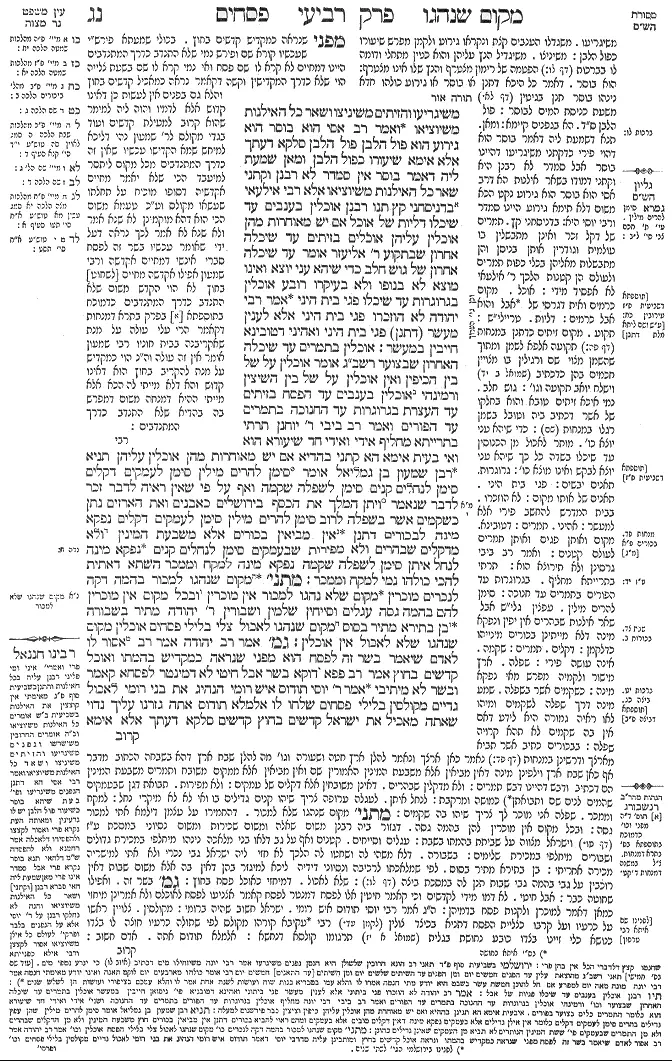
Pesahim 53a - Guemara
משיגריעו והזיתים משיניצו ושאר כל האילנות משיוציאו ואמר רב אסי הוא בוסר הוא גירוע הוא פול הלבן פול הלבן סלקא דעתך אלא אימא שיעורו כפול הלבן ומאן שמעת ליה דאמר בוסר אין סמדר לא רבנן וקתני שאר כל האילנות משיוציאו אלא רבי אילעאי בדניסחני קץ תנו רבנן אוכלין בענבים עד שיכלו דליות של אוכל אם יש מאוחרות מהן אוכלין עליהן אוכלים בזיתים עד שיכלה אחרון שבתקוע ר' אליעזר אומר עד שיכלה אחרון של גוש חלב כדי שיהא עני יוצא ואינו מוצא לא בנופו ולא בעיקרו רובע אוכלין בגרוגרות עד שיכלו פגי בית היני אמר רבי יהודה לא הוזכרו פגי בית היני אלא לענין מעשר (דתנן) פגי בית היני ואהיני דטובינא חייבין במעשר:
אוכלין בתמרים עד שיכלה האחרון שבצוער רשב"ג אומר אוכלין על של בין הכיפין ואין אוכלין על של בין השיצין ורמינהי אוכלין בענבים עד הפסח בזיתים עד העצרת בגרוגרות עד החנוכה בתמרים עד הפורים ואמר רב ביבי ר' יוחנן תרתי בתרייתא מחליף אידי ואידי חד שיעורא הוא ואי בעית אימא הא קתני בהדיא אם יש מאוחרות מהן אוכלין עליהן תניא רבן שמעון בן גמליאל אומר סימן להרים מילין סימן לעמקים דקלים סימן לנחלים קנים סימן לשפלה שקמה ואף על פי שאין ראיה לדבר זכר לדבר שנאמר (מלכים א י, כז) ויתן המלך את הכסף בירושלים כאבנים ואת הארזים נתן כשקמים אשר בשפלה לרוב סימן להרים מילין סימן לעמקים דקלים נפקא מינה לבכורים דתנן אין מביאין בכורים אלא משבעת המינין ולא מדקלים שבהרים ולא מפירות שבעמקים סימן לנחלים קנים נפקא מינה לנחל איתן סימן לשפלה שקמה נפקא מינה למקח וממכר השתא דאתית להכי כולהו נמי למקח וממכר:
מתני׳ מקום שנהגו למכור בהמה דקה לנכרים מוכרין מקום שלא נהגו למכור אין מוכרין ובכל מקום אין מוכרין להם בהמה גסה עגלים וסייחין שלמין ושבורין ר' יהודה מתיר בשבורה בן בתירא מתיר בסוס מקום שנהגו לאכול צלי בלילי פסחים אוכלין מקום שנהגו שלא לאכול אין אוכלין:
גמ׳ אמר רב יהודה אמר רב אסור לו לאדם שיאמר בשר זה לפסח הוא מפני שנראה כמקדיש בהמתו ואוכל קדשים בחוץ אמר רב פפא דוקא בשר אבל חיטי לא דמינטר לפסחא קאמר ובשר לא מיתיבי אמר ר' יוסי תודוס איש רומי הנהיג את בני רומי לאכול גדיים מקולסין בלילי פסחים שלחו לו אלמלא תודוס אתה גזרנו עליך נדוי שאתה מאכיל את ישראל קדשים בחוץ קדשים סלקא דעתך אלא אימא
Comments from Rashi on Masechet Pesahim Page 53a
משיגריעו . משגדלו הענבים קצת ונקראו גירוע ולקמן מפרש שיעורו כפול הלבן: משיניצו . משיגדיל הנץ עליהן והוא כעין מתחלי ודומה לו בברכות (דף לו:) הפטמה של רימון מצטרף והנץ שלו אינו מצטרף: הוא בוסר . דאמר כל היכא דתנן או בוסר או גירוע כולהו חדא נינהו בוסר תנן בגיטין (דף לא.) משעת כניסת המים לבוסר: פול הלבן ס"ד . הא בגפנים קיימא: ומאן . תנא דשמעת ליה דאמר בוסר הוא דהוי פירי כדקתני משיגריעו דהיינו בוסר אבל סמדר לא רבנן היא וקתני דמודו בשאר אילנות הא דרב אסי הוא בוסר הוא גירוע נקט הכא משום דלא תימא גירוע היינו סמדר ורבי יוסי היא: בדניסחני קץ . תמרים של דקל זכר ואינן מתבשלין בו עולמית וגודרין אותן בניסן והן מתבשלות מאליהן בכלי כפות תמרים ולעולם הן קטנות הלכך ר' אילעאי לא אפסיד מידי: אוכל . מקום כרמים ואית דגרסי של אבל והוא אבל כרמים: דליות . טריילי"ש ([[:קטגוריה:{קטן (גפני|{קטן, (גפני]][[קטגוריה:{קטן (גפני]])} : תקוע . מקום זיתים כדתנן במנחות (דף פה:) תקועה אלפא לשמן ומתוך שהשמן מצוי שם ורגילין בו מצויין חכמים בהן כדכתיב (שמואל ב יד) וישלח יואב תקועה וגו': גוש חלב . נמי איכא זיתים טובא והוא בחלקו של אשר דכתיב ביה וטובל בשמן רגלו במנחות (שם): כדי שיהא עני יוצא כו' . מותר לאכול מן הכנוסין עד שיכלו בשדה כל כך שיהא עני יוצא לבקש ואינו מוצא כו': גרוגרות . תאנים יבשים: פגי בית היני . תאנים של אותו מקום: לא הוזכרו . בבית המדרש להחשב פירי אלא למעשר: אהיני . תמרים: דטובינא . מקום ואותן פגים ואותן תמרים לעולם קטנים: ואמר רב ביבי . גרסינן ולא תירוצא הוא: תרתי בתרייתא מחליף . בגרוגרות עד הפורים בתמרים עד חנוכה: סימן להרים מילין . עפצין גלי"ש (עפצים (גידולים טפיליים בעלה האלון)) אבל שאר אילנות שבהרים אין יפין ונפקא מינה דלא מייתינן בכורים מינייהו כדלקמן: דקלים . תמרים: שקמה . אינה עושה פירי: שפלה . ארץ מישור ולקמיה מפרש מאי נפקא מינה: כשקמים אשר בשפלה . שמע מינה דרך שפלה לשקמים ומיהו לאו ראיה גמורה היא לידע דאם אין בה שקמים לא תהא קרויה שפלה בבכורים כתיב אשר תביא מארצך ודרשינן במנחות (דף פד:) נאמר כאן ארצך ונאמר להלן ארץ חטה ושעורה וגו' מה להלן שבח ארץ דהא בשבחה הכתוב מדבר אף כאן שבח ארץ וילפינן מינה דאין מביאין אלא משבעת המינין האמורין שם ואין מביאין אלא ממקום משובח ותמרים משבעת המינין הם דכתיב ודבש דהיינו דבש תמרים: ולא מדקלין שבהרים . דאינן משובחין אלא דקלים של עמקים: ולא מפירות . תבואת דגן שבעמקים שהמים לנין שם ותבואתן כמושה ומרקבת: לנחל איתן . לעגלה ערופה צריך שיהו קנים גדילים בו ואי לא לא מיקרי נחל: למקח וממכר . שפלה אני מוכר לך צריך שיהו בה שקמים: מתני' מקום שנהגו שלא למכור . דהחמירו על עצמן דילמא אתי למכור גסה: ובכל מקום אין מוכרין להן בהמה גסה . דגזור ביה רבנן משום שאלה ומשום שכירות ומשום נסיוני במסכת ע"ז (דף טו.) וישראל מצווה על שביתת בהמתו בשבת: עגלים וסייחים . קטנים ואף על גב דלאו בני מלאכה נינהו מיחלפי במכירת גדולים ושבורים מיחלפי במכירת שלמים: בשבורה . דלא משהי לה ושחטו לה הלכך לא חזי ליה ישראל גבי נכרי ולא אתי למישריה מכירה אחריתי: בן בתירא מתיר בסוס . לפי שמלאכתו לרכיבה ונסיוני דידיה ליכא למיגזר בהן דאין בה אלא משום שבות דאין רוכבין על גבי בהמה גבי שבות תנן לה במסכת ביצה (דף לו:): שלא לאכול . דמיחזי כאוכל פסח בחוץ: גמ' בשר זה . ואפילו שחוטה כבר: אבל חיטי . לא דמו מידי לקדשים וכי קאמר חיטין אלו לפסח דמנטר לפסח קאמר אצניעו לפסח לאוכלם ולא אמרינן מיחזי כמאן דאמר למוכרן ולקנות פסח בדמיהן: ה"ג אמר רבי יוסי תודוס איש רומי . ישראל חשוב שהיה ברומי: מקולסין . צלויין ראשו על כרעיו ועל קרבו כצליית הפסח דתניא בכיצד צולין (לקמן פסחים עד.) רבי עקיבא קורהו מקולס לפי שתולה כרעיו חוצה לו בצדו כנושא כלי זיינו בצדו כובע נחושת בגלית (שמואל א יז) תרגומו קולסא דנחושא: אלמלא תודוס אתה . אדם חשוב:
Comments from Tosafot - Pesahim 53a
מפני שנראה כמקדיש קדשים בחוץ . בכולי שמעתא פירש"י שעכשיו קורא שם ופירש נמי שלא התנדב כדרך המתנדבים היינו דמחיים לא קרא לו שם פסח ואי נמי קרא לו שם בשעת צלייה הוי שלא כדרך המקדישין וקשה דקאמר נראה כמאכיל קדשים בחוץ והלא גם בפנים אין לעשות כן דאינו קדוש אלא לדמיו והוה ליה למימר שהוא קרוב למעילת קדשים ועוד בגדי מקולס לר' שמעון נהי דליכא למיחש שמא הקדישו עכשיו שאין זה כדרך המתנדבים מכל מקום ליתסר למיעבד הכי שלא יאמר מחיים אקדשיה דסופו מוכיח על תחלתו שעשאו מקולס וע"כ טעמא משום הכי הוא דהא מוקמינן לא שנא אמר ולא שנא לא אמר לכך נראה דעל ידי שאומר עכשיו בשר זה לפסח סברי אינשי דמחיים אקדשה ורבי שמעון אפילו אקדשה מחיים [לשחוט] בחוץ לא הוי הקדש משום שלא התנדב כדרך המתנדבים כדמוכח בתוספתא בפרק בתרא דמנחות דקאמר הרי עלי עולה על מנת שאקריבנה בבית חוניו רבי שמעון אומר אין זה עולה וה"נ הוי כמקדיש על מנת להקריב בחוץ הוא דאינו קדוש והא דלא מייתי לה הכא אלא מייתי ההיא דמנחה משום דמפרש בה בהדיא שלא התנדב כדרך המתנדבים:
Pesahim 53a - Mishnah translated into english
from when the grapes form kernels and grow slightly; and olive trees, from when they blossom; and all other trees may not be chopped down from when they produce fruit. And Rav Asi said: It is an unripe grape, it is a grape kernel, it is a white bean, i.e., their legal status is the same. Before this is explained, the Gemara expresses astonishment: Does it enter your mind that the grape is at any stage a white bean? Rather, say: The size of an unripe grape is equivalent to the size of a white bean.
In any case, whom did you hear that said: An unripe grape, yes, is considered fruit, while a grape bud, no, it is not considered fruit? Wasn’t it the Rabbis, who disagree with Rabbi Yosei? And it is taught that, according to the Rabbis, it is prohibited to chop down all other trees from when they produce fruit. This indicates that unripe dates have the same status as ordinary dates. Rather, the Gemara retracts its previous answer and explains that Rabbi Elai chopped down a palm tree with stunted dates, which never ripen on the tree. It was permitted to chop down the tree because the dates can be ripened only after they are removed from the tree.
The Sages taught: One may eat grapes during the Sabbatical Year until the grapes on the vine branches in the place called Okhel have ceased. And if there are grapes elsewhere later than those, one may continue eating grapes on their basis, as the Sages’ statement is merely based on the assumption that the grapes in Okhel are the last to remain in the field, but the halakha is not specific to them.
Similarly, one may eat olives until the final olives have ceased on the trees in Tekoa. Rabbi Eliezer says: One may eat olives until the final olives have ceased on the trees in Gush Ḥalav. At what point is the fruit considered to have ceased? At the point that a poor person will go out to search for fruit and find, neither in the tree’s branches nor in the proximity of its trunk, a quarter-kav of olives that have fallen. One may eat dried figs until the unripe figs of Beit Hini have ceased.
Rabbi Yehuda said: The unripe figs of Beit Hini were mentioned only with regard to tithes, not with regard to the Sabbatical Year. As we learned in a mishna: The unripe figs of Beit Hini and the dates of Tovyana, both of which never completely ripen but are nonetheless edible, one is obligated to tithe them.
We learned in the mishna: One may eat dates in all of Judea until the last palm tree in Tzoar has ceased producing dates. Rabban Shimon ben Gamliel says: One may continue eating dates based on those between the palm branches; but one may not continue eating on the basis of those between the thorn branches.
And the Gemara raises a contradiction from that which was taught in a different baraita: One may eat from the grapes until Passover; from the olives, until the festival of Assembly, i.e., Shavuot; from the dried figs, until Hanukkah; and from the dates, until Purim. And Rav Beivai said: Rabbi Yoḥanan transposes the last two. According to his version of the baraita, one may eat dried figs until Purim and dates until Hanukkah. This is inconsistent with the previous statement that dates may be eaten until those in Tzoar have ceased. The Gemara resolves this contradiction: Both this time and that time are one period. The first Sage designated the deadline in terms of the place where dates grow, and Rabban Shimon ben Gamliel designated the deadline in terms of the dates. And if you wish, say instead that it is taught explicitly: And if there are fruits elsewhere later than those, one may continue eating on their basis. This indicates that the places and the times mentioned are merely indicators, but that the prohibition depends on actual conditions in the field.
The Gemara continues: It was taught in a baraita that Rabban Shimon ben Gamliel says: A good sign for mountains is that gallnut oaks, used in the preparation of ink, grow there. A good sign for valleys is palm trees. A good sign for streams is reeds. A good sign for the plain is a sycamore tree. And although there is no proof for these indicators, there is an allusion to the matter in the verse, as it is stated: “And the king made silver to be in Jerusalem like stones, and he made cedars to be as the sycamore trees in the plain” (I Kings 10:27).
The Gemara elaborates on this baraita: A good sign for mountains is gallnut oaks, a good sign for valleys is palm trees. What purpose is served by these signs? The practical difference of these signs pertains to the halakha of first fruits. As we learned in a mishna: One may bring first fruits only from the seven species and only from the highest quality fruit. Therefore, one may not bring first fruits from palm trees that grow in the mountains. Since the mountains are not a suitable location for palm trees, the dates grown there are inferior. Similarly, one does not bring first fruits from produce, i.e., from wheat and barley, that grow in the valleys, because mountain fruits do not grow there properly.
A good sign for streams is reeds. The case where this sign makes a practical halakhic difference is with regard to the rough dried-up stream mentioned in the Torah. When a corpse is found between two towns and the murderer cannot be identified, the Torah states that a calf’s neck is broken in a rough stream. The baraita teaches that growing reeds identify the spot as a stream. A good sign for the plain is a sycamore tree. The Gemara explains that the case where this sign makes a practical difference is with regard to buying and selling. If one stipulates that he is buying land in the plains, it is defined as an area where sycamore trees grow. The Gemara notes: Now that you have arrived at this practical halakhic difference with regard to assessing the quality of land for the purpose of transactions, all the signs can be understood as pertaining to buying and selling as well, to identify valleys and mountainous regions.
MISHNA: Apropos different local customs discussed in the first mishna in this chapter, this mishna discusses various halakhot with regard to which there are different customs. In a place where the people were accustomed to sell small livestock to gentiles, one may sell them. In a place where the people were not accustomed to sell them due to certain concerns and decrees, one may not sell them. However, in every place, one may sell to gentiles neither large livestock, e.g., cows and camels, nor calves or foals, whether these animals are whole or damaged. The Sages prohibited those sales due to the concern lest the transaction be voided or one side reconsider, creating retroactively a situation where a Jew’s animal performed labor for the gentile on Shabbat in violation of an explicit Torah prohibition. Rabbi Yehuda permits the sale of a damaged animal because it is incapable of performing labor. Ben Beteira permits the sale of a horse for riding, because riding a horse on Shabbat is not prohibited by Torah law.
The mishna cites another custom related to Passover. In a place where people were accustomed to eat roasted meat on Passover evenings, outside of Jerusalem or after the Temple was destroyed, one may eat it. In a place where people were accustomed not to eat outside Jerusalem, one may not eat it.
GEMARA: Rav Yehuda said that Rav said that it is prohibited for a person to say in modern times: This meat is for Passover, due to the fact that one appears to be consecrating his animal as his Paschal lamb, and he thereby eats consecrated items outside the permitted area. Rav Pappa said: This prohibition against saying: This is for Passover, applies specifically to meat, which is similar to consecrated meat; however, with regard to wheat, no, it does not apply. In that case, it is clear that one is saying that the flour be watched for Passover.
The Gemara asks: And with regard to meat is that not the case? Is it really prohibited to say that meat is for Passover? The Gemara raises an objection. Rabbi Yosei said: Theodosius [Todos] of Rome, leader of the Jewish community there, instituted the custom for the Roman Jews to eat kids roasted [mekulas] whole with their entrails over their heads on the evenings of Passover, as was the custom in the Temple. The Sages sent a message to him: If you were not Theodosius, an important person, we would have decreed ostracism upon you, as it appears as if you are feeding Israel consecrated food, which may be eaten only in and around the Temple itself, outside the permitted area. The Gemara asks about the terminology used here: Could it enter your mind that this meat was actually consecrated meat? That was certainly not the case. Rather, say instead:
Traduction : The William Davidson digital edition of the Koren Noé Talmud, with commentary by Rabbi Adin Even-Israel Steinsaltz.