 Talmud Bavli
Pesahim 13a : Youtube
Daf TubeYoutube
3 video classes :
Pesahim Page 13a
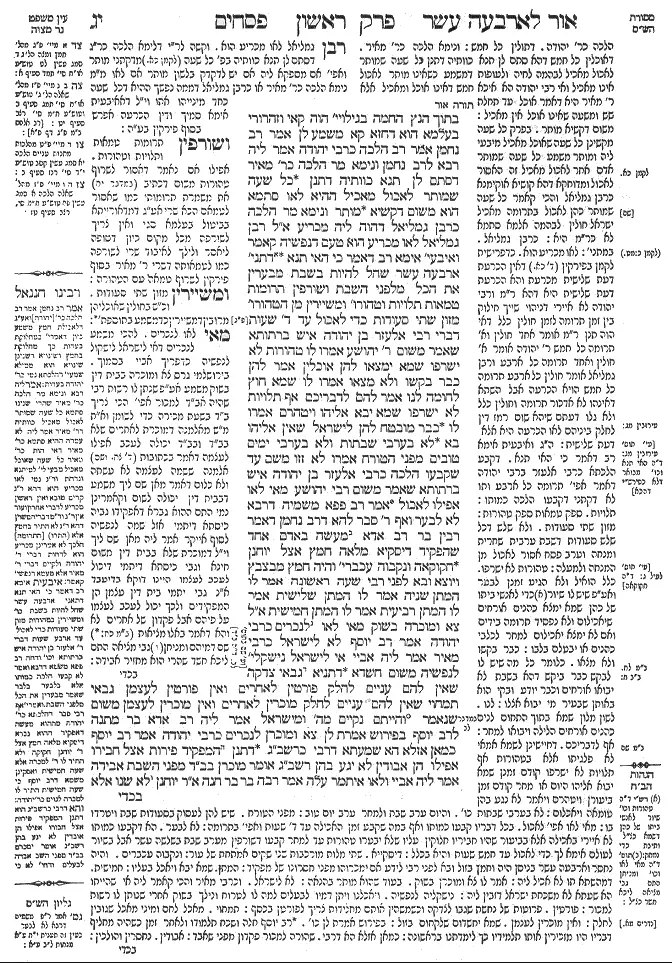
Pesahim 13a - Guemara
בתוך הנץ החמה בגילויי' הוה קאי וזהרורי בעלמא הוא דחזא קא משמע לן אמר רב נחמן אמר רב הלכה כרבי יהודה אמר ליה רבא לרב נחמן ונימא מר הלכה כר' מאיר דסתם לן תנא כוותיה דתנן כל שעה שמותר לאכול מאכיל ההיא לאו סתמא הוא משום דקשיא מותר ונימא מר הלכה כרבן גמליאל דהוה ליה מכריע א"ל רבן גמליאל לאו מכריע הוא טעם דנפשיה קאמר ואיבעי' אימא רב דאמר כי האי תנא דתני' ארבעה עשר שחל להיות בשבת מבערין את הכל מלפני השבת ושורפין תרומות טמאות תלויות וטהורו' ומשיירין מן הטהורו' מזון שתי סעודות כדי לאכול עד ד' שעות דברי רבי אלעזר בן יהודה איש ברתותא שאמר משום ר' יהושע אמרו לו טהורות לא ישרפו שמא ימצאו להן אוכלין אמר להן כבר בקשו ולא מצאו אמרו לו שמא חוץ לחומה לנו אמר להם לדבריכם אף תלויות לא ישרפו שמא יבא אליהו ויטהרם אמרו לו כבר מובטח להן לישראל שאין אליהו בא לא בערבי שבתות ולא בערבי ימים טובים מפני הטורח אמרו לא זזו משם עד שקבעו הלכה כרבי אלעזר בן יהודה איש ברתותא שאמר משום רבי יהושע מאי לאו אפילו לאכול אמר רב פפא משמיה דרבא לא לבער ואף ר' סבר להא דרב נחמן דאמר רבין בר רב אדא מעשה באדם אחד שהפקיד דיסקיא מלאה חמץ אצל יוחנן חקוקאה ונקבוה עכברי' והיה חמץ מבצבץ ויוצא ובא לפני רבי שעה ראשונה אמר לו המתן שניה אמר לו המתן שלישית אמר לו המתן רביעית אמר לו המתן חמישית א"ל צא ומוכרה בשוק מאי לאו לנכרים כרבי יהודה אמר רב יוסף לא לישראל כרבי מאיר אמר ליה אביי אי לישראל נישקלי' לנפשיה משום חשדא דתניא גבאי צדקה שאין להם עניים לחלק פורטין לאחרים ואין פורטין לעצמן גבאי תמחוי שאין להם עניים לחלק מוכרין לאחרים ואין מוכרין לעצמן משום שנאמר (במדבר לב, כב) והייתם נקיים מה' ומישראל אמר ליה רב אדא בר מתנה לרב יוסף בפירוש אמרת לן צא ומוכרן לנכרים כרבי יהודה אמר רב יוסף כמאן אזלא הא שמעתא דרבי כרשב"ג דתנן המפקיד פירות אצל חבירו אפילו הן אבודין לא יגע בהן רשב"ג אומר מוכרן בב"ד מפני השבת אבידה אמר ליה אביי ולאו איתמר עלה אמר רבה בר בר חנה א"ר יוחנן לא שנו אלא
Comments from Rashi on Masechet Pesahim Page 13a
הלכה כר' יהודה . דתולין כל חמש: ונימא הלכה כר' מאיר . דאוכלין כל חמש דהא סתם לן תנא כוותיה דתנן כל שעה שמותר לאכול מאכיל לבהמה לחיה ולעופות דמשמע כשאינו מותר לאכול אינו מאכיל ואי רבי יהודה הא איכא חמש דאינו אוכל ומאכיל אלא ר' מאיר היא דאמר אוכל עד תחלת שש ומשעה שאינו אוכל אין מאכיל: משום דקשיא מותר . בפרק כל שעה מקשינן כל שעה שאוכל מאכיל מיבעי ליה ומותר משמע כל שעה שמותר אדם אחר לאכול מאכיל זה האסור לאכול ומדוחקא דהא קושיא אוקימנא כרבן גמליאל והכי קאמר כל שעה שמותר כהן לאכול בתרומה מאכיל ישראל חולין לבהמה אלמא סתמא לא כר"מ היא: כרבן גמליאל . במתני': לאו מכריע הוא . כדפרישית לקמן בפירקין (פסחים ד' כא.) דאין הכרעת דעת שלישית מכרעת והא הכרעת דעת שלישית היא דהא ר"מ ורבי יהודה לא איירי דניהוי שייך חילוק בין זמן תרומה לזמן חולין כלל דאי הוה תנן ר"מ אומר אחד חולין וא' תרומה כל חמש ר' יהודה אומר א' חולין ואחד תרומה כל ארבע ורבן גמליאל אומר חולין כל ארבע תרומה כל חמש הויא הכרעה אבל השתא דאינהו לא אדכור תרומה וחולין כלל ולא גלו דעתם שיהא שום רמז דין לחלק ביניהם לאו הכרעה היא אלא דעת שלישית: ה"ג ואיבעית אימא רב דאמר כי האי תנא . דקבע הלכתא כר' אלעזר בר' יהודה דאמר אפי' תרומה כל ארבע ותו לא דקתני דקבעו הלכה כמותו: תלויות . ספק טמאות ספק טהורות: מזון שתי סעודות . ולא שלש דכל שלש סעודות דשבת ערבית שחרית ומנחה וערב פסח אסור לאכול מן המנחה ולמעלה: טהורות לא ישרפו . כלל הואיל ולא הגיע זמנן לבער ואע"פ שיש לו שיור כדי לאנשי ביתו של כהן שמא ימצא כהנים אורחים שיאכילום ולא נפסיד תרומה בידים ואם לא ימצא יאכילום למחר לכלבי כהנים או יבטלם בלבו: כבר בקשו ולא מצאו . כלומר כל מה שיש לו לבקש כבר ביקש דהא בשבת לא יבואו אורחים וכבר יודע ובקי הוא באותן שבעיר מי יבוא אצלו: לנו . לשון מלון שמא בתוך התחום לנים כהנים אורחים הלילה ויבואו למחר: אף לדבריכם . דחיישינן לשמא אמאי לא פלגיתו אלא בטהורות אף תלויות לא ישרפו קודם זמנן שמא יבוא אליהו היום או מחר קודם זמן ביעורן ויטהרם ויאמר לא נגע בהן טומאה ויאכלום: לא בערבי שבתות כו' . והיום ערב שבת ולמחר ערב יום טוב: מפני הטורח . שיש להן לעסוק בסעודות שבת ויטרדו בו: מאי לאו אפי' לאכול . בכל דבריו קבעו כמותו ואף במה שקבע זמן האכילה עד ד' שעות ואפילו בתרומה: לא לבער . הא דקבעו כמותו לא איירי באכילה אלא בביעור שהיו חביריו חלוקין עליו שלא יבערו טהורות עד למחר קבעו דשורפין מערב שבת בשלשה עשר אבל בשיור לעולם אימא לך כדי לאכול עד חמש שעות והיא בכלל: דיסקייא . שתי מלות מורכבות שני שקים אמתחת של עור: ונקבוה עכברים . והיה נחסר וארבעה עשר בניסן היה וחמץ בזול ובא לפני רבי לידע אם ימכרוהו מפני חסרונו של מפקיד: המתן . שמא יבא ויאכל בעליו: חמישית . דמהשתא תו לא אכיל ליה: אמר לו צא ומוכרן בשוק . בעוד שהוא מותר בהנאה: לא לישראל . וכר' מאיר והכי קאמר ליה אי שהייתו הא שעתא לא משכחת ישראל דזבין ליה: נישקליה לנפשיה . ויאכלנו ויתן דמין לבעלים למה לו לטרוח ולילך בשוק אחרי שנותן לו רשות למכור: פורטין . פרוטות של נחשת שגבו לצדקה וכשמשהין אותם מחלידות צריך לפורטן בכסף: תמחוי . מאכל לחם ומיני מאכל שגובין לחלק: ואין מוכרין לעצמן . שמא יחשדום שלקחום בזול: בפירוש אמרת לן כו' . רב יוסף חלה ושכח תלמודו ולאחר זמן כשהיה מחליף דבריו היו מזכירין אותו תלמידיו כך לימדתנו בראשונה: כמאן אזלא הא דרבי . שהורה למכור פקדון מפני שאבד: אבודין . נחסרין והולכין:
Comments from Tosafot - Pesahim 13a
רבן גמליאל לאו מכריע הוא . וקשה לר"י דלימא הלכה כר"ג דסתם לן תנא כוותיה בפ' כל שעה (לקמן פסחים כא.) מדקתני מותר ואפי' אם מספקא ליה אם יש לדקדק בלשון מותר אם לאו מ"מ נימא הלכה כר' מאיר או כרבן גמליאל דממה נפשך ההיא דכל שעה כחד מינייהו אתו וי"ל דאאיבעית אימא סמיך ודין הכרעה אפרש בסוף פירקין בע"ה: ושורפין תרומות טמאות ותלויות וטהורות . אפילו אם נאמר דאסור לשרוף טהורות משום דכתיב (במדבר יח) את משמרת תרומותי כמו שאסור לטמאם הכא שרי אע"ג דמדאורייתא בביטול בעלמא סגי ואין צריך לשורפה מכל מקום כיון דסופה ליאסר ולילך לאיבוד שרי לשורפה כמו לטמאותה דשרי ר' מאיר בסוף פירקין לשרוף טמאה עם הטהורה: ומשיירין מזון שתי סעודות . וכ"ש בחולין שאוכליהן מרובין דמשיירין כדמשמע בתוספת': מאי לאו לנכרים . להכי משמע לנכרים דאי לישראל לישקול לנפשיה כדפריך אביי בסמוך. בירושלמי גרס צא ומוכרה בבית דין בשוק משמע אע"פ שנתן לו רשות רבי שהיה אב"ד למכור אפי' הכי צריך ב"ד בשעת מכירה כדי לשומן וא"ת מ"ש מאלמנה דמוכרת לאחרים שלא בב"ד ובב"ד יכולה לעכב אפילו לעצמה דאמר בכתובות (ד' צח. ושם) אלמנה ששמה לעצמה לא עשתה ולא כלום דאמר מאן שם ליך משמע דבבית דין יכולה לשום וקאמרינן נמי התם ההוא גברא דאפקידו גביה כיסתא דיתמי אזל שמה לנפשיה לסוף אייקר אמר ליה מאן שם ליך וי"ל דמוכרת שלא בבית דין משום חינא וגבי כיסתא דיתמי דיכול לעכב לעצמו היינו דוקא בדיעבד א"נ גבי יתמי בית דין עצמן הן המפקידים ולכך יכול לעכב לעצמו על פיהם אבל פקדון של אחרים לא והא דאמר באלו מציאות (ב"מ כח:) שם דמיהם ומניחן גבי מציאה התם ליכא חשד שהרי הוא מחזיר אבידה:
Pesahim 13a - Mishnah translated into english
that the incident occurred during sunrise is because he was standing out in the open and they were mere rays of light that he saw which he mistook for sunrise. In actuality, he too is testifying to an incident that occurred before sunrise, and the testimony of the two witnesses is therefore compatible testimony. Rav Shimi bar Ashi therefore teaches us that there is no concern that it transpired in that manner.
Rav Naḥman said that Rav said: The halakha is in accordance with the opinion of Rabbi Yehuda. Rava said to Rav Naḥman: And let the Master say that the halakha is in accordance with the opinion of Rabbi Meir, who maintains that one may eat during the entire fifth hour, as the tanna taught an unattributed mishna in accordance with his opinion, indicating that this is the halakha.
As we learned in a mishna: For the entire time that one is permitted to eat leaven himself, he feeds it to his animal. It can be inferred from this mishna that there is no intermediate period when it is prohibited for a person to eat leaven but he may feed it to his animal. This unattributed mishna must be in accordance with the opinion of Rabbi Meir, as Rabbi Yehuda maintains that during the fifth hour it is prohibited to eat leaven but one may feed it to an animal.
The Gemara rejects this contention: That mishna is not classified as unattributed, as it is in accordance with the opinion of Rabban Gamliel, due to the fact that had the mishna been in accordance with the opinion of Rabbi Meir, the term: Permitted, is difficult. Instead, the mishna should have been formulated: When one eats he may feed.
Rava raised an additional difficulty to Rav Naḥman: And let the Master say that the halakha is in accordance with the opinion of Rabban Gamliel, as he is the decisor in this dispute, and there is a general principle that the halakha is always in accordance with the decisor who states an opinion that compromises between two opinions cited previously. He said to him: Rabban Gamliel is not a decisor; he is stating a reason of his own. Rabbi Yehuda and Rabbi Meir disagree with regard to consumption of any type of leaven; they do not distinguish between teruma and non-sacred food. Since Rabban Gamliel distinguishes between the time one must desist from eating teruma and the latest time that one may eat non-sacred food, his is evidently an unrelated opinion that is in no way a compromise between the other two rulings.
And if you wish, say instead: When Rav said that the halakha is in accordance with the opinion of Rabbi Yehuda, he ruled in accordance with the opinion of this tanna, as it was taught in a baraita: With regard to the fourteenth of Nisan that occurs on Shabbat, one does not remove leaven on Passover eve in the usual manner. Rather, one removes everything leavened before Shabbat, and one burns ritually impure teruma: Teruma in abeyance, whose purity is uncertain, and even any pure teruma that he does not require for his Shabbat meals. And one leaves from the pure leaven food for two meals, the meal at night and the one in the morning, in order to eat and finish until four hours of Shabbat morning. This is the statement of Rabbi Elazar ben Yehuda of Bartota, who said it in the name of Rabbi Yehoshua.
The Sages said to him: One should not burn pure teruma, as perhaps those who can eat it will be found on Shabbat, and he will have retroactively violated a Torah prohibition by burning pure teruma unnecessarily. Instead, one places the teruma aside, and if no one is found to eat it, he feeds it to the dogs or renders it null and void in his heart. He said to them: They already sought people to eat the teruma and they did not find any other priests in the city to eat it. They said to him: Perhaps those priests who could eat the teruma on that Shabbat slept outside the wall of the city and will enter the city on Shabbat morning, at which point they could eat the teruma.
He said to the Sages: According to your statement, that you take into account this unlikely scenario, one should not even burn teruma in abeyance, as perhaps Elijah the Prophet will come on Shabbat and establish prophetically that the teruma is not ritually impure, and render it ritually pure. They said to him: That possibility is no source of concern, as the Jewish people have already been assured that Elijah will come neither on a Friday nor on the eve of a Festival, due to the exertion involved preparing for the upcoming holy day. Consequently, Elijah will certainly come neither on Friday, nor on Shabbat itself, which is Passover eve.
They said: They did not move from there until the Sages voted and they established the halakha in accordance with the opinion of Rabbi Elazar ben Yehuda of Bartota, who said it in the name of Rabbi Yehoshua.
Apropos the previous statement that the halakha is in accordance with the opinion of Rabbi Yehuda, what, is it not that the halakha is in accordance with his opinion even with regard to eating? Rav’s ruling indicates that one may eat leaven until the end of the fourth hour, in accordance with the opinion of Rabbi Yehuda. Rav Pappa said in the name of Rava: No, the aforementioned ruling applies only to the obligation to remove leaven, i.e., the Sages agreed that it is permitted to remove pure teruma on Friday only if there is no one available to eat it.
The Gemara notes: And even Rabbi Yehuda HaNasi holds in accordance with this statement of Rav Naḥman, and rules that the halakha is in accordance with the opinion of Rabbi Yehuda. As Ravin bar Rav Adda said: There was an incident that occurred involving a certain person who deposited a saddlebag [disakkayya] filled with leavened bread with Yoḥanan Ḥakuka’a, and mice bore a hole in the bag, and leavened bread was spilling out of the sack. And he came before Rabbi Yehuda HaNasi on Passover eve to ask what he should do. In the first hour of the day Rabbi Yehuda HaNasi said to him: Wait, as the owner of the bag might yet return to take it from you and eat the leaven. In the second hour he said to him: Wait. In the third hour he said to him: Wait. In the fourth hour he said to him: Wait. In the fifth hour, concluding that the person was not coming, he said to him: Go and sell it in the market.
What, did Rabbi Yehuda HaNasi not mean that Yoḥanan Ḥakuka’a should sell this leaven to gentiles, in accordance with the opinion of Rabbi Yehuda, who says that it is prohibited for a Jew to eat leaven during the fifth hour? Rav Yosef said: No, it could be that he meant to sell it to a Jew, in accordance with the opinion of Rabbi Meir that one may eat leaven during the fifth hour. Rabbi Yehuda HaNasi was simply advising him to sell the leaven quickly before the sixth hour begins, at which point it would be prohibited for Jews to eat it. Abaye said to him: If it is permitted for a Jew to eat leaven, let him take it for himself and pay the owner back later. Why trouble him to sell it to someone else?
The Gemara responds: Eating it himself is not an option due to the potential of suspicion. As it was taught in a baraita with regard to a similar situation: Collectors of charity who have no poor people to whom they can distribute the money, change the money with other people and do not change it themselves, i.e., with their own coins.
Likewise, collectors of food for the charity plate, who would collect food in large vessels for the poor to eat, who do not have poor people to whom to distribute the food, sell the food to others and do not sell it to themselves, as it is stated: “And you shall be clear before God and before Israel” (Numbers 32:22). It is not sufficient that a person is without sin in the eyes of God. He must also appear upright in the eyes of other people so that they will not suspect him of wrongdoing.
Rav Adda bar Mattana said to Rav Yosef: You told us explicitly that Rabbi Yehuda HaNasi meant: Go and sell it to gentiles, in accordance with the opinion of Rabbi Yehuda. Rav Yosef took ill late in life and forgot his studies, and therefore his student would remind him that he also agreed with that version of the incident.
Rav Yosef said: In accordance with whose opinion, i.e., the opinion of which tanna, is that halakha which was taught by Rabbi Yehuda HaNasi, that one should sell leaven deposited with him in order to prevent the depositor from losing his possession? Rav Yosef explains: It is in accordance with the opinion of Rabban Shimon ben Gamliel, as we learned in a mishna: With regard to one who deposits produce with another, even if the produce will be ruined by insects or mold, he should not touch them. Rabban Shimon ben Gamliel says: He should sell them in court, due to the obligation to restore lost property. Just as one is required to return a lost item, he is likewise required to prevent loss of another’s property for which he assumed responsibility.
Abaye said to him: Wasn’t it stated with regard to that mishna that Rabba bar bar Ḥana said that Rabbi Yoḥanan said: The Rabbis taught that one may not touch them only if
Traduction : The William Davidson digital edition of the Koren Noé Talmud, with commentary by Rabbi Adin Even-Israel Steinsaltz.