 Talmud Bavli
Pesahim 35a : Youtube
Daf TubeYoutube
3 video classes :
Pesahim Page 35a
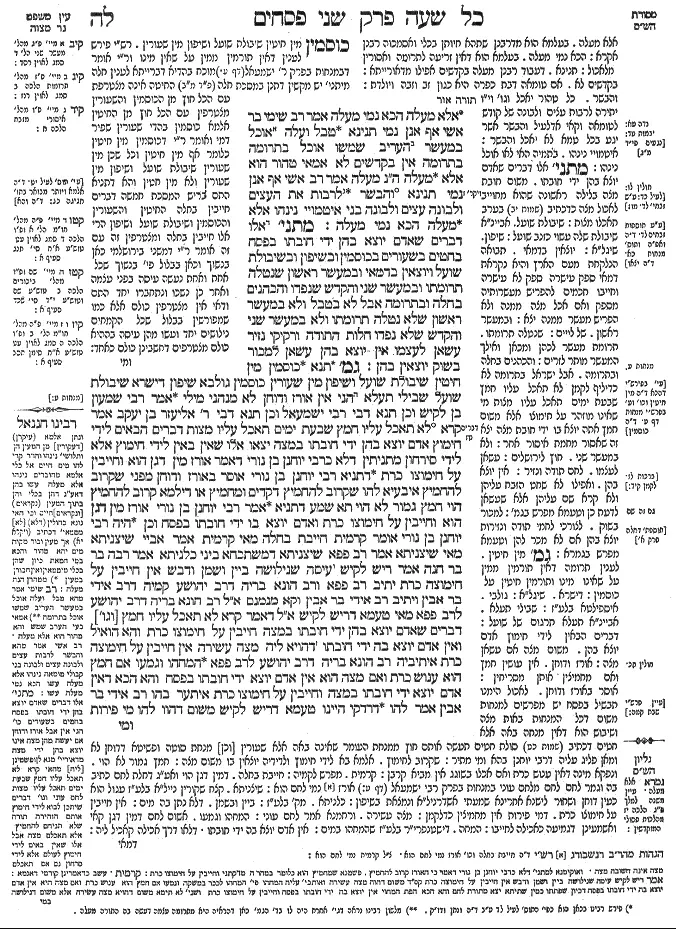
Pesahim 35a - Guemara
אלא מעלה הכא נמי מעלה אמר רב שימי בר אשי אף אנן נמי תנינא טבל ועלה אוכל במעשר העריב שמשו אוכל בתרומה בתרומה אין בקדשים לא אמאי טהור הוא אלא מעלה ה"נ מעלה אמר רב אשי אף אנן נמי תנינא (ויקרא ז, יט) והבשר לרבות את העצים ולבונה עצים ולבונה בני איטמויי נינהו אלא מעלה הכא נמי מעלה:
מתני׳ אלו דברים שאדם יוצא בהן ידי חובתו בפסח בחטים בשעורים בכוסמין ובשיפון ובשיבולת שועל ויוצאין בדמאי ובמעשר ראשון שנטלה תרומתו ובמעשר שני והקדש שנפדו והכהנים בחלה ובתרומה אבל לא בטבל ולא במעשר ראשון שלא נטלה תרומתו ולא במעשר שני והקדש שלא נפדו חלות התודה ורקיקי נזיר עשאן לעצמו אין יוצא בהן עשאן למכור בשוק יוצאין בהן:
גמ׳ תנא כוסמין מין חיטין שיבולת שועל ושיפון מין שעורין כוסמין גולבא שיפון דישרא שיבולת שועל שבילי תעלא הני אין אורז ודוחן לא מנהני מילי אמר רבי שמעון בן לקיש וכן תנא דבי רבי ישמעאל וכן תנא דבי ר' אליעזר בן יעקב אמר קרא (דברים טז, ג) לא תאכל עליו חמץ שבעת ימים תאכל עליו מצות דברים הבאים לידי חימוץ אדם יוצא בהן ידי חובתו במצה יצאו אלו שאין באין לידי חימוץ אלא לידי סירחון מתניתין דלא כרבי יוחנן בן נורי דאמר אורז מין דגן הוא וחייבין על חימוצו כרת דתניא רבי יוחנן בן נורי אוסר באורז ודוחן מפני שקרוב להחמיץ איבעיא להו שקרוב להחמיץ דקדים ומחמיץ או דילמא קרוב להחמיץ הוי חמץ גמור לא הוי תא שמע דתניא אמר רבי יוחנן בן נורי אורז מין דגן הוא וחייבין על חימוצו כרת ואדם יוצא בו ידי חובתו בפסח וכן היה רבי יוחנן בן נורי אומר קרמית חייבת בחלה מאי קרמית אמר אביי שיצניתא מאי שיצניתא אמר רב פפא שיצניתא דמשתכחא ביני כלניתא אמר רבה בר בר חנה אמר ריש לקיש עיסה שנילושה ביין ושמן ודבש אין חייבין על חימוצה כרת יתיב רב פפא ורב הונא בריה דרב יהושע קמיה דרב אידי בר אבין ויתיב רב אידי בר אבין וקא מנמנם א"ל רב הונא בריה דרב יהושע לרב פפא מאי טעמא דריש לקיש א"ל דאמר קרא לא תאכל עליו חמץ [וגו'] דברים שאדם יוצא בהן ידי חובתו במצה חייבין על חימוצו כרת והא הואיל ואין אדם יוצא בה ידי חובתו דהויא ליה מצה עשירה אין חייבין על חימוצה כרת איתיביה רב הונא בריה דרב יהושע לרב פפא המחהו וגמעו אם חמץ הוא ענוש כרת ואם מצה הוא אין אדם יוצא ידי חובתו בפסח והא הכא דאין אדם יוצא ידי חובתו במצה וחייבין על חימוצו כרת איתער בהו רב אידי בר אבין אמר להו דרדקי היינו טעמא דריש לקיש משום דהוו להו מי פירות
Comments from Rashi on Masechet Pesahim Page 35a
אלא מעלה . בעלמא הוא מדרבנן שתהא חיותן בכלי ואסמכוה רבנן אקרא: הכא נמי מעלה . בעלמא הוא דאין זריעה לתרומה ואסורין מלאכול: תנינא . דעבוד רבנן מעלה בקדשים אפילו מדאורייתא: בקדשים לא . אם טומאה דבת כפרה היא כגון זב וזבה ויולדת: והבשר . כל טהור יאכל וגו' וי"ו יתירה לרבות עצים ולבונה של קודש לטומאה וקאי אדלעיל והבשר אשר יגע בכל טמא לא יאכל והבשר: איטמויי נינהו . בתמיה הא לאו אוכל נינהו מתני' אלו דברים שאדם יוצא בהן ידי חובתו משום חובת מצה בלילה ראשונה שהוא מחוייב לאכול מצה כדכתיב (שמות יב) בערב תאכלו מצות: מתני' אלו דברים שאדם יוצא בהן ידי חובתו . משום חובת מצה בלילה ראשונה שהוא מחוייב לאכול מצה כדכתיב (שמות יב) בערב תאכלו מצות: שיפון . שיגל"א: שיבולת שועל . אביינ"א (שיבולת שועל) שיבולת שלה עשוי כזנב שועל: יוצאין בדמאי . תבואה הנלקחת מעם הארץ והיא נקראת דמאי ספק עישרה ספק לא עישרה וחייבו חכמים להפריש מעשרותיה מספק ואם אכל מצה ממנה ולא הפריש מעשר ממנה יצא: ובמעשר ראשון . של לויים: שנטלה תרומתו . תרומת מעשר לכהן ומכאן ואילך המעשר מותר לזרים: והכהנים בחלה ובתרומה . אבל ישראל בתרומה לא כדיליף לקמן לא תאכל עליו חמץ שבעת ימים תאכל עליו מצות מי שאינו מוזהר על חימוצו אלא משום חמץ אתה יוצא בו ידי חובת מצה יצא זה שאסור מחמת איסור אחר: ולא במעשר שני . חוץ לירושלים: עשאן לעצמו . לחם תודה ונזיר: אין יוצא בהן . ואפילו לא שחט הזבח עליהן ולא קרא שם עליהן אלא שעשאן לדעת כן וטעמא מפרש בגמ': למכור בשוק . לצורכי לחמי תודה ונזירות יוצא בהן אם לא מכר להן וטעמא מפרש בגמרא: גמ' מין חיטין . לענין תרומה דאין תורמין ממין על שאינו מינו ותורמין חיטין על כוסמין: דישרא . שיגל"א: גולבי . איספילט"א בלע"ז: שבילי תעלא . אביינ"א (שיבולת.שועל) תעלא תרגום של שועל: דברים הבאין לידי חימוץ אדם יוצא בהן . משום מצה אם עשאן מצה: אורז ודוחן . אין עושין חמץ ואם מחמיצין אותן מסריחין: אוסר באורז ודוחן . לאכול הימנו תבשיל בפסח יש מפרשים למנחות משום דכל המנחות באות מצה ושיבוש הוא דאין מנחה באה אלא חטים דכתיב (שמות כט) סולת חטים תעשה אותם חוץ ממנחת העומר שאינה באה אלא שעורין [וכן] מנחת סוטה ופשיטא דדוחן לא ומאן פליג עליה דרבי יוחנן בהא ומי מתיר: שקרוב לחימוץ . אלמא בא לידי חימוץ ולדידיה יוצאין בו משום מצה: חמץ גמור לא הוי . ונפקא מינה דאין ענוש כרת ואם אכלו בשוגג אין מביא קרבן: קרמית . מפרש לקמיה: חייבת בחלה . דמין דגן הוי ואע"ג דחלת לחם כתיב בה וגמר לחם לחם מלחם עוני במנחות בפרק ר' ישמעאל (דף ע:) אורז נמי לחם הוא: שיצניתא . קצח שקורין נייל"א בלע"ז עגול הוא כעין דוחן ושחור לישנא אחרינא שמעתי אשדרניל"א ונמצאת בשיפון: כלניתא . מק' (מ"ק: פרג) בלע"ז: ביין ובשמן . דלא נתן בה מים: אין חייבין על חימוצו כרת . דמי פירות אין מחמיצין כדלקמן: מצה עשירה . ורחמנא אמר לחם עוני: המחהו וגמעו . אשום לחם דמין דגן קאי ואשמעינן דגמיעה כאכילה לחייבו: המחה . דישטנפרי"ר בלע"ז שהמחהו במים: אין אדם יוצא בה ידי חובתו . דלאו דרך אכילה קאכיל ליה:
Comments from Tosafot - Pesahim 35a
כוסמין מין חיטין שיבולת שועל ושיפון מין שעורין . רש"י פירש לענין דאין תורמין ממין על שאין מינו ור"י אומר דבמנחות בפרק ר' ישמעאל (דף ע.) מוכח בהדיא דברייתא לענין חלה מיתני' יש מקשין דתנן במסכת חלה (פ"ד מ"ב) החיטה אינה מצטרפת עם הכל חוץ מן הכוסמין והשעורין מצטרפין עם הכל חוץ מן החיטין אלמא כוסמין בהדי שעורין שפיר דמי ואומר ר"י דכוסמין מין חיטין כלומר אף מין חיטין וכל שכן מין שעורין שיבולת שועל ושיפון מין שעורין ולא מין חטין והא דתניא התם בריש המסכת חמשה דברים חייבין בחלה החיטין והשעורין והכוסמין ושיבולת שועל ושיפון הרי אלו חייבין בחלה ומצטרפין זה עם זה אומר ר"י דמשני בירושלמי כאן בנשוך וכאן בבלול פי' בנשוך שכל אחת ואחת נעשה עיסה בפני עצמה ואחר כן נשכו ונתחברו יחד התם ודאי אין מצטרפין כולם אלא כמו שמפורשין בבלול שכל הקמחים נילושים יחד ועשו מהן עיסה בההיא כולם מצטרפים דחשבינן כולם כאחד:
Pesahim 35a - Mishnah translated into english
Rather, this is merely a higher standard, as by Torah law the water may be drawn with one vessel and sanctified in another vessel. The Sages added that this water must be sanctified in the same vessel in which it was drawn from the spring, and they found support for their opinion in the Torah. Here too, the Sages established a higher standard for a consecrated object that became ritually impure, as they decreed that it cannot be ritually purified through insertion in the ground.
Rav Shimi bar Ashi said: We, too, learned a similar statement in a baraita: When the period of ritual impurity of a zav or leper has been completed, and he immersed during the day and emerged, he may eat tithes immediately. Once the sun set for him, he may eat teruma. Rav Shimi bar Ashi infers from this statement: With regard to teruma, yes, he may eat it; however, with regard to consecrated food, no, he may not. Given that conclusion, Rav Shimi bar Ashi asks: Why is there a difference between teruma and consecrated foods? After all, he is ritually pure. Rather, the Sages established a higher standard for consecrated food, and permitted one to eat them only after sacrificing the requisite purification offering. Here too, the Sages established a higher standard for the ritual purity of consecrated liquids.
Rav Ashi said: We, too, learned another case where the Sages established a higher standard. The verse says: “And the flesh that touches any ritually impure thing shall not be eaten; it shall be burnt with fire. And as for the flesh, anyone who is ritually pure may eat from it” (Leviticus 7:19). And the flesh comes to include the wood in the Temple and the frankincense. The Gemara asks: Do wood and frankincense have the capacity to become ritually impure, given that they are neither food nor drink? Rather, the Sages established a higher standard for these objects due to their sanctity; here too, the Sages established a higher standard for the ritual purity of consecrated liquids.
MISHNA: These are the types of grain with which a person fulfills his obligation to eat matza on the first night of Passover: With wheat, with barley, with spelt [kusmin], with rye [shifon], and with oats [shibbolet shu’al]. And one fulfills his obligation by eating not only matza made from properly tithed grains, but even with matza made from doubtfully tithed produce, and matza made with first tithe from which its teruma was already taken, or second tithe and consecrated food that were redeemed. And priests may eat matza prepared from ḥalla, the portion of dough that is given to priests, or with teruma, as priests are permitted to eat these portions.
However, one may not fulfill one’s obligation to eat matza made with untithed produce, nor with matza made from the first tithe from which its teruma was not separated, nor with matza made either from the second tithe, nor from consecrated grain that was not redeemed. With regard to one who prepared loaves of matza that are brought with a thanks-offering, or to the wafers brought by a nazirite, the Sages drew the following distinction: If he prepared them for himself, then he does not fulfill his obligation to eat matza with them. However, if he prepared them to sell them in the market to those who require these loaves or wafers, one fulfills the obligation to eat matza with them.
GEMARA: The Gemara identifies the species mentioned in the mishna. One of the Sages taught in the Tosefta: Spelt is a type of wheat, while oats [shibbolet shu’al] and rye [shifon] are a type of barley. The Gemara translates the lesser-known species into the vernacular Aramaic: Spelt is called gulba; rye is dishra; and oats are shevilei ta’ala. The Gemara infers: These species, yes, they may be used for matza; however, rice [orez] and millet [doḥan], no, they may not be used.
The Gemara asks: From where are these matters, that matza cannot be prepared from rice or millet, derived? Rabbi Shimon ben Lakish said, and likewise a Sage of the school of Rabbi Yishmael taught, and likewise a Sage of the school of Rabbi Eliezer ben Ya’akov taught that the verse states: “You shall eat no leavened bread with it; seven days you shall eat with it matza, the bread of affliction” (Deuteronomy 16:3). This verse indicates that only with substances which will come to a state of leavening, a person fulfills his obligation to eat matza with them, provided he prevents them from becoming leavened. This excludes these foods, i.e., rice, millet, and similar grains, which, even if flour is prepared from them and water is added to their flour, do not come to a state of leavening but to a state of decay [siraḥon].
The Gemara notes: The mishna is not in accordance with the opinion of Rabbi Yoḥanan ben Nuri, who said: Rice is a full-fledged type of grain, and one is liable to receive karet for eating it in its leavened state, like other types of grain. As it was taught in a baraita: Rabbi Yoḥanan ben Nuri prohibits eating cooked rice and millet on Passover, due to the fact that they are close to being leavened.
A dilemma was raised before the scholars who were studying this issue. What is the meaning of the expression: That it is close to becoming leavened? Does this mean that it will be leavened even quicker than wheat or barley? Or does it perhaps mean that it is only close to being leavened, i.e., it resembles leavened bread, but it is not full-fledged leavened bread. In other words, perhaps Rabbi Yoḥanan ben Nuri maintains that these grains cannot in fact become full-fledged leavened bread, and one is not punished with karet for eating them on Passover. However, he rules that one should nevertheless avoid eating them, due to their similarity to leavened bread.
The Gemara responds: Come and hear a resolution to this question, as it was taught in a baraita that Rabbi Yoḥanan ben Nuri said: Rice is a full-fledged type of grain. Therefore, one is liable to receive karet for eating it in its leavened state, and a person can fulfill his obligation to eat matza with it on Passover. This baraita clearly indicates that, according to the opinion of Rabbi Yoḥanan ben Nuri, rice becomes leavened like other grains, and the expression: It is close to becoming leavened, means that it becomes leavened quicker than other grains.
And so too, Rabbi Yoḥanan ben Nuri would say: One who has prepared bread from keramit, a type of wild wheat, is obligated to separate ḥalla, just as he must separate ḥalla from dough prepared of other types of grain. The Gemara asks: What is keramit? Abaye said: It is a plant called shitzanita. Since this name was not widely known either, the Gemara asks: What is shitzanita? Rav Pappa said: This is the wild grain that is found between papyrus reeds.
Rabba bar bar Ḥana said that Reish Lakish said: With regard to dough that was kneaded with wine, oil, or honey, one is not liable to receive karet for eating it in its leavened state, since these liquids will not cause the dough to be leavened. Rav Pappa and Rav Huna, son of Rav Yehoshua, were sitting before Rav Idi bar Avin, and Rav Idi bar Avin was sitting and dozing as his students conversed. Rav Huna, son of Rav Yehoshua, said to Rav Pappa: What is the reason of Reish Lakish, who maintains that one is not liable to receive karet for this type of leavening?
Rav Pappa said to him: The verse states: “You shall eat no leavened bread with it; seven days you shall eat with it matza” (Deuteronomy 16:3). In light of the juxtaposition of leavened bread and matza, Reish Lakish compares these two types of bread: With regard to those substances through which a person fulfills his obligation to eat matza, one is liable to receive karet for eating them in their leavened state. And with regard to this dough, which was kneaded with wine, oil, or honey, since a person does not fulfill his obligation to eat matza with it, as it is called rich, i.e., enhanced, matza, one is not liable to receive karet for eating it in its leavened state on Passover. Matza is called the bread of affliction, or the poor man’s bread, a description that does not apply to dough prepared with wine, oil, or honey.
Rav Huna, son of Rav Yehoshua, raised an objection to Rav Pappa: We learned with regard to one who took a baked item, dissolved it in water, and swallowed this mixture on Passover: If the baked item is leavened bread, he is punished with karet; and if it is matza, a person does not fulfill his obligation to eat matza on Passover with this food. The reason one does not fulfill the obligation to eat matza is because swallowing in this manner is not considered an act of eating. But here this is a case where a person does not fulfill his obligation to eat matza with this dissolved food, and nevertheless he is liable to receive karet for eating it in its leavened state. This ruling conflicts with Rav Pappa’s general principle.
At this point Rav Idi bar Avin woke up, due to their discussion, and said to them: Children, this is the reasoning of Reish Lakish: One is not liable to receive karet for eating dough kneaded with oil or honey, because oil and honey are considered fruit juices,
Traduction : The William Davidson digital edition of the Koren Noé Talmud, with commentary by Rabbi Adin Even-Israel Steinsaltz.