 Talmud Bavli
Pesahim 46a : Youtube
Daf TubeYoutube
3 video classes :
Pesahim Page 46a
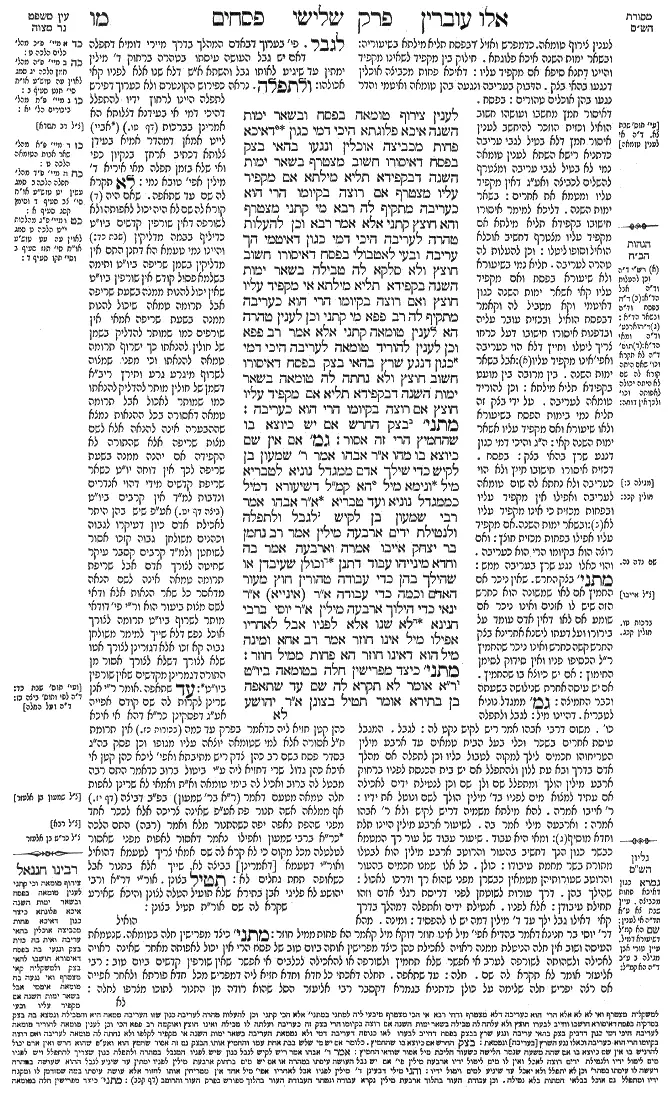
Pesahim 46a - Guemara
לענין צירוף טומאה בפסח ובשאר ימות השנה איכא פלוגתא היכי דמי כגון דאיכא פחות מכביצה אוכלין ונגעו בהאי בצק בפסח דאיסורו חשוב מצטרף בשאר ימות השנה דבקפידא תליא מילתא אם מקפיד עליו מצטרף אם רוצה בקיומו הרי הוא כעריבה מתקיף לה רבא מי קתני מצטרף והא חוצץ קתני אלא אמר רבא וכן להעלות טהרה לעריבה היכי דמי כגון דאיטמי הך עריבה ובעי לאטבולי בפסח דאיסורו חשוב חוצץ ולא סלקא לה טבילה בשאר ימות השנה בקפידא תליא מילתא אי מקפיד עליו חוצץ ואם רוצה בקיומו הרי הוא כעריבה מתקיף לה רב פפא מי קתני וכן לענין טהרה הא לענין טומאה קתני אלא אמר רב פפא וכן לענין להוריד טומאה לעריבה היכי דמי כגון דנגע שרץ בהאי בצק בפסח דאיסורו חשוב חוצץ ולא נחתה לה טומאה בשאר ימות השנה דבקפידא תליא אם מקפיד עליו חוצץ אם רוצה בקיומו הרי הוא כעריבה:
מתני׳ בצק החרש אם יש כיוצא בו שהחמיץ הרי זה אסור:
גמ׳ אם אין שם כיוצא בו מהו א"ר אבהו אמר ר' שמעון בן לקיש כדי שילך אדם ממגדל נוניא לטבריא מיל ונימא מיל הא קמ"ל דשיעורא דמיל כממגדל נוניא ועד טבריא א"ר אבהו אמר רבי שמעון בן לקיש לגבל ולתפלה ולנטילת ידים ארבעה מילין אמר רב נחמן בר יצחק אייבו אמרה וארבעה אמר בה וחדא מינייהו עבוד דתנן וכולן שעיבדן או שהילך בהן כדי עבודה טהורין חוץ מעור האדם וכמה כדי עבודה א"ר (אינייא) א"ר ינאי כדי הילוך ארבעה מילין א"ר יוסי ברבי חנינא לא שנו אלא לפניו אבל לאחריו אפילו מיל אינו חוזר אמר רב אחא ומינה מיל הוא דאינו חוזר הא פחות ממיל חוזר:
מתני׳ כיצד מפרישין חלה בטומאה ביו"ט ר"א אומר לא תקרא לה שם עד שתאפה בן בתירא אומר תטיל בצונן א"ר יהושע
Comments from Rashi on Masechet Pesahim Page 46a
לענין צירוף טומאה . כדמפרש ואזיל דבפסח תליא מילתא בשיעוריה: ובשאר ימות השנה איכא פלוגתא . חילוק בין מקפיד לשאינו מקפיד והיינו דתנא סיפא אם מקפיד עליו: דאיכא פחות מכביצה אוכלין דנגעו בהאי בצק . הדבוק בעריבה ונגעה בהן טומאה ואיטמי והדר נגעו בהן אוכלים טהורים: בפסח . דאיסור חמץ מחשבו ועושהו חשוב הואיל וכזית הוזכר להיחשב לענין איסור חמץ דלא בטיל לגבי עריבה כדתניא רישא השתא לענין טומאה נמי לא בטיל לגבי עריבה ומצטרף להשלים לכביצה ואע"ג דאין מקפיד עליו ומטמא את אחרים: בשאר ימות השנה . דליכא למימר איסורו חישובו בקפידא תליא מילתא אם מקפיד עליו מצטרף דחשיב אוכלא הואיל וסופו ליטלו: וכן להעלות לה טהרה לעריבה . תליא נמי בשיעורא ולא שיעורא בפסח ואם מקפיד עליו קאי אשאר ימות השנה כגון דאיטמי וקא מטביל לה וקאמר דבפסח הואיל ובכזית עובר עליה ובדפנות איסורו חישובו דעל כרחו צריך ליטלו וחייץ דלא הוי כעריבה ואפי' אינו מקפיד עליו: אבל בשאר ימות השנה . בין מרובה בין מועט בקפידא תליא מילתא: וכן להוריד טומאה לעריבה . על ידי בצק זה תליא נמי בימות הפסח בשיעורא ולאו שיעורא ואם מקפיד עליו אשאר ימות השנה קאי: ה"ג והיכי דמי כגון דנגע שרץ בהאי בצק: בפסח . דכזית איסורו חישובו חייץ ולא הוי כעריבה ולא נחתא לה שום טומאה לעריבה ואפילו אין מקפיד עליו ובפחות מכזית כי אינו מקפיד עליו לא: ובשאר ימות השנה . אם מקפיד עליו אפילו בפחות מכזית חוצץ: ואם רוצה הוא בקיומו הרי הוא כעריבה . והוי כאלו נגע שרץ בעריבה ממש: מתני' בצק החרש . שאין ניכר אם החמיץ אם לאו שמשונה הוא כחרש הזה שיש לו אזנים ואינו ניכר אם שומע אם לאו דאין אדם עומד על ברורו ועל דעתו לישנא אחרינא בצק החרש קשה כחרש ואינו ניכר שהחמיץ ר"ל הכסיפו פניו ואין סידוק לסימן החימוץ: אם יש כיוצא בו שהחמיץ . אם יש עיסה אחרת שנילושה בשעתה וכבר החמיצה: גמ' ממגדל נוניא לטבריא . דהיינו מיל: לגבל ולתפלה כו' . משום דר' אבהו אמר ריש לקיש נקט לה: לגבל . המגבל עיסת אחרים בשכר וכלי בעל הבית טמאים עד ארבע מילין הטריחוהו חכמים לילך למקוה לטבול כליו וכן לתפלה אם מהלך אדם בדרך ובא עת ללון ולהתפלל אם יש בית הכנסת לפניו ברחוק ארבע מילין הולך ומתפלל שם ולן שם וכן לנטילת ידים לאכילה אם עתיד למצוא מים לפניו בד' מילין הולך לשם ונוטל את ידיו: ר' אייבו אמרה . להא מילתא משמיה דריש לקיש ולא ר' אבהו אמרה: וארבעה מילי אמר בה . לשיעור ארבע מילין היינו תלת וחדא מוסיף: ומאי היא עבוד . שיעור עבוד של עור רך המטמא כבשר כגון הנך דחשיב בהעור והרוטב ארבע מילין הוא לבטלו מתורת בשר מחמת עיבודו: כולן . כל אלו שמנו חכמים בהעור והרוטב שעורותיהן מטמאין כבשרן מפני שהוא רך ודרכו לאכול: שהילך בהן . דרך עורות לשוטחן לפני דריסת רגלי אדם וזהו תחילת עיבודן: אלא לפניו . אנטילת ידים ואתפלה דמהלך בדרך קאי דאילו גבל ילך עד ד' מילין דמה יש לו להפסיד: ומינה . מהא דר' יוסי בר חנינא דאמר בהדיא אפי' מיל אינו חוזר דוקא מיל קאמר הא פחות ממיל חוזר: מתני' כיצד מפרישין חלה בטומאה . שנטמאת העיסה ושוב אין חלה הניטלת ממנה ראויה לאכילת כהן כיצד מפרישין אותה ביום טוב של פסח הרי אין יכול לאפותה מאחר שאינה ראויה לאכילה ולשהותה לשורפה לערב אי אפשר שלא תחמיץ ולשורפה או להאכילה לכלבים אי אפשר שאין שורפין קדשים ביום טוב: רבי אליעזר אומר לא תקרא לה שם . חלה: עד שתאפה . תחלה דאכתי כל חדא וחדא חזי ליה דמפריש מכל חדא פורתא ולאחר אפייה אם רצה יפריש חלה שלימה על כולן כדתניא בגמרא דקסבר רבי אליעזר הסל שהוא רודה מן התנור לתוכו מצרפו לחלה:
Comments from Tosafot - Pesahim 46a
לגבר . פי' בערוך דבאדם המהלך בדרך מיירי דומיא דתפלה דאם יש גבל העושה עיסתו בטהרה ברחוק ד' מילין ימתין עד שיגיע לאותו גבל והשתא א"ש דלא שנו אלא לפניו קאי אכולהו: ולתפלה . נראה כפירוש הקונטרס ולא כערוך דפירש לתפלה היינו לרחוץ ידיו להתפלל דהיכי דמי אי בעידנא דצלותא הא אמרינן בברכות (דף טו.) (אביי) לייט אמאן דמהדר אמיא בעידן צלותא דכתיב ארחץ בנקיון כפי ואי שלא בזמן תפלה מאי איריא ד' מילין אפי' טובא נמי: לא תקרא לה שם עד שתאפה . שאם היה קורא לה שם לא היה יכול לאפותה ולא לשורפה דאין שורפין קדשים ביו"ט כדיליף בבמה מדליקין (שבת כד:) והיינו נמי טעמא הא דתנן התם אין מדליקין בשמן שריפה ביו"ט ותימה בשלמא פסול קודש אין שורפין ביו"ט שאין יכול להנות ממנה בשעת שריפה אבל תרומה טמאה שיכול להנות ממנה בשעת שריפה אמאי אין שורפים כמו שמותר להדליק בשמן של חולין להנאתו כך ישרוף תרומה טמאה להנאתו וכי מפני שמצוה לשרוף מיגרע גרע ותירץ ריב"א דשמן של חולין מותר להדליק להנאתו כמו שמותר לאכול אבל תרומה טמאה דאסורה בכל ההנאות נמצא שההבערה אינה להנאה אלא לשם מצות שריפה אלא שהתורה לא הקפידה אם יהנה ממנה בשעת שריפה לכך אין דוחה יו"ט כשאר שריפת קדשים מידי דהוי אנדרים ונדבות למ"ד אין קרבים ביו"ט (ביצה דף יט.) אע"פ שיש בהן היתר לאכילת אדם כיון דעיקרו לגבוה וכהנים משולחן גבוה קזכו אסור לשוחטן ולמ"ד קרבים קסבר עיקר שחיטה לצורך אדם אבל שריפת תרומה טמאה אינה לשם הנאה מדאסר כל שאר הנאות אלא ודאי לשם מצות ביעור הוא ור"י פי' דודאי מותר לשרוף ביו"ט תרומה לצורך אוכל נפש דלא שייך למימר משולחן גבוה קא זכו אלא דגזרינן לצורך אטו שלא לצורך דשלא לצורך אסור מן התורה דגמרינן מקדשים שאין שורפין ביו"ט: עד שתאפה . אומר ר"י אנן שרינן לקרות לה שם קודם אפייה אע"ג דפסקינן כר"א דהא אי איכא כהן קטן חזיא ליה כדאמר בפרק עד כמה (בכורות כז.) אין תרומת ח"ל אסורה אלא למי שטומאה יוצאה עליו מגופו וכן פסק בה"ג בסדר פסח בשם רב כהן צדק ריש מתיבתא ואפי' ליכא כהן קטן אי איכא כהן גדול שרי דחזיא ליה ע"י ביטול ברוב כדאמר התם רבה מבטל לה ברוב ואכיל לה בימי טומאה וא"ת ואמאי לא שרינן לאפות חלה טמאה מטעם דאמר (ר"א בר' שמעון) בפ"ב דביצה (דף יז.) אף ממלאה אשה תנור פת אע"פ שאינה צריכה אלא לככר אחד מפני שהפת נאפה יפה כשהתנור מלא ואמר (רבה) התם הלכה כר"א ברבי שמעון ואפילו נאמר דאסור לאפות מפני שאסור לטלטלה מכל מקום כי לא קרא לה שם אמאי צריך לטעמא דהואיל ואור"י דטעמא [דאמרינן] בביצה לא שייך אלא בתנור אבל כשאופה תחת גחלים לא: תטיל בצונן . אור"י דר"א ורבי יהושע לא פליגי אבן בתירא שלא תועיל הטלה לצונן והיכא שאירע שקרא לה שם אור"ת תטיל בצונן:
Pesahim 46a - Mishnah translated into english
with regard to the combination of two pieces vis-à-vis ritual impurity during Passover, when it depends upon their volume. However, during the rest of the year there is a distinction based upon whether the owner is particular about it or not.
The Gemara explains: What are the circumstances of the mishna’s case? It is a case where there is less than an egg-bulk of ritually impure food, and it touched this dough in the bowl, and then it came into contact with ritually pure food. During Passover, when the prohibition that applies to the dough causes it to be considered significant although it is a very small quantity, it combines with the first piece of food. Together they are the size of an egg-bulk, which is able to transmit the ritual impurity of foods. However, during the rest of the year, when there is no prohibition that imparts this significance to the dough, the matter is dependent on the owner’s particularity; if he is particular about it, i.e., he does not want the dough to be there, it is considered food rather than part of the bowl, and it combines with the other piece of food. However, if one prefers its continued presence in its current location, it is considered like part of the kneading bowl itself, rather than food.
Rava strongly objects to this: Was the language taught in the mishna: Combines? Didn’t the mishna teach that it interposes? Abaye’s explanation does not account for this term. Rather, Rava said that the mishna should be understood as saying: And so too with regard to purifying the kneading bowl via immersion.
The Gemara explains: What are the circumstances of the mishna’s case? It is a case where the kneading bowl became ritually impure, and one wishes to immerse it. During Passover, when the prohibition of an olive-bulk of leaven causes it to be considered significant, it interposes between the water and the kneading bowl, and the immersion is ineffective. However, during the rest of the year, the matter depends upon whether or not the owner is particular about it. If he is particular about the dough and wishes to remove it, it interposes between the water and the bowl. However, if the owner desires it to be present, it is considered like part of the kneading bowl itself, and it does not interpose between the water and the bowl.
Rav Pappa strongly objects to this: Was the language taught in the mishna: And similarly with regard to ritual purity? Didn’t the mishna teach: And similarly with regard to ritual impurity? Rather, Rav Pappa said the mishna should be understood as saying: And similarly with regard to the transfer of ritual impurity to the kneading bowl via this dough.
The Gemara explains: What are the circumstances of the mishna’s case? It is a case where the carcass of a creeping animal touched this dough. During Passover, when its prohibition causes the dough to be considered significant, it interposes between the bowl and the creeping animal, and ritual impurity does not descend to the kneading bowl, i.e., the kneading bowl does not become impure. During the rest of the year, when it depends upon whether one is particular about the presence of the dough, if he is particular about it, it interposes between the bowl and the creeping animal and prevents the bowl from becoming impure. However, if he desires it to be present, it is considered like it is part of the kneading bowl itself. Therefore, the entire bowl becomes ritually impure when the carcass of the creeping animal touches the dough.
MISHNA: Deaf dough is dough for which it is difficult to determine if it has been leavened. It is comparable to a deaf-mute, who cannot communicate. If there is dough similar to it in that water was added to both at the same time, which became leavened, the deaf dough is prohibited. Although it has not shown external signs of becoming leavened, it can be presumed that the deaf dough has also become leavened.
GEMARA: The Gemara seeks to clarify the ruling of the mishna: If there is no dough similar to it, what is the halakha? Rabbi Abbahu said that Rabbi Shimon ben Lakish said: According to the Sages, leavening occurs in the time it takes a person to walk the distance from Migdal Nunaya to Tiberias, which is a mil, two thousand cubits.
The Gemara asks about this formulation: Why is it necessary to mention the distance between these two places? Let us say that leavening begins after the time it takes a person to walk a mil. The Gemara answers: This statement incidentally teaches us that the length of a mil is the distance from Migdal Nunaya to Tiberias.
Rabbi Abbahu said that Rabbi Shimon ben Lakish said: With regard to a kneader, i.e., one who kneads dough for others and should maintain the ritual purity of the dough; and similarly, with regard to washing one’s hands for prayer (Arukh), and with regard to washing hands before eating, one must search either for a ritual bath to immerse the vessel he is using to knead the dough, or for water to purify his hands, provided that water is accessible within the time it takes to walk four mil, eight thousand cubits.
Rav Naḥman bar Yitzḥak said: Ayvu said this halakha, and he said it about four cases, as opposed to the three cases mentioned previously. And one of them pertained to the tanning of hides, which lasts for the time that it takes a person to walk four mil. As we learned in a mishna: And all types of thin, soft hides, which have the status of flesh with regard to ritual impurity because their texture is similar to flesh, that were tanned in order to be made into leather, or that one trod upon for as long as necessary for the leatherworking process, are ritually pure. They are considered to be leather and are no longer considered like the flesh of the animal, except for the skin of a human corpse, which always remains ritually impure. The Gemara asks: How much time must one tread upon a hide for the leatherworking process? Rabbi Ayvu said that Rabbi Yannai said: It is the amount of time it takes to walk four mil.
Rabbi Yosei, son of Rabbi Ḥanina, said: They taught that one must search for water to wash one’s hands before eating or prayer for the amount of time it takes to walk four mil only when the water is before him, in the direction that he is traveling. However, when it is behind him, he need not return even a mil. Rav Aḥa said: From this statement one may infer that he need not return a mil, but he must return less than one mil in order to obtain water.
MISHNA: How does one separate ḥalla in ritual impurity during the Festival day of Passover? Ordinarily, one may separate ritually pure ḥalla from dough and give it to a priest immediately so that he may eat it. Ritually impure ḥalla is unfit for a priest and must be burned, yet it is prohibited to bake or burn anything that is not fit to be eaten during the Festival day. However, it is also prohibited to wait and burn it after the Festival day, since it will become leavened in the meantime.
Rabbi Eliezer says: A woman should not designate it as ḥalla prior to baking; rather, she should refrain from doing so until it is baked. In other words, she should wait until she has baked all of the dough, and there is no risk of it becoming leavened. Only then should she separate ḥalla from it. The portion of ḥalla may then be kept until after the Festival day, when it may be burned. Ben Beteira says: She should separate the ḥalla before it is baked, and place the dough in cold water so that it will not become leavened. Rabbi Yehoshua said:
Traduction : The William Davidson digital edition of the Koren Noé Talmud, with commentary by Rabbi Adin Even-Israel Steinsaltz.