 Talmud Bavli
Pesahim 117a : Youtube
Daf TubeYoutube
3 video classes :
Pesahim Page 117a
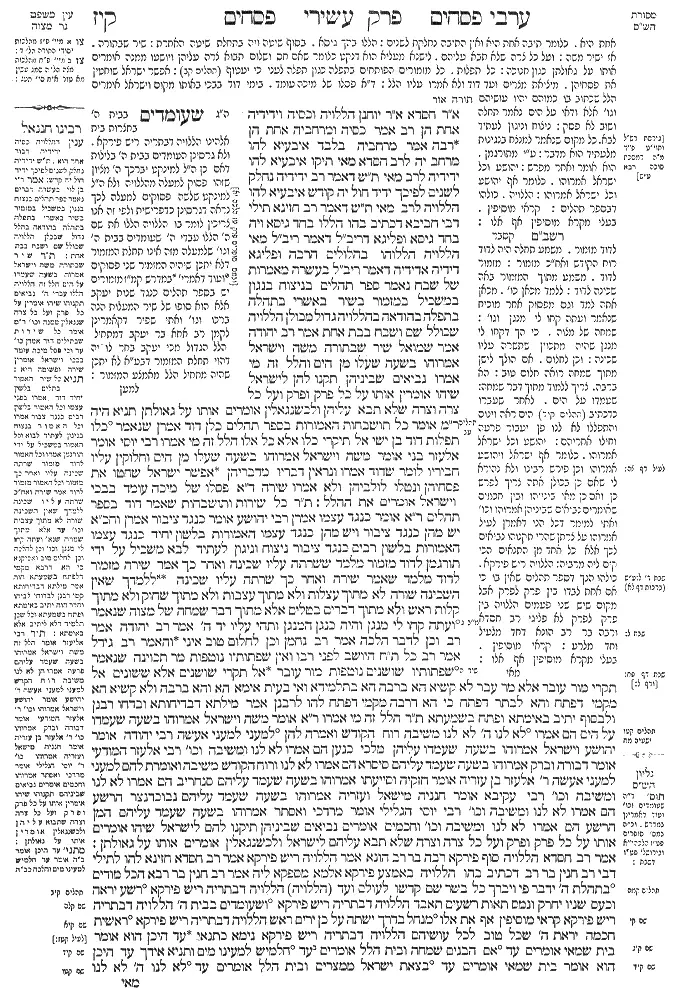
Pesahim 117a - Guemara
א"ר חסדא א"ר יוחנן הללויה וכסיה וידידיה אחת הן רב אמר כסיה ומרחביה אחת הן רבה אמר מרחביה בלבד איבעיא להו מרחב יה לרב חסדא מאי תיקו איבעיא להו ידידיה לרב מאי ת"ש דאמר רב ידידיה נחלק לשנים לפיכך ידיד חול יה קודש איבעיא להו הללויה לרב מאי ת"ש דאמר רב חזינא תילי דבי חביבא דכתיב בהו הללו בחד גיסא ויה בחד גיסא ופליגא דריב"ל דאמר ריב"ל מאי הללויה הללוהו בהלולים הרבה ופליגא דידיה אדידיה דאמר ריב"ל בעשרה מאמרות של שבח נאמר ספר תהלים בניצוח בנגון במשכיל במזמור בשיר באשרי בתהלה בתפלה בהודאה בהללויה גדול מכולן הללויה שכולל שם ושבח בבת אחת אמר רב יהודה אמר שמואל שיר שבתורה משה וישראל אמרוהו בשעה שעלו מן הים והלל זה מי אמרו נביאים שביניהן תקנו להן לישראל שיהו אומרין אותו על כל פרק ופרק ועל כל צרה וצרה שלא תבא עליהן ולכשנגאלין אומרים אותו על גאולתן תניא היה ר"מ אומר כל תושבחות האמורות בספר תהלים כלן דוד אמרן שנאמר (תהלים עב, כ) כלו תפלות דוד בן ישי אל תיקרי כלו אלא כל אלו הלל זה מי אמרו רבי יוסי אומר אלעזר בני אומר משה וישראל אמרוהו בשעה שעלו מן הים וחלוקין עליו חביריו לומר שדוד אמרו ונראין דבריו מדבריהן אפשר ישראל שחטו את פסחיהן ונטלו לולביהן ולא אמרו שירה ד"א פסלו של מיכה עומד בבכי וישראל אומרים את ההלל:
ת"ר כל שירות ותושבחות שאמר דוד בספר תהלים ר"א אומר כנגד עצמו אמרן רבי יהושע אומר כנגד ציבור אמרן וחכ"א יש מהן כנגד ציבור ויש מהן כנגד עצמו האמורות בלשון יחיד כנגד עצמו האמורות בלשון רבים כנגד ציבור ניצוח וניגון לעתיד לבא משכיל על ידי תורגמן לדוד מזמור מלמד ששרתה עליו שכינה ואחר כך אמר שירה מזמור לדוד מלמד שאמר שירה ואחר כך שרתה עליו שכינה ללמדך שאין השכינה שורה לא מתוך עצלות ולא מתוך עצבות ולא מתוך שחוק ולא מתוך קלות ראש ולא מתוך דברים בטלים אלא מתוך דבר שמחה של מצוה שנאמר (מלכים ב ג, טו) ועתה קחו לי מנגן והיה כנגן המנגן ותהי עליו יד ה' אמר רב יהודה אמר רב וכן לדבר הלכה אמר רב נחמן וכן לחלום טוב איני והאמר רב גידל אמר רב כל ת"ח היושב לפני רבו ואין שפתותיו נוטפות מר תכוינה שנאמר (שיר השירים ה, יג) שפתותיו שושנים נוטפות מור עובר אל תקרי שושנים אלא ששונים אל תקרי מור עובר אלא מר עבר לא קשיא הא ברבה הא בתלמידא ואי בעית אימא הא והא ברבה ולא קשיא הא מקמי דפתח והא לבתר דפתח כי הא דרבה מקמי דפתח להו לרבנן אמר מילתא דבדיחותא ובדחו רבנן ולבסוף יתיב באימתא ופתח בשמעתא ת"ר הלל זה מי אמרו ר"א אומר משה וישראל אמרוהו בשעה שעמדו על הים הם אמרו (תהלים קטו, א) לא לנו ה' לא לנו משיבה רוח הקודש ואמרה להן (ישעיהו מח, יא) למעני למעני אעשה רבי יהודה אומר יהושע וישראל אמרוהו בשעה שעמדו עליהן מלכי כנען הם אמרו לא לנו ומשיבה וכו' רבי אלעזר המודעי אומר דבורה וברק אמרוהו בשעה שעמד עליהם סיסרא הם אמרו לא לנו ורוח הקודש משיבה ואומרת להם למעני למעני אעשה ר' אלעזר בן עזריה אומר חזקיה וסייעתו אמרוהו בשעה שעמד עליהם סנחריב הם אמרו לא לנו ומשיבה וכו' רבי עקיבא אומר חנניה מישאל ועזריה אמרוהו בשעה שעמד עליהם נבוכדנצר הרשע הם אמרו לא לנו ומשיבה וכו' רבי יוסי הגלילי אומר מרדכי ואסתר אמרוהו בשעה שעמד עליהם המן הרשע הם אמרו לא לנו ומשיבה וכו' וחכמים אומרים נביאים שביניהן תיקנו להם לישראל שיהו אומרים אותו על כל פרק ופרק ועל כל צרה וצרה שלא תבא עליהם לישראל ולכשנגאלין אומרים אותו על גאולתן:
אמר רב חסדא הללויה סוף פירקא רבה בר רב הונא אמר הללויה ריש פירקא אמר רב חסדא חזינא להו לתילי דבי רב חנין בר רב דכתיב בהו הללויה באמצע פירקא אלמא מספקא ליה אמר רב חנין בר רבא הכל מודים (תהלים קמה, כא) בתהלת ה' ידבר פי ויברך כל בשר שם קדשו לעולם ועד (הללויה) הללויה דבתריה ריש פירקא (תהלים קיב, י) רשע יראה וכעס שניו יחרק ונמס תאות רשעים תאבד הללויה דבתריה ריש פירקא (תהלים קלה, ב) ושעומדים בבית ה' הללויה דבתריה ריש פירקא קראי מוסיפין אף את אלו (תהלים קי, ז) מנחל בדרך ישתה על כן ירים ראש הללויה דבתריה ריש פירקא (תהלים קיא, י) ראשית חכמה יראת ה' שכל טוב לכל עושיהם הללויה דבתריה ריש פירקא נימא כתנאי עד היכן הוא אומר בית שמאי אומרים עד (תהלים קיג, ט) אם הבנים שמחה ובית הלל אומרים עד (תהלים קיד, ח) חלמיש למעינו מים ותניא אידך עד היכן הוא אומר בית שמאי אומרים עד (תהלים קיד, א) בצאת ישראל ממצרים ובית הלל אומרים עד (תהלים קטו, א) לא לנו ה' לא לנו
Comments from Rashi on Masechet Pesahim Page 117a
אחת היא . כלומר תיבה אחת היא ואין התיבה נחלקת לשנים: הללו בהך גיסא . בסוף שיטה ויה בתחלת שיטה האחרת: שיר שבתורה . אז ישיר משה: ועל כל צרה שלא תבא עליהם . לישנא מעליא הוא דנקט כלומר שאם חס ושלום תבוא צרה עליהן ויושעו ממנה אומרים אותו על גאולתן כגון חנוכה: כל תפלות . כל מזמורים הפותחים בתפלה כגון תפלה לעני כי יעטוף (תהלים קב): אפשר ישראל שוחטין את פסחיהן . מיציאת מצרים ועד דוד לא אמרו עליו הלל: ד"א פסלו של מיכה עומד . בימי דוד בבכי באותו מקום וישראל אומרים הלל שכתוב בו כמוהם יהיו עושיהם וגו' אלא ודאי על הים נאמר תחלה ושוב לא פסק: ניצוח וניגון לעתיד לבא . מקום שנאמר למנצח בנגינות מלעתיד הוא מדבר: ע"י מתורגמן . הוא אומר ואחר מפרש: יהושע וכל ישראל אמרוהו . כלומר אף יהושע וכל ישראל אמרוהו: הללויה . כולהו דבספר תהלים: קראי מוסיפין . בעלי מקרא מוסיפין אף אלו:
Comments from Rashbam - Pesahim 117a
ידידיה . ויקרא שמו ידידיה (ש''ב יב) נתן הנביא קרא כן לשלמה מרחביה . כמו מרחב חביבי . דודי ר' חייא: הללו בהך גיסא . בסוף שיטה ויה בתחלת שיטה אחרת: בהלולים הרבה . בהללויה הרבה וכולהו הללויה דריש ליה הכי אלמא תיבה אחת היא בתהלה . תהלה לדוד: בתפלה . תפלה לעני כי יעטוף תפלה למשה: שיר שבתורה . אז ישיר משה: משה וישראל כו' . כלומר באותו פשיטא לן דמשה וישראל באותה שעה שעלו מן הים תיקנוהו ולא היה מקודם לכן אבל הלל דראשי חדשים וימים טובים מי תיקנו שעמדו על הים . לאחר שעברו כדכתיב (תהלים קיד) הים ראה וינוס והתפללו לא לנו פן יעבור פרעה וחילו אחריהם: על כל פרק ופרק ועל כל רגל ורגל ועל כל צרה שלא תבא עליהן . לישנא מעליא נקט כלומר שאם ח''ו תהא צרה עליהן ויושעו ממנה אומר אותה על גאולתה כגון חנוכה: דוד אמרן . על המאורעות שאירע: כל אלו . תפלות: הלל זה . בספר תהלים שאנו אומרים על כל פרק ופרק משה וישראל אמרוהו . דכתיב ביה בצאת ישראל ממצרים הים ראה וינוס ואח''כ קבעו דוד בספר: אפשר ישראל שוחטין את פסחיהן . מיציאת מצרים ועד דוד ולא אמרו עליו הלל: ד''א פסלו של מיכה עומד בבכי . באותו מקום דבימי דוד היה דכתיב ביה עד גלות כל הארץ (שופטים יח) וישראל אומרים הלל שכתוב בו כמוהם יהיו עושיהם בתמיה אלא ודאי על הים נאמר תחלה ושוב לא פסק כך שמעתי. ול''נ בבכי כינוי הוא לגנאי כלומר עומד בשמחה: וישראל אמרו לפניו ל''ג ואי גרס ליה מפרשינן ליה כמו בפני הבית בעודו קיים: כנגד ציבור . כנסת ישראל שנתנבא על גלותן והתפלל עליהן: ניצוח וניגון לעתיד לבא . כל מקום שנאמר ניצוח למנצח בנגינות לעתיד לבא הוא מדבר ולא ידענא היכי משמע אלא הכי הוה קים להו: ע''י תורגמן . הוא אומר ואחר משמיע לרבים והיינו משכיל לוחש לתורגמן: לדוד מזמור . משמע תחלה היה לדוד רוח הקודש ואח''כ מזמור: מזמור לדוד . משמע מתוך המזמור באה שכינה לדוד: ללמד מכאן כו' . מכאן אתה למד וגם מפסוק אחר מוכיח שנאמר ועתה קחו לי מנגן וגו': שמחה של מצוה . כי הך דקחו לי מנגן שהיה מתכוין שתשרה עליו שכינה: וכן לחלום . אם הולך לישן מתוך שמחה רואה חלום טוב הא ברבה . צריך ללמוד מתוך דבר שמחה: יהושע וכל ישראל אמרוהו . כלומר אף ישראל ויהושע אמרוהו וכן פירש רבינו ולא נהירא לי שאם כן בכולן אתה צריך לפרש כן ואם כן מאי בינייהו ובין חכמים שאומרים נביאים שביניהן אמרוהו וכו' ואתי למימר דכל הני דאמרן לעיל אמרוהו על צרתן שהרי תקנוהו נביאים לכך אלא כל אחד מן התנאים הכי קים ליה מרביה: הללויה ריש פירקא . כולהו הנך דספר תהלים שאין בו כי אם אחת לבדו בין פרק לפרק אבל מקום שיש שני פעמים הללויה בין פרק לפרק לא פליגי רב חסדא ורבה בר רב הונא דחד מלעיל וחד מלרע: קראי מוסיפין . בעלי מקרא מוסיפין אף אלו:
Comments from Tosafot - Pesahim 117a
ה"ג שעומדים בבית ה' בחצרות בית אלהינו הללויה דבתריה ריש פירקא . ולא גרסינן העומדים בבית ה' בלילות דאם כן ה"ל למינקט יברכך ה' מציון שזהו פסוק למעלה מהללויה ולא ה"ל למינקט שלשה פסוקים למעלה לכך נראה דגרסינן כדפרישית ולפי זה אנו צריכין לומר בו הללויה הללו את שם ה' הללו עבדי ה' שעומדים בבית ה' וגו' שלמעלה מזה אינו תחלת המזמור דלא יתכן שיהיה המזמור שני פסוקים ועוד דאמרי' במדרש קמ"ז מזמורים יש בספר תהלים כנגד שנות יעקב אלא הוא סופו של שיר המעלות הנה ברכו וגו' ואתי שפיר דקאמרינן לקמן רב אחא בר יעקב דמתחיל הלל הגדול מכי יעקב בחר לו יה דהוי תחלת המזמור דבע"א לא יתכן שהיה מתחיל הלל מאמצע המזמור:
Pesahim 117a - Mishnah translated into english
The mishna states that we will say before Him: Halleluya. The Gemara discusses the meaning of this term. Rav Ḥisda said that Rabbi Yoḥanan said: The word halleluya and the word kesya (Exodus 17:16) and the name Yedidya (II Samuel 12:25) are each regarded as a single word, not an amalgamation of two smaller words, i.e., Hallelu-ya. Rav said that kesya and merḥavya (Psalms 118:5) are single words. Rabba said: Only merḥavya is a single word; the others are two words.
A dilemma was raised before the Sages: According to the opinion of Rav Ḥisda, what is the status of merḥavya? Is it counted as two words or one? This dilemma was raised because Rav Ḥisda himself did not mention this term. No answer was found for this dilemma, and therefore the Gemara states: Let it stand unresolved.
Another dilemma was raised before the Sages: According to the opinion of Rav, what is the status of the name Yedidya? The Gemara answers: Come and hear, as Rav said explicitly: Yedidya is divided into two separate names. Therefore, yedid is a mundane word, whereas ya is a sacred name, which must be treated respectfully like the other sacred names of God.
A dilemma was raised before the Sages: According to the opinion of Rav, what is the status of halleluya? Is it one word or two? The Gemara answers: Come and hear, as Rav said: I saw a book of Psalms in the study hall of my uncle, Rabbi Ḥiyya, in which the word hallelu is written on one side, at the end of a line, and ya was written on one side, at the beginning of the next line. This shows that the word halleluya can indeed be split in two.
The Gemara comments: This opinion disputes that of Rabbi Yehoshua ben Levi, as Rabbi Yehoshua ben Levi said: What is the meaning of the word halleluya? It means praise Him [halleluhu] with many praises [hillulim]. According to this opinion, the ya at the end of the word is a superlative, not a divine name.
The Gemara adds: This statement of Rabbi Yehoshua ben Levi disagrees with another ruling that he himself issued, as Rabbi Yehoshua ben Levi said: The book of Psalms is said by means of ten expressions of praise: By nitzuaḥ, niggun, maskil, mizmor, shir, ashrei, tehilla, tefilla, hoda’a, and halleluya. He continues: The greatest of them all is halleluya, as it includes God’s name and praise at one time. This statement indicates that Rabbi Yehoshua ben Levi considers halleluya to be a combination of two words, one of which is the name of God.
Rav Yehuda said that Shmuel said: The song in the Torah, i.e., the Song at the Sea (Exodus 15:1–19), Moses and the Jewish people recited it when they ascended from the sea. The Gemara asks: And who said this hallel mentioned in the mishna, Psalms 113–118? The Gemara answers: The Prophets among them established this hallel for the Jewish people, that they should recite it on every appropriate occasion; and for every trouble, may it not come upon them, they recite the supplications included in hallel. When they are redeemed, they recite it over their redemption, as hallel includes expressions of gratitude for the redemption.
It was taught in a baraita that Rabbi Meir would say: All the praises stated in the book of Psalms were recited by David, as it is stated: “The prayers of David, son of Yishai, are ended [kalu]” (Psalms 72:20). Do not read kalu; rather, read kol elu, all of these, which indicates that the entire book of Psalms consists of the prayers of King David.
The Gemara clarifies: According to those who dispute Rabbi Meir’s claim that the entire book of Psalms was composed by King David, who recited this hallel? Rabbi Yosei says: My son Elazar says that Moses and the Jewish people recited it when they ascended from the sea. And his colleagues dispute him, saying that it was recited by King David. And the statement of my son, Elazar, appears more accurate than their statement. The reason is as follows: Is it possible that the Jewish people slaughtered their Paschal lambs and took and waved their lulavim all those generations without reciting a song? Rather, the Jews must have recited a song each year. Since it is the custom to sing hallel nowadays, it is evidently an ancient institution.
Alternatively, is it possible that Micah’s idol stood in tears, and the Jewish people were reciting hallel before it? The reference is to the idol of Micah, which was still standing in the days of David (see Judges 17). The Gemara states that the idol was crying, as a euphemism for its laughter, to avoid shaming the Jewish people (ge’onim). The point is that the Jews would not have chanted: “They who make them shall be like them” (Psalms 115:8) at a time that they were worshipping idols. Rather, hallel must be older than that, and it dates back to the Song at the Sea.
The Sages taught in a baraita that with regard to all the songs and praise that David recited in the book of Psalms, Rabbi Eliezer says: David said them about himself. They were the praises of an individual that were later transmitted to the community. Rabbi Yehoshua says: He originally said them about the community. He composed all of the psalms for the people, including those he wrote about himself. And the Rabbis say: There are among these psalms some that are about the community, and there are among these psalms some that are about himself. The Rabbis clarify their opinion: The psalms that are stated in the singular form are about himself, and those stated in the plural form are about the community.
The Gemara continues to discuss the book of Psalms. If a psalm begins with the terms nitzuaḥ or niggun, this indicates that its praise will be fulfilled in the future. Psalms that begin with the word maskil were delivered by means of a disseminator, a spokesman in a public address. The lecturer would speak softly, followed by a repetition of his discourse in the disseminator’s louder voice, so that everyone could hear. If a psalm begins: Of David a psalm, this teaches that the Divine Presence rested upon him first and afterward he recited the song. However, if a psalm opens with: A psalm of David, this teaches that he first recited the song, and afterward the Divine Presence rested upon him.
The Gemara adds: Incidentally, this serves to teach you that the Divine Presence rests upon an individual neither from an atmosphere of laziness, nor from an atmosphere of sadness, nor from an atmosphere of laughter, nor from an atmosphere of frivolity, nor from an atmosphere of idle chatter, but rather from an atmosphere imbued with the joy of a mitzva. As it is stated with regard to Elisha, after he became angry at the king of Israel, his prophetic spirit left him until he requested: “But now bring me a minstrel; and it came to pass when the minstrel played, that the hand of the Lord came upon him” (II Kings 3:15).
Rav Yehuda said that Rav said: And, so too, one should be joyful before stating a matter of halakha. Rav Naḥman said: And, so too, one should be joyful before going to sleep, to ensure he will have a good dream.
The Gemara asks: Is that so, that one should introduce matters of halakha joyfully? Didn’t Rav Giddel say that Rav said: Any Torah scholar who sits before his teacher and his lips are not dripping with bitterness due to fear of his teacher, those lips shall be burned, as it is stated: “His lips are as lilies [shoshanim] dripping with flowing myrrh [notefot mor over]” (Song of Songs 5:13). He interpreted homiletically: Do not read it as shoshanim, lilies; rather, read it as sheshonim, who are studying. Likewise, do not read it as mor over, flowing myrrh; rather, read it as mar over, flowing bitterness. In other words, lips that are studying Torah must be full of bitterness.
The Gemara explains: This is not difficult; there is no contradiction here, as this statement, which teaches that one should introduce matters of halakha joyfully, is referring to a rabbi, and that statement, which teaches that one must be filled with bitterness, is referring to a student, who must listen to his teacher with trepidation.
And if you wish, say instead that this and that are referring to a rabbi, and it is not difficult. This statement, where it is taught that one must be joyful, is before one begins teaching; that statement, where it is taught that he must be filled with bitterness and trepidation, is after he already began teaching halakha. The Gemara adds: That explanation is like that practice of Rabba’s. Before he began teaching halakha to the Sages, he would say some humorous comment, and the Sages would be cheered. Ultimately, he sat in trepidation and began teaching the halakha.
The Sages taught: This hallel, who initially recited it? Rabbi Eliezer says: Moses and the Jewish people recited it when they stood by the sea. They said: “Not to us, God, not to us, but to Your name give glory” (Psalms 115:1). The Divine Spirit responded and said to them: “For My own sake, for My own sake, will I do it” (Isaiah 48:11). Rabbi Yehuda says: Joshua and the Jewish people recited it when they defeated the kings of Canaan who stood against them (see Joshua 12:7–24). They said: Not to us, and the Divine Spirit responded: For My own sake.
Rabbi Elazar HaModa’i says: Deborah and Barak recited it when Sisera stood against them (see Judges 4–5). They said: Not to us, and the Divine Spirit responded and said to them: For My own sake, for My own sake, will I do it. Rabbi Elazar ben Azarya says: Hezekiah and his company recited it when Sennacherib stood against them (see II Kings 18–19). They said: Not to us and the Divine Spirit responded: For My own sake. Rabbi Akiva says: Hananiah, Mishael, and Azariah recited it when the wicked Nebuchadnezzar stood against them (see Daniel 3). They said: Not to us, and the Divine Spirit responded: For My own sake. Rabbi Yosei HaGelili says: Mordecai and Esther recited it when the wicked Haman stood against them. They said: Not to us, and the Divine Spirit responded: For My own sake (see the book of Esther).
And the Rabbis say that hallel was not established for any specific event, but the Prophets among them instituted that the Jewish people should recite it on every appropriate occasion, and for every trouble, may it not come upon the Jewish people. When they are redeemed, they recite it over their redemption.
The Gemara continues to discuss the term halleluya. Rav Ḥisda said: The halleluya stated in the final verse in several Psalms signifies the end of a chapter. Rabba bar Rav Huna said: Halleluya marks the start of a new chapter, the beginning of the next psalm. Rav Ḥisda said: I saw a book of Psalms in the study hall of Rav Ḥanin bar Rav, in which it is written halleluya in the middle of the chapter, i.e., between the chapters, neither at the start of one psalm nor at the end of the next. Apparently, Rav Ḥanin bar Rav was uncertain where the word belonged.
Rav Ḥanin bar Rava said: Everyone concedes with regard to the verse: “My mouth shall speak the praise of the Lord; and let all flesh bless His holy name forever and ever” (Psalms 145:21), that the halleluya that follows, the opening word of the subsequent psalm, marks the start of the next chapter, not the conclusion of the previous one. Likewise, with regard to the verse: “The wicked shall see and be vexed; he shall gnash with his teeth, and melt away; the desire of the wicked shall perish” (Psalms 112:10), the halleluya that follows it, is the start of the next chapter. And similarly, with regard to: “You who stand in the house of the Lord” (Psalms 135:2) the halleluya that follows it, in verse 3, signifies the start of the next chapter.
Those Sages who were expert in the verses of the Bible add these too: “He will drink of the brook in the way; therefore will he lift up the head” (Psalms 110:7); the halleluya that follows it, the first word of the subsequent psalm, is the start of the next chapter. With regard to the verse: “The fear of God is the beginning of wisdom; a good understanding have all they who practice them; His praise endures forever” (Psalms 111:10), the halleluya that follows it, marks the start of the next chapter.
The Gemara suggests: Let us say it is parallel to a dispute between the tanna’im, as we learned in the mishna: Until where does one recite hallel? Beit Shammai say: Until “A joyful mother of children, halleluya” (Psalms 113:9). And Beit Hillel say: Until “The flint into a fountain of waters” (Psalms 114:8). And it was taught in another source, a baraita: Until where does one recite hallel? Beit Shammai say: Until “When Israel came forth out of Egypt” (Psalms 114:1), the beginning of the first passage after “A joyful mother of children, halleluya.” And Beit Hillel say: Until “Not to us, God, not to us” (Psalms 115:1), which follows “the flint into a fountain of waters.”
Traduction : The William Davidson digital edition of the Koren Noé Talmud, with commentary by Rabbi Adin Even-Israel Steinsaltz.