 Talmud Bavli
Pesahim 87b : Youtube
Daf TubeYoutube
3 video classes :
Pesahim Page 87b
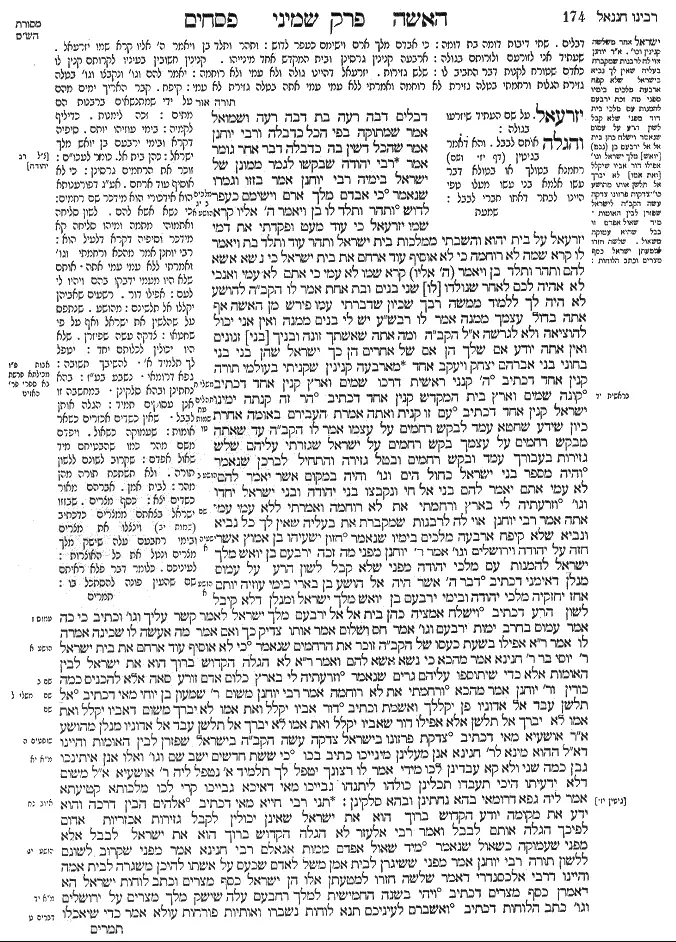
Pesahim 87b - Guemara
דבלים דבה רעה בת דבה רעה ושמואל אמר שמתוקה בפי הכל כדבלה ורבי יוחנן אמר שהכל דשין בה כדבלה דבר אחר גומר אמר רבי יהודה שבקשו לגמר ממונן של ישראל בימיה רבי יוחנן אמר בזזו וגמרו שנאמר (מלכים ב יג, ז) כי אבדם מלך ארם וישימם כעפר לדוש (הושע א, ג) ותהר ותלד לו בן ויאמר ה' אליו קרא שמו יזרעאל כי עוד מעט ופקדתי את דמי יזרעאל על בית יהוא והשבתי ממלכות בית ישראל ותהר עוד ותלד בת ויאמר לו קרא שמה לא רוחמה כי לא אוסיף עוד ארחם את בית ישראל כי נשא אשא להם ותהר ותלד בן ויאמר (ה' אליו) קרא שמו לא עמי כי אתם לא עמי ואנכי לא אהיה לכם לאחר שנולדו [לו] שני בנים ובת אחת אמר לו הקב"ה להושע לא היה לך ללמוד ממשה רבך שכיון שדברתי עמו פירש מן האשה אף אתה בדול עצמך ממנה אמר לו רבש"ע יש לי בנים ממנה ואין אני יכול להוציאה ולא לגרשה א"ל הקב"ה ומה אתה שאשתך זונה ובניך [בני] זנונים ואין אתה יודע אם שלך הן אם של אחרים הן כך ישראל שהן בני בני בחוני בני אברהם יצחק ויעקב אחד מארבעה קנינין שקניתי בעולמי תורה קנין אחד דכתיב (משלי ח, כב) ה' קנני ראשית דרכו שמים וארץ קנין אחד דכתיב (בראשית יד, יט) קונה שמים וארץ בית המקדש קנין אחד דכתיב (תהלים עח, נד) הר זה קנתה ימינו ישראל קנין אחד דכתיב (שמות טו, טז) עם זו קנית ואתה אמרת העבירם באומה אחרת כיון שידע שחטא עמד לבקש רחמים על עצמו אמר לו הקב"ה עד שאתה מבקש רחמים על עצמך בקש רחמים על ישראל שגזרתי עליהם שלש גזירות בעבורך עמד ובקש רחמים ובטל גזירה והתחיל לברכן שנאמר (הושע ב, א) והיה מספר בני ישראל כחול הים וגו' והיה במקום אשר יאמר להם לא עמי אתם יאמר להם בני אל חי ונקבצו בני יהודה ובני ישראל יחדו וגו' (הושע ב, כה) וזרעתיה לי בארץ ורחמתי את לא רוחמה ואמרתי ללא עמי עמי אתה אמר רבי יוחנן אוי לה לרבנות שמקברת את בעליה שאין לך כל נביא ונביא שלא קיפח ארבעה מלכים בימיו שנאמר (ישעיהו א, א) חזון ישעיהו בן אמוץ אשר חזה על יהודה וירושלים וגו' אמר ר' יוחנן מפני מה זכה ירבעם בן יואש מלך ישראל להמנות עם מלכי יהודה מפני שלא קבל לשון הרע על עמוס מנלן דאימני דכתיב (הושע א, א) דבר ה' אשר היה אל הושע בן בארי בימי עוזיה יותם אחז יחזקיה מלכי יהודה ובימי ירבעם בן יואש מלך ישראל ומנלן דלא קיבל לשון הרע דכתיב (עמוס ז, י) וישלח אמציה כהן בית אל אל ירבעם מלך ישראל לאמר קשר עליך וגו' וכתיב כי כה אמר עמוס בחרב ימות ירבעם וגו' אמר חס ושלום אמר אותו צדיק כך ואם אמר מה אעשה לו שכינה אמרה לו אמר ר"א אפילו בשעת כעסו של הקב"ה זוכר את הרחמים שנאמר (הושע א, ו) כי לא אוסיף עוד ארחם את בית ישראל ר' יוסי בר ר' חנינא אמר מהכא כי נשא אשא להם ואמר ר"א לא הגלה הקדוש ברוך הוא את ישראל לבין האומות אלא כדי שיתוספו עליהם גרים שנאמר (הושע ב, כה) וזרעתיה לי בארץ כלום אדם זורע סאה אלא להכניס כמה כורין ור' יוחנן אמר מהכא (הושע ב, כה) ורחמתי את לא רוחמה אמר רבי יוחנן משום ר' שמעון בן יוחי מאי דכתיב (משלי ל, י) אל תלשן עבד אל אדוניו פן יקללך ואשמת וכתיב (משלי ל, יא) דור אביו יקלל ואת אמו לא יברך משום דאביו יקלל ואת אמו לא יברך אל תלשן אלא אפילו דור שאביו יקלל ואת אמו לא יברך אל תלשן עבד אל אדוניו מנלן מהושע א"ר אושעיא מאי דכתיב (שופטים ה, יא) צדקת פרזונו בישראל צדקה עשה הקב"ה בישראל שפזרן לבין האומות והיינו דא"ל ההוא מינא לר' חנינא אנן מעלינן מינייכו כתיב בכו (מלכים א יא, טז) כי ששת חדשים ישב שם וגו' ואלו אנן איתינכו גבן כמה שני ולא קא עבדינן לכו מידי אמר לו רצונך יטפל לך תלמיד א' נטפל ליה ר' אושעיא א"ל משום דלא ידעיתו היכי תעבדו תכלינן כולהו ליתנהו גבייכו מאי דאיכא גבייכו קרי לכו מלכותא קטיעתא אמר ליה גפא דרומאי בהא נחתינן ובהא סלקינן:
תני רבי חייא מאי דכתיב (איוב כח, כג) אלהים הבין דרכה והוא ידע את מקומה יודע הקדוש ברוך הוא את ישראל שאינן יכולין לקבל גזירות אכזריות אדום לפיכך הגלה אותם לבבל ואמר רבי אלעזר לא הגלה הקדוש ברוך הוא את ישראל לבבל אלא מפני שעמוקה כשאול שנאמר (הושע יג, יד) מיד שאול אפדם ממות אגאלם רבי חנינא אמר מפני שקרוב לשונם ללשון תורה רבי יוחנן אמר מפני ששיגרן לבית אמן משל לאדם שכעס על אשתו להיכן משגרה לבית אמה והיינו דרבי אלכסנדרי דאמר שלשה חזרו למטעתן אלו הן ישראל כסף מצרים וכתב לוחות ישראל הא דאמרן כסף מצרים דכתיב (מלכים א יד, כה) ויהי בשנה החמישית למלך רחבעם עלה שישק מלך מצרים על ירושלים וגו' כתב הלוחות דכתיב (דברים ט, יז) ואשברם לעיניכם תנא לוחות נשברו ואותיות פורחות עולא אמר כדי שיאכלו
Comments from Rashi on Masechet Pesahim Page 87b
דבלים . שתי דיבות דומה בת דומה: כי אבדם מלך ארם וישימם כעפר לדוש: ותהר ותלד בן ויאמר ה' אליו קרא שמו יזרעאל . שעתיד אני לזורעם ולזרותם בגולה: ארבעה קנינין גרסינן ובית המקדש אחד מינייהו . קנינין חשובין בעניו לקרותם קנין לו כאדם שטורח לקנות דבר החביב לו: שלש גזירות . יזרעאל דהיינו גולה ולא עמי ולא רוחמה: קיפח . קבר האריך ימים מהם על ידי שמתנשאים ברבנות הם מתים: זכה לימנות . כדיליף לקמיה: בימי עוזיהו יותם . סיפיה דקרא ובימי ירבעם בן יואש מלך ישראל: כהן בית אל . כומר לעכו"ם: זוכר את הרחמים . גרסינן: כי לא אוסיף עוד ארחם . אע"ג דפורענותא הוא אידכורי הוא מידכר שם רחמים: כי נשא אשא להם . לשון סליחה ואתמוהי מתמה ומיהו סליחה קא מידכר וסיפיה דקרא דלעיל הוא: רבי יוחנן אמר מהכא ורחמתי וגו' ואמרתי ללא עמי עמי אתה . אותם שלא היו מעמי ידבקו בהם ויהיו לי לעם: אפילו דור . רשעים שאביהן יקללו אל תלשינם: מהושע . שנתפס על שהלשין את ישראל ואף על פי שחטאו: צדקה עשה שפיזרן . שלא היו יכולין לכלותם יחד: יטפל לך תלמיד א' . להשיבך תשובה: גפא דרומאי . נשבע בע"ז: בהא נחתינן ובהא סלקינן . במחשבה זו אנן עסוקים תמיד: הגלה אותן לבבל . שאין כשדים אכזרים כשאר אומות: שעמוקה כשאול . ויפדם משם מהר כמו שהבטיחם מיד שאול אפדם: שקרוב לשונם ללשון תורה . ולא תשתכח תורה מהן מהר: לבית אמן . אברהם מאור כשדים יצא: כסף מצרים . שבזזו ישראל בצאתם ממצרים כדכתיב (שמות יב) וינצלו את מצרים ובימי רחבעם עלה שישק מלך מצרים ונטל את כל האוצרות: לעיניכם . כלומר דבר פלא ראיתם שם שהעין פונה להסתכל בו:
Comments from Tosafot - Pesahim 87b
יזרעאל . על שם העתיד שיזרעו בגולה: והגלה אותם לבבל . והא דאמר בגיטין (דף יז. ושם) רחמנא בטולך או בטולא דבר עשו אלמא בני עשו מעלו טפי היינו לבתר דאתו חברי לבבל:
Pesahim 87b - Mishnah translated into english
Diblaim”; the name Diblaim can be taken as the dual form of the word dibba, ill repute. It suggests that she was a woman of ill repute, daughter of a woman of ill repute. And Shmuel said: The name Diblaim is the plural of the word deveila, a cake of pressed figs, indicating that she was as sweet as a cake of pressed figs, and therefore everyone used her services. Rabbi Yoḥanan, based on a similar derivation, said the name signifies that everyone would tread [dashin] upon her, a euphemism for sexual relations, like a cake of pressed figs.
Alternatively, with regard to the name Gomer, Rav Yehuda said: The name can be understood as deriving from the root gamar, to finish. It alludes to the fact that the gentiles sought to finish the money of the Jewish people in her days. Rabbi Yoḥanan said: They did not just seek to do so, but were successful. They plundered and finished it, as it is stated: “For the king of Aram destroyed them and made them like the dust in threshing” (II Kings 13:7).
The passage in Hosea continues: “And she conceived, and bore him a son. And the Lord said to him: Call his name Jezreel; for soon I will visit the blood of Jezreel upon the house of Jehu, and will obliterate the kingdom of the house of Israel…And she conceived again, and bore a daughter. And He said to him: Call her name Lo-ruhamah, for I will no more have compassion upon the house of Israel that I should bear them…And she conceived, and bore a son. And He said: Call his name Lo-ammi; for you are not My people, and I will not be yours” (Hosea 1:3–9).
After two sons and one daughter had been born to him, the Holy One, Blessed be He, said to Hosea: Shouldn’t you have learned from the example of your master Moses, who, once I spoke with him, separated from his wife? You too, separate yourself from your wife. He said to Him: Master of the Universe, I have sons from her and I am unable to dismiss her or to divorce her.
In response to Hosea’s show of loyalty to his family, the Holy One, Blessed be He, rebuked him and said to him: Just as you, whose wife is a prostitute and your children from her are children of prostitution, and you do not even know if they are yours or if they are children of other men, despite this, you are still attached to them and will not forsake them, so too, I am still attached to the Jewish people, who are My sons, the sons of My faithful who withstood ordeals, the sons of Abraham, Isaac, and Jacob. They are so special that they are one of the four acquisitions that I acquired in My world.
The Gemara proceeds to enumerate all four: Torah is one acquisition, as it is written: “The Lord acquired me as the beginning of His way” (Proverbs 8:22). Heaven and earth are one acquisition [kinyan], as it is written: “Blessed be Abram of God Most High, Creator [koneh] of heaven and earth” (Genesis 14:19). The Holy Temple is one acquisition, as it is written: “And He brought them to His sacred border, to this mountain, which His right hand had acquired” (Psalms 78:54). The Jewish people are one acquisition, as it is written: “The nation that You have acquired” (Exodus 15:16). And you, Hosea, said that I should replace them with another nation?
Once Hosea realized that he had sinned, he got up to request that God have compassion upon him for having spoken ill of the Jewish people. The Holy One, Blessed be He, said to him: Before you request compassion upon yourself, first request compassion upon the Jewish people, since I have already decreed upon them three harsh decrees on your account, in response to your condemnation of them. There is an allusion to these three decrees in the names of the children born of the prostitute. Jezreel is an allusion to a decree for Jehu’s actions in the Jezreel Valley (see II Kings 9–10). Lo-ruhamah, one that had not received compassion, suggests that God will no longer have compassion for the Jewish people. Lo-ammi, not My people, indicates that the Jewish people will no longer be considered God’s people.
Hosea stood and requested compassion upon the Jewish people and nullified the decree. God responded and began to bless them, as it is stated: “Yet the number of the children of Israel shall be as the sand of the sea, which cannot be measured nor numbered. And it will be that instead of that which was said to them: You are not My people, it shall be said to them: You are the children of the living God. And the children of Judea and the children of Israel shall be gathered together” (Hosea 2:1). And I will sow her to Me in the land; and I will have compassion upon her that had not received compassion; and I will say to them that were not My people: You are My people” (Hosea 2:25).
Rabbi Yoḥanan said: Woe to authority, which shortens the life and buries its holders. This is evident from the fact that you don’t have any prophet who did not outlast four kings in his lifetime, as the kings’ positions of authority caused them to die young. A prophet outliving four kings is demonstrated in the opening verses of Hosea, and similarly, as it is stated with regard to Isaiah: “The vision of Isaiah, the son of Amoz, which he saw concerning Judea and Jerusalem in the days of Uzziah, Jotham, Ahaz, and Hezekiah, kings of Judea” (Isaiah 1:1).
Rabbi Yoḥanan said: Due to what reason was the less than righteous Jeroboam, son of Joash, king of Israel, privileged to be counted in the verse together with the righteous kings of Judea? It is due to the fact that he did not accept slander about Amos.
The Gemara asks: From where do we derive that he was counted together with the righteous kings of Judea? As it is written: “The word of the Lord that came to Hosea, son of Beeri, in the days of Uzziah, Jotham, Ahaz, and Hezekiah, kings of Judea, and in the days of Jeroboam, the son of Joash, king of Israel” (Hosea 1:1).
And from where do we derive that he did not accept slander? As it is written: “Then Amaziah the priest of Beth-El sent to Jeroboam king of Israel, saying: Amos has conspired against you in the midst of the house of Israel” (Amos 7:10). And it is written: “For thus said Amos: Jeroboam shall die by the sword and Israel shall surely be led away captive out of his land” (Amos 7:11). Jeroboam said: Heaven forfend that that righteous person, Amos, said this, that I will die by the sword; and if he indeed said it, what shall I do to him and why should I punish him? The Divine Presence said it to him, and he is required to transmit his prophecy.
Rabbi Elazar said: Even at the time of the anger of the Holy One, Blessed be He, He remembers the attribute of compassion, as it is stated: “For I will no more have compassion upon the house of Israel” (Hosea 1:6). Even when implementing His attribute of justice, God still mentions His attribute of compassion. Rabbi Yosei bar Rabbi Ḥanina said that this is also indicated from here, from the continuation of the verse, which states: “That I should bear them,” indicating that God promised to eventually bear Israel’s sins and pardon them.
And Rabbi Elazar said: The Holy One, Blessed be He, exiled Israel among the nations only so that converts would join them, as it is stated: “And I will sow her to Me in the land” (Hosea 2:25). Does a person sow a se’a of grain for any reason other than to bring in several kor of grain during the harvest? So too, the exile is to enable converts from the nations to join the Jewish people.
And Rabbi Yoḥanan said that this idea may be derived from here: “And I will have compassion upon her that had not received compassion; and I will say to them that were not My people: You are My people” (Hosea 2:25). Even those who were initially “not My people,” i.e., gentiles, will convert and become part of the Jewish nation.
Rabbi Yoḥanan said in the name of Rabbi Shimon ben Yoḥai: What is the meaning of that which is written: “Slander not a servant to his master, lest he curse you, and you be found guilty” (Proverbs 30:10), and it is then written in the next verse: “There is a generation that curses its father, and does not bless its mother” (Proverbs 30:11). Is it because they curse their father and do not bless their mother that you should not slander them? Clearly that is absurd.
Rather, the juxtaposition serves to emphasize that even in a wicked generation that curses its father and does not bless its mother, one should not slander a servant to his master. From where do we derive this? From Hosea, whose criticism of the Jewish people, God’s servants, to God, their master, aroused His ire, despite the fact that it was a wicked generation.
Rabbi Oshaya said: What is the meaning of that which is written: “The righteous acts of His rulers [pirzono] in Israel” (Judges 5:11)? The Holy One, Blessed be He, performed a charitable deed toward Israel in that He scattered them [pizran] among the nations; had He exiled them to one place, they could have all been destroyed at once. And this concept is that which a certain apostate said to Rabbi Ḥanina: We gentiles are superior to you Jews in that we have patience. It is written of you: “For Joab and all Israel remained there six months until he had cut off every male in Edom” (I Kings 11:16), whereas we, although you have been with us for several years, are not doing anything to you. He said to him: With your consent, let one student deal with your assertion and answer you.
Rabbi Oshaya dealt with his assertion and said to him: This is not a sign of your righteousness but is simply because you do not know how to do it, to destroy us. If you seek to destroy all of the Jewish people, you cannot because they are not all with you in your kingdom. If you destroy only those Jews who are with you in your kingdom, you will be called a severed kingdom for murdering part of its own population. The apostate said to him: I swear by Gappa, god of the Romans, with this problem we lie down and with this problem we rise up, for we are constantly struggling with the dilemma of how to eliminate the Jewish people.
Rabbi Ḥiyya teaches: What is the meaning of that which is written: “God understands its ways and He knows its place” (Job 28:23)? The Holy One, Blessed be He, knows the Jewish people, who are unable to withstand the harsh decrees of the Romans. Therefore, He exiled them to Babylonia, whose people are less cruel. And Rabbi Elazar said: The Holy One, Blessed be He, exiled Israel to Babylonia only due to the fact it is a land as deep as the netherworld, i.e., it is a land of plains and valleys, which alludes to that which is stated: “I shall ransom them from the power of the netherworld, I shall redeem them from death” (Hosea 13:14). Rabbi Ḥanina said: It is due to the fact that their language, Aramaic, is similar to the language of the Torah, which enables the Jews who live there to study Torah.
Rabbi Yoḥanan said: It is due to the fact that He sent them to their mother’s house, i.e., the birthplace of the forefathers of the Jewish people, who lived in Aram-Nahara’im, which is in Babylonia. This is comparable to a man who is angry at his wife; to where does he send her? He sends her to her mother’s house.
And this is expressed in the statement of Rabbi Alexandri, who said: There are three that returned to their points of origin, and these are they: The Jewish people, the money of Egypt, and the writing on the Tablets of the Covenant. The Jewish people; that which we just said, they returned to Babylonia. The money of Egypt; as it is written: “And it came to pass in the fifth year of King Rehoboam, that Shishak, king of Egypt, came up against Jerusalem; and he took away the treasures of the house of the Lord and the treasures of the king’s house; he took everything” (I Kings 14:25–26). The writing on the Tablets of the Covenant; as it is written: “And I took hold of the two tablets, and cast them out of my two hands, and broke them before your eyes” (Deuteronomy 9:17). And it was taught in the Tosefta: The tablets were broken and the letters are flying and returning to their point of origin.
Ulla said that Israel was exiled to Babylonia in order to enable them to eat
Traduction : The William Davidson digital edition of the Koren Noé Talmud, with commentary by Rabbi Adin Even-Israel Steinsaltz.