 Talmud Bavli
The learning on the whole site is dedicated : L'ilui Nishmat Reuven ben Rivka SEBBAG
The learning on the whole site is dedicated : L'ilui Nishmat Avraham Ben Simha
The learning on the whole site is dedicated : L'ilui Nishmat Jacques Isaac Ben Amram Loubaton
Sanhedrin 30b : Youtube
Daf TubeYoutube
2 video classes :
Sanhedrin Page 30b
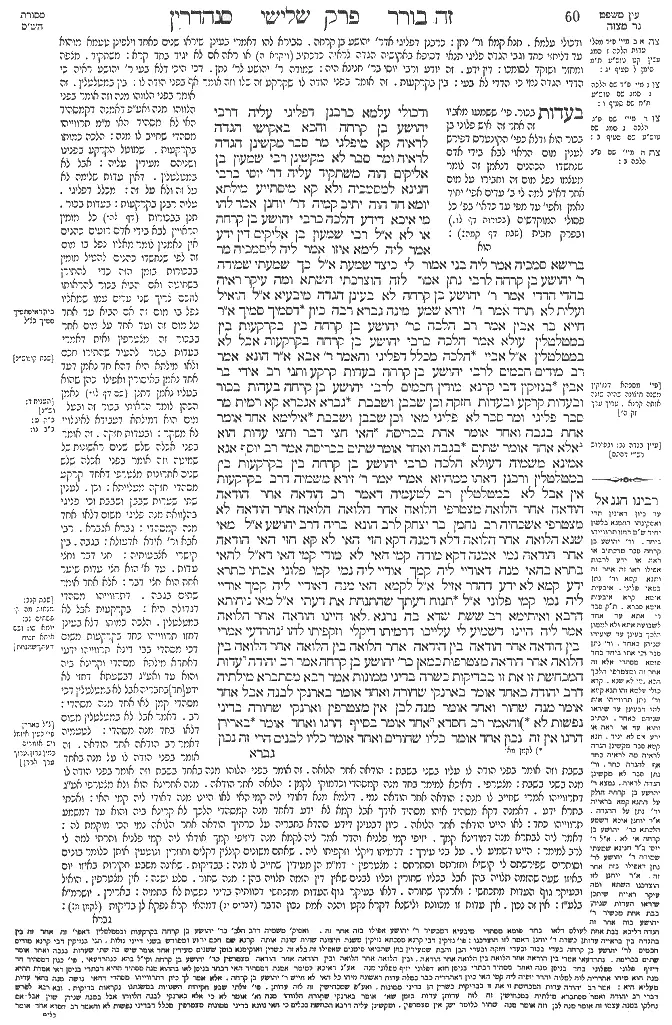
Sanhedrin 30b - Guemara
ודכולי עלמא כרבנן דפליגי עליה דרבי יהושע בן קרחה והכא באקושי הגדה לראיה קא מיפלגי מר סבר מקשינן הגדה לראיה ומר סבר לא מקשינן רבי שמעון בן אליקים הוה משתקיד עליה דר' יוסי ברבי חנינא למסמכיה ולא קא מיסתייע מילתא יומא חד הוה יתיב קמיה דר' יוחנן אמר להו מי איכא דידע הלכה כרבי יהושע בן קרחה או לא א"ל רבי שמעון בן אליקים דין ידע אמר ליה לימא איזו אמר ליה ליסמכיה מר ברישא סמכיה אמר ליה בני אמור לי כיצד שמעת א"ל כך שמעתי שמודה ר' יהושע בן קרחה לרבי נתן אמר לזה הוצרכתי השתא ומה עיקר ראיה בהדי הדדי אמר ר' יהושע בן קרחה לא בעינן הגדה מיבעיא א"ל הואיל ועלית לא תרד אמר ר' זירא שמע מינה גברא רבה כיון דסמיך סמיך א"ר חייא בר אבין אמר רב הלכה כר' יהושע בן קרחה בין בקרקעות בין במטלטלין עולא אמר הלכה כרבי יהושע בן קרחה בקרקעות אבל לא במטלטלין א"ל אביי הלכה מכלל דפליגי והאמר ר' אבא א"ר הונא אמר רב מודים חכמים לרבי יהושע בן קרחה בעדות קרקע ותני רב אידי בר אבין בנזיקין דבי קרנא מודין חכמים לרבי יהושע בן קרחה בעדות בכור ובעדות קרקע ובעדות חזקה וכן שבבן ושבבת גברא אגברא קא רמית מר סבר פליגי ומר סבר לא פליגי מאי וכן שבבן ושבבת אילימא אחד אומר אחת בגבה ואחד אומר אחת בכריסה האי חצי דבר וחצי עדות הוא אלא אחד אומר שתים בגבה ואחד אומר שתים בכריסה אמר רב יוסף אנא אמינא משמיה דעולא הלכה כרבי יהושע בן קרחה בין בקרקעות בין במטלטלין ורבנן דאתו ממחוזא אמרי אמר ר' זירא משמיה דרב בקרקעות אין אבל לא במטלטלין רב לטעמיה דאמר רב הודאה אחר הודאה הודאה אחר הלואה מצטרפי הלואה אחר הלואה הלואה אחר הודאה לא מצטרפי אשכחיה רב נחמן בר יצחק לרב הונא בריה דרב יהושע א"ל מאי שנא הלואה אחר הלואה דלא דמנה דקא חזי האי לא קא חזי האי הודאה אחר הודאה נמי אמנה דקא מודה קמי האי לא מודי קמי האי דא"ל להאי בתרא בהאי מנה דאודיי ליה קמך אודיי ליה נמי קמי פלוני אכתי בתרא ידע קמא לא ידע דהדר אזיל א"ל לקמא האי מנה דאודיי ליה קמך אודיי ליה נמי קמי פלוני א"ל תנוח דעתך שהתנחת את דעתי א"ל מאי ניחותא דרבא ואיתימא רב ששת שדא בה נרגא לאו היינו הודאה אחר הלואה אמר ליה היינו דשמיע לי עלייכו דרמיתו דיקלי וזקפיתו להו נהרדעי אמרי בין הודאה אחר הודאה בין הודאה אחר הלואה בין הלואה אחר הלואה בין הלואה אחר הודאה מצטרפות כמאן כר' יהושע בן קרחה אמר רב יהודה עדות המכחשת זו את זו בבדיקות כשרה בדיני ממונות אמר רבא מסתברא מילתיה דרב יהודה באחד אומר בארנקי שחורה ואחד אומר בארנקי לבנה אבל אחד אומר מנה שחור ואחד אומר מנה לבן אין מצטרפין וארנקי שחורה בדיני נפשות לא והאמר רב חסדא אחד אומר בסייף הרגו ואחד אומר בארירן הרגו אין זה נכון אחד אומר כליו שחורים ואחד אומר כליו לבנים הרי זה נכון
Comments from Rashi on Masechet Sanhedrin Page 30b
ודכולי עלמא . תנא קמא ור' נתן: כרבנן דפליגי אדר' יהושע בן קרחה . סבירא להו דאמרי בעינן שיראו שנים כאחד וילפינן טעמא מוהוא עד דליחזי כחד וגבי הגדה פליגי תנאי דסיפא באקושיה הגדה לראיה כדכתיב (ויקרא ה) או ראה אם לא יגיד בחד קרא: משתקיד . מצפה ומחזר ושוקד לסומכו: דין ידע . זה יודע ורבי יוסי בר' חנינא היה: שמודה ר' יהושע לר' נתן . דכי היכי דלא בעי ר' יהושע ראיה כי הדדי הגדה נמי כי הדדי לא בעי: בין בקרקעות . זה אומר בפני הודה לו שקרקע זה שלו וזה אומר אף בפני הודה לו: בין במטלטלין . זה אומר בפני הלווהו מנה וזה אומר בפני הלווהו מנה ואע"פ דאמנה דקמסהיד האי לא מסהיד האי מ"מ תרווייהו מסהדי שחייב לו מנה: הלכה כמותו בקרקעות . שמוטל הקרקע בפנינו ושניהם מעידין עליה: אבל לא במטלטלין . דאין עדות שלימה לא על זה ולא על זה: מכלל דפליגי . עליה רבנן בקרקעות: בעדות בכור . תנן בבכורות (דף לה.) כל מומין הראויין לבא בידי אדם רועים כהנים אין נאמנין לומר מאליו נפל בו מום זה לפי שנחשדו כהנים להטיל מומין בבכורות בזמן הזה כדי להתירן בשחיטה ואם הביא בכור להראותו לחכם צריך שני עדים עמו שמאליו נפל בו מום זה אם הביא עד אחד על מום זה ועד אחד על מום אחר בבכור זה מצטרפין ואית דאמרי בעדות בכור להעיד שהתירו חכם ולאו מילתא היא דהא חד נאמן דעד אחד נאמן באיסורין ואפילו כהן שהוא בעליו נאמן דתנן (שם דף לו.) נאמן הכהן לומר הראיתי בכור זה ובעל מום הוא דמילתא דעבידא לאיגלויי לא משקר: ובעדות חזקה . זה אומר בפני אכלה שלש שנים ראשונות של שמיטה וזה אומר בפני אכלה שלש שנים אחרונות מצטרפי דאחד קרקע מסהדי חזקה מעלייתא: וכן . לענין שתי שערות שבבן ושבבת וכי פליגי בהלוואת מנה פליגי משום דלאו אחד מנה קמסהדי: גברא אגברא . רבי אבא ור' אידי אדעולא: בגבה . בין קישרי אצבעותיה: חצי דבר וחצי עדות . עד א' הוא חצי עדות שיער אחת הוא חצי דבר: אלא אחד אומר שתים בגבה . דתרווייהו מסהדי דגדולה היא: בקרקעות אבל לא במטלטלין . הלכה כמותו דלא בעינן דחזו תרווייהו כחד בקרקעות משום דכי מסהדי בבי דינא תרווייהו ידעי דאחדא מילתא מסהדי וקרינא ביה והוא עד ואע"ג דבשעתא דחזי לא ידע [חד] בחבריה אבל לא במטלטלין דכי מסהדי קמן לאו אחד מנה מסהדי: רב . דאמר אבל לא במטלטלין משום דלאו בחד מנה מסהדי: לטעמיה דאמר רב הודאה אחר הודאה . זה אומר בפני הודה לו על מנה באחד בשבת וזה אומר בפני הודה לו עליו בשני בשבת: הודאה אחר הלואה . זה אומר בפני הלוהו מנה באחד בשבת וזה אומר בפני הודה לו מנה בשני בשבת: מצטרפי . דאיכא למימר בחד מנה קמסהדי וכדמוקי לקמן: הלואה אחר הודאה . מנה אחרינא הוא ולא מצטרפי אע"ג דתרווייהו אמרי שחייב לו מנה: הודאה אחר הודאה נמי . דילמא מנה דאודי ליה קמי האי לאו היינו מנה דאודי ליה קמי האי: ואכתי בתרא ידע . דאמנה דקא מסהיד איהו מסהיד אידך אבל קמא לא ידע דאחד מנה קמסהדי הלכך לא קרינא ביה והוא עד דמשמע תרווייהו כחד: לאו היינו הודאה אחר הלואה . כיון דבעינן דידע סהדא בחבריה על כרחיך הודאה אחר הלואה נמי הכי מוקמת לה דאמר ליה לבתרא מנה דמודינא קמך יזיפי קמי פלניא והדר אמר ליה לקמא מנה דיזיפי קמך אודאי ליה קמי פלניא ותרתי למה לי לרב למימר: היינו דשמיע לי . על בני עירך: דרמיתו דיקלי וזקפיתו ליה . שאתם משונים קוצצין דקלים וחוזרין ונוטעין אותן כלומר בונים וסותרים שפירשתם לי קושיא וחזרתם וסתרתם: מצטרפין . דמ"מ הן מעידין שחייב לו מנה: בבדיקות . שאינה משבע חקירות באיזו יום באיזו שעה שהזמה תלויה בהן אבל בכליו שחורין וכליו לבנים שאין דין הזמה תלויה בהן: מנה שחור . סלע ישנה: אין מצטרפין . הואיל ובעיקר גוף העדות מתכחשי: וארנקי שחורה . דלאו בעיקר גוף העדות מתכחשי דכוותיה בדיני נפשות לא בתמיה: בארירן . יושרמ"א בלע"ז: אין זה נכון . אין עדות זו מכוונת ולישנא דקרא נקט והנה אמת נכון הדבר (דברים יג) דמהאי קרא נפקא לן בדיקות (לקמן סנהדרין מ:):
Comments from Tosafot - Sanhedrin 30b
בעדות בכור . פי' ששמעו מאביו זה אחר זה איש פלוני בן בכור הוא ודלא כפי' הקונטרס דפירש לענין מום הראוי לבא בידי אדם שנחשדו הכהנים דנאמן זה לומר מעצמו נפל מום זה וחבירו על מום אחר דא"כ למה לי ב' עדים אפי' יחיד נאמן ואפי' עד מפי עד כדאי' בפ' כל פסולי המוקדשים (בכורות דף לו.) ובפרק חבית (שבת דף קמה:):
Sanhedrin 30b - Mishnah translated into english
and everyone, both the first tanna and Rabbi Natan, holds in accordance with the opinion of the Rabbis who disagree with Rabbi Yehoshua ben Korḥa, and derive from this verse that it is necessary that the witnesses see the incident together, i.e., they were both present and observed the incident at the same time. And here, with regard to whether or not the witnesses must testify in court together, they disagree with regard to whether or not the statement of the witnesses, i.e., their testimony in court, is compared to their observation of the incident. One Sage, the first tanna, holds that we compare their statement to their observation. Therefore, just as they must see the incident together, so too, they must testify together in court. And one Sage, Rabbi Natan, holds that we do not compare their statement to their observation.
The Gemara relates: Rabbi Shimon ben Elyakim was striving to ordain Rabbi Yosei, son of Rabbi Ḥanina, and was not successful in his attempts. One day, Rabbi Shimon ben Elyakim was sitting before Rabbi Yoḥanan among Rabbi Yoḥanan’s other students.
Rabbi Yoḥanan said to his students: Is there anyone who knows whether the halakha is in accordance with the opinion of Rabbi Yehoshua ben Korḥa, or not? Rabbi Shimon ben Elyakim said to him: This one, Rabbi Yosei, son of Rabbi Ḥanina, knows. Rabbi Yoḥanan said to him: If so, let him say. Rabbi Shimon ben Elyakim said to him: Let the Master ordain him first; since we are all in need of his wisdom, he is fit for ordination. Rabbi Yoḥanan then ordained Rabbi Yosei, son of Rabbi Ḥanina.
Rabbi Yoḥanan said to him: My son, tell me what you heard. Rabbi Yosei, son of Rabbi Ḥanina, said to him: This is what I heard: That Rabbi Yehoshua ben Korḥa concedes to the opinion of Rabbi Natan that it is unnecessary for the witnesses to testify together.
Rabbi Yoḥanan was disappointed, and said: For this I needed to ordain him? Now that with regard to the main element of testimony, i.e., observing the incident, Rabbi Yehoshua ben Korḥa says we do not need both witnesses to see it together, with regard to their statement in court, is it necessary to explicate that there is no requirement that they testify together?
Although the statement of Rabbi Yosei, son of Rabbi Ḥanina, was unnecessary, Rabbi Yoḥanan said to him: Since you ascended, i.e., you were ordained, you will not descend, even though it was in error. Rabbi Zeira said: Conclude from it that with regard to a great man, once he is ordained, even if it was due to mistaken judgment, he is ordained. The ordination is not canceled.
As for the halakha in this matter, Rabbi Ḥiyya bar Avin says that Rav says: The halakha is in accordance with the opinion of Rabbi Yehoshua ben Korḥa that it is unnecessary for the two witnesses to observe the incident together, both with regard to cases of land and with regard to cases of movable property.
Ulla says: The halakha is in accordance with the opinion of Rabbi Yehoshua ben Korḥa with regard to land, which is unmovable, and therefore both testimonies are certainly about the same piece of land; but not with regard to movable property, as there is a concern that they are not testifying about the same item.
Abaye said to Ulla: If you say that the halakha is in accordance with the opinion of Rabbi Yehoshua ben Korḥa with regard to land, by inference you hold that they disagree with regard to this matter. But doesn’t Rabbi Abba say that Rav Huna says that Rav says: The Rabbis concede to the opinion of Rabbi Yehoshua ben Korḥa with regard to testimony concerning land?
And Rav Idi bar Avin teaches in the halakhot of damages that were taught at the school of the Sage Karna: The Rabbis concede to the opinion of Rabbi Yehoshua ben Korḥa that the witnesses do not need to see the incident together with regard to testimony concerning a blemish in a male firstborn kosher animal, which renders it permitted to derive benefit from it, and with regard to testimony concerning ownership of land, and with regard to testimony concerning presumptive ownership of land. Since it is clear that they are testifying about the same land, it is unnecessary for them to see it together. And so they concede with regard to testimony over the two pubic hairs of a boy or of a girl, which are a sign of adulthood.
The Gemara rejects Abaye’s question: Are you setting the statement of one man against the statement of another man? One Sage, Ulla, holds that the Rabbis disagree with Rabbi Yehoshua ben Korḥa even with regard to land, and one Sage, i.e., Rav and Rav Idi, holds that they do not disagree.
The Gemara asks tangentially about the statement: And so they concede with regard to testimony over the two pubic hairs of a boy or of a girl: What is this referring to? If we say it is referring to testimony that a girl has reached majority, in which one witness says that he saw one hair on the her lower back and one witness says that he saw one hair on her lower abdomen, that is difficult. A girl is considered to have reached maturity when she has two pubic hairs. In this case, two witnesses separately testify that they have each seen one hair. In this case each testimony is obviously invalid, as it is half a matter and also half a testimony. Not only does each testimony refer to one hair, which is half a matter, it is submitted by one witness, which is half a testimony. Consequently, it is obvious that the girl is not considered to have reached majority in this case.
Rather, it must be referring to a case where one says that he saw two hairs on her lower back, and the other one says he saw two hairs on her lower abdomen. Since they each testify that she has reached adulthood, it is unnecessary for them to see the same hairs.
Rav Yosef said: I say in the name of Ulla that the halakha is in accordance with the opinion of Rabbi Yehoshua ben Korḥa both with regard to land and with regard to movable property. But the Sages who came from Meḥoza say that Rabbi Zeira says in the name of Rav: With regard to land the halakha is in accordance with the opinion of Rabbi Yehoshua ben Korḥa, but not with regard to movable property.
The Gemara comments: Rav conforms to his standard line of reasoning, as Rav says: Testimonies of an admission following an admission are combined into one; if one witness testifies that the respondent admitted in his presence that he owes the claimant, and the other witness testifies that the respondent admitted in his presence that he owes the claimant in a separate incident, their testimonies are combined. Likewise, testimonies of an admission following a loan are combined into one; where one witness testifies that the respondent admitted in his presence that he owes the claimant, and the other one testifies that on a previous date the respondent borrowed money from the claimant in his presence, their testimonies are combined.
Rav continues: But testimonies of a loan following a loan are not combined. If one testifies that the claimant lent the respondent one hundred dinars in his presence, and the other testifies that he lent him one hundred dinars in a separate incident in his presence, their testimonies are not combined, as they are clearly testifying about two separate loans. Similarly, testimonies of a loan following an admission are not combined. If one testifies that the claimant lent money to the respondent, and the other one testifies that on an earlier date the respondent admitted to owing the claimant, their testimonies are not combined.
Rav Naḥman bar Yitzḥak encountered Rav Huna, son of Rav Yehoshua. He said to him: What is different about a loan following a loan, in which case the testimonies are not combined, as the one hundred dinars that this witness saw, that witness did not see? In the case of an admission following an admission as well, perhaps the one hundred dinars about which the respondent admitted in the presence of this witness, he did not admit in the presence of that witness. Perhaps his admissions were in reference to two separate loans, and therefore the testimonies should not be combined.
Rav Huna, son of Rav Yehoshua, answered him: The reference is to a case where the respondent said to this last witness: With regard to the one hundred dinars that I admitted to owing in your presence, I admitted to owing them in the presence of so-and-so, the first witness, as well.
Rav Naḥman bar Yitzḥak asked: Still, the last witness knows that he is testifying about the same loan as the first witness, but the first witness does not know this. Since only one witness testifies that it is the same loan, the testimonies still cannot be combined.
Rav Huna, son of Rav Yehoshua, answered: It is a case where, after his admission to the second witness, the respondent went back and said to the first witness: With regard to those one hundred dinars that I admitted to owing in your presence, I admitted owing them in the presence of so-and-so as well. Therefore, both witnesses know that they are testifying about the same loan. Rav Naḥman bar Yitzḥak said to him: May your mind be settled, as you have settled my mind and put it at ease by answering this question that was troubling me.
Rav Huna, son of Rav Yehoshua, said to him: What is settling about this explanation? As Rava, and some say Rav Sheshet, threw an ax at my answer, i.e., he rejected my explanation, as follows: According to this interpretation of the case of an admission following an admission, isn’t this the same as an admission following a loan? The case of an admission following an admission is now rendered superfluous, as it adds no new insight on the matter.
Rav Naḥman bar Yitzḥak said to him: This is what I heard about you Sages of Meḥoza, that you knock down palm trees and erect them, i.e., you build and then destroy what you built. After you came up with such an excellent explanation, you ruined it yourselves.
The Sages of Neharde’a say: Whether it is a case of an admission following an admission, or an admission following a loan, or a loan following a loan, or a loan following an admission, in all these cases the testimonies are combined. In accordance with whose opinion is this? It is in accordance with the opinion of Rabbi Yehoshua ben Korḥa, who teaches that since both witnesses testify about a debt of one hundred dinars, it is considered like one testimony.
§ Rav Yehuda says: Testimony of two witnesses who contradict the testimony of each other in response to the judges’ examination of the details of the story is valid in cases of monetary law, although a contradiction of this type disqualifies testimony in cases of capital law.
Rava says: The statement of Rav Yehuda is reasonable in a case where one witness says: The money was in a black purse [be’arnaki], and the other one says: It was in a white purse. Since this is a secondary detail, they may not remember it accurately. But if one says: He lent him a black coin, i.e., the coin was dark, and the other one says: He lent him a white coin, the testimonies are not combined. Since they contradict each other with regard to a characteristic of the money itself, one is probably lying.
The Gemara challenges Rabbi Yehuda’s ruling: And if witnesses contradict each other with regard to secondary details such as a black purse in cases of capital law, is it the case that their testimony is not accepted? But doesn’t Rav Ḥisda say: In a case where one of the witnesses says: The murderer killed the victim with a sword, and one of the witnesses says: The murderer killed the victim with an ariran, another type of weapon, this is not congruent testimony, as this is a clear contradiction. But if one of the witnesses says: The murderer’s garments were black, and one of the witnesses says: The murderer’s garments were white, this is congruent testimony, as this is not a meaningful discrepancy.
Traduction : The William Davidson digital edition of the Koren Noé Talmud, with commentary by Rabbi Adin Even-Israel Steinsaltz.