 Talmud Bavli
Pesahim 32b : Youtube
Daf TubeYoutube
3 video classes :
Pesahim Page 32b
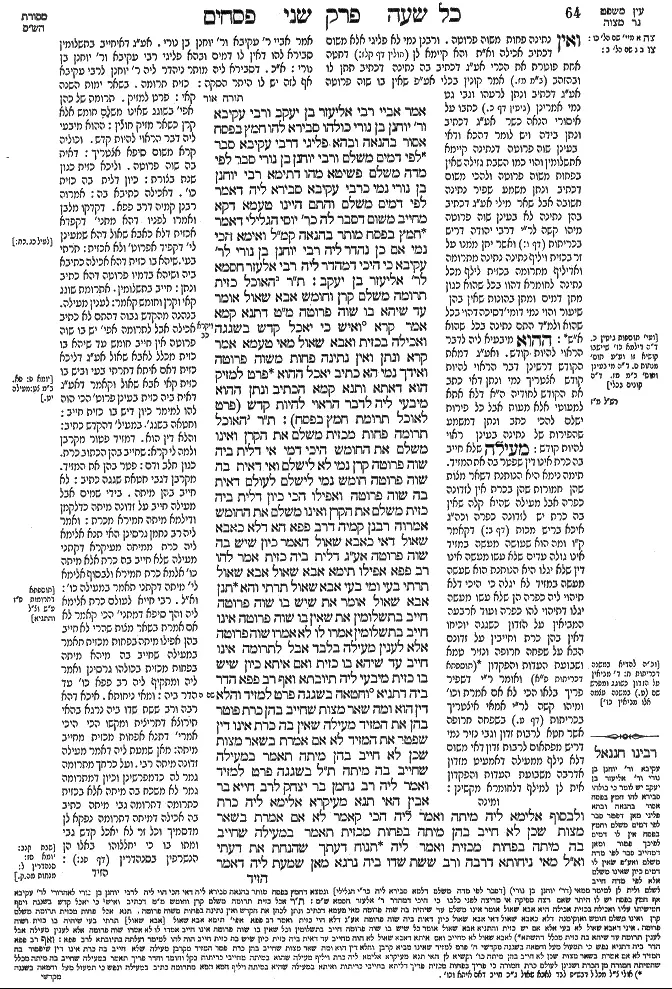
Pesahim 32b - Guemara
אמר אביי רבי אליעזר בן יעקב ורבי עקיבא ור' יוחנן בן נורי כולהו סבירא להו חמץ בפסח אסור בהנאה ובהא פליגי דרבי עקיבא סבר לפי דמים משלם ורבי יוחנן בן נורי סבר לפי מדה משלם פשיטא מהו דתימא רבי יוחנן בן נורי נמי כרבי עקיבא סבירא ליה דאמר לפי דמים משלם והתם היינו טעמא דקא מחייב משום דסבר לה כר' יוסי הגלילי דאמר חמץ בפסח מותר בהנאה קמ"ל ואימא הכי נמי אם כן נהדר ליה רבי יוחנן בן נורי לר' עקיבא כי היכי דמהדר ליה רבי אלעזר חסמא לר' אליעזר בן יעקב:
ת"ר האוכל כזית תרומה משלם קרן וחומש אבא שאול אומר עד שיהא בו שוה פרוטה מ"ט דתנא קמא אמר קרא (ויקרא כב, יד) ואיש כי יאכל קדש בשגגה ואכילה בכזית ואבא שאול מאי טעמא אמר קרא ונתן ואין נתינה פחות משוה פרוטה ואידך נמי הא כתיב יאכל ההוא פרט למזיק הוא דאתא ותנא קמא הכתיב ונתן ההוא מיבעי ליה לדבר הראוי להיות קדש (פרט לאוכל תרומת חמץ בפסח):
ת"ר האוכל תרומה פחות מכזית משלם את הקרן ואינו משלם את החומש היכי דמי אי דלית ביה שוה פרוטה קרן נמי לא לישלם ואי דאית בה שוה פרוטה חומש נמי לישלם לעולם דאית בה שוה פרוטה ואפילו הכי כיון דלית ביה כזית משלם את הקרן ואינו משלם את החומש אמרוה רבנן קמיה דרב פפא הא דלא כאבא שאול דאי כאבא שאול האמר כיון שיש בה שוה פרוטה אע"ג דלית ביה כזית אמר להו רב פפא אפילו תימא אבא שאול אבא שאול תרתי בעי ומי בעי אבא שאול תרתי והא תנן אבא שאול אומר את שיש בו שוה פרוטה חייב בתשלומין את שאין בו שוה פרוטה אינו חייב בתשלומין אמרו לו לא אמרו שוה פרוטה אלא לענין מעילה בלבד אבל לתרומה אינו חייב עד שיהא בו כזית ואם איתא כיון שיש בו כזית מיבעי ליה תיובתא ואף רב פפא הדר ביה דתניא (ויקרא ה, טו) וחטאה בשגגה פרט למזיד והלא דין הוא ומה שאר מצות שחייב בהן כרת פוטר בהן את המזיד מעילה שאין בה כרת אינו דין שפטר את המזיד לא אם אמרת בשאר מצות שכן לא חייב בהן מיתה תאמר במעילה שחייב בה מיתה ת"ל בשגגה פרט למזיד ואמר ליה רב נחמן בר יצחק לרב חייא בר אבין האי תנא מעיקרא אלימא ליה כרת ולבסוף אלימא ליה מיתה ואמר ליה הכי קאמר לא אם אמרת בשאר מצות שכן לא חייב בהן מיתה בפחות מכזית תאמר במעילה שחייב בה מיתה בפחות מכזית ואמר ליה תנוח דעתך שהנחת את דעתי וא"ל מאי ניחותא דרבה ורב ששת שדו ביה נרגא מאן שמעת ליה דאמר
Comments from Rashi on Masechet Pesahim Page 32b
אמר אביי ר' עקיבא ור' יוחנן בן נורי . אע"ג דאיחייב בתשלומין סבירא להו דאין לו דמים ובהא פליגי רבי עקיבא ור' יוחנן בן נורי: א"כ . דסבירא ליה מותר ניהדר ליה ר' יוחנן לרבי עקיבא אף לזה יש לו היתר הסקה: כזית תרומה . בשאר ימות השנה קאי: פרט למזיק . תרומה של כהן אפי' בשוגג שאינו משלם חומש אלא קרן כשאר מזיק חולין: ההוא מיבעי ליה דבר הראוי להיות קדש . וכוליה קרא משום סיפא אצטריך: דאית בה שוה פרוטה . וליכא כזית כגון שנת בצורת: כיון דלית בה כזית כו' . דאכילה כתיבא בה: אמרוה רבנן קמיה דרב פפא . דקדקו מלבן ואמרו לפניו דהא מתני' דקפדא אכזית דלא כאבא שאול דהא שמעינן ליה דקפיד אפרוט' ולא אכזית: תרתי בעי . שיהא בו כזית דהא אכילה כתיבא ביה ושיהא בדמיו פרוטה דהא כתיב ונתן: חייב בתשלומין . אתרומת שוגג קאי וקרן וחומש קאמר: לענין מעילה . בנהנה מהקדש גבוה דהתם לא כתיב אכילה אבל לתרומה אפי' יש בו שוה פרוטה אין חייב חומש עד שיהא בו כזית מכלל לאבא שאול אע"ג דליכא כזית דאם איתא דתרתי בעי וביש בו כזית קאי אבא שאול וקאמר דאע"ג דאית ביה כזית בעינן פרוט' הכי הוה להו למימר כיון דיש בו כזית חייב: וחטאה בשגג' . במעיל' דהקדש כתיב: והלא דין הוא . דמזיד פטור מקרבן ולמה לי קרא: שחייב בהן הכתוב כרת . כגון חלב ודם: פטר בהן את המזיד . מקרבן דגבי חטאת שגגה כתיב: לא חייב בהן מיתה . בידי שמים אבל מעילה חייב על זדונה מיתה כדלקמן ודילמא מיתה חמירא מכרת: ואמר ליה רב נחמן . גרסינן האי תנא אלימא ליה כרת ממיתה מעיקרא דקתני מעילה שלא חייב בה כרת אלא מיתה כו' אלמא כרת חמירא ולבסוף אלימא ליה מיתה דקתני תאמר במעילה כו': וא"ל . רבי חייא לעולם כרת אלימא ליה והך סיפא דמתני' הכי קאמר לא אם אמרת בשאר מצות שהרי לא חייב בהן אפילו מיתה בפחות מכזית תאמר מעילה שחייב בה מיהא מיתה בפחות מכזית בכולהו גרסינן ואמר ליה ומתקיף ליה רב פפא כו' עד הדר ביה: ומאי ניחותא . איכא דהא רבה ורב ששת שדו ביה נרגא בהאי תירוצא דתריצית ומקשו הכי היכי אמרי' דתנא אפחות מכזית מחייב מיתה: מאן שמעת ליה דאמר מעילה זדונה מיתה רבי . ועל כרחך מתרומה גמר לה כדמפרשינן וכיון דמתרומה גמר לא משכח בה מיתה אלא בכזית כתרומה דתרומה גבי מיתה כתיב בה אכילה דמיתה דתרומה נפקא לן מדסמיך וכל זר לא יאכל קדש גבי ומתו בו כי יחללוהו באלו הן הנשרפין בסנהדרין (דף פג:):
Comments from Tosafot - Pesahim 32b
ואין נתינה פחות משוה פרוטה . ורבנן נמי לא פליגי אלא משום דכתיב אכילה וא"ת והא קיימא לן (חולין דף קלז:) דחטה אחת פוטרת את הכרי אע"ג דכתיב בה נתינה דכתיב תתן לו ובהזהב (ב"מ מז.) אמר קונין בכלי אע"פ שאין בו שוה פרוטה אע"ג דכתיב ונתן לרעהו וגבי גט נמי אמרינן (גיטין דף כ) כתבו על איסורי הנאה כשר אע"ג דכתיב ונתן בידה ויש לומר דהכא ודאי בעינן שוה פרוטה דנתינה קיימא אתשלומין והוי כמו השבת גזילה שאין בפחות משוה פרוטה ולהכי משום דכתיב ונתן משמע שפיר נתינה חשובה אבל שאר מילי אע"ג דכתיב בהן נתינה לא בעינן שוה פרוטה מיהו קשה לר"י דרבי יהודה דריש בכריתות (דף ו:) ואשר יתן ממנו על זר בכזית ויליף נתינה נתינה מתרומה ואדיליף מתרומה בכזית לילף מכל נתינה לחומרא דהוו בכל שהוא כגון מתן דמים ומתן בהונות שאין בהן שיעור והוי נמי דומי' דסיכה דהוי בכל שהוא ולמ"ד התם נתינה בכל שהוא א"ש: ההוא מיבעיא ליה לדבר הראוי להיות קודש . ואע"ג דמאת הקודש דרשינן דבר הראוי להיות קודש אצטריך נמי ונתן דאי כתב את הקודש לחודיה ה"א דלא אתא למעוטי אלא מעות אבל כל פירות ישלם להכי כתב ונתן דמשמע שהפירות של נתינה בעינן ראוי להיות קודש: מעילה שלא חייב בה כרת אינו דין שפטר בה את המזיד . תימה נימא היא הנותנת דשאר מצות שהן חמורות שהן בכרת אין לזדונה כפרה אבל מעילה שהיא קלה שאין בה כרת יש לזדונה כפרה וכה"ג איכא בריש מכות (דף ב:) דקאמר ק"ו ומה הוא שעושה מעשה במזיד אינו גולה עדים שלא עשו מעשה אינו דין שלא יגלו היא הנותנת הוא שעשה מעשה במזיד לא יגלה כי היכי דלא תיהוי ליה כפרה הן שלא עשו מעשה יגלו דתיהוי להו כפרה ועוד ארבעה המביאין על הזדון כשגגה יוכיחו דאין בהן כרת וחייבין על זדונם הבא על שפחה חרופה ונזיר טמא ושבועת העדות והפקדון (תוספתא דכריתות פ"א) ואומר ר"י דשפיר פריך בלאו הכי לא אם אמרת וכו' ומיהו קשה לר"י אמאי איצטריך בכריתות (דף ט.) בשפחה חרופה אשר חטא לרבות זדון וגבי נזיר נמי דריש מפתאום לרבות זדון דאי משום דלא נילף ממעילה דאמעיט מזדון אדרבה משבועת העדות והפקדון אית לן למילף דלחומרא מקשינן:
Pesahim 32b - Mishnah translated into english
Abaye said: Rabbi Eliezer ben Ya’akov, Rabbi Akiva, and Rabbi Yoḥanan ben Nuri all hold that it is forbidden to derive benefit from leavened bread during Passover. And they disagree with regard to the following issue: Rabbi Akiva holds that one pays according to the monetary value, and therefore he need not pay anything for consuming teruma of leavened bread during Passover. And Rabbi Yoḥanan ben Nuri holds that one pays according to the measure of teruma that he consumed, such that even if he ate teruma of leavened bread on Passover he must repay this amount.
The Gemara asks: Isn’t this obvious? There does not seem to be another way to explain these opinions. The Gemara rejects this question: This statement is necessary lest you say that Rabbi Yoḥanan ben Nuri also holds in accordance with the opinion of Rabbi Akiva that states that one must pay according to the monetary value of the teruma. And there, in the case of leavened bread, this is the reason that Rabbi Yoḥanan ben Nuri deems him liable to pay for the teruma because he holds in accordance with the opinion of Rabbi Yosei HaGelili, who said: It is permissible to derive benefit from leavened bread during Passover. Therefore, he teaches us that Rabbi Yoḥanan ben Nuri agrees that one may not derive benefit from leavened bread during Passover.
The Gemara suggests: And say it is indeed so, that Rabbi Yoḥanan ben Nuri accepts Rabbi Yosei HaGelili’s position. The Gemara rejects this possibility: If this was the case, then Rabbi Yoḥanan ben Nuri should have responded to Rabbi Akiva in the same way that Rabbi Elazar Ḥisma responded to Rabbi Eliezer ben Ya’akov, by saying that this leavened bread may be fed to a dog thus deriving benefit from it. Since he did not offer this answer, it is clear that he agrees that deriving benefit from leavened bread during Passover is forbidden.
After mentioning cases where a person damages teruma, the Gemara continues with a discussion of this topic. The Rabbis taught: A non-priest who eats an olive-bulk of teruma must pay the principal value of the teruma itself and an additional fifth. Abba Shaul says: He is not required to pay unless the teruma he ate is worth a peruta. The Gemara explains: What is the reason for the opinion of the first tanna? It is because the verse states: “And if a man eats a sacred item in error, then he shall add a fifth part in addition to it, and he shall give to the priest the sacred item” (Leviticus 22:14). The minimal amount that is halakhically considered eating is an olive-bulk.
And what is the reason for the opinion of Abba Shaul? The verse states: “And he shall give,” and giving less than the value of a peruta is not legally considered to be giving. The Gemara asks: And according to the other one, Abba Shaul, too, isn’t it written: “Eats,” implying that there must be at least an olive-bulk portion? The Gemara answers: That verse comes to exclude one who damages teruma without deriving benefit from it, such that he is exempt from the requirement to add an additional fifth. This is derived from the fact that the verse specifies that only one who eats is required to add a fifth.
And according to the first tanna, one can ask: Isn’t it written “And he shall give”? The Gemara answers: That phrase is necessary to teach the requirement that teruma must be an item that is fit to be consecrated, as an item cannot become teruma unless it is has some value. This is meant to exclude one who eats teruma of leavened bread on Passover, since it is worthless and therefore cannot be designated as teruma.
The Sages taught in a baraita: One who eats less than an olive-bulk of teruma must pay the principal, but is not required to pay the additional fifth. The Gemara asks: What are the circumstances of this case? If there was not the value of a peruta of teruma, then he should also not be required to pay for the principal either, because that is less than the amount for which one is obligated to pay. But if there was the value of a peruta of teruma, then he should be required to pay the additional fifth as well. The Gemara explains the case: Actually, it should be understood that there was the value of a peruta of teruma, and nonetheless, since the food was not at least an olive-bulk, he is required to pay only the principal, but he does not pay the additional fifth.
The Sages said before Rav Pappa that this halakha is not in accordance with the opinion of Abba Shaul. As, if it were in accordance with the opinion of Abba Shaul, didn’t he say: One is obligated to pay because there is the value of a peruta, even if it is not at least an olive-bulk? Rav Pappa said to them: This is no proof, as even if you say that this halakha is in accordance with the opinion of Abba Shaul, Abba Shaul requires two conditions: That the teruma be at least an olive-bulk in volume, and that it be worth at least a peruta.
The Gemara asks: Does Abba Shaul actually require two conditions? Didn’t we learn in the mishna that Abba Shaul says: For that food which is at least the value of a peruta of teruma, one is liable to pay compensation to the priest, but for that food which does not contain the value of a peruta of teruma, he is not liable to pay compensation to the priest? The Rabbis said to Abba Shaul: They said that the item must be worth a peruta only with regard to misuse of consecrated items; however, with regard to teruma, one is liable to reimburse the priest only when he eats an olive-bulk or more. And if it is so, that Abba Shaul requires both conditions, and this is a case where there is an olive-bulk, then the Rabbis should have worded their objection differently. They should have said: Since it is at least an olive-bulk, he is liable to pay, even though it is not worth a peruta. The Gemara concludes: Indeed, this is a conclusive refutation, and Rav Pappa’s position is rejected.
The Gemara notes that Rav Pappa himself also retracted this explanation. As it was taught in a baraita with regard to the verse: “If any one commits a trespass, and sins through error, in the sacred items of the Lord, then he shall bring his guilt-offering to the Lord, a ram without blemish from the flock, according to your valuation in silver shekels, after the shekel of the sanctuary, for a guilt-offering” (Leviticus 5:15), the baraita explains: The phrase “and sins through error” excludes one who sins intentionally through misuse of consecrated property. Could this not be derived through an a fortiori inference, as follows: Just as with regard to other mitzvot for which one is liable to receive karet the verse exempts one from bringing an offering when the transgression was committed intentionally, is it not right that with regard to misuse of consecrated property, which does not incur the punishment of karet, it should exempt one who acts intentionally?
The baraita rejects this claim: No, if you say that this is true with regard to the rest of the mitzvot, even those for which one is liable to receive karet, for which one is not liable to receive the death penalty if he violates them, shall you also say that this is the case with regard to misuse of consecrated items, for which one is liable to receive the death penalty, as this offense is punishable by death at the hand of Heaven? Since one cannot logically deduce this principle, the verse states “through error” to exclude one who acted intentionally.
And Rav Naḥman bar Yitzḥak said to Rav Ḥiyya bar Avin in wonderment with regard to this baraita: This tanna initially considers the punishment of karet to be stronger by assuming that misuse of consecrated property was less severe because it was not punished by karet, and subsequently he considers the punishment of death at the hand of Heaven to be stronger by stating that one cannot deduce this principle from other sins whose punishment is not death at the hand of Heaven.
And Rav Ḥiyya bar Avin said to him that it is possible to maintain the accepted position that karet is more stringent by explaining that this is what he is saying: No, these are incomparable for the following reason: If you say that one is exempt from an offering when he violates the rest of the mitzvot, for which one is not liable to receive death at the hand of Heaven if he eats less than an olive-bulk of a forbidden substance, shall you also say that this is the case with regard to misuse of consecrated property, for which one is liable to receive death at the hand of Heaven if he eats less than an olive-bulk? Rav Naḥman bar Yitzḥak said to him: May your mind be settled, as you have settled my mind and put it at ease by answering this question that was troubling me. Rav Ḥiyya bar Avin said to him: What is settling about this explanation? Rabba and Rav Sheshet threw an axe at my answer; i.e., they reject my explanation, as follows: Who did you hear that said
Traduction : The William Davidson digital edition of the Koren Noé Talmud, with commentary by Rabbi Adin Even-Israel Steinsaltz.