 Talmud Bavli
The learning on the whole site is dedicated : L'ilui Nishmat Amram ben Itshak Loubaton
The learning on the whole site is dedicated : For the success of Elyahou ben H'anna & family
The learning on the whole site is dedicated : L'ilui Nishmat אסתר בת חיים
Sanhedrin 95b : Youtube
Daf TubeYoutube
2 video classes :
Sanhedrin Page 95b
Sanhedrin 95b - Guemara
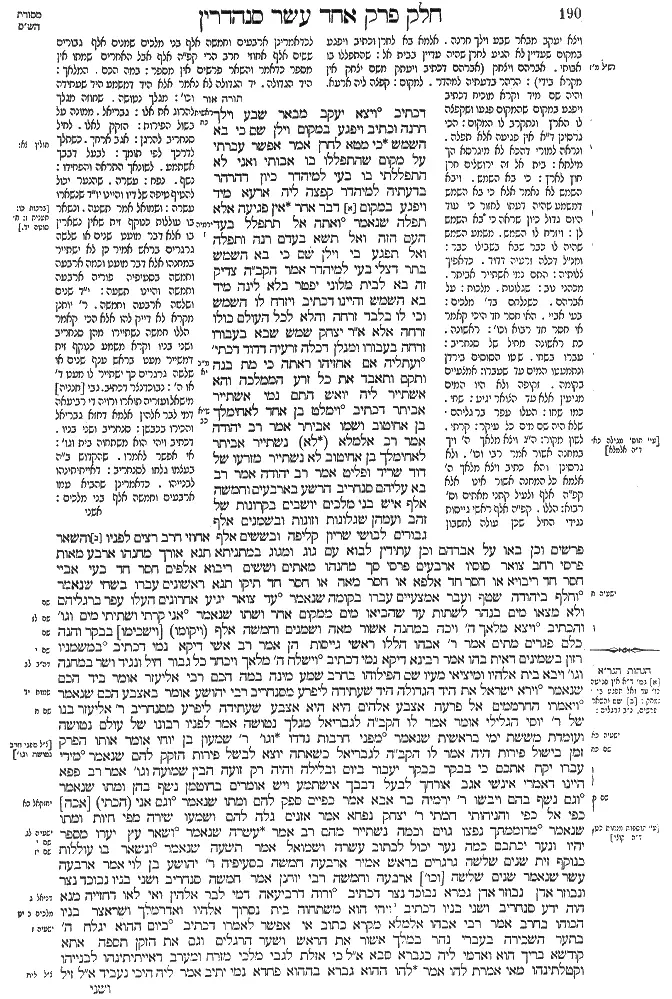
דכתיב (בראשית כח, י) ויצא יעקב מבאר שבע וילך חרנה וכתיב ויפגע במקום וילן שם כי בא השמש כי מטא לחרן אמר אפשר עברתי על מקום שהתפללו בו אבותי ואני לא התפללתי בו בעי למיהדר כיון דהרהר בדעתיה למיהדר קפצה ליה ארעא מיד ויפגע במקום דבר אחר אין פגיעה אלא תפלה שנאמר (ירמיהו ז, טז) ואתה אל תתפלל בעד העם הזה ואל תשא בעדם רנה ותפלה ואל תפגע בי וילן שם כי בא השמש בתר דצלי בעי למיהדר אמר הקב"ה צדיק זה בא לבית מלוני יפטר בלא לינה מיד בא השמש והיינו דכתיב ויזרח לו השמש וכי לו בלבד זרחה והלא לכל העולם כולו זרחה אלא א"ר יצחק שמש שבא בעבורו זרחה בעבורו ומנלן דכלה זרעיה דדוד דכתי' (מלכים ב יא, א) ועתליה אם אחזיהו ראתה כי מת בנה ותקם ותאבד את כל זרע הממלכה והא אשתייר ליה יואש התם נמי אשתייר אביתר דכתיב (שמואל א כב, כ) וימלט בן אחד לאחימלך בן אחיטוב ושמו אביתר אמר רב יהודה אמר רב אלמלא (לא) נשתייר אביתר לאחימלך בן אחיטוב לא נשתייר מזרעו של דוד שריד ופליט אמר רב יהודה אמר רב בא עליהם סנחריב הרשע בארבעים וחמשה אלף איש בני מלכים יושבים בקרונות של זהב ועמהן שגלונות וזונות ובשמנים אלף גבורים לבושי שריון קליפה ובששים אלף אחוזי חרב רצים לפניו והשאר פרשים וכן באו על אברהם וכן עתידין לבוא עם גוג ומגוג במתניתא תנא אורך מחנהו ארבע מאות פרסי רחב צואר סוסיו ארבעים פרסי סך מחנהו מאתים וששים ריבוא אלפים חסר חד בעי אביי חסר חד ריבויא או חסר חד אלפא או חסר מאה או חסר חד תיקו תנא ראשונים עברו בשחי שנאמר (ישעיהו ח, ח) וחלף ביהודה שטף ועבר אמצעיים עברו בקומה שנאמר (ישעיהו ח, ח) עד צואר יגיע אחרונים העלו עפר ברגליהם ולא מצאו מים בנהר לשתות עד שהביאו מים ממקום אחר ושתו שנאמר (ישעיהו לז, כה) אני קרתי ושתיתי מים וגו' והכתיב (ישעיהו לז, לו) ויצא מלאך ה' ויכה במחנה אשור מאה ושמנים וחמשה אלף (ויקומו) [וישכימו] בבקר והנה כלם פגרים מתים אמר ר' אבהו הללו ראשי גייסות הן אמר רב אשי דיקא נמי דכתיב (ישעיהו י, טז) במשמניו רזון בשמינים דאית בהו אמר רבינא דיקא נמי דכתיב (דברי הימים ב לב, כא) וישלח ה' מלאך ויכחד כל גבור חיל ונגיד ושר במחנה וגו' ויבא בית אלהיו ומיציאי מעיו שם הפילוהו בחרב שמע מינה במה הכם רבי אליעזר אומר ביד הכם שנאמר (שמות יד, לא) וירא ישראל את היד הגדולה היד שעתידה ליפרע מסנחריב רבי יהושע אומר באצבע הכם שנאמר (שמות ח, טו) ויאמרו החרטמים אל פרעה אצבע אלהים היא היא אצבע שעתידה ליפרע מסנחריב ר' אליעזר בנו של ר' יוסי הגלילי אומר אמר לו הקב"ה לגבריאל מגלך נטושה אמר לפניו רבונו של עולם נטושה ועומדת מששת ימי בראשית שנאמר (ישעיהו כא, טו) מפני חרבות נדדו וגו' ר' שמעון בן יוחי אומר אותו הפרק זמן בישול פירות היה אמר לו הקב"ה לגבריאל כשאתה יוצא לבשל פירות הזקק להם שנאמר (ישעיהו כח, יט) מידי עברו יקח אתכם כי בבקר בבקר יעבור ביום ובלילה והיה רק זועה הבין שמועה וגו' אמר רב פפא היינו דאמרי אינשי אגב אורחך לבעל דבבך אישתמע ויש אומרים בחוטמן נשף בהן ומתו שנאמר (ישעיהו מ, כד) וגם נשף בהם ויבשו ר' ירמיה בר אבא אמר כפיים ספק להם ומתו שנאמר (יחזקאל כא, כב) וגם אני (הכתי) [אכה] כפי אל כפי והניחותי חמתי ר' יצחק נפחא אמר אזנים גלה להם ושמעו שירה מפי חיות ומתו שנאמר (ישעיהו לג, ג) מרוממתך נפצו גוים וכמה נשתייר מהם רב אמר עשרה שנאמר (ישעיהו י, יט) ושאר עץ יערו מספר יהיו ונער יכתבם כמה נער יכול לכתוב עשרה ושמואל אמר תשעה שנאמר (ישעיהו יז, ו) ונשאר בו עוללות כנוקף זית שנים שלשה גרגרים בראש אמיר ארבעה חמשה בסעיפיה ר' יהושע בן לוי אמר ארבעה עשר שנאמר שנים שלשה [וכו'] ארבעה וחמשה רבי יוחנן אמר חמשה סנחריב ושני בניו נבוכדנצר ונבוזר אדן נבוזר אדן גמרא נבוכדנצר דכתיב (דניאל ג, כה) ורוה דרביעאה דמי לבר אלהין ואי לאו דחזייה מנא הוה ידע סנחריב ושני בניו דכתיב (מלכים ב יט, לז) ויהי הוא משתחוה בית נסרוך אלהיו ואדרמלך ושראצר בניו הכוהו בחרב אמר רבי אבהו אלמלא מקרא כתוב אי אפשר לאמרו דכתיב (ישעיהו ז, כ) ביום ההוא יגלח ה' בתער השכירה בעברי נהר במלך אשור את הראש ושער הרגלים וגם את הזקן תספה אתא קודשא בריך הוא ואדמי ליה כגברא סבא א"ל כי אזלת לגבי מלכי מזרח ומערב דאייתיתינהו לבנייהו וקטלתינהו מאי אמרת להו אמר להו ההוא גברא בההוא פחדא נמי יתיב אמר ליה היכי נעביד א"ל זיל
Comments from Rashi on Masechet Sanhedrin Page 95b
ויצא יעקב מבאר שבע וילך חרנה . אלמא בא לחרן וכתיב ויפגע במקום שעדיין לא הגיע לחרן שהיה עדיין בבית אל: בית אל זה ירושלים חרן חוץ לארץ: שהתפללו בו אבותי . אברהם ויצחק (אברהם דכתיב ויעתק משם יצחק אין מקרא בידי): הרהר בדעתיה למהדר . למקום: קפצה ליה ארעא . והיה שם מיד וקרא מוכיח דכתיב ויפגע במקום שהמקום פגעו ושקפצה לו הארץ ונתקרב לו המקום: הכי גרסינן ד"א אין פגיעה אלא תפלה . ונראה למורי דהכא לא מיגרסא הך מילתא: כי בא השמש . ויבא השמש לא נאמר אלא כי בא השמש דמשמע שהיה דעתו לחזור כי עוד היום גדול כיון שראה כי בא השמש לן: ויזרח לו השמש . משמע השמש שהיה לו כבר שבא בשבילו כבר: ומנ"ל דכלה זרעיה דדוד . כדאפיך צלותיה: התם נמי אשתייר אביתר . מכהני נוב: שגלונות . מלכות: על אברהם . כשנלחם בד' מלכים: בעי אביי . האי חסר חד היכי קאמר אי חסר חד רבוא וכו': ראשונה . כת ראשונה מחיל של סנחריב: עברו בשחי . שטו הסוסים בירדן ונתמעטו המים עד שעברו: אמצעיים בקומה . זקופה ולא היו המים מגיעין אלא עד הצואר יגיע: שחי . כמו שחו: העלו עפר ברגליהם . שלא היה שם מים כל עיקר: קרתי . לשון מקור: ה"ג ויצא מלאך ה' ויך במחנה אשור אמר רבי וכו' . ולא גרסינן והא כתיב ויצא מלאך ה' אלמא כל המחנה אשור אינו אלא קפ"ה אלף ולעיל קתני מאתים וס' רבוא: הללו . קפ"ה אלף ראשי גייסות נגידי החיל שכן עולה לחשבון לכדאמרינן ארבעים וחמשה אלף בני מלכים שמנים אלף גבורים ששים אלף אחוזי חרב הרי קפ"ה אלף אבל האחרים שמתו אין מספר כדאמר והשאר פרשים אין מספר: במה הכם . המלאך: היד הגדולה . יד הגדולה לא נאמר אלא היד דמשמע היד שעתידה וכו': מגלך נטושה . שחוזה מגלך להרוג את אלו: גבריאל . ממונה על בשול הפירות: הזקק לאלו . לחיל סנחריב להרגן: אגב ארחך . כשתלך לדרכך לפי. תומך: לבעל דבבך אשתמע . לשונאך התראה והפחידו: נשף . נפח: עשרה . שהנער יכול להטיף טיפה של דיו והיינו יו"ד שנשארו עשרה: ושמואל אמר תשעה . ונשאר בו עוללות כנוקף זית שאין נשארין בו אלא דבר מועט שנים או שלשה גרגרים בראש אמיר כן לא ישתייר במחנהו אלא דבר מועט וכמה ארבעה וחמשה בסעיפיה פוריה ארבעה וחמשה והיינו תשעה: י"ד שנים ושלשה ארבעה וחמשה . ר' יוחנן מקרא לא דייק להו אלא הכי קאמר הללו חמשה נשתיירו מהן סנחריב ושני בניו וקרא משמע כנוקף זית דמשייר מעט בראש ענף שנים או שלשה גרגרים כך ישתייר לו מעט ד' או ה': נבוכדנצר דכתיב . גבי [חנניה] מישאל ועזריה תוארו ורויה די רביעאה דמי לבר אלהין אלמא דחזא גבריאל והכירו בכבשן: סנחריב ושני בניו . דכתיב ויהי הוא משתחוה בית וגו': אי אפשר לאמרו . שהקדוש ב"ה בעצמו גלחו לסנחריב: דאייתיתינהו לבנייהו . כדאמרינן שהביא עמו ארבעים וחמשה אלף בני מלכים:
Sanhedrin 95b - Mishnah translated into english
is as it is written: “And Jacob departed from Beersheba and went to Haran” (Genesis 28:10), and it is written thereafter, ostensibly after he arrived in Haran: “And he encountered [vayyifga] the place, and he slept there, for the sun had set” (Genesis 28:11). This means that when Jacob arrived at Haran, he said: Is it possible that I bypassed a place where my forefathers prayed and I did not pray there? He sought to return to Beit El. Once he contemplated in his mind to return, the land contracted for him, and immediately: “And he encountered the place,” indicating that he arrived there unexpectedly, sooner than he would have arrived without a miracle.
Alternatively, encounter means nothing other than prayer, as it is stated: “And you, do not pray on behalf of this nation, and do not raise on their behalf song and prayer, and do not encounter [tifga] Me, for I do not hear you” (Jeremiah 7:16).
It is written: “And he slept there because the sun had set” (Genesis 28:11). After Jacob prayed and he sought to return to his travels, the Holy One, Blessed be He, said: This righteous man came to My inn. Will I allow him to take leave without sleeping here? Immediately the sun set, not at the proper time, and that is the meaning of that which is written with regard to Jacob: “And the sun shone for him when he passed Penuel” (Genesis 32:32). The Gemara asks: And did the sun shine only for him? But didn’t the sun shine for the entire world? Rather, Rabbi Yitzḥak says: The sun that set not at the proper time exclusively for him shone not at the proper time exclusively for him in order to rectify the disparity created by the premature sunset.
Apropos David’s prayer that his descendants cease, the Gemara asks: And from where do we derive that David’s descendants ceased to exist? It is derived from a verse, as it is stated: “And Athaliah the mother of Ahaziah saw that her son was dead, and she arose and destroyed all the royal descendants” (II Kings 11:1). The Gemara asks: But didn’t Joash remain alive, and therefore, not all of David’s descendants ceased to exist? The Gemara answers: There too, in the massacre in Nov, Abiathar, one of the priests, remained alive, as it is written: “And one of the sons of Ahimelech, son of Ahitub, named Abiathar, escaped” (I Samuel 22:20). Rav Yehuda says that Rav says: Were it not for the fact that Abiathar remained alive for Ahimelech, son of Ahitub, there would have been no remnant or refugee remaining from the descendants of David.
§ Apropos Sennacherib, Rav Yehuda says that Rav says: Sennacherib the wicked came upon them with forty-five thousand men, sons of kings, sitting in carriages of gold, and with them were consorts and prostitutes, and with eighty thousand warriors each wearing a coat of mail, and with sixty thousand sword-bearers running before him, and the rest were cavalry. And likewise, when the four kings came upon Abraham to wage war in the land of Canaan (see Genesis, chapter 14), they brought forces of that magnitude. And likewise, forces of that magnitude are destined to come with Gog and Magog in the ultimate war.
It was taught in a baraita: The length of the camp of Sennacherib was four hundred parasangs and the width of the necks of his horses side by side was forty parasangs. The total number of soldiers in his camp was 260 ten thousands, i.e., 2,600,000, minus one. Abaye asks: Is the tanna saying minus one unit of ten thousand, or minus one unit of one thousand, or minus one unit of one hundred or minus one? The Gemara concludes: The question shall stand unresolved.
It was taught: The first set of soldiers in the army of Sennacherib crossed by swimming across the Jordan, as it is stated: “And he shall sweep through Judea; he shall overflow and pass” (Isaiah 8:8). Since the water level diminished with their crossing, the middle group of soldiers passed while standing upright, as it is stated: “It shall reach even the neck” (Isaiah 8:8). The last soldiers already kicked up dust with their feet, and they did not find water in the river to drink, and they had no water until they brought water from another place and drank it, as it is stated: “I dug and drank water” (Isaiah 37:25).
The Gemara asks: But isn’t it written: “Then the angel of the Lord went forth and smote in the camp of the Assyrians one hundred and eighty-five thousand. And when they arose early in the morning, behold, they were all dead corpses” (Isaiah 37:36)? Apparently, there were many fewer soldiers than the number listed in the baraita. Rabbi Abbahu says: These listed here are regiment leaders, who commanded numerous soldiers.
Rav Ashi says: It is also precise in the formulation of the verse, as it is written: “Therefore shall the Master, the Lord of hosts, send among his fat ones leanness” (Isaiah 10:16), indicating that it was the fat, i.e., significant, among them who were afflicted. Ravina says: The language is also precise in the formulation of another verse, as it is written: “And the Lord sent an angel, who obliterated the mighty men-at-arms and the leaders and captains in the camp of the king of Assyria. So he returned shamefacedly to his own land. And when he came into the house of his God, his own offspring slew him there with a sword” (II Chronicles 32:21). The Gemara affirms: Conclude from it that the leaders of the regiment were the ones killed.
The Gemara asks: With what did the angel strike them? Rabbi Eliezer says: He struck them by hand, as it is stated: “And Israel saw the great hand” (Exodus 14:31), where the term for hand, yad, is preceded by the definite article ha, indicating that this was the hand that was destined to exact retribution from Sennacherib. Rabbi Yehoshua says: He struck them with His finger, as it is stated: “And the sorcerers said to Pharaoh: This is the finger of God” (Exodus 8:15), indicating that it is the finger that was destined to exact retribution from Sennacherib. Rabbi Eliezer, son of Rabbi Yosei HaGelili, says that the Holy One, Blessed be He, said to Gabriel: Is your scythe honed? Gabriel said before Him: Master of the Universe, it is standing honed from the six days of Creation, as it is stated: “For they have fled from the swords, from the honed sword” (Isaiah 21:15).
Rabbi Shimon ben Yoḥai says: That period was the season of the ripening of the fruit. The Holy One, Blessed be He, said to Gabriel: When you emerge to ripen the fruits, attend to the army of Assyria and destroy them, as it is stated: “As often as it passes through, it shall take you; for morning by morning shall it pass through, by day and by night; and the mere understanding of the report shall bring terror” (Isaiah 28:19), indicating that Gabriel was to kill them while engaged in another activity. Rav Pappa says that this is in accordance with the adage that people say: While on your path, appear before your enemy and afflict him.
And there are those who say: The angel blew into the soldiers of the Assyrian army through their noses and they died, as it is stated: “When he blows upon them, and they wither” (Isaiah 40:24). Rabbi Yirmeya bar Abba says: The angel clapped his hands to them and they died, as it is stated: “I will also strike My hands together and I will assuage My anger” (Ezekiel 21:22). Rabbi Yitzḥak Nappaḥa says: He revealed ears for them and they were able to hear the songs of praise from the mouths of the celestial creatures drawing the chariot of God, and they died, as it is stated: “From Your exaltation the nations were scattered” (Isaiah 33:3), indicating that their death was caused by the revelation of God’s greatness.
And how many of the soldiers remained alive? Rav says: Ten soldiers, as it is stated: “And the rest of the trees of his forest shall be few, that a child may write them” (Isaiah 10:19). And what number can a child easily write? It is the number ten, represented by the letter yod, which is the smallest letter. And Shmuel says: Nine remained, as it is stated: “And gleanings shall be left of him, as in the beating of an olive tree, two or three berries in the top of the uppermost bough, four or five in the branches of a fruitful tree” (Isaiah 17:6). Four and five total nine.
Rabbi Yehoshua ben Levi says: Fourteen remained, as it is stated: “Two or three…four or five,” which total fourteen. Rabbi Yoḥanan says: Five remained: Sennacherib, and his two sons, and Nebuchadnezzar, and Nebuzaradan, the captain of the guard. The fact that Nebuzaradan was among them is learned through tradition. Nebuchadnezzar was among them, as it is written that Nebuchadnezzar said when he saw an angel with Hananiah, Mishael, and Azariah: “And the appearance of the fourth is like that of an angel” (Daniel 3:25). And if he had not seen the angel that smote Sennacherib’s army, from where would he have known that the fourth person looked like an angel? Sennacherib and his two sons were among them, as it is written later in their regard: “And it came to pass as he was worshipping in the house of Nisroch his god that Adrammelech and Sarezer, his sons, smote him with the sword” (II Kings 19:37). Evidently, the three of them survived.
§ Rabbi Abbahu says: Were the following verse not written, it would have been impossible to say it, since it appears to be a desecration of the name of God, as it is written: “On that day shall the Lord shave with a hired razor in the parts beyond the river the king of Assyria, the head, and the hair of the legs, and it shall also sweep away the beard” (Isaiah 7:20). The blasphemous indication is that the Holy One, Blessed be He, will Himself shave Sennacherib.
Rather, this is the incident depicted in the verse: The Holy One, Blessed be He, came and appeared to Sennacherib as an old man. God said to him: When you go to the kings of the east and the west whose children you brought and killed, what will you say to them? Sennacherib said to the Holy One, Blessed be He: That man, referring to himself, also sits overcome with the same fear, as I do not know what to say to them. Sennacherib said to the Holy One, Blessed be He: What should we do? The Holy One, Blessed be He, said to him: Go
Traduction : The William Davidson digital edition of the Koren Noé Talmud, with commentary by Rabbi Adin Even-Israel Steinsaltz.