 Talmud Bavli
The learning on the whole site is dedicated : L'ilui Nishmat Margalit bat Ledicia
The learning on the whole site is dedicated : For the success of Elyahou ben H'anna & family
The learning on the whole site is dedicated : L'ilui Nishmat אליעזר בן רחל
Sanhedrin 69b : Youtube
Daf TubeYoutube
2 video classes :
Sanhedrin Page 69b
Sanhedrin 69b - Guemara
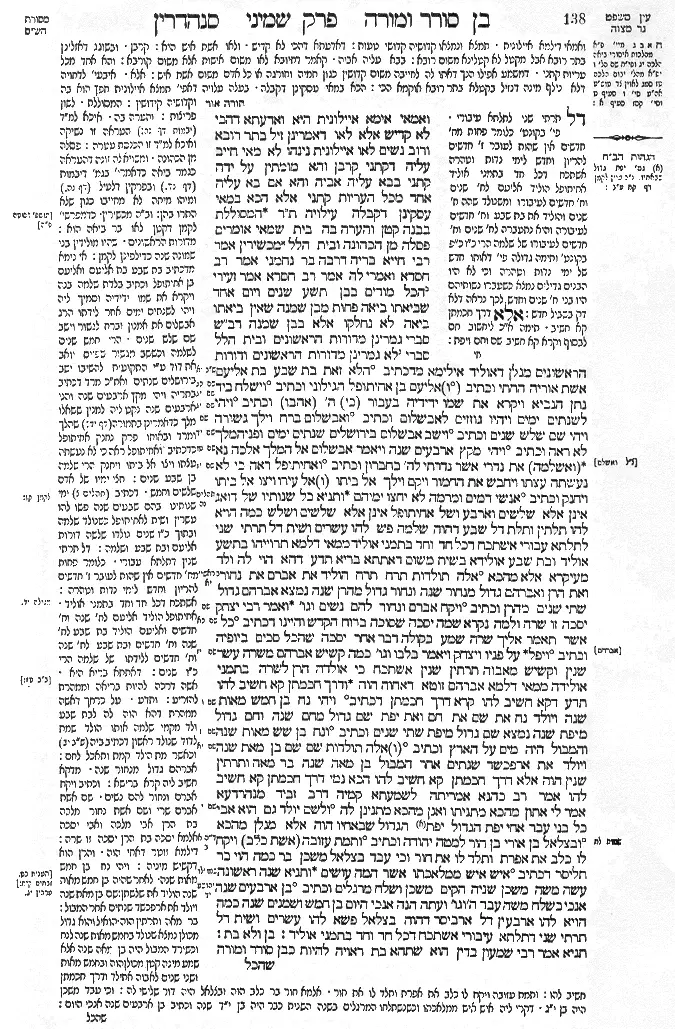
ואמאי אימא איילונית היא ואדעתא דהכי לא קדיש אלא לאו דאמרינן זיל בתר רובא ורוב נשים לאו איילונית נינהו לא מאי חייב עליה דקתני קרבן והא מומתין על ידה קתני בבא עליה אביה והא אם בא עליה אחד מכל העריות קתני אלא הכא במאי עסקינן דקבלה עילויה ת"ר המסוללת בבנה קטן והערה בה בית שמאי אומרים פסלה מן הכהונה ובית הלל מכשירין אמר רבי חייא בריה דרבה בר נחמני אמר רב חסדא ואמרי לה אמר רב חסדא אמר זעירי הכל מודים בבן תשע שנים ויום אחד שביאתו ביאה פחות מבן שמנה שאין ביאתו ביאה לא נחלקו אלא בבן שמנה דב"ש סברי גמרינן מדורות הראשונים ובית הלל סברי לא גמרינן מדורות הראשונים ודורות הראשונים מנלן דאוליד אילימא מדכתיב (שמואל ב יא, ג) הלא זאת בת שבע בת אליעם אשת אוריה החתי וכתיב ((שמואל ב כג, לד) (ו)אליעם בן אחיתופל הגילוני וכתיב (שמואל ב יב, כה) וישלח ביד נתן הנביא ויקרא את שמו ידידיה בעבור (כי) ה' (אהבו) וכתיב (שמואל ב יג, כג) ויהי לשנתים ימים ויהיו גוזזים לאבשלום וכתיב (שמואל ב יג, לח) ואבשלום ברח וילך גשורה ויהי שם שלש שנים וכתיב (שמואל ב יד, כח) וישב אבשלום בירושלים שנתים ימים ופני המלך לא ראה וכתיב (שמואל ב טו, ז) ויהי מקץ ארבעים שנה ויאמר אבשלום אל המלך אלכה נא (ואשלמה) את נדרי אשר נדרתי לה' בחברון וכתיב (שמואל ב יז, כג) ואחיתופל ראה כי לא נעשתה עצתו ויחבש את החמור ויקם וילך אל ביתו (ו)אל עירו ויצו אל ביתו ויחנק וכתיב (תהלים נה, כד) אנשי דמים ומרמה לא יחצו ימיהם ותניא כל שנותיו של דואג אינן אלא שלשים וארבע ושל אחיתופל אינן אלא שלשים ושלש כמה הויא להו תלתין ותלת דל שבע דהוה שלמה פש להו עשרים ושית דל תרתי שני לתלתא עבורי אשתכח דכל חד וחד בתמני אוליד ממאי דלמא תרוייהו בתשע אוליד ובת שבע אולידא בשית משום דאתתא בריא תדע דהא הוי לה ולד מעיקרא אלא מהכא (בראשית יא, כז) אלה תולדות תרח תרח הוליד את אברם את נחור ואת הרן ואברהם גדול מנחור שנה ונחור גדול מהרן שנה נמצא אברהם גדול שתי שנים מהרן וכתיב (בראשית יא, כט) ויקח אברם ונחור להם נשים וגו' ואמר רבי יצחק יסכה זו שרה ולמה נקרא שמה יסכה שסוכה ברוח הקדש והיינו דכתיב (בראשית כא, יב) כל אשר תאמר אליך שרה שמע בקולה דבר אחר יסכה שהכל סכים ביופיה וכתיב (בראשית יז, יז) ויפל על פניו ויצחק ויאמר בלבו וגו' כמה קשיש אברהם משרה עשר שנין וקשיש מאבוה תרתין שנין אשתכח כי אולדה הרן לשרה בתמני אולידה ממאי דלמא אברהם זוטא דאחוה הוה ודרך חכמתן קא חשיב להו תדע דקא חשיב להו קרא דרך חכמתן דכתיב (בראשית ה, לב) ויהי נח בן חמש מאות שנה ויולד נח את שם את חם ואת יפת שם גדול מחם שנה וחם גדול מיפת שנה נמצא שם גדול מיפת שתי שנים וכתיב (בראשית ז, ו) ונח בן שש מאות שנה והמבול היה מים על הארץ וכתיב (בראשית יא, י) (ו)אלה תולדות שם שם בן מאת שנה ויולד את ארפכשד שנתים אחר המבול בן מאה שנה בר מאה ותרתין שנין הוה אלא דרך חכמתן קא חשיב להו הכא נמי דרך חכמתן קא חשיב להו אמר רב כהנא אמריתה לשמעתא קמיה דרב זביד מנהרדעא אמר לי אתון מהכא מתניתו ואנן מהכא מתנינן לה (בראשית י, כא) ולשם יולד גם הוא אבי כל בני עבר אחי יפת הגדול יפת הגדול שבאחיו הוה אלא מנלן מהכא (שמות לח, כב) ובצלאל בן אורי בן חור למטה יהודה וכתיב (דברי הימים א ב, יט) ותמת עזובה (אשת כלב) ויקח לו כלב את אפרת ותלד לו את חור וכי עבד בצלאל משכן בר כמה הוי בר תליסר דכתיב (שמות לו, ד) איש איש ממלאכתו אשר המה עושים ותניא שנה ראשונה עשה משה משכן שניה הקים משכן ושלח מרגלים וכתיב (יהושע יד, ז) בן ארבעים שנה אנכי בשלח משה עבד ה' וגו' ועתה הנה אנכי היום בן חמש ושמנים שנה כמה הויא להו ארבעין דל ארביסר דהוה בצלאל פשא להו עשרים ושית דל תרתי שני דתלתא עיבורי אשתכח דכל חד וחד בתמני אוליד:
בן ולא בת:
תניא אמר רבי שמעון בדין הוא שתהא בת ראויה להיות כבן סורר ומורה
Comments from Rashi on Masechet Sanhedrin Page 69b
ואמאי דילמא איילונית . תמצא ונמצאו קדושיה קדושי טעות: דאדעתא דהכי לא קדיש . ולאו אשת איש היא: קרבן . ובשוגג דאזלינן בתר רובא אבל מקטל לא קטלינא משום רובא: בבא עליה אביה . קאמר דחיובא לאו משום אישות אלא משום קורבא: והא אחד מכל עריות קתני . דמשמע אפילו הנך דאתו לה לחייבה משום קדושין כגון חמיה וחורגה או כל אדם משום אשת איש: אלא . איבעי' לדחויה דלא נילף מינה דנזיל בקטלא בתר רובא אוקמא הכי: הכא במאי עסקינן דקבלה . בעלה עלויה דאפי' תמצא איילונית חפץ הוא בה וקדושיה קידושין: המסוללת . לשון פריצות: והערה בה . איכא למ"ד (יבמות דף נה:) העראה זו נשיקה ואיכא למ"ד זו הכנסת עטרה: פסלה מן הכהונה . ומשויא לה זונה דהעראה כגמר ביאה כדאמרי' בגמ' דיבמות (דף נד.) ובפרקין דלעיל (סנהדרין דף נה.) ומיהו מיתה לא מחייבו כגון שלא התרו בהן: וב"ה מכשירין . כדמפרשי' לקמן דקטן לאו בר ביאה הוא: מדורות הראשונים . שהיו מולידין בני שמונה שנה כדילפינן לקמן: אי נימא מדכתיב בת שבע בת אליעם ואליעם בן אחיתופל וכתיב בלדת שלמה בנה ויקרא את שמו ידידיה וסמיך ליה ויהי לשנתים ימים אחר לידתו הרג אבשלום את אמנון וברח לגשור וישב שם שלש שנים . הרי חמש שנים לשלמה וכששב מגשור שפייס יואב את דוד ע"י התקועית להשיבו ישב בירושלים שנתים ואח"כ מרד דכתיב בתריה ויהי מקץ ארבעים שנה והני ארבעים שנה נקט ליה למנין ששאלו מלך כדאמרינן בתמורה (דף יד:) שהלך ומרד ובאותו פרק נחנק אחיתופל כדכתיב ואחיתופל ראה כי לא נעשתה עצתו ויצו אל ביתו ויחנק הרי שלמה בן שבע שנים: חצי ימיו של אדם שלשים וחמש דכתיב (תהלים צ) ימי שנותינו בהם שבעים שנה: פשו להו עשרין ושית . לאחיתופל כשנולד שלמה ובתוך כ"ו שנים נולדו שלשה דורות אליעם ובת שבע ושלמה: דל תרתי שנין דתלתא עבורי . כלומר פחות מח' חדשים אין שהות לעובר ז' חדשים להריון וחדש לימי נדות וטהרה: אשתכח דכל חד וחד בתמני אוליד . אחיתופל הוליד אליעם לח' שנה וח' חדשים ואליעם הוליד בת שבע לח' שנה וח' חדשים ובת שבע לח' שנה וח' חדשים ללידתו של שלמה הרי כ"ו שנים: דאתתא בריא היא . אשה דרכה להיות בריאה וממהרת להזריע: ותדע . על כרחך דאשה ממהרת דהא הוה לה לבת שבע ולד מקמי שלמה אותו הולד שמת לדוד שנולד ראשון דכתיב ביה (שמואל ב יב) וכאשר מת הילד קמת ותאכל לחם: אברהם גדול מנחור שנה . מדקא חשיב ליה קרא ברישא: וכתיב ויקח אברם ונחור להם נשים . שם אשת אברם שרי ושם אשת נחור מלכה בת הרן אבי מלכה ואבי יסכה אלמא יסכה בת הרן יסכה זו שרה: דילמא זוטר דאחי הוה . והרן הוא דקשיש מיניה: ויהי נח בן חמש מאות שנה . לאחר שהיה בן חמש מאות שנה הוליד את שלשתן: שם בן מאת שנה ויולד את ארפכשד שנתים אחר המבול: בר מאה ותרתין הוה . הואיל והוא גדול מכולן נמצא שנולד בחמש מאות שנה לנח וכשירד המבול היה בן מאה שנה אלא שמע מינה קטן מכולן הוה ובחמש מאות ושני שנים לאבוה אתילד ודרך חכמתן חשיב להו: ותמת עזובה ויקח לו כלב את אפרת ותלד לו את חור . אלמא חור בר כלב הוה ובצלאל היה דור שלישי לו: וכי עבד משכן היה בן י"ג . דקרי ליה איש איש ממלאכתו וכשנשתלחו המרגלים בשנה השנית כבר היה בן י"ד שנה וכתיב בן ארבעים שנה אנכי היום:
Comments from Tosafot - Sanhedrin 69b
דל תרתי שני לתלתא עיבורי . פי' בקונט' כלומר פחות מח' חדשים אין שהות לעובר ז' חדשים להריון וחדש לימי נדות וטהרה אשתכח דכל חד בתמני אוליד אחיתופל הוליד אליעם לח' שנים וח' חדשים לעיבורו ומשנולד שהה ח' שנים והוליד את בת שבע וח' חדשים לעיבורה והיא נתעברה לח' שנים וח' חדשים לעיבורו של שלמה הרי כ"ו כ"פ בקונט' ותימה גדולה פי' דאותו חדש של ימי נדות וטהרה וכי לא היו הבנים גדילים נמצא כשעברו נשותיהם היו בני ח' שנים וחדש לכך נראה דלא דק בשביל חדש: אלא דרך חכמתן קא חשיב . תימה א"כ ליחשוב חם לבסוף וקרא קא חשיב שם וחם ויפת:
Sanhedrin 69b - Mishnah translated into english
Rabbi Yirmeya of Difti explains how this mishna demonstrates that one follows the majority even in cases of capital law: Why is a man who engaged in intercourse with a three-year-old girl who was married to another man liable to receive the death penalty? Say that perhaps it will turn out that she is a sexually underdeveloped woman [ailonit] who is incapable of bearing children, and her husband did not betroth her with this understanding; and consequently the marriage is null, as it was entered into in error. Therefore, a man who engaged in intercourse with her should not be liable to receive the death penalty for adultery. Rather, is it not that we say that one follows the majority, and the majority of women are not sexually underdeveloped women, and therefore the assumption is that the betrothal was valid? This is proof that even in cases of capital law one follows the majority.
The Gemara refutes this claim: No; rather, what is the meaning of that which is taught in the mishna: And if she is married, a man other than her husband is liable for engaging in intercourse with her due to violation of the prohibition against intercourse with a married woman? This means that if a man unwittingly engaged in intercourse with a three-year-old girl who was married to another man, he is liable to bring a sin-offering, but there is no liability to receive the death penalty based on a majority.
The Gemara asks: But wasn’t it taught in the mishna: And if one of any of those with whom relations are forbidden, which are enumerated in the Torah, engaged in intercourse with her, the man is executed by the court for engaging in intercourse with her? The Gemara answers: This is referring to a case where her father or some other close relative engaged in intercourse with her, so that the prohibition is incest, rather than adultery.
The Gemara asks: But wasn’t it taught: If one of any of those with whom relations are forbidden engaged in intercourse with her, the man is executed by the court for engaging in intercourse with her? This seems to indicate that the death penalty is imposed for all types of forbidden intercourse with a three-year-old girl, even if the intercourse is forbidden as a result of her being married. The Gemara refutes this claim: Rather, what are we dealing with here? With a case where the husband explicitly accepted her upon himself as his wife even if she turns out to be a sexually undeveloped woman. Therefore, another man who engages in intercourse with her is liable to receive the death penalty even if he is not one of her close relatives.
§ The Sages taught in a baraita: If a woman was acting lewdly with her minor son and he performed the initial stage of intercourse with her, Beit Shammai say that he has thereby disqualified her from marrying into the priesthood. And Beit Hillel deem her fit to marry into the priesthood, because they maintain that the intercourse of a minor is not regarded as intercourse.
Rabbi Ḥiyya, son of Rabba bar Naḥmani, says that Rav Ḥisda says, and some say that Rav Ḥisda says that Ze’eiri says: All, i.e., both Beit Shammai and Beit Hillel, concede with regard to a boy nine years and one day old that his intercourse is regarded as intercourse and disqualifies a woman from marrying into the priesthood as well as results in her liability to receive the death penalty, even though he himself is not liable to receive it. And they also all concede concerning a boy less than eight years old that his intercourse is not regarded as intercourse vis-à-vis these halakhot. They disagree only about a boy who is eight years old, as Beit Shammai maintain that we learn from earlier generations, when people were able to father children at that age, and we apply that reality to the present; and Beit Hillel maintain that we do not learn from earlier generations.
The Gemara asks: And from where do we derive that in earlier generations men fathered children at this age? If we say that we know this from the following calculation: It is written: “Is this not Bathsheba, daughter of Eliam, wife of Uriah the Hittite?” (II Samuel 11:3). And it is also written: “And Eliam, son of Ahithophel the Gilonite” (II Samuel 23:34), which teaches that Bathsheba was the granddaughter of Ahithophel. And it is written with reference to the birth of Solomon: “And he sent by the hand of Nathan the prophet, and he called his name Jedidiah, for the Lord’s sake” (II Samuel 12:25).
And later it is written: “And it came to pass after two years, that Absalom had sheepshearers” (II Samuel 13:23), and at that time Amnon was killed (see II Samuel 13:23–29), this being at least two years after Solomon was born. And afterward it is written: “So Absalom fled, and went to Geshur, and was there three years” (II Samuel 13:38), so that this was five years after Solomon was born.
And it is written: “So Absalom dwelt two years in Jerusalem, and did not see the king’s face” (II Samuel 14:28), bringing the tally to seven years after Solomon was born. And it is written: “And it came to pass after forty years, that Absalom said to the king, I pray you, let me go and pay my vow, which I have vowed to the Lord, in Hebron” (II Samuel 15:7). This was the beginning of Absalom’s rebellion against David. Accordingly, at that time Solomon was at least seven years old. And at some point during the rebellion it is written: “And when Ahithophel saw that his counsel was not followed, he saddled his donkey, and arose, and went to his house, to his city, and put his household in order, and strangled himself and died” (II Samuel 17:23).
And it is written: “Bloody and deceitful men shall not live out half their days” (Psalms 55:24). And in keeping with this verse, it is taught in a baraita: All of Doeg’s years were only thirty-four and Ahithophel’s were only thirty-three. Neither reached the age of thirty-five, half of the normal life span of seventy years. Based on this, one can calculate: How many years did Ahithophel live? Thirty-three. Subtract seven years, Solomon’s age at the time of Ahithophel’s death, which leaves Ahithophel twenty-six years old at the time of Solomon’s birth. Subtract two more years for three pregnancies, one preceding the birth of Eliam the son of Ahithophel, one preceding the birth of Bathsheba, daughter of Eliam, and one preceding the birth of Solomon, son of Bathsheba. It turns out that three generations were born in twenty-four years, and that each and every parent begot a child at the age of eight.
The Gemara refutes this proof: From where do you prove this? Perhaps both Ahithophel and his son Eliam fathered children when they were each nine years old, and Bathsheba gave birth to Solomon when she was six, because a woman is stronger and can conceive at an earlier age. Know that this is true that women conceive at an earlier age, as Bathsheba had already given birth to a child from David before giving birth to Solomon (see II Samuel 11:27). Therefore, no proof can be derived from here.
Rather, it is from here that one can deduce that in earlier generations men fathered children at the age of eight, as it is written: “And these are the generations of Terah; Terah begot Abram, Nahor, and Haran” (Genesis 11:27). And Abraham was at least one year older than Nahor, and Nahor was one year older than Haran, so it turns out that Abraham was two years older than Haran. And it is written: “And Abram and Nahor took wives for themselves; the name of Abram’s wife was Sarai and the name of Nahor’s wife was Milka, daughter of Haran, father of Milka and father of Iscah” (Genesis 11:29).
And Rabbi Yitzḥak says: Iscah is in fact Sarah. And why was she called Iscah? Because she envisioned [shesokha] hidden matters by means of divine inspiration. And this explains what is written: “In all that Sarah has said to you, hearken to her voice” (Genesis 21:12). Alternatively, Sarah was also called Iscah, because all gazed [sokhim] upon her beauty. And it is written: “And Abraham fell upon his face, and laughed, and said in his heart: Shall a child be born to him that is a hundred years old? And shall Sarah, who is ninety years old, give birth?” (Genesis 17:17). How much older was Abraham than Sarah? He was ten years older than her and, as stated above, he was two years older than her father, Haran. It turns out then that when Haran begot Sarah, he begot her at the age of eight.
The Gemara refutes this proof: From where do you prove this? Perhaps Abraham was the youngest of the brothers, and not the oldest among them. The fact that Abraham is listed first is no proof that he was the oldest, as perhaps the verse listed them in the order of their wisdom and therefore Abraham, being the wisest, was mentioned first.
Know that it is true that the verse sometimes lists brothers not according to their birth order, but in the order of their degrees of wisdom, as it is written: “And Noah was five hundred years old; and Noah begot Shem, Ham, and Japheth” (Genesis 5:32). According to this, Shem was at least one year older than Ham, and Ham one year older than Japheth, so it turns out that Shem was two years older than Japheth. And it is written: “And Noah was six hundred years old when the flood of waters was upon the earth” (Genesis 7:6). And it is written: “These are the descendants of Shem; Shem was one hundred years old, and begot Arpachshad two years after the flood” (Genesis 11:10). If Shem was the oldest brother, how could he be only 100 years old? He must have been at least 102 years old, as Noah was 500 years old when his third son was born, and he was 600 years old at the time of the flood.
Rather, the verse listed them in the order of their degrees of wisdom, Shem being the wisest. With regard to his age, Shem was the youngest of the brothers, having been born when Noah was 502 years old. Shem begot his son 100 years later, which was two years after the flood. Here too, then, with regard to the sons of Terah, it can be argued that the verse lists them in the order of their degrees of wisdom.
Rav Kahana says: I stated this discussion before Rav Zevid of Neharde’a. When he heard it, he said to me: You learn that Shem was not Noah’s oldest son from there, and we learn it from here: “And to Shem, the father of all the children of Eber, the brother of Japheth the elder, to him also were children born” (Genesis 10:21). This verse indicates that Japheth, rather than Shem, was the oldest of the brothers.
The Gemara asks: Rather, from where do we derive that in earlier generations men fathered children at the age of eight? From here, as it is written: “And Bezalel, son of Uri, son of Hur, of the tribe of Judah, made all that the Lord commanded Moses” (Exodus 38:22). And it is written: “And Azubah died, and Caleb took for himself Ephrat, who bore him Hur. And Hur begot Uri, and Uri begot Bezalel” (I Chronicles 2:19–20). And when Bezalel made the Tabernacle how old was he? He must have been at least thirteen years old, as it is written: “And all the wise men that carried out all the work of the sanctuary, came every man from his work that they did” (Exodus 36:4), and one who is less than thirteen is not called a man. And it is taught in a baraita: In the first year following the exodus from Egypt Moses made the Tabernacle; in the second year he erected the Tabernacle and sent out the spies.
And it is written that Caleb, Bezalel’s great-grandfather, said to Joshua: “I was forty years old when Moses the servant of the Lord sent me from Kadesh Barnea to spy out the land” (Joshua 14:7). And he added: “And now, behold, I am this day eighty-five years old” (Joshua 14:10). How many years old was Caleb when he was sent off with the spies? He was forty. Subtract fourteen years, as Bezalel was at least fourteen years old when Caleb was sent to spy out the land. This is known because that mission took place a year after the Tabernacle was erected. This leaves twenty-six years. Subtract two more years for three pregnancies, one preceding the birth of Hur, son of Caleb, one preceding the birth of Uri, son of Hur, and one preceding the birth of Bezalel, son of Uri. It turns out that three generations were born in twenty-four years, and that each and every parent begot a child at the age of eight.
§ The mishna teaches that the penalty for rebelliousness is imposed upon a son, but not upon a daughter. It is taught in a baraita: Rabbi Shimon says: It would be reasonable that a daughter should be fit to be treated like a stubborn and rebellious son, and to be punished like him if she sins in the same way as he does.
Traduction : The William Davidson digital edition of the Koren Noé Talmud, with commentary by Rabbi Adin Even-Israel Steinsaltz.