 Talmud Bavli
The learning on the whole site is dedicated : L'ilui Nishmat Rav Chlomo Ben Jamilla
The learning on the whole site is dedicated : L'ilui Nishmat Amram ben Itshak Loubaton
The learning on the whole site is dedicated : L'ilui Nishmat יוסף בן מושה
Sanhedrin 72b : Youtube
Daf TubeYoutube
2 video classes :
Sanhedrin Page 72b
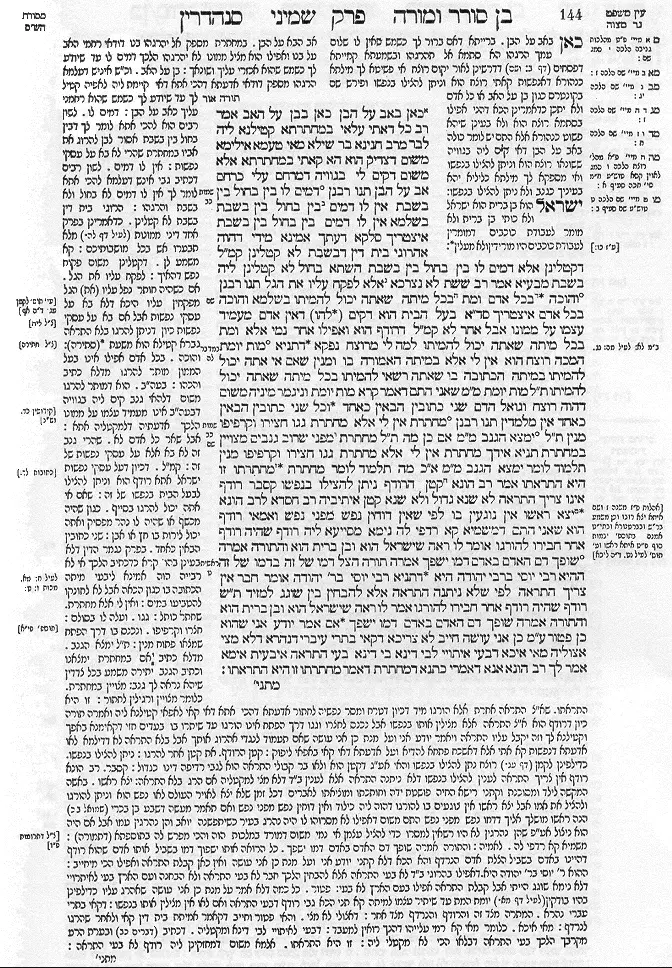
Sanhedrin 72b - Guemara
כאן באב על הבן כאן בבן על האב אמר רב כל דאתי עלאי במחתרתא קטילנא ליה לבר מרב חנינא בר שילא מאי טעמא אילימא משום דצדיק הוא הא קאתי במחתרתא אלא משום דקים לי בגוויה דמרחם עלי כרחם אב על הבן תנו רבנן (שמות כב, ב) דמים לו בין בחול בין בשבת אין לו דמים בין בחול בין בשבת בשלמא אין לו דמים בין בחול בין בשבת איצטריך סלקא דעתך אמינא מידי דהוה אהרוגי בית דין דבשבת לא קטלינן קמ"ל דקטלינן אלא דמים לו בין בחול בין בשבת השתא בחול לא קטלינן ליה בשבת מבעיא אמר רב ששת לא נצרכא אלא לפקח עליו את הגל תנו רבנן (שמות כב, א) והוכה בכל אדם ומת בכל מיתה שאתה יכול להמיתו בשלמא והוכה בכל אדם איצטריך סד"א בעל הבית הוא דקים (להו) דאין אדם מעמיד עצמו על ממונו אבל אחר לא קמ"ל דרודף הוא ואפילו אחר נמי אלא ומת בכל מיתה שאתה יכול להמיתו למה לי מרוצח נפקא דתניא (במדבר לה, כא) מות יומת המכה רוצח הוא אין לי אלא במיתה האמורה בו ומנין שאם אי אתה יכול להמיתו במיתה הכתובה בו שאתה רשאי להמיתו בכל מיתה שאתה יכול להמיתו ת"ל מות יומת מ"מ שאני התם דאמר קרא מות יומת וניגמר מיניה משום דהוה רוצח וגואל הדם שני כתובין הבאין כאחד וכל שני כתובין הבאין כאחד אין מלמדין תנו רבנן (שמות כב, א) מחתרת אין לי אלא מחתרת גגו חצירו וקרפיפו מנין ת"ל (שמות כב, א) ימצא הגנב מ"מ אם כן מה ת"ל מחתרת מפני שרוב גנבים מצויין במחתרת תניא אידך מחתרת אין לי אלא מחתרת גגו חצירו וקרפיפו מנין תלמוד לומר ימצא הגנב מ"מ א"כ מה תלמוד לומר מחתרת מחתרתו זו היא התראתו אמר רב הונא קטן הרודף ניתן להצילו בנפשו קסבר רודף אינו צריך התראה לא שנא גדול ולא שנא קטן איתיביה רב חסדא לרב הונא יצא ראשו אין נוגעין בו לפי שאין דוחין נפש מפני נפש ואמאי רודף הוא שאני התם דמשמיא קא רדפי לה נימא מסייעא ליה רודף שהיה רודף אחר חבירו להורגו אומר לו ראה שישראל הוא ובן ברית הוא והתורה אמרה (בראשית ט, ו) שופך דם האדם באדם דמו ישפך אמרה תורה הצל דמו של זה בדמו של זה ההיא רבי יוסי ברבי יהודה היא דתניא רבי יוסי בר' יהודה אומר חבר אין צריך התראה לפי שלא ניתנה התראה אלא להבחין בין שוגג למזיד ת"ש רודף שהיה רודף אחר חבירו להורגו אמר לו ראה שישראל הוא ובן ברית הוא והתורה אמרה שופך דם האדם באדם דמו ישפך אם אמר יודע אני שהוא כן פטור ע"מ כן אני עושה חייב לא צריכא דקאי בתרי עיברי דנהרא דלא מצי אצוליה מאי איכא דבעי איתויי לבי דינא בי דינא בעי התראה איבעית אימא אמר לך רב הונא אנא דאמרי כתנא דמחתרת דאמר מחתרתו זו היא התראתו:
Comments from Rashi on Masechet Sanhedrin Page 72b
אב הבא על הבן . במחתרת מספק אל יהרגהו בנו דודאי רחמי האב על בנו ואפילו הוא מציל ממונו לא יהרגהו הלכך דמים לו עד שיודע לך כשמש שהוא אכזרי עליך ושונאך: בן על האב . וכ"ש איניש דעלמא הרגהו מספק דודאי אדעתא דהכי אתא דאי קיימת ליה לאפיה קטיל לך עד שיודע לך כשמש שהוא רחמני עליך כאב על הבן: דמים לו . לשון רבים הוא להכי אתא לומר לך דבין בחול בין בשבת אסור לבן להרוג את אביו במחתרת שהרי לא בא על עסקי נפשות: אין לו דמים . לשון רבים דכתיב גבי אינש דעלמא להכי אתא לומר לך אין לו דמים לא בחול ולא בשבת והרגהו: הרוגי בית דין בשבת לא קטלינן . כדאמרינן בפרק אחד דיני ממונות (לעיל סנהדרין דף לה:) מלא תבערו אש בכל מושבותיכם: קא משמע לן . דקטלינן משום פקוח נפש דהאיך: לפקח עליו את הגל . אם כשהיה חותר נפל עליו (את) הגל מפקחין עליו היכא דלא בא על עסקי נפשות אבל אם בא על עסקי נפשות כיון דניתן להרגו בלא התראה גברא קטילא הוא משעת (סתירה): והוכה בכל אדם . אפילו אינו בעל הממון מותר להרגו מדלא כתיב והכהו: בעה"ב . הוא דמותר להרגו משום דלהאי גנב קים ליה בגוויה דבעה"ב אינו מעמיד עצמו על ממונו הלכך אדעתיה דלמקטליה אתא: אבל שאר כל אדם לא . שהרי גנב זה לא בא אלא על עסקי נפשות של זה: קמ"ל . דכיון דעל עסקי נפשות ישראל אתא רודף הוא וניתן להצילו לבעל הבית בנפשו של זה: שאם אי אתה יכול להרגו בסייף . כגון שהיה מכשף או שהיה לו נהר מפסיק ואתה יכול לירות בו חץ או אבן: שני כתובין הבאין כאחד . בפרק נגמר הדין דלא בעינן בהו קרא כדכתיב הלכך אי לא רבייה הוה אמינא ליבעי מיתה הכתובה בו כגון הכאה אבל לא לחונקו להטביעו במים: ואין לי אלא מחתרת . שחתר כותל: גגו . ועלה לו בסולם: חצרו וקרפיפו . ונכנס בו דרך הפתח שמצאו פתוח מנין: ת"ל ימצא הגנב . מדלא כתיב אם במחתרת ימצאנו וכתיב הגנב יתירה משמע בכל צדדין שיהא נראה לך גנב: מצויין במחתרת . כלומר מצויין ורגילין לחתור: זו היא התראתו . שא"צ התראה אחרת אלא הורגו מיד דכיון דטרח ומסר נפשיה לחתור אדעתא דהכי אתא דאי קאי לאפאי קטילנא ליה ואמרה תורה כיון דרודף הוא א"צ התראה אלא מצילין אותו בנפשו אבל נכנס לחצרו וגגו דרך הפתח אינו הורגו עד שיתרו בו בעדים חזי דקאימנא באפך וקטילנא לך וזה יקבל עליו התראה ויאמר יודע אני ועל מנת כן אני עושה שאם תעמוד לנגדי אהרוג אותך אבל בלא התראה לא דדילמא לאו אדעתא דנפשות קא אתי אלא דאשכח פתחא להדיא ועל אדעתא דאי קאי באפאי ליפוק: קטן הרודף . את קטן אחר להרגו: ניתן להצילו בנפשו . כדילפינן לקמן (סנהדרין דף עג.) רוצח ניתן להצילו בנפשו והאי אע"ג דקטן הוא ולאו בר קבולי התראה הוא לגבי רדיפה דינו כגדול: קסבר . רב הונא רודף אין צריך התראה לענין להצילו בנפשו דלא ניתנה התראה אלא לענין ב"ד דלא מצי למקטליה אם הרג בלא התראה: יצא ראשו . באשה המקשה לילד ומסוכנת וקתני רישא החיה פושטת ידה וחותכתו ומוציאתו לאברים דכל זמן שלא יצא לאויר העולם לאו נפש הוא וניתן להורגו ולהציל את אמו אבל יצא ראשו אין נוגעים בו להורגו דהוה ליה כילוד ואין דוחין נפש מפני נפש ואם תאמר מעשה דשבע בן בכרי (שמואל ב כ) הנה ראשו מושלך אליך דדחו נפש מפני נפש התם משום דאפילו לא מסרוהו לו היה נהרג בעיר כשיתפשנה יואב והן נהרגין עמו אבל אם היה הוא ניצול אע"פ שהן נהרגין לא היו רשאין למסרו כדי להציל עצמן אי נמי משום דמורד במלכות הוה והכי מפרש לה בתוספתא (דתמורה): משמיא קא רדפי לה . לאמיה: והתורה אמרה שופך דם האדם באדם דמו ישפך . כל הרואה אותו ישפוך דמו בשביל אותו אדם שהוא רודף דהיינו באדם בשביל הצלת אדם הנרדף והא הכא דלא קתני יודע אני ועל מנת כן אני עושה ואין כאן קבלת התראה ואפילו הכי מיחייב: ההוא ר' יוסי בר' יהודה היא . דאפילו בהרוגי ב"ד לא בעי התראה אלא להבחין הלכך חבר לא בעי התראה ולא הבחנה ועם הארץ בעי לאיתרויי דלא נימא שוגג הייתי אבל קבלת התראה אפילו בעם הארץ לא בעי: פטור . כל כמה דלא אמר על מנת כן אני עושה שאהרג עליו כדילפינן בהיו בודקין (לעיל סנהדרין דף מא.) יומת המת עד שיתיר עצמו למיתה קא תני הכא גבי רודף דבעי התראה ואם לאו אין מצילין אותו בנפשו: דקאי בתרי עברי נהרא . המתרה מצד זה והרודף והנרדף מצד אחר: דאצולי לא מצי . והאי פטור וחייב דקאמר אמיתת בית דין קאי ולאחר שהרגו לנרדף: מאי איכא . כלומר מאי קא רמי עלייהו דהנך רואין למעבד: דבעי לאיתויי לבי דינא ומקטליה . דכתיב (דברים כב) ובערת הרע מקרבך הלכך בעי התראה דבלאו הכי לא מקטלי ליה: זו היא התראתו . אלמא משום דמחזקינן ליה רודף לא בעי התראה:
Comments from Tosafot - Sanhedrin 72b
כאן באב על הבן . ברייתא דאם ברור לך כשמש שאין לו שלום עמך הרגהו הא סתמא אל תהרגהו ובשמעתא קמייתא דפסחים (דף ב: ושם) דדרשינן לאור יקום רוצח אי פשיטא לך מילתא כנהורא דאנפשות קאתי רוצח הוא וניתן להצילו בנפשו ופירש שם בקונטרס כגון בן על האב או כל אדם ולא יתכן כדאמרינן הכא דהני אפילו בסתמא רוצח הוא ולא בעינן שיהא פשוט כנהורא אלא התם יש לומר כולה באב על הבן דאי קים ליה בגוויה ששונאו רוצח הוא וניתן להצילו בנפשו ואי מספקא לך מילתא כליליא יהא בעיניך כגנב ולא ניתן להצילו בנפשו: ישראל הוא בן ברית הוא . ישראל ולא כותי בן ברית ולא מומר לעבודת כוכבים דמומרין לעבודת כוכבים היו מורידין ולא מעלין:
Sanhedrin 72b - Mishnah translated into english
Here, where the baraita teaches that if one is unsure about the burglar’s intentions it is prohibited for him to kill him, it is referring to a father who comes to rob his son. A father has great compassion for his son, and therefore it may be presumed that he will not kill his son if he resists. Accordingly, the son is prohibited from killing his father unless he knows for certain that his father has the intention of killing him. There, where the baraita teaches that if one is unsure about the burglar’s intentions it is permitted for him to kill him, it is referring to a son who comes to rob his father. Since a son has less compassion for his father, it may be presumed that he would be ready to kill his father if he resists. Therefore, the father is permitted to kill his son unless he knows for certain that his son would never kill him.
Rav says: With regard to anyone who breaks into my house, I would kill him, as I would presume that he is ready to kill me, except for Rav Ḥanina bar Sheila, whom I would not kill. The Gemara asks: What is the reason that Rav excludes Rabbi Ḥanina bar Sheila? If we say that Rav trusts him because he is a righteous person, this is difficult, as the case is one where he broke into his house, which indicates that he is not a righteous person. Rather, it is because he would say: I am certain that he would have mercy upon me just like a father would have mercy on a son.
§ The Sages taught in a baraita: “If the sun is risen upon him, there shall be blood shed on his account” (Exodus 22:2), both during the week and on Shabbat. “If a burglar is found breaking in…there shall not be blood shed on his account” (Exodus 22:1), both during the week and on Shabbat.
The Gemara clarifies this baraita: Granted that with regard to “there shall not be blood shed on his account,” it was necessary to say that this applies both during the week and on Shabbat, as it might enter your mind to say that this is just as it is in the case of those who are executed by the court, who are not executed on Shabbat. Therefore, the baraita teaches us that the burglar may be slain in self-defense even on Shabbat. But with regard to “there shall be blood shed on his account,” the statement that this applies both during the week and on Shabbat is puzzling. Now, if on a weekday he may not be slain, is it necessary to say that he may not be slain on Shabbat?
Rav Sheshet says: This ruling is necessary only to teach that if a building collapsed on the burglar on Shabbat, one is obligated to clear the pile of stones from on top of him and perform any action necessary to rescue him, even if it involves the desecration of Shabbat; one does not say that while he is not permitted to actively kill him, he is also not obligated to save him.
§ Concerning the verse that states: “If a burglar is found breaking in, and is smitten and dies, there shall not be blood shed on his account” (Exodus 22:1), the Sages taught a baraita: “And is smitten,” by any person who strikes him; “and dies,” by any means of death by which you can put him to death. The Gemara clarifies this baraita: Granted, with regard to the words “and is smitten,” it was necessary to say that he may be struck by any person, as it might enter your mind to say that it is only the owner of the house whom the burglar is certain will resist him, because there is a presumption that a person does not restrain himself when faced with losing his money, and therefore it is only the homeowner’s life that is in danger from the burglar. But as for another person, the burglar is not sure that he will try to stop him, and therefore that other person may not kill him, since the burglar did not come with the intention of killing him.
Therefore, the baraita teaches us that this burglar is considered a pursuer, and he is subject to the same halakha as anyone who pursues another in order to kill him, namely, that anyone may kill the pursuer in order to rescue the one being pursued. Therefore, even another person is permitted to kill the burglar in order to save the homeowner. But that which the baraita teaches, that the words “and dies” teach that he may be slain by any means of death by which you can put him to death, why do I need this?
The Gemara clarifies the difficulty: This can be derived from the halakha governing a murderer, as it is taught in a baraita: The verse with regard to a murderer states: “He that smote him shall be put to death, for he is a murderer” (Numbers 35:21). I have derived only that the murderer is put to death with the mode of execution stated concerning him, namely, killing by decapitation. From where do I derive that if you cannot put him to death with the mode of execution written concerning him, e.g., if he is escaping, that you can put him to death with any mode of execution with which you can put him to death? The verse states: “He that smote him shall be put to death [mot yumat],” the doubled verb teaching that he is put to death in any case, by any mode of execution. Why not derive the halakha of a burglar from the halakha of a murderer?
The Gemara rejects this reasoning: There it is different, as the verse explicitly states: “Mot yumat,” which serves to include all modes of execution.
The Gemara asks: But why not learn from it a principle that can be applied to all people who may be put to death? The Gemara rejects this reasoning: This case does not serve as a source for a principle, because the halakhot of a murderer and of a blood redeemer, i.e., a relative of one who was killed who is allowed to kill his relative’s killer (see Makkot 11b), are two verses that come as one, and two verses that come as one do not teach a principle. In other words, if a halakha is stated with regard to two specific cases in the Torah, the halakha is understood to apply only to those cases. Had the halakha applied to all other relevant cases as well, it would not have been necessary for the Torah to teach it twice. Therefore, the baraita had to teach us that this halakha also applies to a burglar who breaks into a person’s house.
§ The Sages taught in a baraita: From the words: “If a burglar is found breaking in” (Exodus 22:1), I have derived only that this halakha applies to a burglar who came breaking in through a wall. But from where do I derive that the same halakha applies if he was found on his roof, in his yard, or in the enclosed area behind his house? Therefore, the verse states: “If a burglar is found,” which teaches that the halakha applies in any case. If that is so, what is the meaning when the verse states: “Breaking in”? Because the Torah speaks of a common case, and most thieves are found breaking in.
It is taught in another baraita: From the words: “If a burglar is found breaking in,” I have derived only that this halakha applies to a burglar who came breaking in through a wall. But from where do I derive that the same halakha applies if he was found on his roof, in his yard, or in the enclosed area behind his house? Therefore, the verse states: “If a burglar is found,” which teaches that the halakha applies in any case. If that is so, what is the meaning when the verse states: “Breaking in”? This teaches that his breaking in is his forewarning. If a burglar is found breaking into a house, the owner need not formally forewarn him before killing him. If he is found elsewhere, such a forewarning is necessary.
§ Rav Huna says: If a minor was pursuing another person in order to kill him, the pursued party may be saved with the pursuer’s life. That is to say, one is permitted to save the pursued party by killing the minor who is pursuing him, and one does not say that since the minor lacks halakhic competence, he is not subject to punishment. The Gemara explains: Rav Huna maintains that a pursuer, in general, does not require forewarning, and there is no difference with regard to this matter between an adult and a minor. The essence of the matter is rescuing the pursued party from death, and therefore the pursuer’s liability to receive the death penalty is irrelevant.
Rav Ḥisda raised an objection to Rav Huna from a baraita: If a woman was giving birth and her life was being endangered by the fetus, the life of the fetus may be sacrificed in order to save the mother. But once his head has emerged during the birthing process, he may not be harmed in order to save the mother, because one life may not be pushed aside to save another life. If one is permitted to save the pursued party by killing the minor who is pursuing him, why is this so? The fetus is a pursuer who is endangering his mother’s life. The Gemara answers: This is not difficult, as it is different there, with regard to the woman giving birth, since she is being pursued by Heaven. Since the fetus is not acting of his own volition and endangering his mother of his own will, his life may not be taken in order to save his mother.
The Gemara suggests: Let us say that a baraita supports the ruling of Rav Huna, who said that a pursuer does not require a forewarning: If a pursuer was pursuing another person in order to kill him, a third party says to the pursuer: See that he whom you are pursuing to kill is a Jew, and a loyal member of the covenant, and the Torah stated: “Whoever sheds the blood of man, by man shall his blood be shed” (Genesis 9:6). The Torah stated: Save the blood of this person who is being pursued with the blood of that person who is pursuing him. The fact that there is no indication here that the pursuer must say that he heard the forewarning suggests that forewarning is not required, as stated by Rav Huna.
The Gemara rejects this suggestion: Perhaps this baraita was taught in accordance with the opinion of Rabbi Yosei, son of Rabbi Yehuda. As it is taught in a baraita: Rabbi Yosei, son of Rabbi Yehuda, says: A ḥaver, who is thoroughly knowledgeable in halakha, does not need to be issued a forewarning by witnesses in order to become liable to be punished, because forewarning is given only to distinguish between unintentional sin and intentional sin, and a ḥaver is certainly aware of the halakha. The same may be said about a pursuer: Since his malice is clear, he does not require a forewarning; his sin is obviously intentional. Those who disagree with Rabbi Yosei, son of Rabbi Yehuda, and say that even a ḥaver needs to be issued a forewarning would say that a pursuer must be forewarned as well.
The Gemara suggests: Come and hear a proof that a pursuer must be forewarned, and therefore one may not save a pursued party by killing a minor who is pursuing him, from a baraita: If a pursuer was pursuing another person in order to kill him, and a third party said to him: See that he whom you are pursuing to kill is a Jew, and a loyal member of the covenant, and the Torah stated: “Whoever sheds the blood of man, by man shall his blood be shed” (Genesis 9:6), in this case, if the pursuer said: I know this to be so, he is exempt from being killed, but if he said: I am doing it on this condition, i.e., knowing that I am liable to be killed for this, he is liable to be slain. This indicates that even a pursuer must be issued a forewarning.
The Gemara rejects this proof: This forewarning is not necessary except in a case where the pursuer and the person issuing the warning are standing on two opposite sides of a river, so that the latter cannot save the party being pursued by killing the pursuer. What is there for him to do? Unable to save the pursued party, he wants at least to bring the pursuer to court, so that he will be convicted and have the death penalty administered to him. But in order to administer punishment, the court requires that the offender receive proper forewarning. It is for this reason that the baraita speaks of forewarning, but a pursuer may be killed by a bystander even without having been forewarned.
If you wish, say instead that Rav Huna could have said to you: I stated my opinion that it is permitted to kill a minor pursuer in accordance with the tanna who spoke of the issue of a burglar who breaks into a house. As this tanna says that his breaking in is his forewarning, that is, a burglar who breaks into a house needs no further forewarning. Here, too, anyone who is pursuing another in order to kill him does not require forewarning since his pursuit is his forewarning.
Traduction : The William Davidson digital edition of the Koren Noé Talmud, with commentary by Rabbi Adin Even-Israel Steinsaltz.