 Talmud Bavli
The learning on the whole site is dedicated : L'ilui Nishmat Nissim ben Barukh Malka
The learning on the whole site is dedicated : L'ilui Nishmat Chemouel Eliezer ben Batcheva
The learning on the whole site is dedicated : L'ilui Nishmat Ledicia bat David Banoun
Sanhedrin 56b : Youtube
Daf TubeYoutube
2 video classes :
Sanhedrin Page 56b
Sanhedrin 56b - Guemara
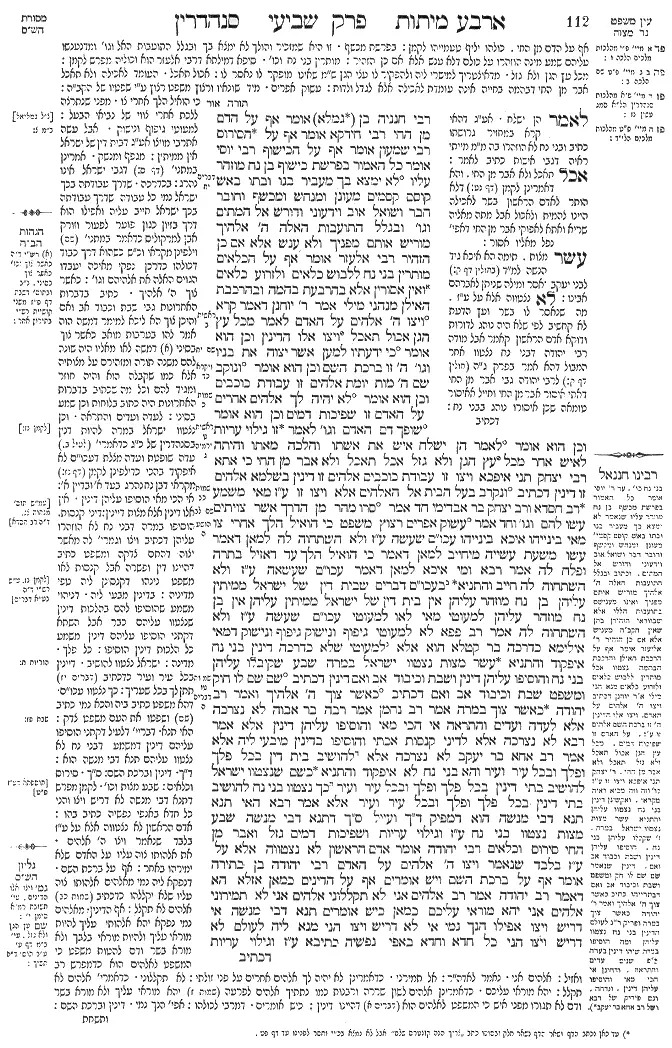
רבי חנניה בן (גמלא) אומר אף על הדם מן החי רבי חידקא אומר אף על הסירוס רבי שמעון אומר אף על הכישוף רבי יוסי אומר כל האמור בפרשת כישוף בן נח מוזהר עליו (דברים יח, י) לא ימצא בך מעביר בנו ובתו באש קוסם קסמים מעונן ומנחש ומכשף וחובר חבר ושואל אוב וידעוני ודורש אל המתים וגו' ובגלל התועבות האלה ה' אלהיך מוריש אותם מפניך ולא ענש אלא אם כן הזהיר רבי אלעזר אומר אף על הכלאים מותרין בני נח ללבוש כלאים ולזרוע כלאים ואין אסורין אלא בהרבעת בהמה ובהרכבת האילן מנהני מילי אמר ר' יוחנן דאמר קרא (בראשית ב, טז) ויצו ה' אלהים על האדם לאמר מכל עץ הגן אכול תאכל ויצו אלו הדינין וכן הוא אומר (בראשית יח, יט) כי ידעתיו למען אשר יצוה את בניו וגו' ה' זו ברכת השם וכן הוא אומר (ויקרא כד, טז) ונוקב שם ה' מות יומת אלהים זו עבודת כוכבים וכן הוא אומר (שמות כ, ב) לא יהיה לך אלהים אחרים על האדם זו שפיכות דמים וכן הוא אומר (בראשית ט, ו) שופך דם האדם וגו' לאמר זו גילוי עריות וכן הוא אומר (ירמיהו ג, א) לאמר הן ישלח איש את אשתו והלכה מאתו והיתה לאיש אחר מכל עץ הגן ולא גזל אכל תאכל ולא אבר מן החי כי אתא רבי יצחק תני איפכא ויצו זו עבודת כוכבים אלהים זו דינין בשלמא אלהים זו דינין דכתיב (שמות כב, ז) ונקרב בעל הבית אל האלהים אלא ויצו זו ע"ז מאי משמע רב חסדא ורב יצחק בר אבדימי חד אמר (שמות לב, ח) סרו מהר מן הדרך אשר צויתים עשו להם וגו' וחד אמר (הושע ה, יא) עשוק אפרים רצוץ משפט כי הואיל הלך אחרי צו מאי בינייהו איכא בינייהו עכו"ם שעשה ע"ז ולא השתחוה לה למאן דאמר עשו משעת עשייה מיחייב למאן דאמר כי הואיל הלך עד דאזיל בתרה ופלח לה אמר רבא ומי איכא למאן דאמר עכו"ם שעשאה ע"ז ולא השתחוה לה חייב והתניא בעכו"ם דברים שבית דין של ישראל ממיתין עליהן בן נח מוזהר עליהן אין בית דין של ישראל ממיתין עליהן אין בן נח מוזהר עליהן למעוטי מאי לאו למעוטי עכו"ם שעשה ע"ז ולא השתחוה לה אמר רב פפא לא למעוטי גיפוף ונישוק גיפוף ונישוק דמאי אילימא כדרכה בר קטלא הוא אלא למעוטי שלא כדרכה דינין בני נח איפקוד והתניא עשר מצות נצטוו ישראל במרה שבע שקיבלו עליהן בני נח והוסיפו עליהן דינין ושבת וכיבוד אב ואם דינין דכתיב (שמות טו, כה) שם שם לו חוק ומשפט שבת וכיבוד אב ואם דכתיב (דברים ה, יא) כאשר צוך ה' אלהיך ואמר רב יהודה כאשר צוך במרה אמר רב נחמן אמר רבה בר אבוה לא נצרכה אלא לעדה ועדים והתראה אי הכי מאי והוסיפו עליהן דינין אלא אמר רבא לא נצרכה אלא לדיני קנסות אכתי והוסיפו בדינין מיבעי ליה אלא אמר רב אחא בר יעקב לא נצרכה אלא להושיב בית דין בכל פלך ופלך ובכל עיר ועיר והא בני נח לא איפקוד והתניא כשם שנצטוו ישראל להושיב בתי דינין בכל פלך ופלך ובכל עיר ועיר כך נצטוו בני נח להושיב בתי דינין בכל פלך ופלך ובכל עיר ועיר אלא אמר רבא האי תנא תנא דבי מנשה הוא דמפיק ד"ך ועייל ס"ך דתנא דבי מנשה שבע מצות נצטוו בני נח ע"ז וגילוי עריות ושפיכות דמים גזל ואבר מן החי סירוס וכלאים רבי יהודה אומר אדם הראשון לא נצטווה אלא על ע"ז בלבד שנאמר ויצו ה' אלהים על האדם רבי יהודה בן בתירה אומר אף על ברכת השם ויש אומרים אף על הדינים כמאן אזלא הא דאמר רב יהודה אמר רב אלהים אני לא תקללוני אלהים אני לא תמירוני אלהים אני יהא מוראי עליכם כמאן כיש אומרים תנא דבי מנשה אי דריש ויצו אפילו הנך נמי אי לא דריש ויצו הני מנא ליה לעולם לא דריש ויצו הני כל חדא וחדא באפי נפשיה כתיבא ע"ז וגילוי עריות
Comments from Rashi on Masechet Sanhedrin Page 56b
אף על הדם מן החי . כולהו יליף טעמייהו לקמן: בפרשת מכשף . זו היא שמזכיר והולך לא ימצא בך ובגלל התועבות האל וגו' ומדנענשו עליהם שמע מינה הוזהרו על כולם דלא ענש אלא אם כן הזהיר: מותרין בני נח וכו' . סיפא דמילתא דרבי אלעזר הוא וכוליה מפרש לקמן: מכל עץ הגן ולא גזל . מדאיצטריך למישרי ליה ולהפקיר לו עצי הגן ש"מ שאינו מופקר לו נאסר לו: אכול תאכל . העומד לאכילה ולא תאכל אבר מן החי דבהמה בחייה אינה עומדת לאכילה אלא לגדל ולדות: עשוק אפרים . מיד שונאיו ורצוץ משפט רצוץ ע"י שפטיו של הקב"ה: כי הואיל הלך אחרי צו . מפני שנתרצה ללכת אחרי צווי של נביאי הבעל: למעוטי גיפוף ונישוק . אבל עשה אתרבי מויצו אע"ג דבית דין של ישראל אין ממיתין: מגפף ומנשק . אמרינן במתני' (דף ס:) דגבי ישראל אינו נהרג: בכדרכה . שדרך עבודתה בכך ישראל נמי כל עבודה שדרך עבודתה בכך ישראל חייב עליה ואפילו הוא דרך בזיון כגון פוער לפעור וזורק אבן למרקוליס כדאמר במתני' (שם) וילפינן מקראי וכ"ש כשהוא דרך כבוד דכולהו כדרכן נפקי מאיכה יעבדו הגוים האלה את אלהיהם וגו': כאשר צוך ה' אלהיך . כתיב בדברות האחרונות גבי שבת וכבוד אב ואם והיכן צוך הא ליכא למימר דמשה הוה אמר להו בערבות מואב כאשר צוך בסיני דמשה לאו מאליו היה שונה להם משנה תורה ומזהירם על מצותיה אלא כמו שקבלה הוא והיה חוזר ומגיד להם וכל מה שכתוב בדברות האחרונות היה כתוב בלוחות וכן שמע בסיני: לעדה ועדים והתראה . וכן נצטוו ישראל במרה להיות דנין בסנהדרין של כ"ג כדאמרי' (לעיל סנהדרין ב.) עדה שופטת ועדה מצלת דעכו"ם לא איפקוד בהכי כדילפינן לקמן (סנהדרין דף נז:) מקראי דבן נח נהרג בעד א' ובדיין א': אי הכי מאי הוסיפו עליהן דינין . אין אלו דינין אלא מצות דיינין: דיני קנסות . הוסיפו במרה דבני נח לא הוזהרו עליהן דכתיב ויצו וגמרי' לה מאשר יצוה דהתם צדקה ומשפט כתיב דהיינו דין ופשרה אבל קנסות לאו משפט נינהו דקנסינן ליה טפי מדיניה: בדינין מבעי ליה . דניהוי משמע שהוסיפו להם בהלכות דינין שנצטוו עליהם כבר אבל השתא דקתני הוסיפו עליהם דינין משמע כל הלכות דינין הוסיפו: כל פלך . מדינה: ישראל נצטוו להושיב . דיינין בכל עיר ועיר כדכתיב (דברים טז) תתן לך בכל שעריך: כך נצטוו עכו"ם . דהא משפט כתיב ביה והכא נמי כתיב (שם) ושפטו את העם משפט צדק: האי תנא . דבריי' דלעיל דקתני הוסיפו עליהם דינין דמשמע דבני נח לא נצטוו עליהם תנא דבי מנשה הוא: ד"ך . דינין וברכת השם: ס"ך . סירוס וכלאים: שבע מצות וכו' . לקמן מפרש דתנא דבי מנשה לא דריש ויצו והני כל חדא באנפי נפשיה כתיב בהו: אדם הראשון לא נצטווה אלא על ע"ז בלבד שנאמר ויצו ה' אלהים . את אלהותו צוה עליו על האדם שלא ימירהו באחר: אף על ברכת השם . דנפקא ליה נמי מאלהים אלהותו צוה עליו שלא יקללהו כדכתיב (שמות כב) אלהים לא תקלל: אף הדינין . מאלהים נמי נפקא יהא אלהותי עליך להיות מוראי עליך ולהיות מוראי בלבך ולא מורא בשר ודם להטות משפט כי המשפט לאלהים הוא כדמפרש רב ואזיל: אלהים אני . נאמר לאדה"ר: אל תמירני . כדאמרינן לא יהיה לך אלהים אחרים על פני זולתי: לא תקללוני . כדאמרי' אלהים לא תקלל: יהא מוראי עליכם . כדאמרינן אלהים לשון שררה ורבנות כמו נתתיך אלהים לפרעה (שמות ז) יהא מוראי עליך ולא מורא בשר ודם לא תגורו מפני איש כי המשפט לאלהים הוא (דברים א) דהיינו דינין: כיש אומרים . דמרבי לכולהו: אפי' הנך נמי . דינין וברכת השם:
Comments from Tosafot - Sanhedrin 56b
לאמר הן ישלח . אע"ג דהאי קרא במחזיר גרושתו כתיב ובני נח לא הוזהרו בה מ"מ מייתי ראיה דגבי אישות כתיב לאמר: אכל תאכל ולא אבר מן החי . והא דאמרינן לקמן (סנהדרין דף נט:) דלא הותר לאדם הראשון בשר לאכילה היינו להמית ולאכול אבל מתה מאליה שריא ואתא לאפוקי אבר מן החי דאפי' נפל מאליו אסור: עשר מצות . תימה הא איכא גיד הנשה למ"ד (בחולין דף ק:) לבני יעקב. אסר ומילה שניתן לאברהם אבינו: לא נצטווה אלא על ע"ז . מה שנאסר לו בשר ועץ הדעת לא קחשיב לפי שלא היה נוהג לדורות ודוקא אדם הראשון קאמר אבל מודה רבי יהודה דבני נח נצטוו אחר המבול דהא אמר בפרק ג"ה (חולין דף ק:) לרבי יהודה גבי אבר מן החי דאתי איסור אבר מן החי וחייל אאיסור טומאה שכן איסורו נוהג בבני נח:
Sanhedrin 56b - Mishnah translated into english
Rabbi Ḥananya ben Gamla says: The descendants of Noah are also commanded concerning the prohibition against consuming the blood from a living animal. Rabbi Ḥideka says: They are also commanded concerning castration, i.e., they are prohibited to castrate any living animal. Rabbi Shimon says: They are also commanded concerning the prohibition against engaging in sorcery.
Rabbi Yosei says: With regard to every type of sorcery that is stated in the passage about sorcery, it is prohibited for a descendant of Noah to engage in it. This is derived from the verses: “When you come into the land that the Lord your God gives you, you shall not learn to do like the abominations of those nations. There shall not be found among you one who makes his son or his daughter pass through the fire, a diviner, a soothsayer, or an enchanter, or a warlock, or a charmer, or one who consults a necromancer and a sorcerer, or directs inquiries to the dead. For whoever does these things is an abomination to the Lord; and because of these abominations, the Lord your God is driving them out from before you” (Deuteronomy 18:9–12). Evidently, the Canaanites were punished for these practices; and since God would not have punished them for an action unless He first prohibited it, these practices are clearly prohibited to gentiles.
Rabbi Elazar says: The descendants of Noah were also commanded concerning the prohibition of diverse kinds. Nevertheless, it is permitted for the descendants of Noah to wear diverse kinds of wool and linen and to sow diverse kinds of seeds together, and they are prohibited only with regard to breeding diverse species of animals and grafting diverse species of trees.
§ The Gemara asks: From where are these matters, the Noahide mitzvot, derived? Rabbi Yoḥanan says: It is from that which the verse states: “And the Lord God commanded the man, saying: Of every tree of the garden you may freely eat; but from the tree of the knowledge of good and evil, you shall not eat from it, for on the day that you eat from it, you shall die” (Genesis 2:16–17).
The verse is interpreted homiletically as follows: With regard to the term “and…commanded,” these are the courts of judgment; and so it states in another verse: “For I have known him, to the end that he may command his children and his household after him, that they may keep the way of the Lord, to do righteousness and justice” (Genesis 18:19).
With regard to the term “the Lord,” this alludes to blessing the name of God; and so it states in another verse: “And he who blasphemes the name of the Lord…shall be put to death” (Leviticus 24:16). “God,” this alludes to idol worship; and so it states: “You shall have no other gods before Me” (Exodus 20:2). “The man,” this alludes to bloodshed; and so it states: “One who sheds the blood of man, by man his blood shall be shed” (Genesis 9:6).
With regard to the term “saying,” this alludes to forbidden sexual relations; and so it states: “Saying, if a man sends his wife, and she goes from him and becomes another man’s…will that land not be greatly polluted? But you have played the harlot with many lovers” (Jeremiah 3:1). “Of every tree of the garden” alludes to the fact that one may partake only of items that are permitted to him, as they belong to him, and he may not partake of stolen items. “You may freely eat” alludes to the fact that one may eat fruit, but not a limb from a living animal.
When Rav Yitzḥak came from Eretz Yisrael to Babylonia, he taught two of the expositions in the opposite order: “And…commanded,” this alludes to idol worship. “God,” this alludes to courts of judgment.
The Gemara asks: Granted, the source for the exposition: “God [Elohim],” this alludes to courts of judgment, is clear; as it is written: “Then the master of the house shall come near the judges [ha’elohim]” (Exodus 22:7). Evidently, judges are called elohim. But with regard to the exposition: “And…commanded,” this alludes to idol worship, from where is this inferred?
Rav Ḥisda and Rav Yitzḥak bar Avdimi both give answers to this question. One of them says that it is inferred from the verse: “They have turned aside quickly out of the way that I commanded them; they have made them a molten calf” (Exodus 32:8). The word “commanded” is mentioned here in the context of idol worship. And the other one says that it is inferred from the verse: “Ephraim is oppressed, crushed in justice, because he willingly went after filth [tzav]” (Hosea 5:11). The word tzav, used in this context in reference to idol worship, is the same Hebrew word used in the phrase: “And…commanded [vaytzav].”
The Gemara asks: What is the difference between these two sources? The Gemara answers: The practical difference between them is in the case of a gentile who fashioned an idol but did not bow to it, i.e., he has not yet worshipped it. According to the one who says that the proof is from the verse: “They have made them a molten calf,” he is rendered liable from the time of fashioning it. According to the one who says that the proof is from the verse: “Because he willingly went after filth,” he is not liable until he goes after it and worships it.
Rava says: And is there anyone who says that a gentile who fashioned an idol but did not bow to it is liable? But isn’t it taught in a baraita: With regard to idol worship, matters, i.e., transgressions, for which a Jewish court executes a Jew who commits one of them, are prohibited to a descendant of Noah. But with regard to transgressions for which a Jewish court does not execute a Jew who commits one of them, a descendant of Noah is not prohibited from doing them. To exclude what transgressions, i.e., to determine that they do not apply to gentiles, is this stated? Is it not to exclude the case of a gentile who fashioned an idol but did not bow to it? Since Jews are not executed for this transgression, gentiles should not be liable for this act either.
Rav Pappa says: No, it is possible that it is stated to exclude embracing and kissing the idol; neither a Jew nor a gentile who embraces or kisses an idol is liable. No proof can be brought from here with regard to a gentile who fashions an idol but does not worship it.
The Gemara asks: Embracing and kissing an idol in what manner? If we say that he did so in its standard manner of worship, i.e., that embracing and kissing is the standard method of worshipping this idol, certainly he is liable to receive the death penalty. Rather, it is stated to exclude a case where he did not do so in its standard manner of worship.
§ The Gemara asks with regard to the list of the Noahide mitzvot: Were the descendants of Noah commanded to establish courts of judgment? But isn’t it taught in a baraita: The Jewish people were commanded to observe ten mitzvot when they were in Marah: Seven that the descendants of Noah accepted upon themselves, and God added to them the following mitzvot: Judgment, and Shabbat, and honoring one’s father and mother.
The mitzva of judgment was given at Marah, as it is written with regard to Marah: “There He made for them a statute and an ordinance” (Exodus 15:25). Shabbat and honoring one’s father and mother were given at Marah, as it is written concerning them in the Ten Commandments: “Observe the day of Shabbat to keep it holy, as the Lord your God commanded you” (Deuteronomy 5:12), and similarly: “Honor your father and your mother, as the Lord your God commanded you” (Deuteronomy 5:16). The phrase “as the Lord your God commanded you” indicates that they had already been commanded to observe these mitzvot previously. And Rav Yehuda says: “As the Lord your God commanded you” in Marah. Apparently, the mitzva of establishing courts is not included in the seven Noahide mitzvot.
Rav Naḥman says that Rabba bar Avuh says: Establishing courts is a Noahide mitzva. The additional mitzva that was given in Marah was necessary only with regard to the details of the halakhot of the justice system, e.g., that a defendant in a capital case is punished only by a full panel of twenty-three judges of the Sanhedrin, and only if there are two witnesses who testify concerning him, and only if he was issued a forewarning before his transgression.
The Gemara asks: If so, and the mitzva given at Marah is a specification of the halakhot of the justice system, what is the meaning of the sentence: And God added to them: Judgment? The details of a preexisting mitzva would not be referred to as an added mitzva.
Rather, Rava says: The mitzva given at Marah was necessary only with regard to the halakhot of fines. Since these are not halakhot that pertain to the basic performance of justice, but rather concern an additional fine for the guilty party, they were not given to the descendants of Noah. The Gemara asks: According to this interpretation, the language of the baraita is still inaccurate, as it should have stated: And God added to them more halakhot of judgment.
Rather, Rav Aḥa bar Ya’akov says: It was necessary only for the additional requirement to establish a court in each and every province and in each and every city. The Gemara asks: And were the descendants of Noah not commanded with regard to this matter? But isn’t it taught in a baraita: Just as the Jewish people were commanded to establish courts in each and every province and in each and every city, so too, the descendants of Noah were commanded to establish courts in each and every province and in each and every city?
Rather, Rava says: This tanna, who holds that the mitzva of establishing courts of judgment is not included in the Noahide mitzvot, is the tanna of the school of Menashe, who removes from the list of the Noahide mitzvot two mitzvot whose mnemonic is dalet, kaf, which stands for judgment [dinim] and blessing the name of God [birkat Hashem], and inserts in their place two mitzvot whose mnemonic is samekh, kaf, standing for castration [seirus] and diverse kinds [kilayim].
As the school of Menashe taught: The descendants of Noah were commanded to observe seven mitzvot: The prohibitions of idol worship, and forbidden sexual relations, and bloodshed, and robbery, and eating a limb from a living animal, and castration, and diverse kinds.
Rabbi Yehuda says: Adam, the first man, was commanded only with regard to the prohibition of idol worship, as it is stated: “And the Lord God commanded the man” (Genesis 2:16). Rabbi Yehuda ben Beteira says: He was also commanded concerning blessing the name of God. And some say that he was also commanded concerning establishing courts of judgment.
The Gemara asks: In accordance with whose opinion is that which Rav Yehuda says that Rav says, in interpretation of the aforementioned verse: Since I am “God,” do not curse Me; since I am “God,” do not exchange Me with another god; since I am “God,” My fear shall be upon you? The Gemara answers: In accordance with whose opinion? It is in accordance with what some say, i.e., that the phrase “and the Lord God commanded the man” includes the prohibitions against cursing God’s name and idol worship, as well as the mitzva of establishing a system of law and justice, so that the fear of God will be upon the people.
The Gemara challenges: If the tanna of the school of Menashe interprets the verse “and the Lord God commanded” homiletically, even these mitzvot, cursing the name of God and establishing courts, should be included. And if he does not interpret the verse “and the Lord God commanded” homiletically, from where does he derive these seven mitzvot in his list?
The Gemara answers: Actually, he does not interpret the verse “and the Lord God commanded” homiletically, but with regard to these mitzvot in his list, each and every one of them is written separately in the Torah. The prohibitions of idol worship and forbidden sexual relations are stated,
Traduction : The William Davidson digital edition of the Koren Noé Talmud, with commentary by Rabbi Adin Even-Israel Steinsaltz.