 Talmud Bavli
The learning on the whole site is dedicated : L'ilui Nishmat יוסף בן מושה
The learning on the whole site is dedicated : L'ilui Nishmat אליעזר בן רחל
The learning on the whole site is dedicated : L'ilui Nishmat אסתר בת חיים
Sanhedrin 52b : Youtube
Daf TubeYoutube
2 video classes :
Sanhedrin Page 52b
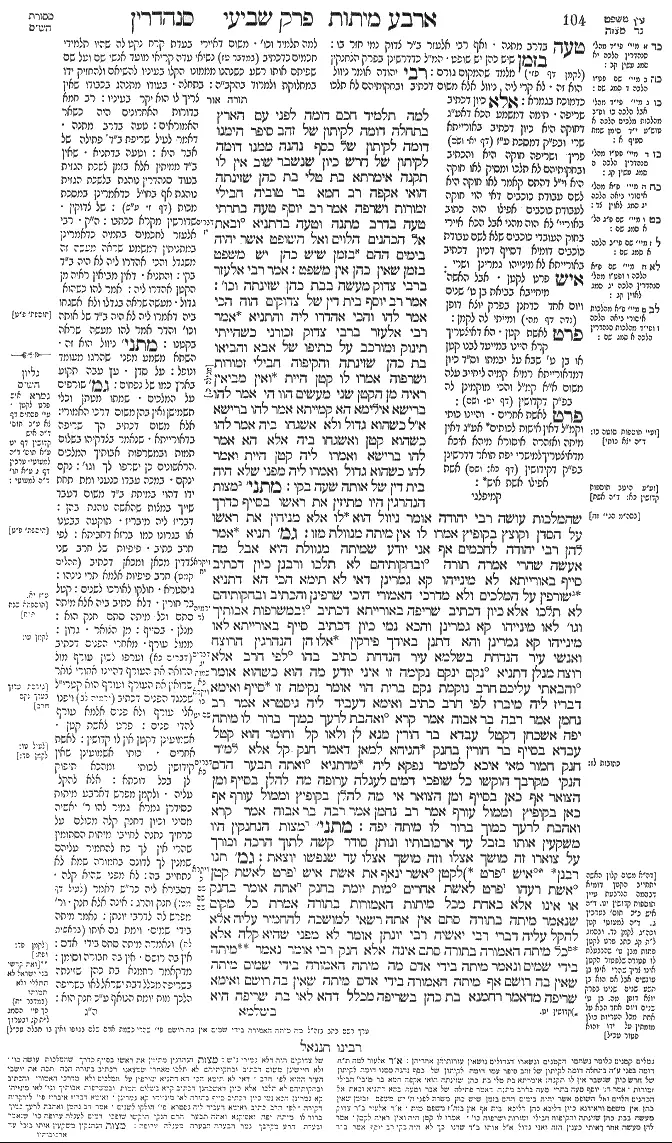
Sanhedrin 52b - Guemara
למה תלמיד חכם דומה לפני עם הארץ בתחלה דומה לקיתון של זהב סיפר הימנו דומה לקיתון של כסף נהנה ממנו דומה לקיתון של חרש כיון שנשבר שוב אין לו תקנה אימרתא בת טלי בת כהן שזינתה הואי אקפה רב חמא בר טוביה חבילי זמורות ושרפה אמר רב יוסף טעה בתרתי טעה בדרב מתנה וטעה בדתניא (דברים יז, ט) ובאת אל הכהנים הלוים ואל השופט אשר יהיה בימים ההם בזמן שיש כהן יש משפט בזמן שאין כהן אין משפט:
אמר רבי אלעזר ברבי צדוק מעשה בבת כהן שזינתה וכו':
אמר רב יוסף בית דין של צדוקים הוה הכי אמר להו והכי אהדרו ליה והתניא אמר רבי אלעזר ברבי צדוק זכורני כשהייתי תינוק ומורכב על כתיפו של אבא והביאו בת כהן שזינתה והקיפוה חבילי זמורות ושרפוה אמרו לו קטן היית ואין מביאין ראיה מן הקטן שני מעשים הוו הי אמר להו ברישא אילימא הא קמייתא אמר להו ברישא א"ל כשהוא גדול ולא אשגחו ביה אמר להו כשהוא קטן ואשגחו ביה אלא הא אמר להו ברישא ואמרו ליה קטן היית ואמר להו כשהוא גדול ואמרו ליה מפני שלא היה בית דין של אותה שעה בקי:
מתני׳ מצות הנהרגין היו מתיזין את ראשו בסייף כדרך שהמלכות עושה רבי יהודה אומר ניוול הוא לו אלא מניחין את ראשו על הסדן וקוצץ בקופיץ אמרו לו אין מיתה מנוולת מזו:
גמ׳ תניא אמר להן רבי יהודה לחכמים אף אני יודע שמיתה מנוולת היא אבל מה אעשה שהרי אמרה תורה (ויקרא יח, ג) ובחקותיהם לא תלכו ורבנן כיון דכתיב סייף באורייתא לא מינייהו קא גמרינן דאי לא תימא הכי הא דתניא שורפין על המלכים ולא מדרכי האמורי היכי שרפינן והכתיב ובחקותיהם לא תלכו אלא כיון דכתיב שריפה באורייתא דכתיב (ירמיהו לד, ה) ובמשרפות אבותיך וגו' לאו מינייהו קא גמרינן והכא נמי כיון דכתיב סייף באורייתא לאו מינייהו קא גמרינן והא דתנן באידך פירקין אלו הן הנהרגין הרוצח ואנשי עיר הנדחת בשלמא עיר הנדחת כתיב בהו (דברים יג, טז) לפי חרב אלא רוצח מנלן דתניא (שמות כא, כ) נקם ינקם נקימה זו איני יודע מה הוא כשהוא אומר (ויקרא כו, כה) והבאתי עליכם חרב נוקמת נקם ברית הוי אומר נקימה זו סייף ואימא דבריז ליה מיברז לפי חרב כתיב ואימא דעביד ליה גיסטרא אמר רב נחמן אמר רבה בר אבוה אמר קרא (ויקרא יט, יח) ואהבת לרעך כמוך ברור לו מיתה יפה אשכחן דקטל עבדא בר חורין מנא לן ולאו קל וחומר הוא קטל עבדא בסייף בר חורין בחנק הניחא למאן דאמר חנק קל אלא למ"ד חנק חמור מאי איכא למימר נפקא ליה מדתניא (דברים כא, ט) ואתה תבער הדם הנקי מקרבך הוקשו כל שופכי דמים לעגלה ערופה מה להלן בסייף ומן הצואר אף כאן בסייף ומן הצואר אי מה להלן בקופיץ וממול עורף אף כאן בקופיץ וממול עורף אמר רב נחמן אמר רבה בר אבוה אמר קרא ואהבת לרעך כמוך ברור לו מיתה יפה:
מתני׳ מצות הנחנקין היו משקעין אותו בזבל עד ארכובותיו ונותן סודר קשה לתוך הרכה וכורך על צוארו זה מושך אצלו וזה מושך אצלו עד שנפשו יוצאת:
גמ׳ תנו רבנן (ויקרא כ, י) איש פרט לקטן (ויקרא כ, י) אשר ינאף את אשת איש פרט לאשת קטן (ויקרא כ, י) אשת רעהו פרט לאשת אחרים (ויקרא כ, ב) מות יומת בחנק אתה אומר בחנק או אינו אלא באחת מכל מיתות האמורות בתורה אמרת כל מקום שנאמר מיתה בתורה סתם אין אתה רשאי למושכה להחמיר עליה אלא להקל עליה דברי רבי יאשיה רבי יונתן אומר לא מפני שהיא קלה אלא כל מיתה האמורה בתורה סתם אינה אלא חנק רבי אומר נאמר מיתה בידי שמים ונאמר מיתה בידי אדם מה מיתה האמורה בידי שמים מיתה שאין בה רושם אף מיתה האמורה בידי אדם מיתה שאין בה רושם ואימא שריפה מדאמר רחמנא בת כהן בשריפה מכלל דהא לאו בת שריפה היא
Comments from Rashi on Masechet Sanhedrin Page 52b
למה תלמיד וכו' . משום דאיירי בעדת קרח נקט לה שהיו תלמידי חכמים כדכתיב (במדבר טז) נשיאי עדה קריאי מועד אנשי שם ועל שם שפיתם אותו רשע כשנהנו מממונו הקלו בעיניו להשיאם ולהחזיק ידו במחלוקת ולמרוד בהקב"ה: בתחלה . בעודו מתנהג בכבודו שאין צריך לו הוא יקר בעיניו: רב חמא בדורות האחרונים היה כשאר האמוראים: טעה בדרב מתנה . דאמר לעיל שריפת ב"ד פתילה של אבר היא: וטעה בדתניא . שאין ב"ד ממיתין אלא בזמן לשכת הגזית בעוד סנהדרין נוהגת בלשכת הגזית נוהגת אף בחו"ל כדאמרינן במסכת מכות (דף ז. ע"ש): של צדוקין . שדורשין מקרא ככתבו: ה"ק . רבי אלעזר לחכמים בתמיה כדאמרינן במתניתין דמשמע שראה מעשה זה משגדל והכי אהדרו ליה לא היה ב"ד בקי: והתניא . דאין מביאין ראיה מן הקטן אהדרו ליה: אמר להו כשהוא גדול . מעשה שראה בגדלו ולא אשגחו ביה דאמרו ליה לא היה ב"ד של אותה וכו' והדר אמר להו מעשה שראה בקטנו: מתני' ניוול הוא זה . השתא משמע מפני שהרגו מעומד ונופל: על סדן . עץ עבה תקוע בארץ כמו של נפחים: גמ' שורפים על המלכים . שמתו מטתן וכלי תשמישן ואין בהן משום דרכי האמורי: אלא משום דכתיב הך שריפה בדאורייתא . שנאמר בצדקיהו בשלום תמות ובמשרפות אבותיך המלכים הראשונים כן ישרפו לך וגו': נקם ינקם . במכה עבדו כנעני ומת תחת ידו דהוי במיתת ב"ד משום דעבד שייך במצות שהאשה נוהגת בהן: דבריז ליה מיבריז . תוקעה בבטנו או בגרונו כמו ברזא דחביתא: לפי חרב כתיב . פיפיות של חרב שני צדדין מכאן ומכאן דכתיב (תהלים קמט) חרב פיפיות אלמא תרי נינהו: גיסטרא . חולקו לאורכו לשנים: קטל בר חורין . דלא כתיב ביה אלא מיתה סתם וכל מיתה סתם חנק הוא: מנלן . בסייף: מן הצואר . גרון: ממול עורף . מאחרי הפנים דכתיב (דברים כא) וערפו לשון עורף מול הרואה את העורף דהיינו אחורי צואר שרואין את העורף ועורף הוא קטרי"ל שכנגד הפנים דכתיב (ירמיהו לב) ויפנו אלי עורף ולא פנים אלמא עורף להדי פנים: פרט לאשת קטן . אשמועינן דקטן אין לו קדושין: לאשת אחרים . כותי אשמועינן שאין קידושין לכותי ומהכא תיפוק לן בכל דוכתא: אלא להקל עליה . ולקמן מפרש דארבע מיתות כסידרן גמרא גמיר להו ר' יאשיה מסיני וכיון דחנק קלה מכולם על כרחיך נתנה לחייבי מיתות הסתומין שהרי אין לך כח להחמיר עליהם שמנין לך לדונם בחמורה שמא לא נתחייב בה: לא מפני שהיא קלה . דסבירא ליה כר"ש דאמר (לעיל סנהדרין דף מט:) חנק והרג: נאמר מיתה בידי שמים . וימת גם אותו (בראשית לח) ונאמרה מיתה סתם בידי אדם: אין בה רושם . אין בה חבורה וסימן: מדקאמר רחמנא בת כהן שזינתה בשריפה מכלל דבת ישראל לאו בשריפה הלכך מות יומת הנואף ע"כ חנק הוא:
Comments from Tosafot - Sanhedrin 52b
טעה בדרב מתנה . ואף רבי אלעזר ב"ר צדוק נמי חזר בו: בזמן שיש כהן יש שופט . המ"ל כדדרשינן בפרק הנחנקין (לקמן סנהדרין דף פז.) מלמד שהמקום גורם: רבי יהודה אומר ניוול הוא זה . לא קרי ליה ניוול אלא משום דכתיב ובחקותיהם לא תלכו כדמוכח בגמרא: אלא כיון דכתיב שריפה . תימה דמשמע הכא דאע"ג דחוקה היא כיון דכתיב באורייתא שרי ובפ"ק דמסכת ע"ז (דף יא. ושם) פריך ושריפה חוקה היא והכתיב ובחקותיהם לא תלכו ומסיק לאו חוקה היא וי"ל דהתם קאמר לאו חוקה היא לשם עבודת כוכבים דאי הוי חוקה לעבודת כוכבים אפילו הוה כתוב באוריי' לא הוה מהני אבל הכא איירי בחוק העובדי כוכבים שלא לשם עבודת כוכבים דומיא דסייף דכיון דכתיב באורייתא לא מינייהו גמרינן ושרי: איש פרט לקטן . אבל האשה מיחייבא בביאת בן ט' שנים ויום אחד כדתנן בפרק יוצא דופן (נדה דף מה.) ומייתי לה לקמן: פרט לאשת קטן . הא דאיצטריך קרא היינו במייעד לבנו קטן או בן ט' שבא על יבמתו וס"ד כיון דמדאורייתא רמיא קמיה ליחייב עלה משום א"א קמ"ל והכי מוקמינן לה בפ"ק דקדושין (דף יט. ושם): פרט לאשת אחרים . והיינו כותי וקמ"ל דאין אישות לכותים אע"ג דאין מיתה ואזהרה איסורא מיהא איכא מדאיצטריך למישרי יפת תואר דדרשינן בפ"ק דקידושין (דף כא: ושם) אשת אפילו אשת איש:
Sanhedrin 52b - Mishnah translated into english
To what is a Torah scholar compared when he is standing before an ignoramus? At first, when he does not know him, the ignoramus considers him to be like a goblet [lekiton] of gold. Once he has conversed with him concerning mundane matters, he considers him to be like a goblet of silver, i.e., the stature of the Torah scholar is downgraded in the eyes of the ignoramus. Once the scholar has received benefit from the ignoramus, he considers him to be like an earthenware goblet, which once broken cannot be fixed.
The Gemara relates: Imrata bat Talei was a priest’s daughter who committed adultery. Rav Ḥama bar Toviyya surrounded her with bundles of branches and burned her.
Rav Yosef says: Rav Ḥama bar Toviyya erred with regard to two halakhot. He erred with regard to the ruling of Rav Mattana, i.e., that burning is performed using a wick of lead, and he erred with regard to that which is taught in a baraita: It is derived from the verse: “And you shall come to the priests, the Levites, and to the judge that will be in those days” (Deuteronomy 17:9), that at a time when there is a priest serving in the Temple, i.e., when the Temple is built, there is judgment of capital cases. By inference, at a time when there is no priest, there is no judgment of capital cases.
§ The mishna teaches that Rabbi Elazar, son of Rabbi Tzadok, said: An incident occurred with regard to a priest’s daughter who committed adultery, and she was executed by actual burning, and the Sages said to him that the court at that time was not proficient in halakha. Rav Yosef says: It was a court of the Sadducees, who interpreted the verse according to its straightforward meaning.
The Gemara asks: Did Rabbi Elazar ben Tzadok say that to the Sages, and did the Sages answer him in that manner? But isn’t a different version of the exchange taught in a baraita: Rabbi Elazar, son of Rabbi Tzadok, says: I remember when I was a child, and was riding on my father’s shoulders. And they brought a priest’s daughter who had committed adultery, and surrounded her with bundles of branches and burned her. The Sages said to him: You were a minor at that time and one cannot bring proof from the testimony of a minor, as perhaps you did not understand the proceedings properly. The two versions of this exchange do not accord with each other. The Gemara answers: There were two separate incidents, and Rabbi Elazar ben Tzadok testified with regard to both.
The Gemara asks: Which incident did he tell the Sages about first? If we say that first he told them about this first incident, i.e., the one that is recounted in the mishna, this is unreasonable; if he first told them about the incident that occurred when he was an adult, and they paid no attention to him, but rejected his statement by responding that the court was not proficient in halakha, would he tell them afterward about the incident that occurred when he was a small child and think that they would pay attention to him?
Rather, it is clear that he first told them about that incident, i.e., the one recounted in the baraita, and they said to him: You were a minor, and one cannot bring proof from the testimony of a minor. And then he told them about the incident that occurred when he was an adult, and they said to him: The court did so because the court at that time was not proficient in halakha.
MISHNA: The mitzva of those who are killed, i.e., the process of execution by decapitation, is carried out in the following manner: The executioners cut off his head with a sword, the way that the monarchy does when a king sentences a person to death. Rabbi Yehuda says: This manner of execution is improper, as it degrades him. Rather, they place the head of the condemned on the block, and chop it off with a cleaver [bekofitz]. The Rabbis said to him: If you are concerned about his degradation, there is no death penalty more degrading than that. It is better for him to be executed in the manner described first.
GEMARA: It is taught in a baraita (Tosefta 9:3): Rabbi Yehuda said to the Rabbis: I too, know that it is a degrading death, but what shall I do, as the Torah states: “And you shall not follow their statutes” (Leviticus 18:3), i.e., it is prohibited to adopt the practices of the gentiles.
The Gemara asks: And how do the Rabbis respond to this claim? The Gemara answers: Since decapitation by the sword is written in the Torah, it is not from the gentiles that we learn it. This is Torah law, and the custom of the gentiles is not taken into consideration. It is of no import that they have a corresponding type of execution.
As, if you do not say so, that a Jewish custom is not forbidden even if the gentiles have the same custom, then that which is taught in a baraita poses a difficulty. The baraita teaches: One burns vessels and clothes over the deaths of kings as an expression of grief, and this is not forbidden for being of the ways of the Amorites. How can we perform this burning? But isn’t it written: “And you shall not follow their statutes”? Rather, since burning items over the death of a king is written in the Torah, as it is written: “And with the burnings of your fathers, the first kings who came before you, so shall they make a burning for you” (Jeremiah 34:5), it is not from the gentiles that we learn it. And here too, since decapitation by the sword is written in the Torah, it is not from them that we learn it.
§ The Gemara asks: And with regard to that which we learned in a mishna in another chapter of this tractate (76b): These transgressors are those who are killed by decapitation: The murderer and the people of an idolatrous city, there is a difficulty. Granted, the people of an idolatrous city are executed in this manner, as it is written concerning them: “You shall smite the inhabitants of that city with the edge of the sword” (Deuteronomy 13:16). But with regard to a murderer, from where do we derive that he is executed by decapitation?
The Gemara answers that it is derived as it is taught in a baraita: It is stated in the verse: “And if a man smites his slave or his maidservant by the staff and he dies under his hand, he shall be avenged” (Exodus 21:20). Prima facie, I do not know what this vengeance is referring to. When it says: “And I will bring upon you the sword avenging the vengeance of the covenant” (Leviticus 26:25), you must say that vengeance is decapitation by the sword.
The Gemara asks: But why not say that the executioner should stab him with a sword, rather than decapitate him? The Gemara answers: It is written with regard to the people of an idolatrous city: “With the edge of the sword,” indicating that the execution should be administered with the edge of the sword and not its point.
The Gemara asks: But say that the executioner should cut him in half [gistera], down the middle of his body. The Gemara answers that Rav Naḥman says that Rabba bar Avuh says: The verse states: “And you shall love your neighbor as yourself” (Leviticus 19:18), which teaches that even with regard to a condemned prisoner, one should select a good, i.e., a compassionate, death for him. Cutting his body in half is not a compassionate manner of execution.
The Gemara asks: We have found proof that one who killed a Canaanite slave is executed by decapitation. But from where do we derive that one who kills a freeman is executed in the same manner?
The Gemara answers: But is it not inferred a fortiori? If one who killed a Canaanite slave is executed by the sword, should one who killed a freeman be executed merely by strangulation?
This Gemara rejects this answer: This works out well according to the one who says that strangulation is a more lenient type of capital punishment than decapitation. But according to the one who says that strangulation is more severe than decapitation, what can be said? It is possible that one who murdered a freeman is in fact executed by strangulation.
The Gemara answers: The mishna derives it from that which is taught in a baraita: It is derived from the verse: “And so shall you put away the innocent blood from your midst” (Deuteronomy 21:9), that all spillers of blood are compared to the heifer whose neck is broken as atonement for an unresolved murder. Just as there, the heifer is killed by the sword and at the neck, so too here, murderers are executed by the sword and at the neck.
The Gemara challenges: If so, perhaps it should be derived that just as there, the heifer is decapitated with a cleaver and at the nape of the neck, so too here, murderers should be decapitated with a cleaver and at the nape of the neck. The Gemara answers that Rav Naḥman says that Rabba bar Avuh says: The verse states: “And you shall love your neighbor as yourself” (Leviticus 19:18), which teaches that even with regard to a condemned prisoner, one should select a good, i.e., a compassionate, death for him. Although the type of capital punishment is derived from the heifer whose neck is broken, the most compassionate method of decapitation is selected.
MISHNA: The mitzva of those who are strangled is carried out in the following manner: The agents of the court submerge the condemned one in dung up to his knees so he cannot move, and one of them places a rough scarf within a soft one, and wraps it around his neck. This one, i.e., one of the witnesses, pulls the scarf toward him, and that one, the other witness, pulls it toward him, until the soul of the condemned one departs.
GEMARA: The Sages taught: The verse states: “And a man who commits adultery with another man’s wife, even he who commits adultery with his neighbor’s wife, both the adulterer and the adulteress shall be put to death” (Leviticus 20:10). The term: “A man,” is interpreted as excluding a minor boy who committed adultery before he came of age. The phrase: “Who commits adultery with another man’s wife,” is interpreted as excluding the wife of a minor boy; marriage to a minor is not considered halakhic marriage. “His neighbor’s wife” excludes the wife of another, i.e., a gentile, who is not referred to as “his neighbor.”
“Shall be put to death” means death by strangulation. Do you say that his execution is by strangulation, or is it rather by one of all the other types of death penalty stated in the Torah? You must say that it is by strangulation, as everywhere that the death penalty is stated in the Torah without specification you may not take it to be more stringent with regard to it, i.e., to mean that the sinner should be sentenced to a severe type of execution; rather, you must take it to be more lenient with regard to it, i.e., that a lenient type of execution should be applied. Consequently, the sinner is sentenced to be executed by strangulation, which is the least severe type of capital punishment. This is the statement of Rabbi Yoshiya.
The baraita continues: Rabbi Yonatan says: It is not because strangulation is the most lenient type of capital punishment; rather, there is a principle that every death penalty stated in the Torah without specification is nothing other than strangulation, whereas the other types of capital punishment must be stated explicitly in the verse.
Rabbi Yehuda HaNasi says, in accordance with the opinion of Rabbi Yonatan: Death at the hand of Heaven is stated in the Torah, and death at the hands of a person, i.e., court-imposed capital punishment, is stated in the Torah. Just as the death at the hand of Heaven that is stated in the Torah is a death that leaves no external mark, so too, the death at the hands of a person that is stated in the Torah is a death that leaves no external mark, i.e., strangulation.
The Gemara asks: But why not say that perhaps it is referring to execution by burning, which also leaves no external mark? The Gemara answers: From the fact that the Merciful One states explicitly that a priest’s daughter who committed adultery is executed by burning one can learn by inference that this other woman who committed adultery is not liable to be executed by burning, but rather by a different type of execution that does not leave a mark, i.e., strangulation.
Traduction : The William Davidson digital edition of the Koren Noé Talmud, with commentary by Rabbi Adin Even-Israel Steinsaltz.