 Talmud Bavli
Shabbat 146b : Youtube
Daf TubeYoutube
2 video classes :
Shabbat Page 146b
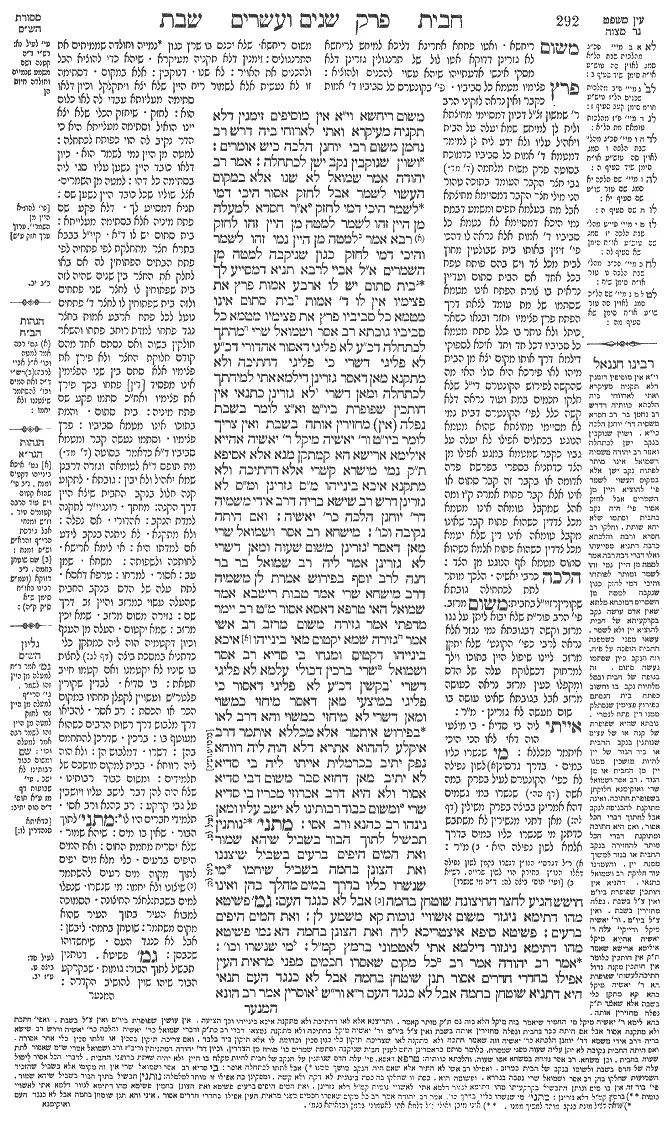
Shabbat 146b - Guemara
משום ריחשא וי"א אין מוסיפים זימנין דלא תקניה מעיקרא ואתי לארוחי ביה דרש רב נחמן משום רבי יוחנן הלכה כיש אומרים:
ושוין שנוקבין נקב ישן לכתחלה:
אמר רב יהודה אמר שמואל לא שנו אלא במקום העשוי לשמר אבל לחזק אסור היכי דמי לשמר היכי דמי לחזק א"ר חסדא למעלה מן היין זהו לשמר למטה מן היין זהו לחזק רבא אמר למטה מן היין נמי זהו לשמר והיכי דמי לחזק כגון שניקבה למטה מן השמרים א"ל אביי לרבא תניא דמסייע לך בית סתום יש לו ארבע אמות פרץ את פצימיו אין לו ד' אמות בית סתום אינו מטמא כל סביביו פרץ את פצימיו מטמא כל סביביו גובתא רב אסר ושמואל שרי מחתך לכתחלה דכ"ע לא פליגי דאסור אהדורי דכ"ע לא פליגי דשרי כי פליגי דחתיכה ולא מתקנא מאן דאסר גזרינן דילמא אתי למיחתך לכתחלה ומאן דשרי לא גזרינן כתנאי אין חותכין שפופרת ביו"ט וא"צ לומר בשבת נפלה (אין) מחזירין אותה בשבת ואין צריך לומר ביו"ט ור' יאשיה מיקל ר' יאשיה אהייא אילימא ארישא הא קמתקן מנא אלא אסיפא ת"ק נמי מישרא קשרי אלא דחתיכה ולא מתקנא איכא בינייהו מ"ס גזרינן ומ"ס לא גזרינן דרש רב שישא בריה דרב אידי משמיה דר' יוחנן הלכה כר' יאשיה:
ואם היתה נקובה וכו':
מישחא רב אסר ושמואל שרי מאן דאסר גזרינן משום שעוה ומאן דשרי לא גזרינן אמר ליה רב שמואל בר בר חנה לרב יוסף בפירוש אמרת לן משמיה דרב מישחא שרי אמר טבות רישבא אמר שמואל האי טרפא דאסא אסור מ"ט רב יימר מדפתי אמר גזירה משום מרזב רב אשי אמר גזירה שמא יקטום מאי בינייהו איכא בינייהו דקטים ומנחי בי סדיא רב אסר ושמואל שרי ברכין דכולי עלמא לא פליגי דשרי בקשין דכ"ע לא פליגי דאסור כי פליגי במיצעי מאן דאסר מיחזי כמשוי ומאן דשרי לא מיחזי כמשוי והא דרב לאו בפירוש איתמר אלא מכללא איתמר דרב איקלע לההוא אתרא דלא הוה ליה רווחא נפק יתיב בכרמלית אייתו ליה בי סדיא לא יתיב מאן דחזא סבר משום דבי סדיא אסור ולא היא דרב אכרוזי מכריז בי סדיא שרי ומשום כבוד רבותינו לא ישב עליו ומאן נינהו רב כהנא ורב אסי:
מתני׳ נותנין תבשיל לתוך הבור בשביל שיהא שמור ואת המים היפים ברעים בשביל שיצננו ואת הצונן בחמה בשביל שיחמו מי שנשרו כליו בדרך במים מהלך בהן ואינו חושש הגיע לחצר החיצונה שוטחן בחמה אבל לא כנגד העם:
גמ׳ פשיטא מהו דתימא ניגזר משום אשוויי גומות קא משמע לן:
ואת המים היפים ברעים:
פשיטא סיפא איצטריכא ליה ואת הצונן בחמה הא נמי פשיטא מהו דתימא ניגזור דילמא אתי לאטמוני ברמץ קמ"ל:
מי שנשרו וכו':
אמר רב יהודה אמר רב כל מקום שאסרו חכמים מפני מראית העין אפילו בחדרי חדרים אסור תנן שוטחן בחמה אבל לא כנגד העם תנאי היא דתניא שוטחן בחמה אבל לא כנגד העם ר"א ור"ש אוסרין אמר רב הונא
Comments from Rashi on Masechet Shabbat Page 146b
משום ריחשא . שלא יכנס בו שרץ כגון נמייה וחולדה שממיתים את התרנגולים: זימנין דלא תקניה מעיקרא . שיהא כדי להוציא הבל ולהכניס את האויר: לא שנו . דנוקבין: אלא במקום . דסתימה זו לא נעשית אלא לשמור ריח היין שלא יצא ויתקלקל וכיון דלאו סתימה מעליותא עבדי לה לאו כלום הוא: לחזק . שיחזק הכלי שלא יצא יינו הואיל וסתימה מעלייתא היא כי הדר נקיב לה הוי כפותח לכתחלה: למטה מן היין נמי לשמר הוא . כיון דלאו כובד היין נשען עליו סגי ליה בסתימה כל דהו: למטה מן השמרים . אצל שוליו שכל כובד היין נשען שם: תניא דמסייע לך . דלא פקע שם פתח מיניה אלא בסתימה מעלייתא: בית סתום יש לו ד"א . קיי"ל בבבא בתרא חצר מתחלקת לפי פתחיה לפי פתח הבתים הפתוחין לה אם באו לחלק את החצר בין שנים שהיה לזה בית שפתוחין לו לחצר שני פתחים ולזה בית שפתוחין לו לחצר ד' פתחים נוטל לכל פתח ארבע אמות בחצר נגד פתחו למדת רוחב פתחו והשאר חולקין בשוה ואם נסתם אחד מהם קודם חלוקת החצר ולא פירץ את פצימיו אלא סתם בין שני הפצימין אינו מפסיד [דין] פתחו בכך פירץ את פצימיו ואח"כ סתמו פקע שם פתח מיניה: בית סתום . והמת בתוכו אינו מטמא סביביו: פרץ פצימיו . וסתמו נעשה קבר ומטמא סביביו ד"א כדאמר בסוטה (ד' מד.) מת תופס ד"א לטומאה וגזרה דרבנן שמא יאהיל ולא יבין: גובתא . לתקוע קנה חלול בנקב החבית שיצא היין דרך הקנה: מחתך . רונגיי"ר לתקנה למדת הנקב: אהדורי . אם נפלה: ולא מתקנא . לא ניתנה בנקב לידע אם למדתו היא: אי לימא ארישא . לחותכה ולשפותה: משחא . שמן עב: אסור . למרחו: טרפא דאסא . לתת עלה של הדס בנקב החבית שהעלה עשוי כמרזב והיין זב דרך שם: גזירה משום מרזב . שמא יכין מרזב: שמא יקטום . העלה מן הענף וכיון דקטמיה הוה ליה כמתקן כלי כדתניא במסכת ביצה (דף לג:) לחצות בו שיניו לא יקטמנו ואם קטמו חייב חטאת: בי סדיא . לבדין שקורין פלטר"ש ועשויין לקפלן תחתיו במקום הכר או הכסת: רב אסר . להביאו דרך מלבוש דרך רשות הרבים כשהוא מעוטף בו: ברכין . שדרכן להתחמם בהן: דשרו . דמלבוש הן: ולא הוה ליה רווחא . בבית למקום מושבם של תלמידים: ומשום כבוד רבותינו . שלא היה להן דבר לישב עליו ויושבין על גבי קרקע: רב כהנא ורב אסי . תלמידי חברים היו לו: מתני' לתוך הבור . שאין בו מים: שיהא שמור . שלא יסריח מחמת החום: ואת המים היפים ברעים . כלי מלא מים יפים לתוך מקוה מים רעים להשתמר שיצונו ולא יחמו: מי שנשרו . שנפלו למים בשבת: לחצר החיצונה . הסמוכה למבוא העיר בתוך העיר שהוא מקום משתמר: שוטחן בחמה . ליבשן: אבל לא כנגד העם . שיחשדוהו שכבסן: גמ' פשיטא . דנותנין תבשיל לתוך הבור: גומות . שבקרקע הבור שיהו שוין להושיב הקדרה:
Comments from Tosafot - Shabbat 146b
משום ריחשא . ואטו פתחא אחרינא דליכא למיחש לריחשא לא גזרינן דדוקא אטו לול של תרנגולין גזרינן דלא מסקי אינשי אדעתייהו שיהא עשוי להכניס ולהוציא: פרץ פצימיו מטמא כל סביביו . פי' בקונטרס כל סביביו ד' אמות כקבר ואין נראה לזקיני הרב ר' שמשון זצ"ל דכיון דמסיימי מחיצתא ולית לן למיחש שמא יעלה על הבית ויאהיל עליו ולא ידע לית לן למימר דמטמא ד' אמות כל סביביו כדמוכח בסוטה פרק משוח מלחמה (ד' מד.) גבי חצר הקבר העומד בתוכה טהור הני מילי חצר הקבר דמסיימא מחיצתא אבל מת בעלמא תפיס ומשמע דבמת נמי היכא דמסיימא לא נטמא כל סביביו ד' אמות אלא נראה לו דהכי פי' זיזין באותו בית שבולטין מחוץ לבית מכל צד ויש בהם פותח טפח בכל אחד אם הבית סתום ועדיין נראית בו צורת הפתח אינו מטמא שסתמו של מת עומד לצאת דרך הפתח פרץ פצימיו וחזר ובנאו כשאר כותל ולא נותר בו כלל פתח מטמא כל סביביו דכל חד וחד איכא לספוקי דילמא דרך אותו מקום יצא מן הבית מיהו לאו פירכא היא כולי האי מה שהקשה לפירוש הקונטרס די"ל שלא חלקו חכמים במת ועוד נראה דלא קשה כלל לפי' הקונטרס דבית נמי לא מסיימי מחיצתא שהוא מטמא הנוגע בכתלים אפילו לא יעלה על גביו כקבר שמטמא במגע אפילו מן הצד כדתניא בספרי בפרשת פרה אדומה או בקבר זה קבר סתום או אינו אלא קבר פתוח אמרת ק"ו ומה אהל שמקבל טומאה אינו מטמא מכל צדדין כשהוא פתוח קבר שאינו מקבל טומאה אינו דין שלא יטמא מכל צדדין כשהוא פתוח אלמא כשהוא סתום מטמא אף הנוגע מן הצד: הלכה כרבי יאשיה . הלכך מותר לתת לכתחילה גובתא שקורין רזיי"ל בחבית: משום מרזב . פי' הרב פור"ת שלא יבוא ליתן על גגו מרזב וקשה דבגובתא נמי נגזר אלא נראה לרבי כפי' הקונט' שלא יתקן מרזב ליינו שיפול היין בתוכו וילך למרחוק דכשלוקח עלה של הדס ומקפלו כעין מרזב נראה כעושה מרזב אבל בגובתא שאינו עושה בו שום מעשה לא גזרינן. מ"ר: אייתי ליה בי סדיא . בי מיצעי הוה דאי לאו הכי היכי איתמר מכללא: מי שנשרו כליו במים . בדרך גרסינן לשון נפילה לא כפי' הקונטרס לעיל בפרק במה אשה (שבת דף סה.) שנשרו במי גשמים דהא אמרינן בביצה בפרק משילין (דף לה:) מאן דתני מנשירין לא משתבש כדתנן מי שנשרו כליו במים בדרך אלמא לשון נפילה הוא. מ"ר:
Shabbat 146b - Mishnah translated into english
because one does not want vermin to enter the coop. And when we learned that some say that one may not add to a preexisting hole, that ruling is also due to a decree lest one come to do so in a chicken coop, as sometimes one does not properly create the opening initially, and comes to expand it so that it will be fit for use. In that case, widening the opening is considered its completion. Rav Naḥman taught in the name of Rabbi Yoḥanan: The halakha is in accordance with the statement cited as: Some say.
We learned in the baraita: And everyone agrees that one may perforate an old hole that was sealed ab initio. Rav Yehuda said that Shmuel said: They only taught this in a place where the hole is made to strain the wine from the sediment; however, if it was made to reinforce the barrel, it is prohibited (ge’onim). The Gemara asks: What are the circumstances in which a hole is considered to have been made to strain and what are the circumstances in which a hole is meant to reinforce the barrel? Rav Ḥisda said: If one perforates the barrel above the level of the wine, that is a hole designated to strain the wine, and if one perforates the barrel below the level of the wine, that is a hole designated to reinforce the barrel. Rava said: A hole made below the level of the wine is also designated to strain the wine, and what are the circumstances in which a hole is meant to reinforce the barrel? It is in a case where one perforated it below the sediment.
Abaye said to Rava: A baraita was taught that supports your opinion that any opening retains its status unless it is absolutely clear that it is no longer used for that purpose. When dividing a courtyard between the owners of the houses in it, in addition to an equal share of the courtyard, each receives the four cubits adjoining each entrance leading from his house to the courtyard. A house with a sealed entrance still has the four cubits adjoining that entrance, because the entrance can be reopened. It is only if one broke its doorposts and sealed the entrance that the entrance has been completely negated and it does not have the four cubits adjoining it. This applies similarly to the halakhot of ritual impurity: A house in which there is a corpse transmits ritual impurity only through its doorways. A house with sealed entrances does not render all of its surroundings ritually impure; the ritual impurity only extends opposite the entrances. However, if one broke its doorposts, it is no longer considered an entrance, and it renders all of its surroundings ritually impure.
With regard to inserting a reed through a hole in a barrel in order to draw wine through it, Rav prohibited doing so on Shabbat, and Shmuel permitted doing so. The Gemara elaborates: With regard to cutting and inserting the reed ab initio, everyone agrees that it is prohibited, because this is considered fashioning a utensil. With regard to restoring a prepared reed to its place, everyone agrees that it is permitted. When they disagree is in a case where the reed has been cut but not yet inserted into the barrel. The one who prohibits doing so, Rav, holds that we issue a decree that prohibits inserting the reed due to the concern that perhaps one will come to cut the reed ab initio for this purpose; and the one who permits doing so, Shmuel, holds that we do not issue a decree in that situation.
The Gemara notes that Rav and Shmuel’s dispute is parallel to a dispute between tanna’im: One may not cut a reed tube on a Festival, and needless to say, it is prohibited on Shabbat. And if it was already cut but fell, one may restore it to its place on Shabbat, and needless to say, it is permitted to do so on a Festival. And Rabbi Yoshiya is lenient in this matter.
The Gemara asks with regard to the statement of Rabbi Yoshiya: On which section of the baraita is he commenting? If you say that he is referring to the first clause of the baraita, which discusses cutting a tube, isn’t he creating a vessel, which is a prohibited labor? How could Rabbi Yoshiya permit doing so? Rather, say that he is referring to the latter clause of the baraita, which discusses restoring a fallen tube to its place; the first tanna also permits doing so, leaving no room for further leniency by Rabbi Yoshiya. Rather, it is with regard to a case in which it was cut but not inserted into the barrel that there is a practical difference between them: One Sage, the first tanna, held that we issue a decree that prohibits doing so, and one Sage held that we do not issue a decree. The Gemara concludes: Rav Sheisha, son of Rav Idi, taught publicly in the name of Rabbi Yoḥanan: The halakha is in accordance with the opinion of Rabbi Yoshiya.
And we also learned in the mishna: And if the barrel was already perforated, one may not seal the hole with wax. There is a dispute among the amora’im whether or not it is permitted to seal that hole with oil: Rav prohibited doing so, and Shmuel permitted doing so. The Gemara explains: The one who prohibits doing so, Rav, holds that we issue a decree prohibiting oil due to concern lest one come to seal the hole with wax. And the one who permits doing so, Shmuel, holds that we do not issue a decree prohibiting oil due to concern lest one come to use wax to seal the hole. Rav Shmuel bar bar Ḥana said to Rav Yosef: How is Rav cited as prohibiting the sealing of the hole in a barrel with oil on Shabbat? You told us explicitly in Rav’s name: Oil is permitted for use in sealing a hole.
The Gemara cites a statement that Tavut the hunter said that Shmuel said: With regard to this myrtle leaf, it is prohibited to insert it into a hole in a barrel to be used as a spout. The Gemara asks: What is the reason for this? Rav Yeimar of Difti said: It is a decree issued due to the concern lest one come to make an actual spout on Shabbat. Rav Ashi said: It is a decree issued lest one cut a myrtle leaf from its branch on Shabbat for this purpose. The Gemara asks: What is the practical difference between them? The Gemara answers: There is a practical difference between them in a case in which the leaves were already cut and placed, as in that case, Rav Ashi’s concern would not apply, but Rav Yeimar would still rule stringently.
The Gemara cites another dispute between Rav and Shmuel: With regard to felt cloths upon which people typically sit but that may also be worn as cloaks, the Sages disagreed whether or not one may wrap himself in them on Shabbat and transfer them from one place to another through a public domain. Rav prohibited doing so, and Shmuel permitted doing so. The Gemara elaborates: With regard to articles made of soft felt, everyone agrees that it is permitted, as their legal status is that of other garments. With regard to articles made of hard felt, everyone agrees that it is prohibited. When they disagree, it is with regard to felt articles that have an intermediate level of softness. The one who prohibits wearing them, Rav, holds that one who wears these as a garment appears as one carrying a burden, and the one who permits wearing them, Shmuel, holds that it does not appear as one carrying a burden, because the material appears to be a garment.
The Gemara points out that this opinion attributed to Rav was not stated explicitly by him; rather, it was stated by inference, i.e., based on Rav’s conduct, it was concluded that this is his opinion. As Rav happened to come to a certain place where there was not enough room for him and his students inside the house, and therefore, he went out and sat in a karmelit. They brought him felt cloths by wearing them outside, and he did not sit on them. One who saw this incident assumed that he refused to sit on them because it is prohibited to move cloths in this manner; however, that is not so, as Rav used to proclaim that it is permitted to move articles made of felt in this manner. And it was in deference to our Rabbis who were there that he did not sit on it, as he did not want to sit on a higher and more distinguished surface than they did. The Gemara adds: And who were these Rabbis? Rav Kahana and Rav Asi, who were Rav’s disciples and colleagues.
MISHNA: One may place a cooked dish into an empty pit on Shabbat so that it will be protected from the heat, and similarly, one may place good potable water into a vessel and place the vessel into bad, non-potable water so that the potable water will cool off. And one may also place cold water out in the sun so that it will be heated. They also taught: Someone whose garments fell into water while walking on the road may replace them and continue to walk wearing them and need not be concerned about violating the prohibitions against wringing or laundering. When he reaches the outer courtyard of a place where he can leave his clothes, he spreads them in the sun to dry, but not opposite the masses, as they will suspect him of laundering on Shabbat.
GEMARA: The Gemara is puzzled by the halakha that was taught about placing food in a pit: It is obvious that it is permitted. The Gemara answers: Lest you say: Let us issue a decree prohibiting this due to concern lest one perform the prohibited labor of leveling holes in the pit when he places the pot in it, it teaches us that no decree was issued due to this concern.
We also learned in the mishna: One may place good water into bad water on Shabbat in order to cool it off. The Gemara says: It is obvious that it is permitted. The Gemara explains: It is necessary to mention the latter clause of the mishna, which states that it is permitted to place cold water out in the sun. The Gemara expresses surprise: This, too, is obvious. The Gemara answers: Lest you say that we should issue a decree prohibiting this action, because perhaps one will come to insulate it in hot ashes to warm it up, which also heats the water without actually placing it on the fire, it teaches us that we do issue a decree in that case.
We learned in the mishna that one whose garments fell into water need not be concerned about wringing or laundering the clothing and may replace them and continue walking, and then place them to dry in the sun, but not before the masses. This is so that they will not suspect him of laundering on Shabbat. In this regard, the Gemara cites that which Rav Yehuda said that Rav said: Wherever the Sages prohibited an action due to the appearance of prohibition, even in the innermost chambers where no one will see it, it is prohibited, as the Sages did not distinguish between different circumstances. The Gemara says: We learned in the mishna that one may spread them in the sun but not opposite the masses, which contradicts that principle. The Gemara explains: It is a dispute between tanna’im, as it was taught in a baraita: One may spread them out in the sun but not opposite the masses. Rabbi Elazar and Rabbi Shimon prohibit doing so, which is a precedent for the opinion that Rav Yehuda stated in the name of Rav.
Rav Huna said:
Traduction : The William Davidson digital edition of the Koren Noé Talmud, with commentary by Rabbi Adin Even-Israel Steinsaltz.
Shabbat 146b : Significance
Next step
Finished studying Shabbat 146b? Carry on with the rest of the tractate.
Study Shabbat 147aFrequently asked questions: Shabbat 146b
Where is Shabbat 146b in tractate Shabbat?
Shabbat 146b is page 290 of 312 in tractate Shabbat (Seder Moed).
When is daf 146 of Shabbat studied in Daf Yomi?
Daf Yomi covers one daf a day, both sides. Daf 146 of Shabbat will be studied on January 1, 2028.
Is there a video class on Shabbat 146b?
Yes, by Daf Tube, Rabbi Dr. Moshe Weisblum. These classes were published on YouTube by their authors and are gathered on this site.
What is tractate Shabbat about?
The Masechet Shabbat is the first tractate of the Seder Moed. The Gemara Shabbat is the study of the laws concerning the Shabbat day during which one must suspend all work according to what is written in the Torah. The preparations before the start of Shabbos, the 39 Melachot that the Torah forbids to be performed on Shabbos, as well as the rabbinical decrees intended to avoid transgressing them. The Shabbat tractate has 24 chapters.
Your study is also dedicated to them
- For the success of Elyahou ben H'anna & family
- L'ilui Nishmat Chemouel Eliezer ben Batcheva
- L'ilui Nishmat יוסף בן מושה