 Talmud Bavli
Shabbat 157a : Youtube
Daf TubeYoutube
2 video classes :
Shabbat Page 157a
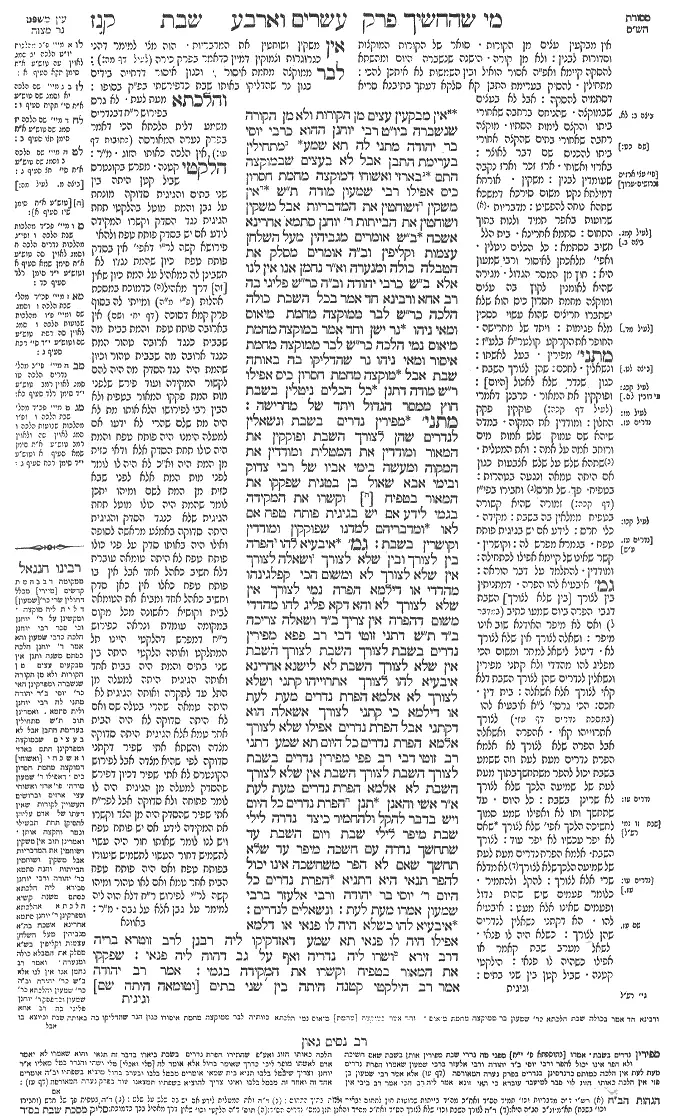
Shabbat 157a - Guemara
אין מבקעין עצים מן הקורות ולא מן הקורה שנשברה ביו"ט רבי יוחנן ההוא כרבי יוסי בר יהודה מתני לה תא שמע מתחילין בערימת התבן אבל לא בעצים שבמוקצה התם בארזי ואשוחי דמוקצה מחמת חסרון כיס אפילו רבי שמעון מודה ת"ש אין משקין ושוחטין את המדבריות אבל משקין ושוחטין את הבייתות ר' יוחנן סתמא אחרינא אשכח ב"ש אומרים מגביהין מעל השלחן עצמות וקליפין וב"ה אומרים מסלק את הטבלה כולה ומנערה וא"ר נחמן אנו אין לנו אלא ב"ש כרבי יהודה וב"ה כר"ש פליגי בה רב אחא ורבינא חד אמר בכל השבת כולה הלכה כר"ש לבר ממוקצה מחמת מיאוס ומאי ניהו נר ישן וחד אמר במוקצה מחמת מיאוס נמי הלכה כר"ש לבר ממוקצה מחמת איסור ומאי ניהו נר שהדליקו בה באותה שבת אבל מוקצה מחמת חסרון כיס אפילו ר"ש מודה דתנן כל הכלים ניטלין בשבת חוץ ממסר הגדול ויתד של מחרישה:
מתני׳ מפירין נדרים בשבת ונשאלין לנדרים שהן לצורך השבת ופוקקין את המאור ומודדין את המטלית ומודדין את המקוה ומעשה בימי אביו של רבי צדוק ובימי אבא שאול בן בטנית שפקקו את המאור בטפיח וקשרו את המקידה בגמי לידע אם יש בגיגית פותח טפח אם לאו ומדבריהם למדנו שפוקקין ומודדין וקושרין בשבת:
גמ׳ איבעיא להו הפרה בין לצורך ובין שלא לצורך ושאלה לצורך אין שלא לצורך לא ומשום הכי קפלגינהו מהדדי או דילמא הפרה נמי לצורך אין שלא לצורך לא והא דקא פליג להו מהדדי משום דהפרה אין צריך ב"ד ושאלה צריכה ב"ד ת"ש דתני זוטי דבי רב פפא מפירין נדרים בשבת לצורך השבת לצורך השבת אין שלא לצורך השבת לא לישנא אחרינא איבעיא להו לצורך אתרוייהו קתני ושלא לצורך לא אלמא הפרת נדרים מעת לעת או דילמא כי קתני לצורך אשאלה הוא דקתני אבל הפרת נדרים אפילו שלא לצורך אלמא הפרת נדרים כל היום תא שמע דתני רב זוטי דבי רב פפי מפירין נדרים בשבת לצורך השבת לצורך השבת אין שלא לצורך השבת לא אלמא הפרת נדרים מעת לעת א"ר אשי והאנן תנן הפרת נדרים כל היום ויש בדבר להקל ולהחמיר כיצד נדרה לילי שבת מיפר לילי שבת ויום השבת עד שתחשך נדרה עם חשכה מיפר עד שלא תחשך שאם לא הפר משחשכה אינו יכול להפר תנאי היא דתניא הפרת נדרים כל היום ר' יוסי בר יהודה ורבי אלעזר ברבי שמעון אמרו מעת לעת:
ונשאלים לנדרים:
איבעיא להו כשלא היה לו פנאי או דלמא אפילו היה לו פנאי תא שמע דאזדקיקו ליה רבנן לרב זוטרא בריה דרב זירא ושרו ליה נדריה ואף על גב דהוה ליה פנאי:
שפקקו את המאור בטפיח וקשרו את המקידה בגמי:
אמר רב יהודה אמר רב הילקטי קטנה היתה בין שני בתים [וטומאה היתה שם]
Comments from Rashi on Masechet Shabbat Page 157a
אין מבקעין עצים מן הקורות . סואר של הקורות המוקצות וסדורות לבנין: ולא מן קורה . הישנה שנשברה היום ומהשתא להסקה קיימא ואפ"ה אסור הואיל ובין השמשות לא איתכן להכי: מתחילין . להסיק בערימת התבן קא סלקא דעתך בתיבנא סריא דסתמיה להסקה: אבל לא בעצים שבמוקצה . שהניחם ברחבה שאחורי ביתו והקצם לימות הסתיו. מוקצה רחבה שאחורי בתים שהקצה אחורי ביתו להכניס שם דבר לאוצר: בארזי ואשוחי . ארז זכר וארז נקבה שעומדין לבנין: משקין . אורחא דמילתא נקט משום סירכא דמשכא שתהא נוחה להפשיט: מדבריות . שרועות באפר תמיד ולנות בתוך התחום: סתמא אחרינא . בית הלל חשיב כסתמא: כל הכלים ניטלין . ואפי' מלאכתן לאיסור ורבי שמעון היא: חוץ מן המסר הגדול . מגירה שהיא לאומנין לקוץ בה עצים ומוקצה מחמת חסרון כיס הוא שלא ישתברו חריצים שהוא עשוי כסכין מלא פגימות: ויתד של מחרישה . החופר את הקרקע קולטר"א בלע"ז: מתני' מפירין . בעל לאשתו: ונשאלין . לחכם: שהן לצורך השבת . כגון שנדר שלא לאכול [היום]: ופוקקין את המאור . כרבנן דאמרי (לעיל שבת דף קכה:) פוקקין פקק החלון: ומודדין את המקוה . במדה שיהא שם עמוק שלש אמות מים ורוחב אמה על אמה: ואת המטלית . שתהא שלש על שלש אצבעות כגון אם היתה טמאה ונגעה בטהרות: בטפיח . פך של חרס וחבירו בפי"ז (דף קכה:) זמורה שהיא קשורה בטפיח ממלאין בה בשבת: מקידה . כלי חרס: לידע אם יש בגיגית פותח טפח . בגמרא מפרש לה: ומודדין . להתלמד על דבר הוראה: וקושרין . קשר שאינו של קיימא אפילו לכתחילה: גמ' איבעיא להו הפרה . דמתניתין בין לצורך [בין שלא לצורך] השבת דגבי הפרה ביום שמעו כתיב (במדבר ל) ואם לא מיפר האידנא שוב אינו מיפר: ושאלה לצורך אין שלא לצורך לא . דיכול לישאל למחר ומשום הכי מפליג להו מהדדי ולא קתני מפירין ונשאלין לנדרים שהן לצורך השבת דלא קאי לצורך אלא אשאלה: בית דין . חכם: הכי גרסי' ל"א איבעיא להו (במסכת נדרים דף עז.) לצורך אתרוייהו קאי . אהפרה ואשאלה אבל הפרה שלא לצורך לא אלמא הפרת נדרים מעת לעת וזה ששמע בשבת יכול להפר משתחשך בתוך מעת לעת של שמיעה הלכך שלא לצורך לא שרינן בשבת: כל היום . עד שתחשך ותו לא ואפילו שמע סמוך לחשיכה הלכך אפי' שלא לצורך שאם לא יפר עכשיו לא יפר עוד: לצורך השבת . אלמא הפרת נדרים מעת לעת של שמיעה הלכך שלא לצורך לא מדלא שרי אלא לצורך: להקל ולהחמיר . כלומר פעמים שיש שהות גדול ופעמים שאינו אלא מעט: איבעיא להו . הא דקתני נשאלין לנדרים שהן לצורך: כשלא היה לו פנאי . לשאל. מערב שבת קאמר או אפילו כשהיה לו פנאי: הילקטי קטנה . שביל קטן בין שני בתים:
Comments from Tosafot - Shabbat 157a
אין משקין ושוחטין את המדבריות . הוה מצי למימר דהני כגרוגרות וצמוקין דמיין כדאמר בפרק כירה (לעיל שבת דף מה:): לבר ממוקצה מחמת איסור . וכגון איסור דדחייה בידים כגון נר שהדליקו באותו שבת כדפירשתי בפ"ק בסופו: והלכתא מעת לעת . לא גרס בפירוש ר"ח דבנדרים משמע דלית הלכתא הכי דאמר בפרק נערה המאורסה (כתובות דף עו:) אין הלכה כאותו הזוג. מ"ר: הלקטי קטנה . מפרש בקונטרס שביל קטן היתה בין שני בתים והגיגית סדוקה מונחת על גבן והמת מוטל בהלקטי תחת הגיגית נגד הסדק וקשרו המקידה לידע אם יש בסדק פותח טפח ולהאי פירושא קשה לר"י דאפי' אין בסדק פותח טפח כיון שהמת נגדו לא חשבינן לה כמאהיל על המת כיון שאין [זה] דרך מאהיל כדמוכח במסכת אהלות (פ"י מ"ה) ומייתי לה בסוף פרק קמא דסוכה (דף יח. ושם) אין בארובה פותח טפח והמת בבית מה שבבית כנגד ארובה טהור המת כנגד ארובה מה שבבית טהור וכיון שהמת היה נגד הסדק מה היה להם לקשור המקודה ועוד פירש שלפני מות המת פקקו המאור בטפיח ולא הבין רבי לפירושו הלא אותו מת לא היה מת שלם שהרי לא ידעו אם למעלה הימנו היה פותח טפח והמת היה כולו תחת הסדק אלא ודאי כזית מן המת היה וא"כ לא היה לו לומר לפני מות המת אלא לפני שבא כזית מן המת לשם ומיהו יתכן לומר שהמת היה כולו מוטל תחת הגיגית שלא כנגד הסדק והגיגית היתה סדוקה באמצע מראשה לסופה ואילו היה באותו סדק על פני כולו פותח טפח לא היתה טומאה עוברת דלא חשיב כאהל אחד אבל אין בו פותח טפח כאלו אין כאן סדק וחשיב כאהל אחד ומביא את הטומאה לבית וקושיא ראשונה מכל מקום במקומה עומדת ונראה כפירוש ר"ח דמפרש דהלקטי היינו תל המתלקט ואותה הלקטי היתה בין שני בתים והמת היה בבית אחד ואותה הגיגית היתה למעלה מן התל עד לתקרה ואותה הגיגית לא היתה טמאה שהרי בטלה שם ואם לא היתה סדוקה לא היה הבית אחר טמא אלא הגיגית היתה סדוקה מצדה והשתא אתי שפיר דקתני סדוקה לפי שהיא מצדה אבל לפירוש הקונטרס לא אתי שפיר דכיון דפירש שהסדק למעלה מן הגיגית היה לו לומר פתוחה ולא סדוקה אבל לפר"ח אתי שפיר שהסדק היה מן הצד וקשרו את המקידה לידע אם יש פותח טפח ויש לנו לומר שאותו חור היה עשוי לתשמיש דחור העשוי לתשמיש שיעורו בפותח טפח ואם היה פותח טפח הבית אחר טמא ואם לאו טהור ומיהו קשה לר"י לפירוש ר"ח דלא הוה ליה למימר על גבן אלא על גבה. מ"ר:
Shabbat 157a - Mishnah translated into english
One may chop wood neither from beams set aside for building nor from a beam that broke on a Festival. Apparently, this unattributed mishna is in accordance with the opinion of Rabbi Yehuda. The Gemara answers that Rabbi Yoḥanan answered: That mishna is actually in accordance with the opinion of Rabbi Yosei bar Yehuda, which is an individual opinion. Come and hear: One may start a fire on a Festival with a pile of straw but not with wood that is from the wood storage behind one’s house, because that wood is set aside for other uses. Apparently, this is an unattributed mishna in accordance with the opinion of Rabbi Yehuda with regard to the prohibition of set-aside. The Gemara answers: There, the mishna is referring to wood from cedar and fir trees that are set aside due to monetary loss. Even Rabbi Shimon concedes that the prohibition of set-aside is in effect in that case.
Come and hear a proof from another mishna: One may neither give water to nor slaughter non-domesticated desert animals, animals that are always grazing in the fields. Since people do not generally tend to them, they are considered set-aside and may not be used. Giving them water would ease removal of their hides. However, one may give water to and slaughter domesticated animals. This is apparently an unattributed mishna in accordance with the opinion of Rabbi Yehuda.
The Gemara answers: Rabbi Yoḥanan found a different unattributed mishna in accordance with the opinion of Rabbi Shimon. Beit Shammai say: One may lift bones and peels and shells, which are set-aside, from the table on Shabbat. And Beit Hillel say: One must remove the entire board from atop the table and shake it; however, he may not lift the set-aside objects. And Rav Naḥman said to reverse the two opinions, and we have only Beit Shammai in accordance with the opinion of Rabbi Yehuda, and Beit Hillel in accordance with the opinion of Rabbi Shimon. As the halakha is always ruled in accordance with the opinion of Beit Hillel, this mishna has the authority of an unattributed mishna.
Rav Aḥa and Ravina disputed this matter. One said: In all of the halakhot of Shabbat in which there is a tannaitic dispute involving Rabbi Shimon, the halakha is in accordance with the opinion of Rabbi Shimon, except for the case of an item set aside due to repulsiveness. And what is that case? It is the case of an old oil lamp, which may not be moved on Shabbat, contrary to Rabbi Shimon’s opinion. And one said: In the case of an item set aside due to repulsiveness, the halakha is also in accordance with the opinion of Rabbi Shimon. The halakha is in accordance with the opinion of Rabbi Shimon except for the case of set aside due to prohibition. And what is that case? It is the case of moving an oil lamp that one kindled for that very Shabbat. However, with regard to an item set aside due to monetary loss, even Rabbi Shimon concedes that it is prohibited to move that item, as we learned in a mishna according to his position: All vessels may be moved on Shabbat except for a large saw and the blade of a plow, both of which are prohibited. Due to their significance, their owners make certain that they will not be damaged.
MISHNA: A father or husband may nullify his daughter’s or his wife’s vows on Shabbat, and one may request from a Sage to dissolve vows that are for the purpose of Shabbat. Failure to dissolve the vow will compromise one’s fulfillment of the mitzva to delight in Shabbat. And one may seal a window on Shabbat to prevent light from entering, and one may measure a rag to determine whether or not it is large enough to contract ritual impurity, and one may measure a ritual bath to determine if it contains enough water for immersion. The mishna relates that there was an incident in the time of Rabbi Tzadok’s father and the time of Abba Shaul ben Botnit, in which they sealed a window using an earthenware vessel and tied an earthenware shard with a long reed-grass with a temporary knot, in order to ascertain whether or not the roofing had an opening the size of a handbreadth. And from their statements and their actions, we derived that one may seal a window, and measure, and tie a knot on Shabbat.
GEMARA: We learned in the mishna that it is permitted to nullify vows and to request that Sages dissolve vows for the purpose of Shabbat. In an attempt to understand the mishna, a dilemma was raised before the Sages: Is nullification of vows on Shabbat permitted both for the purpose of Shabbat and when it is not for the purpose of Shabbat? And the request to dissolve vows, when it is for the purpose of Shabbat, yes, it is permitted, but when it is not for the purpose of Shabbat, no, it is prohibited? And is it due to that distinction that the tanna of the mishna separated the cases from each other and listed them separately?
Or perhaps with regard to nullification of vows on Shabbat as well, when it is for the purpose of Shabbat, yes, it is permitted, but when they are not for the purpose of Shabbat, no, it is prohibited; and the fact that the tanna of the mishna separated the cases from each other and listed them separately is due to the fact that for nullification one does not require a court, and a husband or father can nullify a woman’s vows on his own, but for the request to dissolve vows one requires a court.
Come and hear a resolution to the dilemma from that which the Sage, Zutei, of the school of Rav Pappa taught: One may nullify vows on Shabbat for the purpose of Shabbat. Apparently, when the nullification is for the purpose of Shabbat, yes, it is permitted to nullify vows, but when it is not for the purpose of Shabbat, no, it is prohibited.
The Gemara cites another version of the dilemma that was raised before the Sages. Was the phrase: When they are for the purpose of Shabbat, taught about both of them, and nullification is only permitted for the purpose of Shabbat, but when it is not for the purpose of Shabbat, no, it is prohibited? If so, apparently, nullification of vows may be performed for an entire twenty-four hour period after hearing the vow, and the father or husband can wait until after Shabbat to nullify the vow if he does not need to do so for the purpose of Shabbat. Or perhaps when the mishna taught that it is permitted when the nullification is for the purpose of Shabbat, that was taught only with regard to the request to dissolve that which was prohibited by the vow, but nullification of vows may be performed on Shabbat even when it is not for the purpose of Shabbat. If so, apparently nullification of vows may be performed only for the entire day that the husband or father heard the vow. Once Shabbat concludes, the vow may no longer be nullified. Therefore, even vows whose nullification is not for the purpose of Shabbat may be nullified on Shabbat.
Come and hear a resolution to the dilemma from that which the Sage, Zutei, of the school of Rav Pappa taught: One may nullify vows on Shabbat for the purpose of Shabbat. Apparently, when the nullification is for the purpose of Shabbat, yes, it is permitted to nullify vows, but when it is not for the purpose of Shabbat, no, it is prohibited. If so, apparently nullification of vows may be performed for the entire twenty-four hour period after hearing the vow.
Rav Ashi said: Didn’t we learn in a mishna that one may nullify vows for the entire day, and there is both a leniency and a stricture in this matter to extend or curtail the period during which the vow may be nullified. How so? If the woman vowed on Shabbat evening, her father or husband may nullify the vow on Shabbat evening and on Shabbat day until dark. However, if she vowed before Shabbat at nightfall, her father or husband may only nullify the vow until nightfall, as if he did not nullify the vow before nightfall, he can no longer nullify it because the day ended. The Gemara answers that this issue is subject to a tannaitic dispute, as it was taught in a baraita: One may nullify vows for the entire day. Rabbi Yosei bar Yehuda and Rabbi Elazar, son of Rabbi Shimon, said: For a twenty-four hour period.
We learned in the mishna: And one may request from a Sage to dissolve vows on Shabbat. A dilemma was raised before the Sages: Is this only permitted when one did not have time to request to have the vow dissolved before Shabbat, or perhaps it is permitted even if one had time before Shabbat to request to have his vow dissolved? Come and hear a resolution to this dilemma from the fact that the Sages attended to Rav Zutra, the son of Rav Zeira, and dissolved his vow even though he had time to request its dissolution before Shabbat.
The mishna related: They sealed a window using an earthenware vessel and tied an earthenware shard with a long reed-grass. Rav Yehuda said that Rav said in explanation: There was a small alleyway [heilketei] between two houses, and there was ritual impurity imparted by a corpse there in the alleyway,
Traduction : The William Davidson digital edition of the Koren Noé Talmud, with commentary by Rabbi Adin Even-Israel Steinsaltz.