 Talmud Bavli
Shabbat 70a : Youtube
Daf TubeYoutube
3 video classes :
Shabbat Page 70a
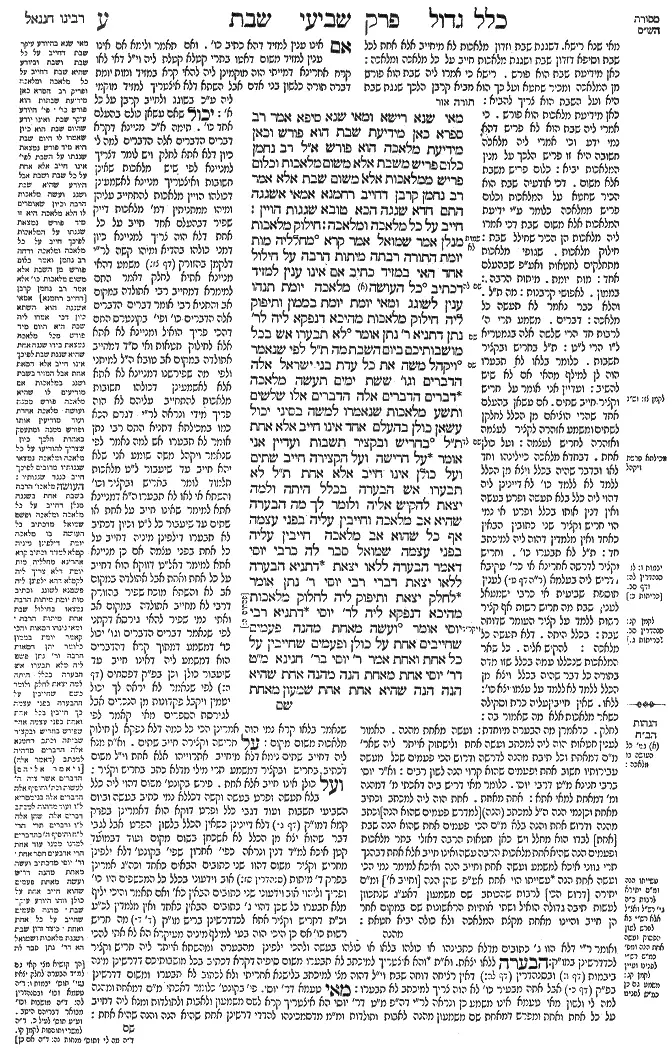
Shabbat 70a - Guemara
מאי שנא רישא ומאי שנא סיפא אמר רב ספרא כאן מידיעת שבת הוא פורש וכאן מידיעת מלאכה הוא פורש א"ל רב נחמן כלום פריש משבת אלא משום מלאכות וכלום פריש ממלאכות אלא משום שבת אלא אמר רב נחמן קרבן דחייב רחמנא אמאי אשגגה התם חדא שגגה הכא טובא שגגות הויין:
חייב על כל מלאכה ומלאכה:
חילוק מלאכות מנלן אמר שמואל אמר קרא (שמות לא, יד) מחלליה מות יומת התורה רבתה מיתות הרבה על חילול אחד האי במזיד כתיב אם אינו ענין למזיד דכתיב (שמות לה, ב) כל העושה מלאכה יומת תנהו ענין לשוגג ומאי יומת יומת בממון ותיפוק ליה חילוק מלאכות מהיכא דנפקא ליה לר' נתן דתניא ר' נתן אומר (שמות לה, ג) לא תבערו אש בכל מושבותיכם ביום השבת מה ת"ל לפי שנאמר (שמות לה, א) ויקהל משה את כל עדת בני ישראל אלה הדברים וגו' ששת ימים תעשה מלאכה דברים הדברים אלה הדברים אלו שלשים ותשע מלאכות שנאמרו למשה בסיני יכול עשאן כולן בהעלם אחד אינו חייב אלא אחת ת"ל (שמות לד, כא) בחריש ובקציר תשבות ועדיין אני אומר על חרישה ועל הקצירה חייב שתים ועל כולן אינו חייב אלא אחת ת"ל לא תבערו אש הבערה בכלל היתה ולמה יצאת להקיש אליה ולומר לך מה הבערה שהיא אב מלאכה וחייבין עליה בפני עצמה אף כל שהוא אב מלאכה חייבין עליה בפני עצמה שמואל סבר לה כרבי יוסי דאמר הבערה ללאו יצאת דתניא הבערה ללאו יצאת דברי רבי יוסי ר' נתן אומר לחלק יצאת ותיפוק ליה לחלוק מלאכות מהיכא דנפקא ליה לר' יוסי דתניא רבי יוסי אומר (ויקרא ד, ב) ועשה מאחת מהנה פעמים שחייבים אחת על כולן ופעמים שחייבין על כל אחת ואחת אמר ר' יוסי בר' חנינא מ"ט דר' יוסי אחת מאחת הנה מהנה אחת שהיא הנה הנה שהיא אחת אחת שמעון מאחת
Comments from Rashi on Masechet Shabbat Page 70a
מאי שנא רישא . דשגגת שבת וזדון מלאכות לא מיחייב אלא אחת לכל שבת וסיפא דזדון שבת ושגגת מלאכות חייב על כל מלאכה ומלאכה: כאן מידיעת שבת הוא פורש . רישא כי אמרו ליה שבת הוא פורש מן המלאכה ומכיר שחטא ועל כך הוא מביא קרבן הלכך שגגת שבת היא ועל השבת הוא צריך להביא: כאן מידיעת מלאכות הוא פורש . כי אמרי ליה שבת הוא לא פריש דהא נמי ידע וכי אמרי ליה מלאכה חשובה היא זו פריש הלכך על מנין המלאכות יביא: כלום פריש משבת אלא משום . דכי אודעיה שבת הוא הכיר שחטא על המלאכות וכלום פריש ממלאכה כלומר ע"י ידיעת המלאכות אלא משום שבת דכי אמרו ליה מלאכות הן הכיר שחילל שבת: חילוק מלאכות . שגופי מלאכות מתחלקים לחטאות אע"פ שבהעלם אחד: מות יומת . מיתות הרבה: בממון . לאפושי קרבנות: מה ת"ל . והלא כבר נאמר לא תעשה כל מלאכה: דברים . משמע תרי ה' לרבות חד הרי שלשה אלה בגמטריא ל"ו הרי ל"ט: ת"ל בחריש ובקציר תשבות . כלומר בלאו לא תבערו הוה לן למילף מהאי אם לא שיש להשיב: ועדיין אני אומר על חריש וקציר חייב שתים . אם עשאן בהעלם אחד שהרי הוציאם מן הכלל לחלקן לשתים ומשמע אזהרה לקציר לעצמה ואזהרה לחריש לעצמה: ועל כולן אחת . דבחדא מלאכה כיילינהו וחד לאו ובדבר שהיה בכלל ויצא מן הכלל ללמד לא ללמד כו' לא דיינינן ליה דהוי ליה כלל בלא תעשה ופרט בעשה ואין דנין אותו בכלל ופרט אי נמי הוי חריש וקציר שני כתובין הבאין כאחד ואין מלמדין דהוה ליה למיכתב חד: ת"ל לא תבערו כו' . וחריש וקציר לדרשה אחרינא אי כר' עקיבא דדריש ליה בעלמא (ר"ה דף ט.) לענין תוספת שביעית אי כרבי ישמעאל לענין שבת מה חריש רשות אף קציר רשות ללמד על קציר העומר שדוחה שבת: בכלל היתה . דלא תעשה כל מלאכה: להקיש אליה . כל שאר המלאכות שנכללו עמה בכלל שזו מדה בתורה כל דבר שהיה בכלל ויצא מן הכלל ללמד לא ללמד על עצמו יצא כו': ללאו . שאין חייבין עליה כרת וסקילה כשאר מלאכות אלא מה שאמור בה: לחלק . כדאמרן מה הבערה מיוחדת: ועשה מאחת מהנה . האמור לענין חטאות הוה ליה למכתב ועשה אחת ולישתוק אייתר ליה שאר' מ"ם דמאחת וכל תיבת מהנה לדרשה ודרוש הכי פעמים שכל מעשה עבירותיו חשוב אחת ופעמים שהוא קרוי הנה לשון רבים: וא"ר יוסי בר' חנינא מ"ט דר' יוסי . כלומר מאי דריש ביה דאכתי מ' דמהנה ומ' דמאחת למאי אתא: אחת מאחת . אחת הוה ליה למכתב וכתיב מאחת וכן נמי הנה ה"ל למכתב (הנה) [למדרש פעמים שהוא הנה] וכתב מהנה ודרוש אחת והנה בלא מ"ם הכי פעמים אחת שהוא הנה שבת [אחת] לבדו הוא מחלל ויש כאן חטאות הרבה דאזלי בתר מלאכות ופעמים הנה שהיא אחת מלאכות הרבה עשה ואינו חייב אלא אחת דבהנך תרי גווני איכא למשמע ועשה אחת וחייב הנה ואיכא למימר נמי הכי ועשה אחת הנה עשייתו הוי אחת אע"פ שהן הנה [וחייב א'] ומ"ם יתירה [דרוש הכי] לרבות שהכותב שם משמעון דאע"ג שנתכוון לעשות תיבה גדולה הואיל ושתי אותיות הראשונות שם במקום אחר הן חייב והיינו מאחת מקצת המלאכה ולא כולה יביא חטאת:
Comments from Tosafot - Shabbat 70a
אם אינו ענין למזיד דהא כתיב כו' . ואם תאמר ולימא אם אינו ענין למזיד משום דאטו בתרי קטלא קטלת ליה וי"ל דאי לאו קרא אחרינא דמייתי הוה מוקמינן ליה להאי קרא במזיד ומות יומת דברה תורה כלשון בני אדם אבל השתא דלא איצטריך למזיד מוקמי ליה ע"כ בשוגג ולחייב קרבן על כל א': יכול שאם עשאן כולם בהעלם אחד כו' . תימה א"כ מניינא דקרא דברים הדברים אלה הדברים למה לי כיון דלא אתא לחלק ויש לומר דצריך למניינא לפי שיש מלאכות שאינן חשובות ואיצטריך מניינא לאשמעינן דכולהו הויין מלאכות להתחייב עליהן ומיהו ממתניתין דמ' מלאכות דייק שפיר דבהעלם אחד חייב על כל אחת דלא הוה צריך למניינא כיון דמני כולהו בהדיא ומיהו קשה לר"י דלקמן בהזורק (שבת דף צז:) משמע דהאי מניינא אתיא לחלק דאמר התם למימרא דמחייב רבי אתולדה במקום אב והתניא רבי אומר דברים הדברים אלה הדברים כו' ופי' בקונטרס התם דהכי פריך הואיל ומניינא לא אתא אלא לחילוק חטאות ואי ס"ד דמחייב אתולדה במקום אב טובא ה"ל למיתני ולפי מה שפירשנו דמניינא לא אתא אלא לאשמעינן דכולהו חשובות מלאכות להתחייב עליהם לא הוה פריך מידי ונראה לר"י דגרס הכא כמו במכילתא דתניא התם רבי נתן אומר לא תבערו אש למה נאמר לפי שנאמר ויקהל משה שומע אני שלא יהא חייב עד שיעבור ל"ט מלאכות תלמוד לומר בחריש ובקציר וכו' והשתא אי לאו לא תבערו ה"א דמניינא אתא למימר שאינו חייב על אחת או שתים עד שיעבור כל ל"ט וכיון דכתיב לא תבערו דילפינן מיניה דחייב על כל אחת בפני עצמה אם כן מניינא אתא למימר דאל"ט דווקא הוא דחייב על כל אחת ואחת אבל אתולדה במקום אב לא והשתא מוכח שפיר בהזורק דרבי לא מחייב אתולדה במקום אב ואתי נמי שפיר להאי גירסא דקתני לפי שנאמר דברים הדברים וגו' יכול כו' דמשמע דמתוך קרא דהדברים הוא דמשמע ליה דאינו חייב עד שיעבור כולן וכן בפ"ק דפסחים (דף ה:) לפי שנאמר לא יראה לך יכול יטמין ויקבל פקדונות מן הנכרים אבל לגירסת הספרים מאי קאמר לפי שנאמר בלאו קרא נמי הוה אמרינן הכי כל כמה דלא נפקא לן חילוק מלאכות משום מקום: על חרישה וקצירה חייב שתים . וא"ת מנא ליה דחייב שתים נימא דלא מיחייב אתרוייהו אלא אחת וי"ל משום דכתיב בחריש ובקציר דמשמע תרי מילי מדלא כתב בחריש וקציר: ועל כולן אינו חייב אלא אחת . פירש בקונט' משום דהוי ליה כלל בלא תעשה ופרט בעשה וקשה דכללא נמי כתיב בעשה וביום השביעי תשבות ועוד דגבי כלל ופרט דוקא הוא דאמרינן בפרק קמא דמו"ק (דף ג.) דלא דיינינן כשאין הכלל בלשון הפרט אבל לגבי דבר שהוא יצא מן הכלל לא אשכחן בשום מקום ועוד דבמועד קטן איכא למ"ד דנין ונראה כפי' אחרון שפי' בקונט' דלא ילפינן מחריש וקציר משום דהוו שני כתובים הבאים כאחד וכה"ג אמרינן בפרק ד' מיתות (סגהדרין סז:) אוב וידעוני בכלל כל המכשפים היו כו' ופריך וליהוי אוב וידעוני שני כתובים הבאין כא' ואם תאמר והיכי יליף מלא תבערו כל שכן דהוי ג' כתובים הבאין כאחד ואין מלמדין לכ"ע וכ"ת דחריש וקציר אתא לכדדרשינן בריש מו"ק (ד' ד.) מה חריש רשות כו' אם כן היכי הוה בעי למילף מיניה מעיקרא הא לא אתי להכי ואומר ר"י דלא הוו ג' כתובים מדלא כתבינהו או כולהו בלאו או כולהו בעשה ולהכי ילפינן מהבערה ומהשתא אייתר ליה חריש וקציר לכדדרשינן במו"ק: הבערה ללאו יצאת . וא"ת והא איצטריך למיכתב לא תבערו משום סיפיה דקרא דכתיב בכל מושבותיכם דדרשינן מינה ביבמות (דף ו:) ובסנהדרין (דף לה:) דאין רציחה דוחה שבת וי"ל דהוה מצי למיכתב בלישנא אחריתי ולא לכתוב לא תבערו ומשום דדרשינן בפ"ק (דף כ.) אבל אתה מבעיר כו' לא הוה צריך למיכתב לא תבערו: מאי טעמא דר' יוסי . פי' בקונט' כלומר דאכתי מ"ם דמאחת ומהנה למה לי ולשון מאי טעמא אינו משמע כן ונראה לר"י דה"פ מ"ט דר' יוסי הא איצטריך קרא לשם משמעון ולאבות ולתולדות ומנא ליה דחייב על כל אחת ואחת ומפרש דמאחת שם משמעון מהנה לאבות ותולדות ומ"מ מדסמכינהו להדדי דרשינן אחת שהיא הנה והנה שהיא אחת:
Shabbat 70a - Mishnah translated into english
The Gemara asks: What is different about the former clause, which states that he in only liable to bring one sin-offering for each Shabbat, and the latter clause, which states that he is liable for each and every primary category of labor that he performed? Rav Safra said: Here, where he is unaware that the day was Shabbat, when he realizes that he sinned, it is due to awareness of Shabbat that he desists. When he is told that it was Shabbat, he stops immediately. And here, where he is unaware that the labors are prohibited, it is due to awareness of the labors that he desists. When he is told that this labor is prohibited, he stops immediately. Rav Naḥman said to Rav Safra: Does he desist due to Shabbat for any reason other than because he knows that the labors are prohibited? If he did not know that the labor is prohibited, telling him that it is Shabbat would not cause him to desist. And similarly, does he desist from performing the labors when told that it is prohibited for any reason other than because he knows that it is Shabbat? If he did not know that it was Shabbat, there would be no reason for him to desist from labor. Ostensibly, attributing the distinction between the two parts of the mishna to what eventually became known to him in the different cases is incorrect. Rather, Rav Naḥman said: The offering that the Torah obligated him to bring; for what is he so obligated? It is for performing an unwitting transgression. There, where he was unaware that the day was Shabbat, he was unwitting with regard to one matter; here, where he was unaware of the prohibited labors, he was unwitting with regard to multiple matters, and he is liable to bring sin-offerings in accordance with the number of matters of which he was unaware.
We learned in the mishna that one is liable to bring a sin-offering for each prohibited labor that he performs on Shabbat. The Gemara asks: From where do we derive the division of labors? What is the source of the halakha that if one performs numerous prohibited labors on Shabbat in the course of one lapse of awareness, each prohibited labor is considered a separate offense with regard to punishment? Shmuel said that the verse says: “And you shall observe the Shabbat, for it is holy to you; he who desecrates it shall surely die [mot yumat]” (Exodus 31:14). We learn from the double language, mot yumat, that the Torah amplified multiple deaths for a single desecration. Although several violations were committed in the course of a single lapse of awareness, each is considered a separate offense with regard to punishment. The Gemara asks: That verse was written with regard to intentional transgression. The Gemara is seeking a source for multiple sacrifices brought for unwitting transgression. The Gemara answers: If it does not refer to the matter of intentional transgression, as the verse does not teach a halakha applicable to intentional acts, as it was already written: “Six days you shall perform work, and on the seventh day it shall be holy to you, a Shabbat of rest to God; all who desecrate it shall die” (Exodus 35:2), refer it to the matter of unwitting transgression. The verse teaches that that which was written with regard to the death penalty for desecration of Shabbat in general applies to all halakhot of Shabbat, including cases of unwitting transgression. And what, then, is the meaning of the term: Shall die, in the verse? Does it mean that one who commits an unwitting transgression is punishable by death? It means that he shall die by payment of money. Death is used in the sense of punishment; he will be forced to pay for numerous sacrifices to atone for his sins.
The Gemara asks: And let him derive division of labors from where it was derived according to Rabbi Natan, as it was taught in a baraita that Rabbi Natan says that it is written: “You shall not kindle fire in all your dwellings on the day of Shabbat” (Exodus 35:3). Why does the verse state this halakha? The prohibition against kindling is included in the general prohibition against performing labor on Shabbat. Rather, it should be understood as follows. Since it is already stated: “And Moses gathered the entire assembly of the children of Israel and said to them: These are the things [eleh hadevarim] that God has commanded to perform them. Six days you shall perform work, and on the seventh day it shall be holy to you, a Shabbat of rest to God” (Exodus 35:1–2), and Rabbi Natan derives as follows: “These are the things,” which refers to the halakhot of Shabbat, there are emphases in this phrase that are superfluous in the context of the verse. The Torah could have simply stated: This is a thing [davar]. When it states: Things [devarim] in the plural, it teaches at least two points. The addition of the definite article: The things [hadevarim], adds at least a third point. The numerological value of letters of the word eleh: Alef, one; lamed, thirty; and heh, five, is thirty-six. The total numerical value, three plus thirty-six, derived from the phrase: “These are the things.” This alludes to the thirty-nine prohibited labors that were stated to Moses at Sinai.
I might have thought that if one performed them all in the course of one lapse of awareness, forgetting that they are prohibited, he would be liable to bring only one sin-offering? Therefore, the verse states: “Six days you shall work, and on the seventh you shall rest; in plowing time and in harvest time you shall rest” (Exodus 34:21), indicating that there are prohibitions specific to both plowing and harvesting. And still I can say: For plowing and for the harvesting he is liable to bring two sin-offerings, as they were stated explicitly. However, for performing all the other prohibited labors, he is liable for only one. Therefore, the verse states: “You shall not kindle fire in all your dwellings on the day of Shabbat” (Exodus 35:3). This is derived in the following manner: Kindling was included in the general prohibition prohibiting all labors, and why was it singled out and prohibited explicitly? It was singled out in order to equate the other labors to it and to tell you: Just as kindling is a primary category of prohibited labor, and one is liable for performing it on its own, so too, with regard to every primary category of prohibited labor, one is liable for performing it on its own.
Rabbi Natan cited a source proving that there is liability for performance of each prohibited labor of Shabbat on its own. Why doesn’t Shmuel derive that halakha from the same source? The Gemara answers: Shmuel holds in accordance with the opinion of Rabbi Yosei, who disagreed with Rabbi Natan’s interpretation of the verse, as Rabbi Yosei said: The prohibition against kindling on Shabbat was singled out to teach that one who lights a fire on Shabbat merely violates a prohibition. Performing other primary categories of prohibited labor is punishable by stoning or karet. In contrast, one who lights a fire on Shabbat has merely violated a prohibition, as it was taught in a baraita: The prohibition of kindling was singled out as a prohibition; this is the statement of Rabbi Yosei. Rabbi Natan says: Kindling is like any other labor prohibited on Shabbat. It was singled out to divide the various labors and to establish liability for performance of each of them.
The Gemara raises an additional challenge to Shmuel’s opinion. If he holds in accordance with the opinion of Rabbi Yosei with regard to the explicit prohibition of kindling, let him derive the division of labors from where Rabbi Yosei derives it. As it was taught in a baraita that Rabbi Yosei says, it is stated: “Speak to the children of Israel, saying: A soul that sins in error, from all the commandments of God that may not be performed, and performs from one of them [me’aḥat me’hena]” (Leviticus 4:2). Rabbi Yosei interprets the verse that at times one is liable to bring one sin-offering for all of his transgressions, and at times one is liable to bring a sin-offering for each and every transgression. And Rabbi Yosei, son of Rabbi Ḥanina, said: What is the rationale for the opinion of Rabbi Yosei? He interprets the unique phrase employed in that verse: From one of these. The Torah could have merely stated: One [aḥat]. Instead, it stated: From one [me’aḥat]. It could have merely stated: Them [hena]. Instead, it stated: Of them [me’hena]. Rabbi Yosei derives that there are cases of one transgression that, with regard to punishment, are them, i.e., many. And there are cases of them, several transgressions, that, with regard to punishment, are one.
Furthermore: The term one refers to a full-fledged transgression of Shabbat, e.g., one who intended to and wrote a complete name, Shimon. The term from one refers to a case where he performed only part of the transgression, e.g., one who wrote
Traduction : The William Davidson digital edition of the Koren Noé Talmud, with commentary by Rabbi Adin Even-Israel Steinsaltz.
Shabbat 70a : Significance
Next step
Finished studying Shabbat 70a? Carry on with the rest of the tractate.
Study Shabbat 70bFrequently asked questions: Shabbat 70a
Where is Shabbat 70a in tractate Shabbat?
Shabbat 70a is page 137 of 312 in tractate Shabbat (Seder Moed).
When is daf 70 of Shabbat studied in Daf Yomi?
Daf Yomi covers one daf a day, both sides. Daf 70 of Shabbat will be studied on October 17, 2027.
Is there a video class on Shabbat 70a?
Yes, by Daf Tube, Rabbi Dr. Moshe Weisblum. These classes were published on YouTube by their authors and are gathered on this site.
What is tractate Shabbat about?
The Masechet Shabbat is the first tractate of the Seder Moed. The Gemara Shabbat is the study of the laws concerning the Shabbat day during which one must suspend all work according to what is written in the Torah. The preparations before the start of Shabbos, the 39 Melachot that the Torah forbids to be performed on Shabbos, as well as the rabbinical decrees intended to avoid transgressing them. The Shabbat tractate has 24 chapters.
Your study is also dedicated to them
- L'ilui Nishmat Margalit bat Ledicia
- L'ilui Nishmat Jamila bat Chlomo Abensour
- L'ilui Nishmat Amram ben Itshak Loubaton