 Talmud Bavli
Shabbat 153a : Youtube
Daf TubeYoutube
2 video classes :
Shabbat Page 153a
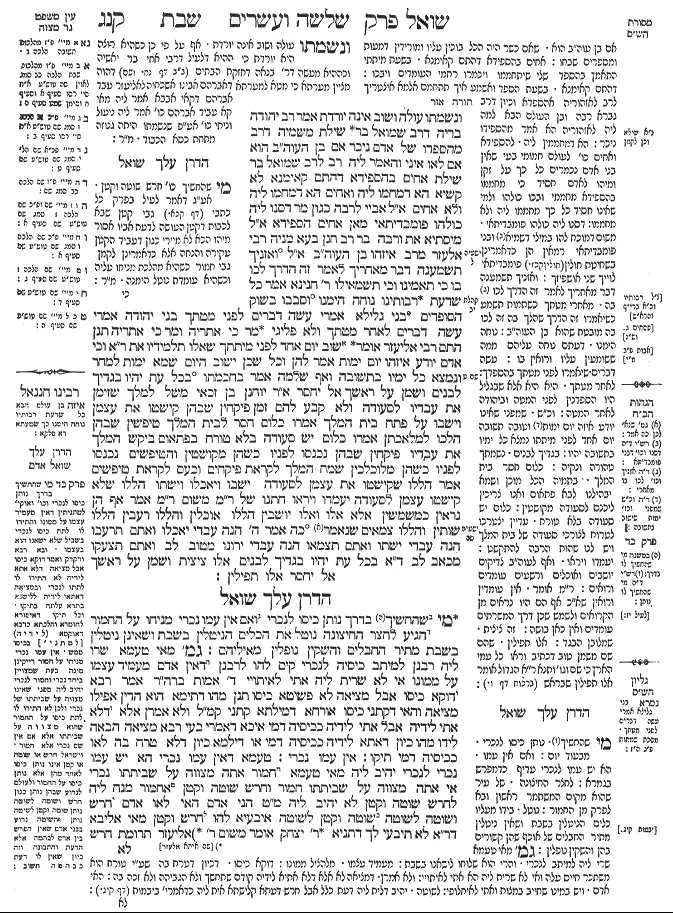
Shabbat 153a - Guemara
ונשמתו עולה ושוב אינה יורדת אמר רב יהודה בריה דרב שמואל בר שילת משמיה דרב מהספדו של אדם ניכר אם בן העוה"ב הוא אם לאו איני והאמר ליה רב לרב שמואל בר שילת אחים בהספידא דהתם קאימנא לא קשיא הא דמחמו ליה ואחים הא דמחמו ליה ולא אחים א"ל אביי לרבה כגון מר דסנו ליה כולהו פומבדיתאי מאן אחים הספידא א"ל מיסתיא את ורבה בר רב חנן בעא מניה רבי אלעזר מרב איזהו בן העוה"ב א"ל (ישעיהו ל, כא) ואזניך תשמענה דבר מאחריך לאמר זה הדרך לכו בו כי תאמינו וכי תשמאילו ר' חנינא אמר כל שדעת רבותינו נוחה הימנו (קהלת יב, ה) וסבבו בשוק הסופדים בני גלילא אמרי עשה דברים לפני מטתך בני יהודה אמרי עשה דברים לאחר מטתך ולא פליגי מר כי אתריה ומר כי אתריה תנן התם רבי אליעזר אומר שוב יום אחד לפני מיתתך שאלו תלמידיו את ר"א וכי אדם יודע איזהו יום ימות אמר להן וכל שכן ישוב היום שמא ימות למחר ונמצא כל ימיו בתשובה ואף שלמה אמר בחכמתו (קהלת ט, ח) בכל עת יהיו בגדיך לבנים ושמן על ראשך אל יחסר א"ר יוחנן בן זכאי משל למלך שזימן את עבדיו לסעודה ולא קבע להם זמן פיקחין שבהן קישטו את עצמן וישבו על פתח בית המלך אמרו כלום חסר לבית המלך טיפשין שבהן הלכו למלאכתן אמרו כלום יש סעודה בלא טורח בפתאום ביקש המלך את עבדיו פיקחין שבהן נכנסו לפניו כשהן מקושטין והטיפשים נכנסו לפניו כשהן מלוכלכין שמח המלך לקראת פיקחים וכעס לקראת טיפשים אמר הללו שקישטו את עצמן לסעודה ישבו ויאכלו וישתו הללו שלא קישטו עצמן לסעודה יעמדו ויראו חתנו של ר"מ משום ר"מ אמר אף הן נראין כמשמשין אלא אלו ואלו יושבין הללו אוכלין והללו רעבין הללו שותין והללו צמאים שנאמר (ישעיהו סה, יג) כה אמר ה' הנה עבדי יאכלו ואתם תרעבו הנה עבדי ישתו ואתם תצמאו הנה עבדי ירונו מטוב לב ואתם תצעקו מכאב לב ד"א בכל עת יהיו בגדיך לבנים אלו ציצית ושמן על ראשך אל יחסר אלו תפילין:
הדרן עלך שואל
מתני׳ מי שהחשיך בדרך נותן כיסו לנכרי ואם אין עמו נכרי מניחו על החמור הגיע לחצר החיצונה נוטל את הכלים הניטלין בשבת ושאינן ניטלין בשבת מתיר החבלים והשקין נופלין מאיליהם:
גמ׳ מאי טעמא שרו ליה רבנן למיתב כיסיה לנכרי קים להו לרבנן דאין אדם מעמיד עצמו על ממונו אי לא שרית ליה אתי לאיתויי ד' אמות ברה"ר אמר רבא דוקא כיסו אבל מציאה לא פשיטא כיסו תנן מהו דתימא הוא הדין אפילו מציאה והאי דקתני כיסו אורחא דמילתא קתני קמ"ל ולא אמרן אלא דלא אתי לידיה אבל אתי לידיה ככיסיה דמי איכא דאמרי בעי רבא מציאה הבאה לידו מהו כיון דאתא לידיה ככיסיה דמי או דילמא כיון דלא טרח בה לאו ככיסיה דמי תיקו:
אין עמו נכרי:
טעמא דאין עמו נכרי הא יש עמו נכרי לנכרי יהיב ליה מאי טעמא חמור אתה מצווה על שביתתו נכרי אי אתה מצווה על שביתתו חמור וחרש שוטה וקטן אחמור מנח ליה לחרש שוטה וקטן לא יהיב ליה מ"ט הני אדם האי לאו אדם חרש ושוטה לשוטה שוטה וקטן לשוטה איבעיא להו חרש וקטן מאי אליבא דר"א לא תיבעי לך דתניא ר' יצחק אומר משום ר' אליעזר תרומת חרש
Comments from Rashi on Masechet Shabbat Page 153a
אם בן עוה"ב הוא . שאם כשר היה הכל בוכין עליו ומורידין דמעות ומספרים שבחו: אחים בהספידא דהתם קאימנא . בשעת מיתתי התאמץ בהספד שלי שיתחממו ויכמרו רחמי העומדים ויבכו: דהתם קאימנא . בשעת הספד ואשמע איך תתחמם אלמא איצטריך לרב לאזהוריה אהספדא וכיון דרב גברא רבה ובן העולם הבא למה ליה לאזהוריה הא אמר מהספידו ניכר: הא דמחממי ליה . להספידא ואחים כו' לעולם חמומי בעי שאין בני אדם נכמרים כל כך על זקן ומיהו לאדם חסיד כי מחממו בהספידא מחממי ובכו כולהו ולמי שאינו חסיד כל כך מחממו ליה ולא מחממו: דסנו ליה כולהו פומבדיתאי . משום דמוכח להו במילי דשמיא ובני פומבדיתאי רמאין הן כדאמרינן בשחיטת חולין (חולין קכז.) פומבדיתאי לוייך שני אושפיזך: ואזניך תשמענה דבר מאחריך לאמר זה הדרך לכו בה . מאחרי מטתך כשתמות תשמע כשיאמרו זה הדרך שהלך בה זה לכו בה מובטח שהוא בן העוה"ב: נוחה הימנו . דעתם נוחה עליהם ממה ששומעין עליו ורואין בו: עשה דברים . שיאמרו לפני מטתך בהספדך: לאחר מטתך . היא היא אלא שבגליל היו הספדנין לפני המטה וביהודה לאחר המטה: וכ"ש . שמפני שאינו יודע איזה יום ימות וטובה תשובה יום אחד לפני מיתתו נמצא כל ימיו בתשובה יהיו: בגדיך לבנים . נשמתך טהורה ונקיה: כלום חסר בית המלך . בתמיה הכל מוכן ושמא יבהילנו לבא פתאום ואנו צריכין ליכנס לסעודה מקושטין: כלום יש סעודה בלא טורח . עדיין יצטרכו לטרוח לצורכי סעודה של בית המלך ויש לנו שהות הרבה להתקשט: יעמדו ויראו . ואף לעוה"ב צדיקים יושבים ואוכלים ורשעים עומדים ורואים: ר"מ אומר . אין עומדין ורואין שא"כ אף הם היו נראים מן הקרואים ולשמש שכן דרך המשרתים עומדים ואין כאן בושה: זה ציצית . שמלובן הבגד: אלו תפילין . שהם שם משמן טוב דכתיב וראי כל עמי הארץ כי שם וגו' ותנא ר"א הגדול אומר אלו תפילין שבראש (ברכות דף ו.): מתני' מי שהחשיך.נותן כיסו לנכרי . מבעוד יום: ואם אין עמו . הא יש עמו לנכרי עדיף כדמפרש בגמרא: לחצר החיצונה . של עיר שהוא מקום המשתמר ראשון ובא לפרק מן החמור: נוטל . בידו מעליו כלים הניטלין בשבת ושאין ניטלין מתיר החבלים של אוכף שהן קשורים בהן והשקין נופלין: גמ' מאי טעמא שרי ליה למיתב לנכרי . והרי הוא שלוחו לישאנו בשבת: מעמיד עצמו . מלהציל ממונו: דוקא כיסו . דכיון דטרח בה שע"י טורח הוא משתכר חייס עלה ואי לא שרית ליה הא אתי לאיתויי: ולא אמרן . דמציאה לא אלא דלא אתיא לידה קודם שתחשך ואל הגביהה ולא זכה בה: האי אדם . ויש במינו שחייב במצות ואתי לאיחלופי: לשוטה . יהיב דלית ליה דעת כלל אבל חרש דעתא קלישתא אית ליה כדאמרי' ביבמות (דף קיג.):
Comments from Tosafot - Shabbat 153a
ונשמתו עולה ושוב אינה יורדת . אף על פי כן כשהיא רוצה היא יורדת כי ההיא דלעיל דרבי אחי בר יאשיה וכההיא מעשה דר' בנאה דחזקת הבתים (ב"ב דף נח. ושם) דהוה מציין מערתא כי מטא למערתא דאברהם אבינו אשכחיה לאליעזר עבד אברהם דקאי אבבא אמר ליה מאי קא עביד אברהם כו' אמר ליה ניעול וניתי כו' אע"פ שנשמתו היתה גנוזה מתחת כסא הכבוד. מ"ר: מתני' מי שהחשיך כו' חרש שוטה וקטן . אע"ג דאמר לעיל בפרק כל כתבי (שבת דף קכא.) גבי קטן שבא לכבות דקטן העושה לדעת אביו אסור מיהו הכא לא מיירי כגון דעביד הקטן עקירה והנחה אלא כדאמרינן לקמן גבי חמור כשהיא מהלכת מניחו עליה וכשהיא עומדת נוטל הימנה. מ"ר:
Shabbat 153a - Mishnah translated into english
and his soul ascends to its place beneath the Throne of Glory, and does not descend anymore.
Rav Yehuda, son of Rav Shmuel bar Sheilat, said in the name of Rav: From a person’s eulogy it is apparent whether or not he has a share in the World-to-Come. If the listeners are pained and brought to tears during the eulogy, it is clear that the person was righteous. The Gemara asks: Is that so? Didn’t Rav say to Rav Shmuel bar Sheilat: Stir the hearts of those gathered during my eulogy, for I will be standing there and listening to your words? Even a person as great as Rav needed to give instructions about his eulogy. The Gemara answers: This is not difficult, for this statement, which maintains that those who merit a share in the World-to-Come can be identified by their eulogies, is referring to a situation in which they attempt to stir the listener and he is stirred; while that statement is referring to a situation in which they attempt to stir the listener and he is not stirred. That is an indication that the deceased person was not righteous.
Abaye said to Rabba: In the case of the Master, i.e., Rabba, whom all of the inhabitants of his city, Pumbedita, hate, who will be stirred during his eulogy? He said to him: It is sufficient for me if you and Rabba bar Rav Ḥanan are stirred.
Rabbi Elazar raised a dilemma before Rav: Which type of person has a share in the World-to-Come? He said to him: We can derive this from the verse: “And your ears shall hear a word behind you, saying: This is the path, walk on it, when you turn to the right or to the left” (Isaiah 30:21). In other words, if people eulogize one by saying that others should follow in his path, he must have a share in the World-to-Come. Rabbi Ḥanina said: Anyone with whom our Rabbis are pleased has a share in the World-to-Come. In interpreting the verse: “And the eulogizers walk about the marketplace” (Ecclesiastes 12:5), the people of the Galilee say: Do things that you will want people to say at your eulogy in front of your bier. The people of Judea say: Do things that you want people to say at your eulogy behind your bier. The Gemara remarks: And they do not disagree; this Sage expressed it according to the norm in his place, and this Sage expressed it differently according to the norm in his place. The custom in the Galilee was that the eulogizers would stand before the bier and the custom in Judea was that eulogizers would stand behind the bier.
We learned there in a mishna that Rabbi Eliezer says: Repent one day before your death. Rabbi Eliezer’s students asked him: But does a person know the day on which he will die? He said to them: All the more so this is a good piece of advice, and one should repent today lest he die tomorrow; and by following this advice one will spend his entire life in a state of repentance. And King Solomon also said in his wisdom: “At all times your clothes should be white, and oil shall not be absent from upon your head” (Ecclesiastes 9:8), meaning that a person always needs to be prepared.
Similarly, Rabban Yoḥanan ben Zakkai said the following story as a parable to this lesson: The situation is comparable to a king who invited his servants to a feast and did not set a time for them to come. The wise among them adorned themselves and sat at the entrance to the king’s house. They said: Is the king’s house missing anything necessary for the feast? Certainly the king could invite them at any moment. The fools among them went to attend to their work and said: Is there such thing as a feast without the toil of preparing for it? While the feast is being prepared, we will attend to other matters.
Suddenly, the king requested that his servants come to the feast. The wise among them entered before him adorned in their finest clothes, and the fools entered before him dirty. The king was happy to greet the wise ones and angry to greet the fools. The king said: These wise servants who adorned themselves for the feast shall sit and eat and drink, but these fools who did not adorn themselves for the feast shall stand and watch. There is a similar outcome for people who think that their day of death and judgment is far away and do not prepare themselves for it.
Rabbi Meir’s son-in-law said in the name of Rabbi Meir: If the punishment for those who did not prepare themselves in advance was merely to stand and watch, it would not be severe enough because they also look like servants at the feast, which is not such a disgraceful punishment. Rather, these and these, both groups of people, sit at the feast. These wise and righteous people eat, and these wicked fools are hungry; these righteous people drink, and these wicked people are thirsty, as it is stated: “Therefore, thus said the Lord, God: Behold, My servants shall eat and you shall be hungry; behold, My servants shall drink and you shall be thirsty; behold, My servants shall rejoice and you shall be ashamed. Behold, My servants shall sing from a joyous heart and you shall scream from a pained heart” (Isaiah 65:13–14).
Alternatively, the verse quoted above can be interpreted in the following way: “At all times let your clothes be white”; this is clothing that contains ritual fringes [tzitzit], which are white. “And oil shall not be absent from upon your head”; these words hint to phylacteries, which are worn on the head.
MISHNA: One who was traveling on Shabbat eve and night fell, and Shabbat began while he was still en route, gives his money pouch to a gentile traveling with him. And if there is no gentile with him he places it on the donkey. Once he reached the outer courtyard of the city, where belongings can be securely placed, he takes the vessels that may be moved on Shabbat off the donkey. With regard to the vessels that may not be moved on Shabbat, he unties the ropes that attach his bags to the donkey, and the bags of vessels fall on their own.
GEMARA: We learned in the mishna: One who was traveling on Shabbat eve and night fell, and Shabbat began while he was still en route, gives his money pouch to a gentile. The Gemara asks: What is the reason that the Sages permitted him to give his pouch to a gentile? Is it not prohibited for a Jew to ask a gentile to perform a prohibited labor on Shabbat? The Gemara answers: The Sages maintain that a person does not restrain himself when faced with losing his money. If you do not permit him to give his pouch to a gentile, he will come to carry four cubits in a public domain, thereby violating a Torah prohibition.
Rava said: This allowance to give the pouch to a gentile is specifically with regard to his own pouch, but in the case of a lost object that he found, no, it was not permitted. The Gemara asks: That is obvious, as we learned in the mishna: His pouch, and nothing else. The Gemara answers: Rava specified this lest you say that the same is true even with regard to a lost object, that one may give it to a gentile on Shabbat, and the mishna taught the case of his pouch merely because it is the manner in which the matter typically occurs. Therefore, Rava teaches us that the mishna is in fact establishing a halakha restricted to his pouch. The Gemara comments: And we only said that this allowance does not apply to a lost object when it did not come into his possession before Shabbat. However, if the object already came into his possession before Shabbat, its legal status is like that of his pouch.
Some state this dilemma in a different manner. Rava raised a dilemma: With regard to a lost object that came into his possession before Shabbat, what is the ruling? Is the halakha that since it already came into his possession, its legal status is like that of his pouch? Or perhaps, since he did not exert himself to acquire it, its legal status is not like that of his pouch. Since he expended no effort, he would be capable of restraining himself even when faced with losing it. Therefore, there is no need for the Sages to permit him to give it to a gentile. The Gemara concludes: Let this dilemma stand unresolved.
We learned in the mishna: And if there is no gentile with him he places it on the donkey. The Gemara infers: The reason is specifically because there is no gentile with him; if there is a gentile with him, he gives it to the gentile and does not place it on a donkey. The Gemara asks: What is the reason for this halakha? The Gemara answers: With regard to a donkey belonging to a Jew, you are commanded with regard to its rest on Shabbat. With regard to a gentile, you are not commanded with regard to his rest and no Torah prohibition is being violated.
The Gemara teaches an additional halakha: If there was no gentile with him but there was a donkey, a deaf-mute, an imbecile, and a minor, meaning someone under thirteen years old, one places it on the donkey, but one neither gives it to the deaf-mute, nor the imbecile, nor the minor. What is the reason for this? Although they are not obligated to fulfill mitzvot, these are people, but this donkey is not a person. It is preferable to place it on the donkey rather than give it to a person. And if a deaf-mute and an imbecile were with him, he gives it to the imbecile. If an imbecile and a minor were with him, he gives it to the imbecile.
A dilemma was raised before the Sages: If a deaf-mute and a minor were with him, what is the ruling? To whom does he give his pouch? The Gemara answers: According to the opinion of Rabbi Eliezer you have no dilemma. Rabbi Eliezer holds that a deaf-mute has a greater degree of halakhic intelligence than does a minor, as it was taught in a baraita: Rabbi Yitzḥak says in the name of Rabbi Eliezer: The teruma of a deaf-mute that he separated from his produce
Traduction : The William Davidson digital edition of the Koren Noé Talmud, with commentary by Rabbi Adin Even-Israel Steinsaltz.