 Talmud Bavli
Shabbat 33a : Youtube
Daf TubeYoutube
3 video classes :
Shabbat Page 33a
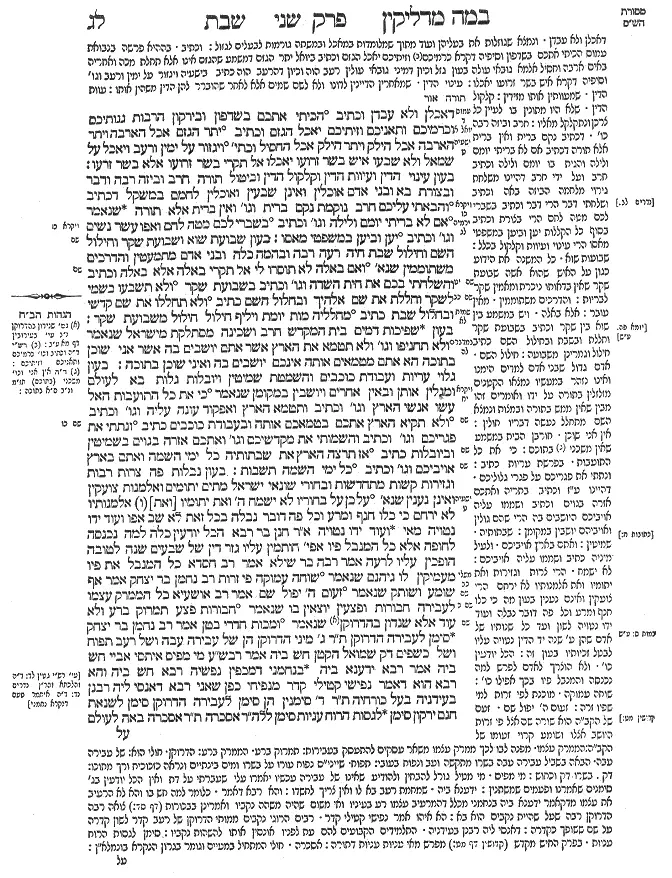
Shabbat 33a - Guemara
דאכלן ולא עבדן וכתיב (עמוס ד, ט) הכיתי אתכם בשדפון ובירקון הרבות גנותיכם וכרמיכם ותאניכם וזיתיכם יאכל הגזם וכתיב (יואל א, ד) יתר הגזם אכל הארבה ויתר הארבה אכל הילק ויתר הילק אכל החסיל וכתי' (ישעיהו ט, יט) ויגזור על ימין ורעב ויאכל על שמאל ולא שבעו איש בשר זרועו יאכלו אל תקרי בשר זרועו אלא בשר זרעו:
בעון עינוי הדין ועיוות הדין וקלקול הדין וביטול תורה חרב וביזה רבה ודבר ובצורת בא ובני אדם אוכלין ואינן שבעין ואוכלין לחמם במשקל דכתיב (ויקרא כו, כה) והבאתי עליכם חרב נוקמת נקם ברית וגו' ואין ברית אלא תורה שנאמר (ירמיהו לג, כה) אם לא בריתי יומם ולילה וגו' וכתיב (ויקרא כו, כו) בשברי לכם מטה לחם ואפו עשר נשים וגו' וכתיב (ויקרא כו, מג) יען וביען במשפטי מאסו:
בעון שבועת שוא ושבועת שקר וחילול השם וחילול שבת חיה רעה רבה ובהמה כלה ובני אדם מתמעטין והדרכים משתוממין שנא' (ויקרא כו, כג) ואם באלה לא תוסרו לי אל תקרי באלה אלא באלה וכתיב והשלחתי בכם את חית השדה וגו' וכתיב בשבועת שקר (ויקרא יט, יב) ולא תשבעו בשמי לשקר וחללת את שם אלהיך ובחלול השם כתיב (ויקרא כב, לב) ולא תחללו את שם קדשי ובחלול שבת כתיב (שמות לא, יד) מחלליה מות יומת ויליף חילול חילול משבועת שקר:
בעון שפיכות דמים בית המקדש חרב ושכינה מסתלקת מישראל שנאמר (במדבר לה, לג) ולא תחניפו וגו' ולא תטמא את הארץ אשר אתם יושבים בה אשר אני שוכן בתוכה הא אתם מטמאים אותה אינכם יושבים בה ואיני שוכן בתוכה:
בעון גלוי עריות ועבודת כוכבים והשמטת שמיטין ויובלות גלות בא לעולם ומגלין אותן ובאין אחרים ויושבין במקומן שנאמר (ויקרא יח, כז) כי את כל התועבות האל עשו אנשי הארץ וגו' וכתיב ותטמא הארץ ואפקוד עונה עליה וגו' וכתיב (ויקרא יח, כח) ולא תקיא הארץ אתכם בטמאכם אותה ובעבודת כוכבים כתיב (ויקרא כו, ל) ונתתי את פגריכם וגו' וכתיב והשמותי את מקדשיכם וגו' ואתכם אזרה בגוים בשמיטין וביובלות כתיב (ויקרא כו, לד) אז תרצה הארץ את שבתותיה כל ימי השמה ואתם בארץ אויביכם וגו' וכתיב (ויקרא כו, לד) כל ימי השמה תשבות:
בעון נבלות פה צרות רבות וגזירות קשות מתחדשות ובחורי שונאי ישראל מתים יתומים ואלמנות צועקין ואינן נענין שנא' (ישעיהו ט, טז) על כן על בחוריו לא ישמח ה' ואת יתומיו [ואת] (ו) אלמנותיו לא ירחם כי כלו חנף ומרע וכל פה דובר נבלה בכל זאת לא שב אפו ועוד ידו נטויה מאי ועוד ידו נטויה א"ר חנן בר רבא הכל יודעין כלה למה נכנסה לחופה אלא כל המנבל פיו אפי' חותמין עליו גזר דין של שבעים שנה לטובה הופכין עליו לרעה אמר רבה בר שילא אמר רב חסדא כל המנבל את פיו מעמיקין לו גיהנם שנאמר (משלי כב, יד) שוחה עמוקה פי זרות רב נחמן בר יצחק אמר אף שומע ושותק שנאמר (משלי כב, יד) זעום ה' יפול שם אמר רב אושעיא כל הממרק עצמו לעבירה חבורות ופצעין יוצאין בו שנאמר (משלי כ, ל) חבורות פצע תמרוק ברע ולא עוד אלא שנדון בהדרוקן שנאמר (משלי כ, ל) ומכות חדרי בטן אמר רב נחמן בר יצחק . סימן לעבירה הדרוקן ת"ר ג' מיני הדרוקן הן של עבירה עבה ושל רעב תפוח ושל כשפים דק שמואל הקטן חש ביה אמר רבש"ע מי מפיס איתסי אביי חש ביה אמר רבא ידענא ביה. בנחמני דמכפין נפשיה רבא חש ביה והא רבא הוא דאמר נפישי קטילי קדר מנפיחי כפן שאני רבא דאנסי ליה רבנן בעידניה בעל כורחיה ת"ר ד' סימנין הן סימן לעבירה הדרוקן סימן לשנאת חנם ירקון סימן לגסות הרוח עניות סימן ללה"ר אסכרה ת"ר אסכרה באה לעולם
Comments from Rashi on Masechet Shabbat Page 33a
דאכלן ולא עבדן . ונמצא שגוזלות את בעליהן ועוד מתוך שמלומדות במאכל ובמשתה גורמות לבעלים לגזול: וכתיב . בההיא פרשה בנבואת עמוס הכיתי אתכם בשדפון וסיפיה דקרא כרמיכם וזיתיכם יאכל הגזם וכתיב ביואל יתר הגזם דמשמע שהגזם אינו אלא תחלת מכה ואחריה באים ארבה וחסיל אלמא גובאי עולה בעון גזל וכיון דמיני גובאי עולין רעב הוה וכיון דהרעב הוה כתיב בישעיה ויגזור על ימין ורעב וגו' וסיפיה דקרא איש בשר זרועו יאכלו: עינוי הדין . שמאחרין הדיינין לדונו ולא לשם שמים אלא לאחר שהוברר להן הדין משהין אותו: עוות הדין . שמעוותין אותו מזידין: קלקול הדין . שלא היו מתונין בו לעיין כל צרכן ונתקלקל מאליו: חרב וביזה רבה כו' . דכתיב נקם ברית ואין ברית אלא תורה דכתיב אם לא בריתי יומם ולילה והגית בו יומם ולילה וכתיב חרב ועל ידי חרב דהיינו משלחת גירוי מלחמה הביזה באה וכתיב ושלחתי דבר הרי דבר וכתיב בשברי לכם מטה לחם הרי בצורת וכתיב בסוף כל הקללות יען וביען במשפטי מאסו הרי עינוי ועיוות וקלקול בכלל: שבועות שוא . כל המשנה את הידוע כגון על האיש שהוא אשה שבועת שקר שאין בדאותו ניכרת ומאמין שקר לבריות: והדרכים משתוממין . מאין עובר: אלא באלה . ויש במשמע בין שוא בין שקר וכתיב בשבועת שקר וחללת ובשבת ובחילול השם כתיב חילול וגמרינן משבועה: חילול השם . אדם גדול שבני אדם למדים הימנו ואינו נזהר במעשיו נמצאו הקטנים מזלזלין בתורה על ידו ואומרים זהו מבין שאין ממש בתורה ובמצות ונמצא השם מתחלל נעשה דבריו חולין: אין אני שוכן . חורבן הבית במשמע שאין משכני בתוכם: כי את כל התועבות . בפרשת עריות כתיב: ונתתי את פגריכם על פגרי גלוליכם . דהיינו ע"ז וכתיב בתריה ואתכם אזרה בגוים וכתיב ושממו עליה אויביכם היושבים בה הרי שהם גולין ואויביהם יושבין במקומן: שבתותיה . שמיטין: ואתם בארץ אויביכם . ולעיל מיניה כתיב ושממו עליה אויביכם: לא ישמח . הרי צרות וגזירות ואת יתומיו ואת אלמנותיו לא ירחם הרי צועקין ואינם נענין בעון מה כי כלו חנף ומרע וכל פה דובר נבלה ועוד ידו נטויה לשון ועד כל שנותיו של אדם שהן ע' שנה יד הדין נטויה עליו לבטל זכיותיו בעון זה: הכל יודעין כו' . ולא הוצרך לאדם לפרש למה נכנסה והמנבל פיו בכך אפילו כו': שוחה עמוקה . מוכנת לפי זרות למי שפיו זרה: זעום ה' יפול שם . זעם של הקב"ה הוא שורה שם אצל פי זרות היושב אצלו ושומע קרוי זעומו של הקב"ה: הממרק עצמו . מפנה לבו לכך ממרק עצמו משאר עסקים להתעסק בעבירות: תמרוק ברע . הממרק ברע: הדרוקן . חולי הוא: תפוח . שייני"ס נפוח עורו על בשרו ומים בינתיים ונראה כזכוכית ורך מתוכו: דק . בשרו דק וכחוש: של עבירה עבה . הבאה בשביל עבירה עבה בשרו מתקשה ועב ונפוח בעובי: מי מפיס . מי מטיל גורל להבחין ולהודיע שאינו של עבירה עכשיו יאמרו עלי שעברתי על דת ואין הכל יודעין בג' סימנים שאמרנו ופעמים שמשתנין: ידענא ביה . שמחמת רעב בא לו ואין צריך לחשדו: והא רבא דאמר . כלומר למה חש בו והא לא הרעיב את עצמו מדקאמר ידענא ביה בנחמני מכלל דהמרעיב עצמו רע בעיניו ואי משום שהיה משהה נקביו ואמרינן בבכורות (דף סד:) צואה רבה הדרוקן רבה שעל שהיית נקבים הוא בא: הא איהו אמר נפישי קטילי קדר . רבים הרוגי נקבים ממותי הדרוקן של רעב קדר לשון קדרה על שם ששופך כקדרה: דאנסי ליה רבנן בעידניה . התלמידים הקבועים להם עת לפניו אונסין אותו להשהות נקביו: סימן לגסות הרוח עניות . בפרק האיש מקדש (קדושין דף מט:) מפרש מאי עניות עניות דתורה: אסכרה . חולי המתחיל במעיים וגומר בגרון הנקרא בונמלא"ן:
Shabbat 33a - Mishnah translated into english
who eat and do nothing to support themselves, and cause their husbands to commit the sin of theft. And it is written: “I have smitten you with blight and mildew; the multitude of your gardens and your vineyards and your fig trees and your olive trees has the palmerworm devoured” (Amos 4:9). And it is written: “That which the palmerworm has left the locust has eaten; and that which the locust has left the cankerworm has eaten; and that which the cankerworm has left the caterpillar has eaten” (Joel 1:4). And it is written: “And one snatches on the right hand, and is hungry; and he eats on the left hand, and is not satisfied; they eat every man the flesh of his own arm [besar zero’o]” (Isaiah 9:19). Do not read it: The flesh of his own arm [besar zero’o]; rather, the flesh of his own offspring [besar zaro]. All the punishments for theft listed above were explicitly mentioned in the verses.
Furthermore, the Sages said that due to the sin of delay of justice, i.e., judges delay issuing their rulings due to personal considerations, and for distortion of justice, i.e., judges intentionally distort their verdicts, and for miscarriage of justice that results from negligence, and for dereliction in the study of Torah, violence and looting abound in the world, and pestilence and famine come, and people eat and are not sated, and they eat their bread measured by weight. As it is written: “And I will bring a sword upon you, that shall execute the vengeance of the covenant; and you shall be gathered together within your cities; and I will send the pestilence among you; and you shall be delivered into the hand of the enemy” (Leviticus 26:25). And covenant means nothing other than Torah, as it is stated: “If My covenant be not with day and night, if I have not appointed the ordinances of heaven and earth” (Jeremiah 33:25). The study of Torah is the mitzva practiced both day and night. And it is written with regard to this punishment: “When I break your staff of bread, ten women shall bake your bread in one oven, and they shall deliver your bread again by weight; and ye shall eat, and not be satisfied” (Leviticus 26:26). And it is written: “Even because they rejected My ordinances, and their soul abhorred My statutes” (Leviticus 26:43). All of these punishments result from breaching the covenant of the Torah and the perversion of justice.
Due to the sin of an oath taken in vain and a false oath, and desecration of God’s name, and desecration of Shabbat, wild beasts abound in the world, and domesticated animals cease to exist, and human beings decrease in number, and the roads become desolate, as it is stated: “And if in spite of these [be’eleh] things you will not be corrected unto Me, but will walk contrary unto Me casually” (Leviticus 26:23). Do not read of these [be’eleh]; rather, due to a vain oath [be’ala]. And it is written that the punishment for this is: “And I will send the beast of the field among you, which shall rob you of your children, and destroy your cattle, and make you few in number; and your ways shall become desolate” (Leviticus 26:22). And it is written with regard to a false oath: “And you shall not swear by My name falsely, so that you desecrate [veḥillalta] the name of your God: I am the Lord” (Leviticus 19:12). And it is written with regard to desecrating the name of God: “And you shall not desecrate [teḥallelu] My Holy Name” (Leviticus 22:32). And it is written with regard to desecrating Shabbat: “Every one that desecrates it [meḥaleleha] shall surely be put to death” (Exodus 31:14). And derive by means of a verbal analogy [gezera shava] desecration [ḥillul] of Shabbat from desecration [ḥillul] of a false oath. Just as punishment for a false oath is desolation and wild beasts, one receives the same punishment for desecrating Shabbat and the name of God.
Due to the sin of bloodshed, the Holy Temple is destroyed, and the Divine Presence leaves Israel, as it says: “So you shall not pollute the land wherein you are; for blood, it pollutes the land; and no expiation can be made for the land for the blood that is shed therein, but by the blood of him that shed it. And you shall not defile the land which you inhabit, in the midst of which I dwell; for I the Lord dwell in the midst of the children of Israel” (Numbers 35:33–34). However, if you defile the land, you will not inhabit it, and I will not dwell in it.
Due to the sin of prohibited sexual relations, and idol worship, and failure to let the land lie fallow during the Sabbatical and Jubilee Years, exile comes to the world and they exile the Jewish people from their land, and others come and settle in their place. As it is stated with regard to illicit sexual relations: “For all these abominations have the men of the land done, that were before you, and the land is defiled; that the land expel not you also, when you defile it, as it expelled the nation that was before you” (Leviticus 18:27–28). And it is written: “And the land was defiled, therefore I did visit the iniquity thereof upon it, and the land expelled her inhabitants” (Leviticus 18:25). And it is written: “That the land expel not you also, when you defile it, as it expelled the nation that was before you.”
And with regard to idol worship it is written: “And I will cast your carcasses upon the carcasses of your idols” (Leviticus 26:30). And it is written: “And I will bring your sanctuaries unto desolation, and I will not smell the savor of your sweet odors” (Leviticus 26:31). “And you will I scatter among the nations, and I will draw out the sword after you; and your land shall be a desolation, and your cities shall be a waste” (Leviticus 26:33).
With regard to the sin of failure to observe the Sabbatical and Jubilee Years it is written: “Then shall the land be paid her Sabbaths, as long as it lies desolate, and you are in your enemies’ land; even then shall the land rest, and repay her Sabbaths” (Leviticus 26:34). And it is written: “As long as it lies desolate it shall have rest; even the rest which it had not in your Sabbaths, when you dwelt upon it” (Leviticus 26: 35).
Due to the sin of vulgar speech, troubles abound, and harsh decrees are renewed, and the youth among the enemies of Israel, a euphemistic reference to Israel, die, and orphans and widows cry out for help and are not answered, as it is stated: “Therefore the Lord shall have no joy in their young men, neither shall He have compassion on their fatherless and widows; for everyone is ungodly and an evildoer, and every mouth speaks wantonness. For all this His anger is not turned away, but His hand is stretched out still” (Isaiah 9:16).
The Gemara explains: What is the meaning of the phrase: But His hand is stretched out still? Rabbi Ḥanan bar Rava said: Everybody knows why the bride enters the wedding canopy. There is no secret revealed. Nevertheless, anyone who speaks vulgarly about it, even if they, on High, sealed for him a decree of seventy years of good fortune, they will reverse it to bad fortune because of this sin. And Rabba bar Sheila said that Rav Ḥisda said: Anyone who speaks vulgarly, they deepen Gehenna for him, as it is stated: “The mouth that speaks perversity is a deep pit: he that is abhorred of the Lord shall fall therein” (Proverbs 22:14), i.e., Gehenna is deepened for one who speaks vulgarly. Rav Naḥman bar Yitzḥak said: Even one who hears vulgar speech and is silent is punished, as it is stated: “He that is abhorred of the Lord shall fall therein,” even if he himself does not speak at all.
And in a similar vein, Rav Oshaya said: Anyone who prepares himself to commit a sin, wounds and bruises emerge on him, as it is stated: “Sharp wounds for one devoted to evil; so do stripes that reach the inward parts” (Proverbs 20:30). And not only that, but he is sentenced to suffer from the disease of edema [hidrokan], as it is stated: So do stripes that reach the inward parts. Rav Naḥman bar Yitzḥak said: A sign indicating one who committed a sin is the disease hidrokan, which afflicts the inner parts.
The Sages taught in a baraita: There are three types of hidrokan: The one that comes as punishment for sin is thick; and that which is the result of hunger is swollen, but not as thick; and the one caused by witchcraft is thin, and the flesh of the sick person becomes thin in other places.
The Gemara relates: Shmuel HaKatan fell ill with hidrokan. He said: Master of the Universe, who will draw lots, meaning, who will be able to determine that this hidrokan is not the consequence of sin? He was cured. Abaye also fell ill with hidrokan. Rava testified and said about him: I know about Naḥmani, Abaye, that he starves himself and that his hidrokan is the result of hunger. The Gemara relates that Rava fell ill with hidrokan, and they asked: But Rava did not starve himself, and there is no reason to suspect him of sin, and we cannot say that he contracted hidrokan because he did not relieve himself on time. Rava knew to relieve himself, as it is he who said: More have been killed due to the chamber pot, because they were not careful about relieving themselves in a timely manner, than those swollen due to starvation. The Gemara answers: Rava is different because the Sages compel him to remain in place against his will while he lectures. Since he could not relieve himself, he became sick with hidrokan.
On a related note, the Sages taught in a baraita that there are four signs: A sign of sin is hidrokan, a sign of gratuitous hatred is jaundice, a sign of arrogance is poverty, and a sign of slander is askara.
The Sages taught: Askara comes to the world as punishment
Traduction : The William Davidson digital edition of the Koren Noé Talmud, with commentary by Rabbi Adin Even-Israel Steinsaltz.