 Talmud Bavli
Shabbat 64a : Youtube
Daf TubeYoutube
3 video classes :
Shabbat Page 64a
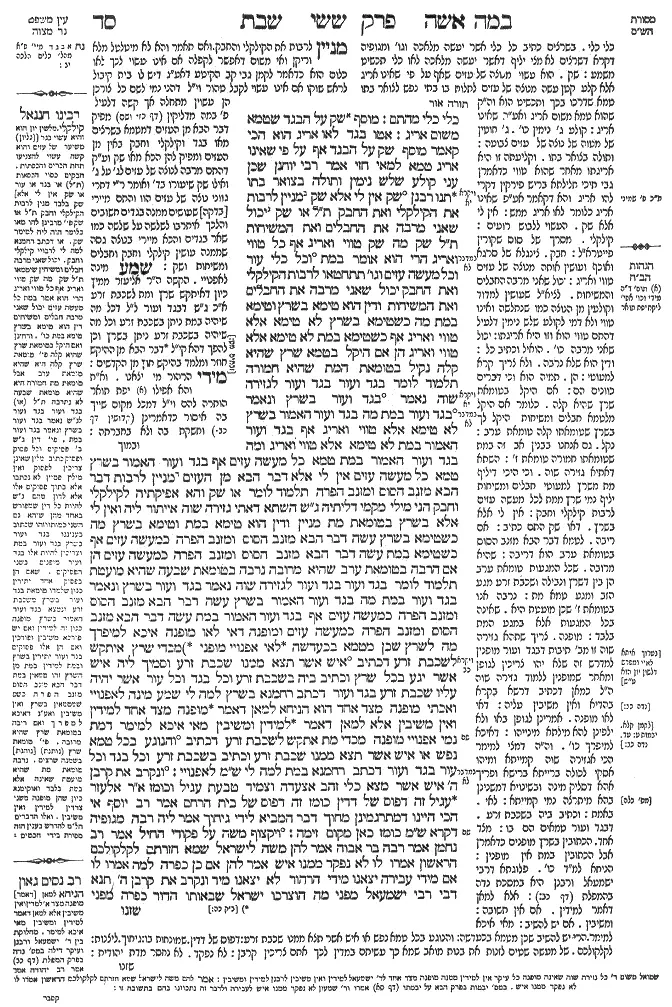
Shabbat 64a - Guemara
כלי כלי מהתם:
מוסף שק על הבגד שטמא משום אריג:
אטו בגד לאו אריג הוא הכי קאמר מוסף שק על הבגד אף על פי שאינו אריג טמא למאי חזי אמר רבי יוחנן שכן עני קולע שלש נימין ותולה בצואר בתו תנו רבנן (ויקרא יא, לב) שק אין לי אלא שק מניין לרבות את הקילקלי ואת החבק ת"ל או שק יכול שאני מרבה את החבלים ואת המשיחות ת"ל שק מה שק טווי ואריג אף כל טווי ואריג הרי הוא אומר במת (במדבר לא, כ) וכל כלי עור וכל מעשה עזים וגו' תתחטאו לרבות הקילקלי ואת החבק יכול שאני מרבה את החבלים ואת המשיחות ודין הוא טימא בשרץ וטימא במת מה כשטימא בשרץ לא טימא אלא טווי ואריג אף כשטימא במת לא טימא אלא טווי ואריג הן אם היקל בטמא שרץ שהיא קלה נקיל בטומאת המת שהיא חמורה תלמוד לומר בגד ועור בגד ועור לגזירה שוה נאמר (ויקרא יא, לב) בגד ועור בשרץ ונאמר (במדבר לא, כ) בגד ועור במת מה בגד ועור האמור בשרץ לא טימא אלא טווי ואריג אף בגד ועור האמור במת לא טימא אלא טווי ואריג ומה בגד ועור האמור במת טמא כל מעשה עזים אף בגד ועור האמור בשרץ טמא כל מעשה עזים אין לי אלא דבר הבא מן העזים מניין לרבות דבר הבא מזנב הסוס ומזנב הפרה תלמוד לומר או שק והא אפיקתיה לקילקלי וחבק הני מילי מקמי דליתיה ג"ש השתא דאתי גזירה שוה אייתור ליה ואין לי אלא בשרץ בטומאת מת מניין ודין הוא טימא במת וטימא בשרץ מה כשטימא בשרץ עשה דבר הבא מזנב הסוס ומזנב הפרה כמעשה עזים אף כשטימא במת עשה דבר הבא מזנב הסוס ומזנב הפרה כמעשה עזים הן אם הרבה בטומאת ערב שהיא מרובה נרבה בטומאת שבעה שהיא מועטת תלמוד לומר בגד ועור בגד ועור לגזירה שוה נאמר בגד ועור בשרץ ונאמר בגד ועור במת מה בגד ועור האמור בשרץ עשה דבר הבא מזנב הסוס ומזנב הפרה כמעשה עזים אף בגד ועור האמור במת עשה דבר הבא מזנב הסוס ומזנב הפרה כמעשה עזים ומופנה דאי לאו מופנה איכא למיפרך מה לשרץ שכן מטמא בכעדשה לאי אפנויי מופני) מכדי שרץ איתקש לשכבת זרע דכתיב (ויקרא כב, ד) איש אשר תצא ממנו שכבת זרע וסמיך ליה איש אשר יגע בכל שרץ וכתיב ביה בשכבת זרע וכל בגד וכל עור אשר יהיה עליו שכבת זרע בגד ועור דכתב רחמנא בשרץ למה לי שמע מינה לאפנויי ואכתי מופנה מצד אחד הוא הניחא למאן דאמר מופנה מצד אחד למידין ואין משיבין אלא למאן דאמר למידין ומשיבין מאי איכא למימר דמת נמי אפנויי מופנה מכדי מת אתקש לשכבת זרע דכתיב (ויקרא כב, ד) והנוגע בכל טמא נפש או איש אשר תצא ממנו שכבת זרע וכתיב בשכבת זרע וכל בגד וכל עור בגד ועור דכתב רחמנא במת למה לי ש"מ לאפנויי:
(במדבר לא, נ) ונקרב את קרבן ה' איש אשר מצא כלי זהב אצעדה וצמיד טבעת עגיל וכומז א"ר אלעזר עגיל זה דפוס של דדין כומז זה דפוס של בית הרחם אמר רב יוסף אי הכי היינו דמתרגמינן מחוך דבר המביא לידי גיחוך אמר ליה רבה מגופיה דקרא ש"מ כומז כאן מקום זימה:
(במדבר לא, יד) ויקצוף משה על פקודי החיל אמר רב נחמן אמר רבה בר אבוה אמר להן משה לישראל שמא חזרתם לקלקולכם הראשון אמרו לו לא נפקד ממנו איש אמר להן אם כן כפרה למה אמרו לו אם מידי עבירה יצאנו מידי הרהור לא יצאנו מיד ונקרב את קרבן ה' תנא דבי רבי ישמעאל מפני מה הוצרכו ישראל שבאותו הדור כפרה מפני
Comments from Rashi on Masechet Shabbat Page 64a
כלי כלי . בשרצים כתיב כל כלי אשר יעשה מלאכה וגו' ומגופיה דקרא דשרצים לא מצי יליף דאשר יעשה מלאכה לאו כלי תכשיט משמע: שק . הוא עשוי מנוצה של עזים שאף על פי שאינו אריג אלא קלע קטן עשה מנוצה של עזים לתלות בו בתי נפש לצואר בתו טמא שדרכו בכך ותכשיט הוא וה"ק שהוא טמא משום אריג ואע"פ שאינו אריג: קולע ג' נימין כו' . ג' חוטין של מטוה של נוצה של עזים צבועה: ותולה בצואר בתו . וקליעתה זו היא אריגתו מאחר שהוא טווי כדאמרן גבי תיכי חלילתא בריש פירקין דקרי להו אריג והא דקאמר אע"פ שאינו אריג כלומר לאו אריג ממש: אין לי אלא שק . העשוי ללבוש רועים: קילקלי . מסרך של סוס שקורין פייטרא"ל: חבק צינגלא של סרגא ואוכף ועושין אותה מנוצה של עזים טווי ואריג: יכול שאני מרבה החבלים והמשיחות . לציא"ל שעושין למדוד וקולעין מן הנוצה כמו שנתלשה ואינו טווי ולא דמי לקולע שלש נימין דלעיל דהתם טווי הוא וזו היא אריגתו: יכול שאני מרבה כו' . הואיל וכתיב כל: ודין הוא שלא נרבה . ולא צריך קרא למעוטי: הן . תמיה הוא וכי דברים כוונים הם: אם היקל בטומאת שרץ שהיא קלה . כלומר אם היקל מלטמא חבלים ומשיחות היקל לך בשרץ שטומאתו קלה טומאת ערב: נקל . גם אנחנו בבנין אב זה במת שטומאתו חמורה טומאת ז': השתא דאתיא גזירה שוה . וכי היכי דיליף מת משרץ למעוטי חבלים ומשיחות יליף נמי שרץ ממת לכל מעשה עזים לרבות קילקלי וחבק: אין לי אלא בשרץ . דאו שק התם כתיב: אם ריבה . לטמא דבר הבא מזנב הסוס בטומאת ערב הוא דריבה: שהיא מרובה . שכל המגעות טומאת ערב הן בין דשרץ ונבילה ושכבת זרע מגע הזב ומגע טמא מת: נרבה אנו בטומאת ז' שכן מועטת היא . שאינה בכל המגעות אלא במגע המת בלבד: מופנה . צריך שתהא גזירה שוה זו מב' תיבות דבגד ועור מופנין למדרש זה שלא יהו צריכין לגופן ומאחר שמופנין ללמוד גזירה שוה ה"ל כמאן דכתיב דרשא בקרא בהדיא ואין משיבין עליה: דאי לאו מופנה . אמרינן לגופן באו ולא ילפינן להא מילתא מינייהו: דאיכא למיפרך כו' . וה"ה דמצי למימר הכי אגזירה שוה קמייתא ומיהו אסקי לכולה ברייתא ברישא ופריך אהא דסליק מינה ובשינויא דמשנינן בהא מתרצה נמי קמייתא: לאי . באמת: וכתיב ביה בשכבת זרע . דבגד ועור טמאים הם בו: מצד אחד . הכתובין בשרץ מופנים כדאמרן אבל הכתובין במת אין מופנין: הניחא למ"ד כו' . פלוגתא דרבי ישמעאל ורבנן היא במסכת נדה בהמפלת (דף כב:): אלא למאן דאמר למידין . אם אין תשובה: ומשיבין . אם יש להשיב: מאי איכא למימר . הרי יש להשיב שכן מטמא בכעדשה: והנוגע בכל טמא נפש או איש אשר תצא ממנו שכבת זרע: דפוס של דדין . שמונחות בו: גיחוך . ליצנות: לקלקולכם . של מעשה שטים לזנות את בנות מואב שמא כך עשיתם במדין לכך אתם צריכין קרבן: לא נפקד . לא נחסר מדת יהודית:
Comments from Tosafot - Shabbat 64a
מניין לרבות את הקילקלי והחבק . ואם תאמר והא לא מיטלטל מלא וריקן ואי משום דאפשר לקפלה אם אינו עשוי לכך לאו כלום הוא כדאמר לקמן גבי קב הקיטע דאע"ג דיש לו בית קיבול לראש שוקו אם אינו עשוי לקבל טהור וי"ל דהני נמי לשם כל צורכן הן עשוין מתחלה אך קשה דלעיל פ' במה מדליקין (שבת דף כז. ושם) מפיק דבר הבא מן העזים דמטמא בשרצים מאו בגד וקילקלי וחבק באין מן העזים ומפיק להן הכא מאו שק וע"ק דהתם מרבה לנוצה של עזים לג' על ג' ואילו שק שיעורו בד' ואומר ר"י דתרי גווני נוצה של עזים הוו והתם מיירי [בדקה] שעושים ממנה בגדים חשובים והלכך איתרבו לשלשה על שלשה כמו שאר בגדים והכא מיירי בנוצה גסה שממנה עושין קילקלי וחבק וחבלים ומשיחות ושק: שמע מינה לאפנויי . הקשה ה"ר אליעזר ממיץ כיון דאיתקש שרץ ומת לשכבת זרע א"כ ג"ש דבגד ועור ל"ל דכל מה שיהיה במת ניתן בשכבת זרע וכל מה שיהיה בשכבת זרע ניתן בשרץ וכן להפך דהא קי"ל דבר הבא מן ההיקש חוזר ומלמד בהיקש חוץ מן הקדשים: מידי הרהור מי יצאנו . וא"ת והא אפילו יפת תואר הותרה להם וי"ל דמכל מקום שייך בה איסור כדאמרינן (קדושין דף כב.) וחשקת בה ולא בחברתה:
Shabbat 64a - Mishnah translated into english
from the word vessel written there, with regard to the halakhot of ritual impurity imparted by a corpse, and the word vessel written with regard to the halakhot of other impurities.
It was taught in the baraita that a sack is added to the category of “garment”; it too is ritually impure due to woven fabric. The Gemara asks: Is that to say that a garment is not a woven fabric? Rather, the statement should be emended and say as follows: A sack made from goat hair is added to the category of garment; even though it is not woven it can nevertheless become ritually impure. The Gemara asks: For what is a garment made of unwoven goat hair suitable? Rabbi Yoḥanan said: Since a poor person occasionally braids three goat hairs and hangs it on his daughter’s neck as an ornament.
The Sages taught a detailed halakhic exposition of that verse in a different baraita. From the fact that the verse mentioned sack, I have only derived that a whole sack can become ritually impure. From where is it derived to include even reins [kilkeli] and a saddle band fastened under the horse’s belly in the category of those objects that can become ritually impure? The verse states: “Or sack”; “or” teaches that the verse is referring to items similar to a sack as well. I might have thought, on that basis, that I should include even the ropes and measuring cords. The verse states: “Sack,” just as a sack is spun and woven, so too, everything that is spun and woven can become ritually impure. Ropes and measuring cords are not made from spun threads, and they are certainly not woven.
The baraita continues: Now, it says with regard to the halakhot of ritual impurity imparted by a corpse: “And every garment and all that is made of skins and all work of goats’ hair and all things made of wood you shall purify” (Numbers 31:20). This verse comes to include reins and the band under the horse’s belly within the category of: All work of goats’ hair. They too can become ritually impure.
I might have thought that I would include even the ropes and thin cords in this category. The Gemara begins with a logical analysis. And it may be inferred logically to the contrary, that a rope cannot become impure. The verse deemed impure an object that came in contact with a creeping animal, and it deemed impure an object that came in contact with a corpse. Just as when it rendered an object impure from contact with a creeping animal it only rendered impure objects spun and woven, as stated above; so too, when it rendered impure an object from contact with a corpse, it only rendered impure objects spun and woven.
There is room to distinguish: Are these indeed comparable? If the Torah was lenient with regard to the ritual impurity of an object that came in contact with a creeping animal, which is a less severe form of impurity, saying that ropes do not become impure from contact with that form of ritual impurity, will we be lenient with regard to ritual impurity imparted by a corpse, which is more severe? Perhaps, since impurity imparted by a corpse is more severe, even objects not woven and spun, e.g., ropes, become ritually impure from contact with it. Therefore, the verse states garment and leather, garment and leather to establish a verbal analogy.
The term garment and leather is stated with regard to ritual impurity imparted by a creeping animal: “And whatever any of them falls upon when they are dead will be impure whether it be any vessel of wood, or a garment, or leather, or sack, whatever vessel it be with which any work is done it must be put into water and it will be impure until evening, then it will be clean” (Leviticus 11:32). And garment and leather is stated with regard to ritual impurity imparted by a corpse. Just as garment and leather stated with regard to a creeping animal only rendered impure objects that are spun and woven, so too, garment and leather stated with regard to a corpse only rendered impure objects that are spun and woven.
Utilizing the same verbal analogy, one could say: And just as garment and leather stated with regard to a corpse rendered impure any object that is the work of goats’ hair, so too, garment and leather stated with regard to a creeping animal rendered impure any object that is the work of goats’ hair.
I have only derived from this verbal analogy that an object that comes from goats can become ritually impure; from where do I derive to include an item that comes from a horse’s tail or from a cow’s tail? The verse states: Or a sack, and anything like a sack, i.e., these other items as well.
The Gemara asks: Didn’t you already derive ritual impurity with regard to reins and a saddle band from this verse? How can ritual impurity for items that come from a horse’s tail and a cow’s tail be derived from the same verse?
The Gemara answers: That applies only before the verbal analogy was cited; now that the verbal analogy was cited, the verse is rendered extraneous. The fact that any item that falls in the category of: “And all work of goats’ hair,” can become ritually impure is derived from the verbal analogy. Reins and a saddle bands are included in the category of work of goats’ hair. Therefore, they need not be derived from that phrase. Consequently, a different halakha can be derived from that extraneous phrase: Objects that come from a horse’s tail or a cow’s tail can become ritually impure.
The baraita continues: And I have derived that an object made from a horse’s tail can become impure only with regard to a creeping animal; however, with regard to a corpse, from where is this derived?
The Gemara begins with a logical analysis. And it may be inferred logically that this is so. The Torah rendered impure a sack that came into contact with a corpse and rendered impure a sack that came into contact with a creeping animal. Just as when the Torah rendered items that came into contact with a creeping animal impure it made the legal status of that which comes from a horse’s tail and a cow’s tail equal to the legal status of that which is made from goats’ hair, i.e., that it contracts ritual impurity, so too when the Torah rendered impure items that came into contact with a corpse, it made the legal status of that which comes from a horse’s tail and a cow’s tail equal to the legal status of that which is made from goats’ hair.
The Gemara rejects this: Are these indeed comparable? If the verse added additional objects to the category of ritual impurity that lasts until nightfall, e.g., the impurity imparted by a creeping animal, which is extensive, will we add additional objects to the category of ritual impurity that lasts for seven days, which is limited to the case of impurity from a corpse? The fact that items made of a horse’s tail or a cow’s tail are added to the already broad category of ritual impurity that lasts until nightfall is not necessarily an indication that they are to be added to the category of ritual impurity that lasts seven days.
The verse states: Garment and leather, garment and leather to establish a verbal analogy. Garment and leather is stated with regard to ritual impurity imparted by a creeping animal, and garment and leather is stated with regard to ritual impurity imparted by a corpse. Just as with regard to the garment and leather stated in the halakhot of a creeping animal the Torah rendered the legal status of an item made from a horse’s tail or a cow’s tail equal to the legal status of that which is made from goats’ hair, so too, with regard to the garment and leather stated in the halakhot of a corpse, the Torah rendered the legal status of an item made from a horse’s tail or a cow’s tail equal to the legal status of that which is made from goats’ hair.
The Gemara notes: And it must be that the words garment and leather are free. Those terms must be superfluous in their context. The Torah included those terms for the express purpose of establishing the verbal analogy. A verbal analogy that is based on otherwise extraneous terms cannot be logically refuted. Because if these terms are not free, the verbal analogy can be refuted: What is unique to a creeping animal? Its ritual impurity is stringent in that it renders objects ritually impure even by means of contact with a lentil-bulk of a creeping animal. That is not the case with regard to a corpse, which is less severe in that it renders objects ritually impure only by means of contact with an olive-bulk of a corpse. Unless the terms are free, the analogy can be refuted.
Indeed [la’ei], they are free. The Gemara proves that the terms garment and leather are extraneous in their context. Now, since ritual impurity from contact with a creeping animal is juxtaposed to ritual impurity from contact with semen, as it is written: “And whoever touches anything that is impure by the dead or a man from whom semen is emitted” (Leviticus 22:4), and juxtaposed to that is the verse: “Or whoever touches any creeping animal which makes him impure, or a person who may make him impure with any impurity that he has” (Leviticus 22:5). And it is written in the halakhot of the ritual impurity of semen: “And every garment and every hide on which the semen is must be washed with water and will be impure until evening” (Leviticus 15:17). Since the verses appear next to each other, the halakhot of each can be derived from the other. Consequently, the words garment and leather, which the Torah wrote with regard to a creeping animal, why do I need them? The relevant halakha could be derived from the halakhot of seminal impurity. Learn from it that garment and leather were mentioned to render them free.
The Gemara comments: And still, it is free only from one side of the verbal analogy. Although the terms garment and leather stated with regard to ritual impurity imparted by a creeping animal are extraneous in their context, and the relevant halakha could have been derived in another manner, those terms stated with regard to ritual impurity imparted by a corpse are not extraneous in their context. This verbal analogy is only free from one side. It works out well according to the opinion of the one who said, with regard to a verbal analogy that is free from only one side, one can derive from it and cannot refute it logically. However, according to the opinion of the one who said that one can derive from a verbal analogy of this kind and one can refute it logically, what can be said?
The Gemara answers: Garment and leather stated with regard to impurity imparted by a corpse are also free. Now, since a corpse is juxtaposed with semen, as it is written: “And whoever touches anything that is impure by the dead or a man whose semen is emitted from him” (Leviticus 22:4); and it is stated with regard to semen: “And every garment and every hide” (Leviticus 15:17); the terms garment and leather, which the Torah wrote with regard to ritual impurity imparted by a corpse, why do I need them? Learn from it that they are mentioned in order to render them free. These terms are extraneous in their context, and were written for the purpose of the verbal analogy with the halakhot of creeping animals.
The Gemara interprets verses written with regard to the Midianite war discussed above: “And we have brought an offering before the Lord what every man has gotten of jewels of gold, chains, and bracelets, rings, agil, and kumaz, to make atonement for our souls before the Lord” (Numbers 31:50). Rabbi Elazar said: Agil is a mold in the shape of a woman’s breasts worn over them as an ornament. Kumaz is a mold in the shape of the womb.
Rav Yosef said: If so, that is the reason that we translate kumaz into Aramaic as maḥokh, meaning an item that leads to foolishness. Rabba said to him: This meaning is learned from the verse itself; kumaz is an acronym for: Here [kan] is the place of [mekom] lewdness [zimma].
Later in that chapter, it is written: “And Moses was angry with the officers of the host, the captains over thousands, and captains over hundreds, who came from the battle” (Numbers 31:14); Rav Naḥman said that Rabba bar Avuh said that Moses said to Israel: Perhaps you have returned to your original sinful behavior, when you sinned with the daughters of Moab and Midian at Shittim? They said to him: “Not one man of us is missing” (Numbers 31:49), we remain as wholesome in deed as we were. He said to them: If so, why do you need atonement? The princes brought these ornaments to atone for their souls. They said to him: If we have emerged from the grasps of actual transgression, we have not emerged from the grasps of thoughts of transgression. Immediately, they decided: “And we have brought an offering before the Lord.”
The Sage of the school of Rabbi Yishmael taught: For what reason did Israel in that generation require atonement? Because
Traduction : The William Davidson digital edition of the Koren Noé Talmud, with commentary by Rabbi Adin Even-Israel Steinsaltz.