 Talmud Bavli
The learning on the whole site is dedicated : L'ilui Nishmat אליעזר בן רחל
The learning on the whole site is dedicated : L'ilui Nishmat אסתר בת חיים
The learning on the whole site is dedicated : L'ilui Nishmat יוסף בן מושה
Shabbat 63a : Youtube
Daf TubeYoutube
3 video classes :
Shabbat Page 63a
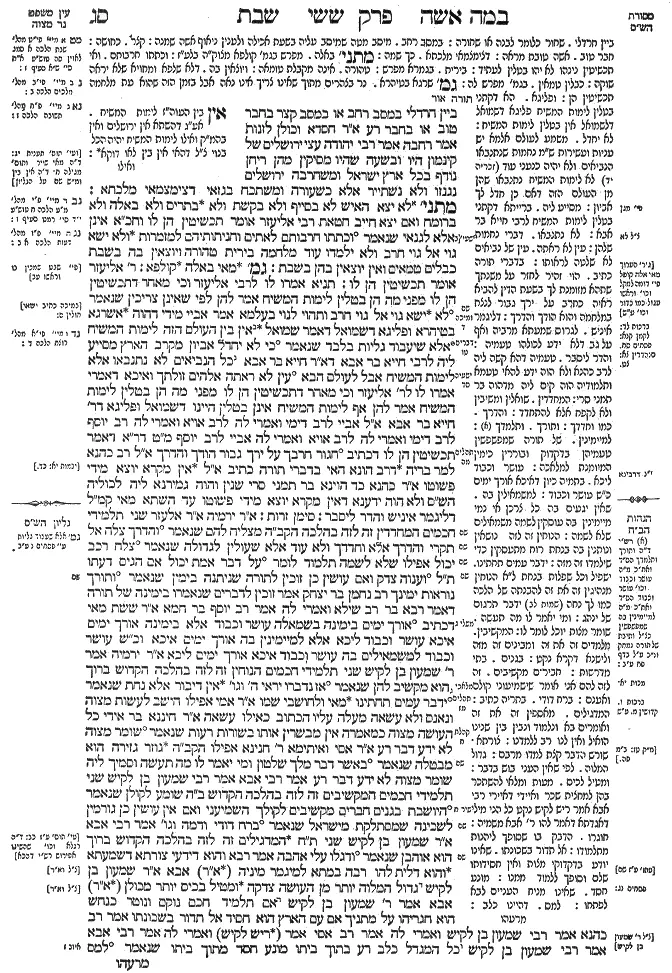
Shabbat 63a - Guemara
ביין חרדלי במסב רחב או במסב קצר בחבר טוב או בחבר רע א"ר חסדא וכולן לזנות אמר רחבה אמר רבי יהודה עצי ירושלים של קינמון היו ובשעה שהיו מסיקין מהן ריחן נודף בכל ארץ ישראל ומשחרבה ירושלים נגנזו ולא נשתייר אלא כשעורה ומשתכח בגזאי דצימצמאי מלכתא:
מתני׳ לא יצא האיש לא בסייף ולא בקשת ולא בתריס ולא באלה ולא ברומח ואם יצא חייב חטאת רבי אליעזר אומר תכשיטין הן לו וחכ"א אינן אלא לגנאי שנאמר (ישעיהו ב, ד) וכתתו חרבותם לאתים וחניתותיהם למזמרות ולא ישא גוי אל גוי חרב ולא ילמדו עוד מלחמה בירית טהורה ויוצאין בה בשבת כבלים טמאים ואין יוצאין בהן בשבת:
גמ׳ מאי באלה קולפא:
ר' אליעזר אומר תכשיטין הן לו:
תניא אמרו לו לרבי אליעזר וכי מאחר דתכשיטין הן לו מפני מה הן בטלין לימות המשיח אמר להן לפי שאינן צריכין שנאמר (ישעיהו ב, ד) לא ישא גוי אל גוי חרב ותהוי לנוי בעלמא אמר אביי מידי דהוה אשרגא בטיהרא ופליגא דשמואל דאמר שמואל אין בין העולם הזה לימות המשיח אלא שיעבוד גליות בלבד שנאמר (דברים טו, יא) כי לא יחדל אביון מקרב הארץ מסייע ליה לרבי חייא בר אבא דא"ר חייא בר אבא כל הנביאים לא נתנבאו אלא לימות המשיח אבל לעולם הבא (ישעיהו סד, ג) עין לא ראתה אלהים זולתך ואיכא דאמרי אמרו לו לר' אליעזר וכי מאחר דתכשיטין הן לו מפני מה הן בטלין לימות המשיח אמר להן אף לימות המשיח אינן בטלין היינו דשמואל ופליגא דר' חייא בר אבא א"ל אביי לרב דימי ואמרי לה לרב אויא ואמרי לה רב יוסף לרב דימי ואמרי לה לרב אויא ואמרי לה אביי לרב יוסף מ"ט דר"א דאמר תכשיטין הן לו דכתיב (תהלים מה, ד) חגור חרבך על ירך גבור הודך והדרך א"ל רב כהנא למר בריה דרב הונא האי בדברי תורה כתיב א"ל אין מקרא יוצא מידי פשוטו א"ר כהנא כד הוינא בר תמני סרי שנין והוה גמירנא ליה לכוליה הש"ס ולא הוה ידענא דאין מקרא יוצא מידי פשוטו עד השתא מאי קמ"ל דליגמר איניש והדר ליסבר:
סימן זרות:
א"ר ירמיה א"ר אלעזר שני תלמידי חכמים המחדדין זה לזה בהלכה הקב"ה מצליח להם שנאמר (תהלים מה, ה) והדרך צלח אל תקרי והדרך אלא וחדדך ולא עוד אלא שעולין לגדולה שנאמר (תהלים מה, ה) צלח רכב יכול אפילו שלא לשמה תלמוד לומר (תהלים מה, ה) על דבר אמת יכול אם הגיס דעתו ת"ל (תהלים מה, ה) וענוה צדק ואם עושין כן זוכין לתורה שניתנה בימין שנאמר (תהלים מה, ה) ותורך נוראות ימינך רב נחמן בר יצחק אמר זוכין לדברים שנאמרו בימינה של תורה דאמר רבא בר רב שילא ואמרי לה אמר רב יוסף בר חמא א"ר ששת מאי דכתיב (משלי ג, טז) אורך ימים בימינה בשמאלה עושר וכבוד אלא בימינה אורך ימים איכא עושר וכבוד ליכא אלא למיימינין בה אורך ימים איכא וכ"ש עושר וכבוד למשמאילים בה עושר וכבוד איכא אורך ימים ליכא א"ר ירמיה אמר ר' שמעון בן לקיש שני תלמידי חכמים הנוחין זה לזה בהלכה הקדוש ברוך הוא מקשיב להן שנאמר (מלאכי ג, טז) אז נדברו יראי ה' וגו' אין דיבור אלא נחת שנאמר (תהלים מז, ד) ידבר עמים תחתינו מאי ולחושבי שמו א"ר אמי אפילו חישב לעשות מצוה . ונאנס ולא עשאה מעלה עליו הכתוב כאילו עשאה א"ר חיננא בר אידי כל העושה מצוה כמאמרה אין מבשרין אותו בשורות רעות שנאמר (קהלת ח, ה) שומר מצוה לא ידע דבר רע א"ר אסי ואיתימא ר' חנינא אפילו הקב"ה גוזר גזירה הוא מבטלה שנאמר (קהלת ח, ד) באשר דבר מלך שלטון ומי יאמר לו מה תעשה וסמיך ליה שומר מצוה לא ידע דבר רע אמר רבי אבא אמר רבי שמעון בן לקיש שני תלמידי חכמים המקשיבים זה לזה בהלכה הקדוש ב"ה שומע לקולן שנאמר (שיר השירים ח, יג) היושבת בגנים חברים מקשיבים לקולך השמיעני ואם אין עושין כן גורמין לשכינה שמסתלקת מישראל שנאמר (שיר השירים ח, יד) ברח דודי ודמה וגו' אמר רבי אבא א"ר שמעון בן לקיש שני ת"ח המדגילים זה לזה בהלכה הקדוש ברוך הוא אוהבן שנאמר (שיר השירים ב, ד) ודגלו עלי אהבה אמר רבא והוא דידעי צורתא דשמעתא והוא דלית להו רבה במתא למיגמר מיניה (א"ר) אבא א"ר שמעון בן לקיש גדול המלוה יותר מן העושה צדקה ומטיל בכיס יותר מכולן (א"ר) אבא אמר ר' שמעון בן לקיש אם תלמיד חכם נוקם ונוטר כנחש הוא חגריהו על מתניך אם עם הארץ הוא חסיד אל תדור בשכונתו אמר רב כהנא אמר רבי שמעון בן לקיש ואמרי לה אמר רב אסי אמר (ריש לקיש) ואמרי לה אמר רבי אבא אמר רבי שמעון בן לקיש כל המגדל כלב רע בתוך ביתו מונע חסד מתוך ביתו שנאמר (איוב ו, יד) למס
Comments from Rashi on Masechet Shabbat Page 63a
ביין חרדלי . שחור כלומר לבנה או שחורה: במסב רחב . מיסב מטה שמיסב עליה בשעת אכילה ולענין ניאוף אשה שמנה: קצר . כחושה: חבר טוב . אשה טובת מראה: דצימצמאי מלכתא . כך שמה: מתני' באלה . מפרש בגמ' קולפא מצוק"ה בלע"ז: וכתתו חרבותם . ואי תכשיטין נינהו לא יהו בטלין לעתיד: בירית . בגמרא מפרש: טהורה . אינה מקבלת טומאה: ויוצאין בה . דלא שלפא ומחויא שלא יראה שוקה: כבלין טמאין . בגמ' מפרש לה: גמ' שרגא בטיהרא . נר בצהרים מתוך שאינו צריך אינו נאה אבל בזמן הזה שהוא עת מלחמה תכשיטין הן: ופליגא . הא דקתני בטלין לימות המשיח פליגא דשמואל דלשמואל אין בטלין לימות המשיח: לא יחדל . משמע לעולם אלמא יש עניות ועשירות ש"מ נחמות שנתנבאו הנביאים ולא יהיה כנעני עוד (זכריה יד) לא לימות המשיח נתנבאו שהן מן העולם הזה דאם כן חדל לך אביון: מסייע ליה . ברייתא דקתני בטלין לימות המשיח לרבי חייא בר אבא: לא נתנבאו . דברי נחמות שלהן: עין לא ראתה . עין של נביאים לא שלטה לראותו: בדברי תורה כתיב . הוי זהיר לחזר על משנתך שתהא מזומנת לך בשעת הדין להביא ראיה כחרב על ירך גבור לנצח במלחמה והוא הודך והדרך: דליגמר איניש . לגרוס שמעתא מרביה ואף על גב דלא ידע לכולהו טעמיה: והדר ליסבר . טעמיה דהא קשה ליה לרב כהנא ולא הוה ידע להאי טעמא ותלמודיה הוה קים ליה מדהוה בר תמני סרי: המחדדין . שואלין ומשיבין ולא לקפח אלא להתחדד: והדרך . כמו וחדדך: ותורך . ותלמדך: עושר וכבוד ליכא . בתמיה כיון דאיכא אורך ימים כ"ש עושר וכבוד: למיימינין . של תורה שמפשפשין טעמיהן בדקדוק ובוררין כימין המיומנת למלאכה: למשמאלין בה . שאין יגעים בה כל צרכן אי נמי מיימינין בה עוסקין לשמה משמאילים שלא לשמה: הנוחין זה לזה . נושאין ונותנין בה בנחת רוח מתעסקין כדי שילמדו זה מזה: ידבר עמים תחתינו . ישפיל וכל שפלות בנחת ל"א הנוחין מנהיגין זה את זה להבנתה של הלכה כמו לך נחה (שמות לב) ידבר תרגום של ינהג: ומי יאמר לו מה תעשה . שומר מצות יוכל לומר לו: המקשיבין . מלמדים זה את זה ומבינים זה מזה ולישנא דקרא נקט: בגנים . בתי מדרשות: חבירים מקשיבים . זה לזה להם אני אומר שישמיעוני קולם ואענם: ברח דודי . בתריה כתיב: המדגילים . מאספין זה את זה ואומרים בא ונלמוד ונבין בין שנינו הואיל ואין לנו רב ללמדנו: צורתא . שורש הדבר קצת למדו מרבם: גדול המלוה . לפי שאין העני בוש בדבר: ומטיל לכיס . מעות ומלאי להשתכר בהן למחצית שכר ואיידי דאיירי רבי אבא אמר ריש לקיש נקט כל הני מילי דאגדתא דאמר להו ר' אבא משמיה: חוגרו . הדבק בו שסופך ליהנות מתלמודו אל תדור בשכונתו . שאינו יודע בדקדוקי מצות ואין חסידותו שלם וסופך ללמוד ממנו: מונע חסד . שאינו מניח העניים לבא לפתחו: למס . דהיינו כלב:
Comments from Tosafot - Shabbat 63a
אין בין העוה"ז לימות המשיח . אע"ג דהשתא אין ירושלים ואין בהמ"ק ואילו לימות המשיח יהיה הכל בנוי צ"ל דהאי אין בין לאו דוקא:
Shabbat 63a - Mishnah translated into english
on black wine? Sitting on a wide divan or on a narrow divan? With a good friend or a bad friend? And Rav Ḥisda said: And all these allude to promiscuity. These are all euphemisms for different types of women. Well-kneaded bread refers to a woman who is not a virgin; white wine refers to a fair-complexioned woman; a wide divan refers to a fat woman; a good friend refers to a good-looking woman.
On the topic of Jerusalem, Raḥava said that Rabbi Yehuda said: The logs of Jerusalem used for fuel were from the cinnamon tree, and when they would ignite them, their fragrance would waft through all of Eretz Yisrael. And since Jerusalem was destroyed, these fragrant logs were buried, and only a sliver the size of a grain of barley remains, and it is located in the treasury of [gazzai] Tzimtzemai the queen.
MISHNA: Just as it is prohibited for a woman to carry out certain items unique to a woman into the public domain, the Sages said that a man may neither go out on Shabbat with a sword, nor with a bow, nor with a shield [teris], nor with an alla, nor with a spear. And if he unwittingly went out with one of these weapons to the public domain he is liable to bring a sin-offering.
Rabbi Eliezer says: These weapons are ornaments for him; just as a man is permitted to go out into the public domain with other ornaments, he is permitted to go out with weapons.
And the Rabbis say: They are nothing other than reprehensible and in the future they will be eliminated, as it is written: “And they shall beat their swords into plowshares and their spears into pruning hooks; nation will not raise sword against nation, neither will they learn war anymore” (Isaiah 2:4).
With regard to women’s ornaments, they added that a garter placed on her leg to hold up stockings is pure and cannot become ritually impure as a utensil, and she may even go out with it on Shabbat.
However, ankle chains, which were also women’s ornaments, can become ritually impure, and she may not go out with them on Shabbat.
GEMARA: The Gemara asks: What is the meaning of the term alla? It means club [kulpa].
We learned in the mishna that Rabbi Eliezer says: These weapons are ornaments for him. It was taught in a baraita that elaborates on this subject: The Rabbis said to Rabbi Eliezer: And since, in your opinion, they are ornaments for him, why are they to be eliminated in the messianic era? He said to them: They will not be needed anymore, as it is stated: “Nation will not raise sword against nation” (Isaiah 2:4). The Gemara asks: And let the weapons be merely for ornamental purposes, even though they will not be needed for war. Abaye said: It is just as in the case of a candle in the afternoon. Since its light is not needed, it serves no ornamental purpose. Weapons, too; when not needed for war, they serve no ornamental purpose either.
And this baraita disagrees with the opinion of Shmuel, as Shmuel said: The only difference between this world and the messianic era is subjugation of the exiles to other kingdoms, from which the Jewish people will be released. However, in other respects, the world will remain as it is, as it is written: “Because the poor will not cease from within the land” (Deuteronomy 15:11). Society will not change, and wars will continue to be waged.
However, this baraita supports the opinion of Rabbi Ḥiyya bar Abba who disagrees with Shmuel. As Rabbi Ḥiyya bar Abba said: All of the prophets only prophesied with regard to the messianic era; however, with regard to the World-to-Come it was stated: “No eye sees, God, except You, that which He will do for he that waits for Him” (Isaiah 64:3). What will be in the World-to-Come cannot be depicted even by means of prophecy.
And some say the disagreement between Rabbi Eliezer and the Rabbis was different. They said to Rabbi Eliezer: Since in your opinion they are ornaments for him, why will they be eliminated in the messianic era? He said to them: Even in the messianic era they will not be eliminated. And that is in accordance with that which Shmuel stated that the world will remain fundamentally the same, and he disagrees with Rabbi Ḥiyya bar Abba.
Abaye said to Rav Dimi, and some say it was to Rav Avya, and some say Rav Yosef said to Rav Dimi, and some say it was to Rav Avya, and some say Abaye said to Rav Yosef: What is the reason for the opinion of Rabbi Eliezer who said: These weapons are ornaments for him? As it is written: “Gird your sword upon your thigh, mighty one, your glory and your splendor” (Psalms 45:4), indicating that a sword is considered an ornament.
The Gemara relates that some time later Rav Kahana said to Mar, son of Rav Huna: Is that really a proof? This verse is written in reference to matters of Torah and should be interpreted as a metaphor. He said to him: Nevertheless, a verse does not depart from its literal meaning, although there may be additional homiletical interpretations.
Rav Kahana said about this: When I was eighteen years old and had already learned the entire Talmud, and yet I did not know that a verse does not depart from its literal meaning until now. The Gemara asks: What is Rav Kahana teaching us with that statement? The Gemara answers: He comes to teach that a person should first learn and then understand the rationale.
Zarot is a mnemonic acronym for Elazar [zayin], Reish Lakish [reish], and their students [vav, tav], the amoraim who interpreted the verse in Psalms cited above
Rabbi Yirmeya said that Rabbi Elazar said: Two Torah scholars who sharpen one another in halakha; the Holy One, Blessed be He, ensures success for them, as it is written: “And in your majesty [vahadarkha] prosper, ride on, in behalf of truth and meekness and righteousness; and let your right hand teach you tremendous things” (Psalms 45:5). The Sages said:
Do not read “and your majesty [vahadarkha],” rather, by changing some of the vocalization and the letters, read it as and He will sharpen you [veḥidedkha], and ultimately you will be successful.
Moreover, they who act in that manner will rise to prominence, as it is written: “Prosper, ride on.”
I might have thought even if one engages in the study of Torah not for its own sake; therefore, the verse states: “On behalf of truth.”
I might have thought that one would be rewarded with prosperity even if he became arrogant; therefore, the verse states: “Meekness and righteousness.”
And if they do so in the proper manner they merit the Torah that was given with the right hand of the Holy One, Blessed be He, as it is written: “And let your right hand teach you tremendous things” (Psalms 45:5).
Rav Naḥman bar Yitzḥak said: They are rewarded with the matters stated with regard to the right hand of the Torah. As Rava bar Rav Sheila said and some say Rav Yosef bar Ḥama said that Rav Sheshet said: What is the meaning of that which is written, “Length of days is in her right hand and in her left hand are riches and honor” (Proverbs 3:16)? Is that to say, however, that in her right there is length of days, but there are not riches and honor? Rather, it means: Those who relate to it with the skilled right hand, i.e., who study Torah for its own sake and with proper intentions, there is length of days and all the more so riches and honor for them. Whereas, those who relate to it with the unskilled left hand, there are riches and honor; there is not length of days.
Rabbi Yirmeya said that Rabbi Shimon ben Lakish said: Two Torah scholars who are agreeable to each other when engaging in discussions of halakha, the Holy One, Blessed be He, listens to them, as it is stated: “Then they that feared the Lord spoke [nidberu] one with another; and the Lord hearkened, and heard, and a book of remembrance was written before Him, for them that fear the Lord, and that think upon His name” (Malachi 3:16). And the term speech [dibbur] means nothing other than calm, as it is stated: “He subdues [yadber] people under us” (Psalms 47:4). He will cause the nations to submit to the Jewish people leading to a period of calm. Here too the term dibbur indicates calm and agreeability.
The Gemara asks: What is the meaning of the phrase in that verse: “And that think upon His name”? Rabbi Ami said: Even if one merely planned to perform a mitzva, and ultimately due to circumstances beyond his control did not perform that mitzva, the verse ascribes him credit as if he performed it.
The Gemara continues in praise of those who perform mitzvot: Rav Ḥinnana bar Idi said: Anyone who performs a mitzva as it was commanded, others do not apprise him of bad tidings, as it is stated: “He who keeps the commandment shall know no evil thing” (Ecclesiastes 8:5).
Rav Asi, and some say Rabbi Ḥanina said: Even if the Holy One, Blessed be He, issued a decree, He may abrogate it, as it is stated: “For the word of the King has authority and who may say to Him: What do You do?” (Ecclesiastes 8:4). And, although this indicates that even though the King, God, issued a decree, juxtaposed to it is the verse: “He who guards the commandment shall know no evil thing” (Ecclesiastes 8:5). For one who observes mitzvot properly, the decree is abrogated and he will know no evil.
Rabbi Abba said that Rabbi Shimon ben Lakish said: Two Torah scholars who listen to each other in the discussion of halakha, the Holy One, Blessed be He, hears their voice, as it is stated: “You who dwell in gardens, the companions heed your voice, cause me to hear it” (Song of Songs 8:13).
And if they do not do so, i.e., they do not listen to each other, they cause the Divine Presence to depart from among Israel, as it is stated in the following verse: “Run away, my beloved, and be like a gazelle or a young hart upon the mountains of spices” (Song of Songs 8:14).
Rabbi Abba said that Rabbi Shimon ben Lakish said: Two individual Torah scholars who, while studying together, cause one another to err [madgilim] in halakha [Tosafot], nevertheless, the Holy One, Blessed be He, loves them, as it is stated: “And his banner [vediglo] over me is love” (Song of Songs 2:4). Rava said: And that is only true in a case where they know the foundation of the law, and their error resulted from the lack of more sophisticated knowledge. And that is only true in a case where they do not have a prominent person in the city from whom they could learn without error.
Rabbi Abba said that Rabbi Shimon ben Lakish said: One who loans another money is greater than one who gives him charity. And the one who places money into a common purse, i.e., one who enters into a partnership with a needy person, is the greatest of them all, since in that case the needy person is not embarrassed when receiving the assistance.
Rabbi Abba said that Rabbi Shimon ben Lakish said: Even if a Torah scholar is as vengeful and begrudging as a snake, wrap him tightly around your waist, i.e., keep him close, because you will benefit from his Torah. On the other hand, even if an am ha’aretz is righteous, do not dwell in his neighborhood, as his righteousness does not compensate for the fact that he is ignorant.
Rav Kahana said that Rabbi Shimon ben Lakish said, and some say Rav Asi said that Reish Lakish said, and some say Rabbi Abba said that Rabbi Shimon ben Lakish said: Anyone who raises an evil dog within his home prevents kindness from entering into his home, since poor people will hesitate to enter his house. As it is alluded to in the verse: “To him that is afflicted [lamas],
Traduction : The William Davidson digital edition of the Koren Noé Talmud, with commentary by Rabbi Adin Even-Israel Steinsaltz.