 Talmud Bavli
The learning on the whole site is dedicated : L'ilui Nishmat Reuven ben Rivka SEBBAG
The learning on the whole site is dedicated : L'ilui Nishmat אסתר בת חיים
The learning on the whole site is dedicated : L'ilui Nishmat Avraham Ben Simha
Sanhedrin 40b : Youtube
Daf TubeYoutube
2 video classes :
Sanhedrin Page 40b
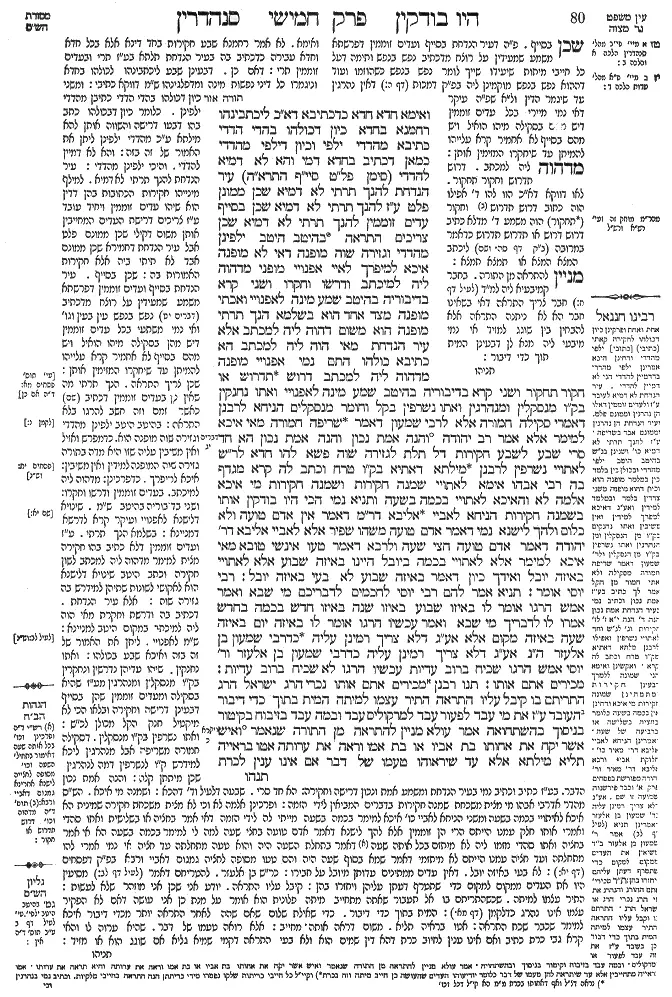
Sanhedrin 40b - Guemara
ואימא חדא חדא כדכתיבא דא"כ ליכתבינהו רחמנא בחדא כיון דכולהו בהדי הדדי כתיבא מהדדי ילפי וכיון דילפי מהדדי כמאן דכתיב בחדא דמי והא לא דמיא להדדי (סימן פל"ט סיי"ף התרא"ה) עיר הנדחת להנך תרתי לא דמיא שכן ממונן פלט ע"ז להנך תרתי לא דמיא שכן בסייף עדים זוממין להנך תרתי לא דמיא שכן צריכים התראה בהיטב היטב ילפינן מהדדי וגזירה שוה מופנה דאי לא מופנה איכא למיפרך לאיי אפנויי מופני מדהוה ליה למיכתב ודרשו וחקרו ושני קרא בדיבוריה בהיטב שמע מינה לאפנויי ואכתי מופנה מצד אחד הוא בשלמא הנך תרתי מופנה הוא משום דהוה ליה למכתב אלא עיר הנדחת מאי הוה ליה למכתב הא כתיבא כולהו התם נמי אפנויי מופנה מדהוה ליה למכתב דרוש תדרוש או חקור תחקור ושני קרא בדיבוריה בהיטב שמע מינה לאפנויי ואתו נחנקין בק"ו מנסקלין ומנהרגין ואתו נשרפין בקל וחומר מנסקלים הניחא לרבנן דאמרי סקילה חמורה אלא לרבי שמעון דאמר שריפה חמורה מאי איכא למימר אלא אמר רב יהודה (דברים יג, טו) והנה אמת נכון והנה אמת נכון הא חד סרי שבע לשבע חקירות דל תלת לגזירה שוה פשא להו חדא לר"ש לאתויי נשרפין לרבנן מילתא דאתיא בק"ו טרח וכתב לה קרא מגדף בה רבי אבהו אימא לאתויי שמנה חקירות ושמנה חקירות מי איכא אלמה לא והאיכא לאתויי בכמה בשעה ותניא נמי הכי היו בודקין אותו בשמנה חקירות הניחא לאביי אליבא דר"מ דאמר אין אדם טועה ולא כלום ולהך לישנא נמי דאמר אדם טועה משהו שפיר אלא לאביי אליבא דר' יהודה דאמר אדם טועה חצי שעה ולרבא דאמר טעו אינשי טובא מאי איכא למימר אלא לאתויי בכמה ביובל היינו באיזה שבוע אלא לאתויי באיזה יובל ואידך כיון דאמר באיזה שבוע לא בעי באיזה יובל:
רבי יוסי אומר:
תניא אמר להם רבי יוסי לחכמים לדבריכם מי שבא ואמר אמש הרגו אומר לו באיזו שבוע באיזו שנה באיזו חדש בכמה בחדש אמרו לו לדבריך מי שבא ואמר עכשיו הרגו אומר לו באיזה יום באיזה שעה באיזה מקום אלא אע"ג דלא צריך רמינן עליה כדרבי שמעון בן אלעזר ה"נ אע"ג דלא צריך רמינן עליה כדרבי שמעון בן אלעזר ור' יוסי אמש הרגו שכיח ברוב עדיות עכשיו הרגו לא שכיח ברוב עדיות:
מכירים אתם אותו:
תנו רבנן מכירים אתם אותו נכרי הרג ישראל הרג התריתם בו קיבל עליו התראה התיר עצמו למיתה המית בתוך כדי דיבור העובד ע"ז את מי עבד לפעור עבד למרקוליס עבד ובמה עבד בזיבוח בקיטור בניסוך בהשתחואה אמר עולא מניין להתראה מן התורה שנאמר (ויקרא כ, יז) ואיש אשר יקח את אחותו בת אביו או בת אמו וראה את ערותה אטו בראייה תליא מילתא אלא עד שיראוהו טעמו של דבר אם אינו ענין לכרת
Comments from Rashi on Masechet Sanhedrin Page 40b
ואימא . לא אמר רחמנא שבע חקירות בחד דינא אלא בכל חדא וחדא עבירה כדכתיב בה בעיר הנדחת תלתא בע"ז תרי ובעדים זוממין תרי: דאם כן . דבעינן שבע ליכתבינהו לכולהו בחדא וניגמרו כל דיני נפשות מינה ומדפלגינהו ש"מ דווקא כתיבי: ומשני כיון דכולהו בהדי הדדי כתיבן מהדדי ילפינן . כלומר כיון דבכולהו כתב בהו דבעו דרישה והשווה אותן להא מילתא ע"כ מהדדי ילפינן ליתן את האמור של זה בזה: והא לא דמיין להדדי . והיכי ילפינן מהדדי: עיר הנדחת להנך תרתי לא דמיא . למילף מינייהו חקירות הכתובות בהן דדין הוא שיהו עדים זוממין ויחיד עובד ע"ז צריכים דרישת העדים המחייבין אותן משום דקילי שכן ממונם פלט אבל עיר הנדחת דחמירא שכן ממונם אבד לא תיתי ביה אלא חקירות האמורות בה: שכן בסייף . עיר הנדחת בסייף ועדים זוממין דפרשתא משמע שמעידין על רוצח מדכתיב (דברים יט) נפש בנפש עין בעין וגו' ואי נמי משתעי בכל עדים זוממין דיש מהן בסקילה מיהו הואיל ויש מהם בסייף לא אחמיר קרא עלייהו להמיתן עד שיחקרו המזימין אותן: שכן צריך התראה . הנך תרתי מה שאין כן בעדים זוממין דכתיב (שם) כאשר זמם וזה חשב להרגו בלא התראה: בהיטב היטב ילפינן מהדדי וגזירה שוה מופנה הוא . כדמפרש ואזיל ואין משיבין עליה שזו היא מדה בתורה גזירה שוה המופנה למידין ואין משיבין: איכא למיפרך . כדפרכינן: מדהוה ליה למיכתב . בעדים זוממין ודרשו וחקרו: ושני בדיבוריה בהיטב ש"מ . שינויא דלישנא לאפנויי ועיקר קרא לדרשא דמניינא: בשלמא הנך תרתי . ע"ז ועדים זוממין דלא כתיב בהו חקירה מצית למימר מדהוה ליה למכתב לשון חקירה וכתב היטב שינויא דלישנא הוא לאקושי לשונות שתיהן למידרש בה גזירה שוה: אלא עיר הנדחת . דכתיב בה ודרשת וחקרת מאי הוה ליה למיכתב במקום היטב למניינא: ש"מ לאפנויי . ליתן את האמור של זה בזה ואיכא שבע בכולהו: ואתו נחנקין . שיהו עדיהן נדרשין ונחקרין בק"ו מנסקלין ומנהרגין מע"ז שהיא בסקילה ומעדים זוממין שהן בסייף דבעינן דרישה וחקירה ובלאו הכי לא מיקטיל חנק הקל מכולן לכ"ש: ואתו נשרפין בק"ו מנסקלין . דסקילה חמורה משריפה אבל מנהרגין ליכא למידרש ק"ו לנשרפין דמה לנהרגין שכן מיתתן קלה: והנה אמת נכון הדבר . בע"ז כתיב וכתיב נמי בעיר הנדחת ומשמע אמת ונכון דרישה וחקירה: הא חד סרי . שבעה דלעיל וד' דהכא: ושמנה מי איכא . הש"ס מהדר אדרבי אבהו מי מצית משכחת שמנה חקירות בדברים המביאין לידי הזמה: ופרכינן אלמה לא וכי לא מצית משכחת חקירה שמינית הא איכא לאיתויי בכמה בשעה: ומשני הניחא לאביי כו' איכא למימר בכמה בשעה מייתי לה לידי הזמה דאי אמר בחציה או בשלישית ואתו סהדי ואמרי אותו חלק עמנו הייתם הרי הן זוממין אלא להך לישנא דאמר אדם טועה בחצי שעה למה לי למימר בכמה בשעה הא אי אמר בחציה ואתו סהדי מזמו ליה לא מיתזם בכל אותה שעה דאמר בתחלת השעה היה והוא טעה מתחלתה עד חציה אי נמי אמרי להו מתחלתה ועד חציה עמנו הייתם לא מיתזמי דאמר שמא בסוף שעה היה והם טעו מסופה לחציה. גמגום. דאביי ורבא בפ"ק דפסחים (דף יא:): לא בעי באיזה יובל . דאין עדים ממתינים עדותן מיובל על חבירו: כר"ש בן אלעזר . להטריחם דאמר (לעיל סנהדרין דף לב:) מסיעין היו את העדים ממקום למקום כדי שתטרף דעתן עליהן ויחזרו בהן: קיבל עליו התראה . יודע אני שכן אני מוזהר שלא לעשות: התיר עצמו למיתה . שכשהתריתם בו אל תעבור שאתה מתחייב מיתה פלונית הוא אומר על מנת כן אני עושה דאם לא הפקיר עצמו אינו נהרג כדלקמן (סנהדרין דף מא.): המית בתוך כדי דיבור . כדי שאילת שלום שאם שהה לאחר התראה יותר מכדי דיבור איכא למימר שכבר שכח התראה: אטו בראיה תליא . משום דראה אותה מחייב: אלא רואה טעמו של דבר . שהיא ערוה לו והאי קרא גבי כרת כתיב ואם אינו ענין לחיוב כרת דהא דין שמים הוא ולא בעי התראה דקמי שמיא גליא אם שוגג הוא או מזיד:
Comments from Tosafot - Sanhedrin 40b
שכן בסייף . פ"ה דעיר הנדחת בסייף ועדים זוממין דפרשתא משמע שמעידין על רוצח מדכתיב נפש בנפש ותימה דעל כל חייבי מיתות שיעידו שייך לומר נפש בנפש כשהוזמו ועוד דההוא נפש בנפש מוקמינן ליה בפ"ק דמכות (דף ה:) דאין נהרגין עד שיגמר הדין ול"א שפ"ה עיקר דאי נמי מיירי בכל עדים זוממין דיש מהם בסקילה מיהו הואיל ויש מהם בסייף לא אחמיר קרא עלייהו להמיתן עד שיחקרו המזימין אותן: מדהוה ליה למכתב דרוש תדרוש וחקור תחקור . לאו דווקא דא"כ הוו להו ד' אפילו הוה כתוב דרוש תדרוש וחקור (תחקור) הוה משמע ד' מדלא כתיב דרוש דרוש או תדרוש תדרוש כדאמר במרובה (ב"ק דף סה. ושם) ליכתב המצא המצא או תמצא תמצא: מניין להתראה מן התורה . בחבר קמיבעיא ליה למ"ד (לעיל סנהדרין דף ח:) חבר צריך התראה דאי בשאינו חבר הא לא ניתנה התראה אלא להבחין בין שוגג למזיד אי נמי מיבעי ליה מנא לן דבעינן המית תוך כדי דיבור:
Sanhedrin 40b - Mishnah translated into english
The Gemara asks: But why not say that each one is as it is written, and conclude that the Torah requires, respectively, three, two, and two interrogations in the three cases of idol worship, an idolatrous city, and conspiring witnesses, discussed in those verses? As, if it is so, i.e., if there is a requirement of seven interrogations in all cases of capital law, let the Merciful One write them in one place, and it would be derived from there to other cases. The Gemara answers: Since they are all written together, i.e., they all employ analogous terminology, one learns the halakhot of one from the other, and once one learns the halakhot of one from the other, they are considered as if they are written in one place.
The Gemara asks: But those three instances of idol worship, an idolatrous city, and conspiring witnesses are not similar to each other, so how can one derive the halakhot of one from the other? The Gemara records a mnemonic device for the following terms: Escapes, sword, forewarning.
What are the differences? The case of an idolatrous city is not similar to those two, i.e., idol worship and conspiring witnesses, because for the others their money escapes their fate. Although the court executes those transgressors, their money is not confiscated. By contrast, in the case of an idolatrous city, not only are the residents executed, all of their property is destroyed. Idol worship is not similar to those two, as the other two transgressions are judged by the sword, while the punishment for idol worship is death by stoning. The case of conspiring witnesses is not similar to those two, as those who transgress the two other transgressions require forewarning in order to be liable for the transgression, while conspiring witnesses are not forewarned before they testify.
The Gemara explains: This is not an association based on conceptual similarity alone; rather, we learn one from the other based on a verbal analogy employing the words “diligently” and “diligently.” “Diligently” is used in all three verses. The Gemara comments: And this verbal analogy must be free, i.e., these terms must be superfluous in their context. The Torah included them for the express purpose of establishing the verbal analogy. A verbal analogy that is based on otherwise extraneous terms cannot be logically refuted. This is because if these terms are not free, the verbal analogy can be refuted. The Gemara concludes: This is not so [la’ei], i.e., the verbal analogy cannot be refuted, as they are free. The Gemara explains: Since the Torah could have written: And they inquire and investigate, and the verse modified its statement by writing “diligently,” learn from it that this term’s function is to have it be free, to enable a verbal analogy.
The Gemara challenges this explanation: And yet it is free on only one side, as the term is superfluous in two of the verses but not in all three of them. The Gemara explains: Granted, with regard to these two, idol worship and conspiring witnesses, it is free, because it could have been written only: And you inquire and you investigate, but instead the word “diligently” also appears in the verse. But in the verses concerning an idolatrous city, what could it have written differently? They are all written.
The Gemara answers: There, it is also free, as the term is superfluous in that verse as well. Since the Torah could have written: You shall inquire, or: You shall investigate, in an emphatic form by doubling the verb, and the verse modified its statement by writing: “And you shall inquire and investigate diligently,” learn from it that this term’s function is to have it be free in order to enable a verbal analogy. By way of this verbal analogy, the Gemara has derived the requirement for seven interrogations in cases of capital law where the punishment is either death by stoning or death by the sword.
The Gemara continues: And one can learn that this applies to those transgressors who are strangled as well, by means of an a fortiori inference from those transgressors who are stoned and from those who are killed by the sword. Just as in these cases, where the transgression is severe as evidenced by their severe mode of execution, seven interrogations are required, the requirement should apply all the more so to those transgressors who are strangled, who committed a less severe transgression. And one can learn that this applies to those transgressors who are burned as well, by means of an a fortiori inference from those transgressors who are stoned.
The Gemara questions this last inference: This works out well according to the opinion of the Rabbis, who say that stoning is more severe than burning (see 49b). Consequently, it is possible to derive by means of an a fortiori inference the halakha of a transgression whose punishment is burning from the halakha of a transgression whose punishment is stoning. But according to the opinion of Rabbi Shimon, who says that burning is more severe than stoning, what is there to say?
Rather, Rav Yehuda said: There are an additional two phrases in the verses that are used to teach the halakha of the seven interrogations. The verse states with regard to the idolatrous city: “And you shall inquire, and investigate, and ask diligently and behold it be truth, the matter certain” (Deuteronomy 13:15). Additionally, the verse states with regard to idol worship: “You have inquired diligently and behold it be truth, the matter certain” (Deuteronomy 17:4). When one adds the two usages of “truth” and “certain” to the seven expressions stated earlier, consequently, there are eleven expressions; seven are used to teach the halakha of the seven interrogations, and of the four that remain, remove three, one for each verse, for the purpose of the verbal analogy, and one remains.
According to the opinion of Rabbi Shimon, this additional expression serves to include the halakha that the seven interrogations applies to those transgressors who are burned. According to the opinion of the Rabbis as well, who learned this from an a fortiori inference, the additional expression teaches this same halakha, as with regard to a matter that can be derived through an a fortiori inference, the verse nevertheless takes the trouble and writes it explicitly.
Rabbi Abbahu ridiculed this explanation: Say this additional expression serves to add that there are eight interrogations. The Gemara asks: And are there eight interrogations? What interrogation can be added? The Gemara suggests: And why not? But there is the possibility to add this question to the interrogation: When in the hour, i.e., at what time within the hour. And this is also taught in a baraita: They would examine him with eight interrogations.
The Gemara comments: This works out well according to the explanation of Abaye of the opinion of Rabbi Meir, who says, in explaining Rabbi Meir’s opinion: A person does not err at all, i.e., when witnesses state an hour in which an event occurred, it is assumed that they are completely accurate. And also according to the version of his statement that Abaye says: A person errs a bit; it is well. Consequently, there is a reason to ask at what time during the hour the event occurred. But according to the explanation of Abaye of the opinion of Rabbi Yehuda, who says, in explaining Rabbi Yehuda’s opinion: A person errs up to half an hour, and according to the opinion of Rava, who says: People err even more than that; what can be said? There is no reason to ask at what time during the hour the event occurred, as any inconsistency will be ascribed to an innocent error.
The Gemara suggests: Rather, there is the possibility to add the question: In how many years within the jubilee, i.e., in which of the fifty years, the event occurred.
The Gemara questions this explanation: This is exactly the same question as: In which seven-year period of the jubilee did the event occur, as one can calculate the year within the jubilee by knowing the seven-year period. The Gemara suggests: Rather, there is the possibility to add the question of: In which jubilee cycle did the event occur, in the current cycle or the previous cycle? And the other Sage, i.e., Rabbi Abbahu, who assumes that there cannot be an eighth interrogation, holds that once the witness said in which seven-year period of the jubilee the event occurred, there is no need to ask in which jubilee it occurred, as the court would have no reason to think that he is testifying about an event that occurred fifty years prior.
§ The mishna teaches that Rabbi Yosei says they ask only on which day, at which hour, and in which place the event occurred, but not more. It is taught in a baraita the reasoning behind this dispute: Rabbi Yosei said to the Rabbis: According to your statement that the court asks all seven interrogations, when there is a witness who came to court and said: The accused killed the victim last night, should the judge say to him in his examination: In which seven-year period of the jubilee, in which year, in which month, on which day of the month did the accused murder the victim? What would be the purpose of asking these questions? It suffices that they ask him about the day, the time, and the place.
The Rabbis said to him: According to your statement, when there is a witness who came to court and said: The accused killed the victim just now, should the judge say to him in his examination: On which day, at which hour, in what place did the accused murder the victim? The witness already stated that the murder had just occurred.
The Rabbis continue: Rather, even according to your opinion, although it is not necessary to ask these questions in this particular case, we impose the obligation to answer all the interrogations on the witnesses, in accordance with the explanation of Rabbi Shimon ben Elazar, that the court beleaguers the witnesses in attempt to confuse them (see 32b). Here too, although it is not necessary to ask these questions in this particular case, we impose the obligation to answer all the interrogations on the witnesses, in accordance with the explanation of Rabbi Shimon ben Elazar.
The Gemara asks: And what would Rabbi Yosei respond to this claim? The Gemara explains: He holds that the witness testifying: The accused killed the victim last night, is common in most testimonies. Therefore, this testimony is taken into account when deciding the content of the interrogations. By contrast, the witness testifying: The accused killed the victim just now, is not common in most testimonies, i.e., it is relatively rare. Therefore, this testimony is not taken into account when deciding the content of the interrogations.
§ The mishna teaches that after the interrogations the court asks several questions essential to the testimony, such as: Do you recognize him? The Sages taught in a baraita: In a trial for murder, the court asks the witness: Do you recognize the accused? Did he kill a gentile? Did he kill a Jew? Did you forewarn him? Did he accept the forewarning on himself, i.e., acknowledge the warning? Did he release himself to death, i.e., acknowledge that he is aware that the court imposes capital punishment for murder? Did he kill within the time required for speaking a short phrase, as if not, he could claim he forgot the warning?
In the case of one who is an accused idol worshipper, the court asks the witness: Whom among the idols did he worship? Did he worship Peor? Did he worship Markulis? And in what manner did he worship? Was it by sacrificing an offering, or by burning incense, by pouring wine as a libation, or by prostrating before the idol?
Ulla says: From where in the Torah is the obligation of forewarning derived? As it is stated: “And if a man shall take his sister, his father’s daughter, or his mother’s daughter, and see her nakedness and she see his nakedness, it is a disgraceful deed and they shall be cut off in the sight of their people” (Leviticus 20:17). One can ask: Is that to say that the matter is dependent on sight? The transgression is engaging in sexual intercourse, not seeing each other. Rather, the meaning of “and see” is: He is not liable until he sees the reason of the matter, that it should be clear to him that he is committing a transgression by having been forewarned. If this halakha is not needed for the matter of excision [karet], as this punishment is in the hands of Heaven, and God is aware whether or not he acted intentionally,
Traduction : The William Davidson digital edition of the Koren Noé Talmud, with commentary by Rabbi Adin Even-Israel Steinsaltz.