 Talmud Bavli
The learning on the whole site is dedicated : L'ilui Nishmat Nissim ben Barukh Malka
The learning on the whole site is dedicated : L'ilui Nishmat אליעזר בן רחל
The learning on the whole site is dedicated : L'ilui Nishmat יוסף בן מושה
Sanhedrin 26b : Youtube
Daf TubeYoutube
2 video classes :
Sanhedrin Page 26b
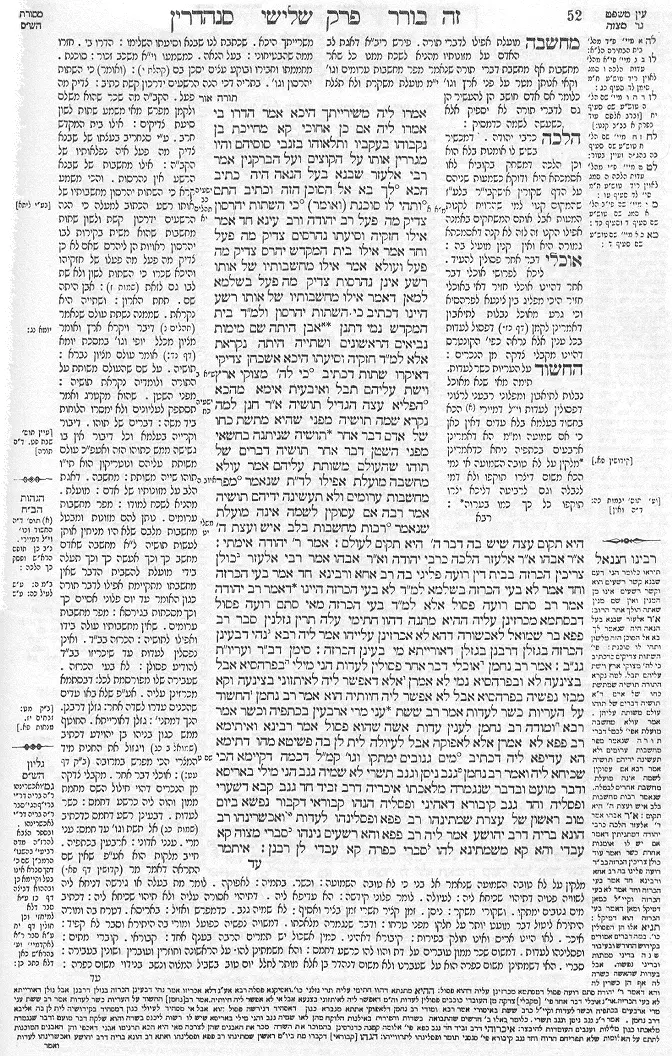
Sanhedrin 26b - Guemara
אמרו ליה משירייתך היכא אמר הדרו בי אמרו ליה אם כן אחוכי קא מחייכת בן נקבוהו בעקביו ותלאוהו בזנבי סוסיהם והיו מגררין אותו על הקוצים ועל הברקנין אמר רבי אלעזר שבנא בעל הנאה היה כתיב הכא (ישעיהו כב, טו) לך בא אל הסוכן הזה וכתיב התם (מלכים א א, ב) ותהי לו סוכנת (ואומר) (תהלים יא, ג) כי השתות יהרסון צדיק מה פעל רב יהודה ורב עינא חד אמר אילו חזקיה וסיעתו נהרסים צדיק מה פעל וחד אמר אילו בית המקדש יהרס צדיק מה פעל ועולא אמר אילו מחשבותיו של אותו רשע אינן נהרסות צדיק מה פעל בשלמא למאן דאמר אילו מחשבותיו של אותו רשע היינו דכתיב כי השתות יהרסון ולמ"ד בית המקדש נמי דתנן אבן היתה שם מימות נביאים הראשונים ושתייה היתה נקראת אלא למ"ד חזקיה וסיעתו היכא אשכחן צדיקי דאיקרו שתות דכתיב (שמואל א ב, ח) כי לה' מצוקי ארץ וישת עליהם תבל ואיבעית אימא מהכא (ישעיהו כח, כט) הפליא עצה הגדיל תושיה א"ר חנן למה נקרא שמה תושיה מפני שהיא מתשת כחו של אדם דבר אחר תושיה שניתנה בחשאי מפני השטן דבר אחר תושיה דברים של תוהו שהעולם משותת עליהם אמר עולא מחשבה מועלת אפילו לד"ת שנאמר (איוב ה, יב) מפר מחשבות ערומים ולא תעשינה ידיהם תושיה אמר רבה אם עסוקין לשמה אינה מועלת שנאמר (משלי יט, כא) רבות מחשבות בלב איש ועצת ה' היא תקום עצה שיש בה דבר ה' היא תקום לעולם:
אמר ר' יהודה אימתי:
א"ר אבהו א"ר אלעזר הלכה כרבי יהודה וא"ר אבהו אמר רבי אלעזר כולן צריכין הכרזה בבית דין רועה פליגי בה רב אחא ורבינא חד אמר בעי הכרזה וחד אמר לא בעי הכרזה בשלמא למ"ד לא בעי הכרזה היינו דאמר רב יהודה אמר רב סתם רועה פסול אלא למ"ד בעי הכרזה מאי סתם רועה פסול דבסתמא מכרזינן עליה ההיא מתנה דהוו חתימי עלה תרין גזלנין סבר רב פפא בר שמואל לאכשורה דהא לא אכרזינן עלייהו אמר ליה רבא נהי דבעינן הכרזה בגזלן דרבנן בגזלן דאורייתא מי בעינן הכרזה:
סימן דב"ר ועריו"ת גנ"ב:
אמר רב נחמן אוכלי דבר אחר פסולין לעדות הני מילי בפרהסיא אבל בצינעה לא ובפרהסיא נמי לא אמרן אלא דאפשר ליה לאיתזוני בצינעה וקא מבזי נפשיה בפרהסיא אבל לא אפשר ליה חיותיה הוא אמר רב נחמן החשוד על העריות כשר לעדות אמר רב ששת עני מרי ארבעין בכתפיה וכשר אמר רבא ומודה רב נחמן לענין עדות אשה שהוא פסול אמר רבינא ואיתימא רב פפא לא אמרן אלא לאפוקה אבל לעיולה לית לן בה פשיטא מהו דתימא הא עדיפא ליה דכתיב (משלי ט, יז) מים גנובים ימתקו וגו' קמ"ל דכמה דקיימא הכי שכיחא ליה ואמר רב נחמן גנב ניסן וגנב תשרי לא שמיה גנב הני מילי באריסא ודבר מועט ובדבר שנגמרה מלאכתו איכריה דרב זביד חד גנב קבא דשערי ופסליה וחד גנב קיבורא דאהיני ופסליה הנהו קבוראי דקבור נפשא ביום טוב ראשון של עצרת שמתינהו רב פפא ופסלינהו לעדות ואכשרינהו רב הונא בריה דרב יהושע אמר ליה רב פפא והא רשעים נינהו סברי מצוה קא עבדי והא קא משמתינא להו סברי כפרה קא עבדי לן רבנן:
איתמר
Comments from Rashi on Masechet Sanhedrin Page 26b
משרייתך היכא . שכתבת לנו שבנא וסיעתו השלימו: הדרו בי . חזרו ממה שהבטיחוני: בעל הנאה . כמשמעו וי"א משכב זכור: סוכנת . מחממתו וחבירו ובוקע עצים יסכן בם (קהלת י): (ואומר) כי השתות יהרסון וגו' . בתריה דכי הנה הרשעים ידרכון קשת כתיב: צדיק מה פעל . הקב"ה מה שכר שהוא משלם ולקמן מפרש מאי משמע שתות לשון סיעת צדיקים: אילו בית המקדש חרב . ע"י סנחריב בעצתו של שבנא צדיק מה פעל איה נפלאותיו של הקב"ה: אילו מחשבות של שבנא הרשע אין נהרסות . והכי משמע קרא כי השתות יהרסון מחשבותיו של אותו רשע הכתוב למעלה כי הנה הרשעים ידרכון קשת ולשון שתות מחשבות שהוא משית בקירות לבו יהרסון ראויות הן ליהרס שאם לא כן צדיק מה פעל מה פעלו של חזקיהו והיכא שכרו כי השתות לשון ולא שת לבו גם לזאת (שמות ז): אבן היתה שם . תחת הארון: ושתייה היא נקראת . שממנה נשתת עולם שנאמר (תהלים נ) דיבר ויקרא ארץ ואומר מציון מכלל יופי וגו' במסכת יומא (דף נד:) אומר עולם מציון נברא: תושיה . על שם שהעולם משותת על התורה ולומדיה נקראת תושיה: מפני השטן . שהוא מקטרג ואמר תסתפק לעליונים ולא ימסרו הלוחות ביד משה: דברים של תוהו . דיבור וקרייה בעלמא וכל דיבור אין בו גשישה ממש כתוהו הזה ואעפ"כ עולם משותת עליהם ונוטריקון הוא תי"ו תוהו שייה משותת: מחשבה . דאגת הלב על מזונותיו של אדם: מועלת . מהניא לשכח למודו: מפר מחשבות ערומים . נותן להם מזונות ומבטל מחשבות מלבם שלא היו מניחין אותן לעשות תושיה ל"א מחשבה שאדם מחשב כך וכך אעשה כך וכך תעלה בידי מועלת להשבית הדבר שאין מחשבתו מתקיימת אפילו לדבר תורה כגון האומר עד יום פלוני אסיים כך וכך מסכתות בגירסא: מפר מחשבות ערומים . שאין מחשבותיו עולה בידו ואפילו לתושיה: הכרזה בב"ד . ואינן נפסלין לעדות עד שיכריזו בב"ד להודיע פסולן: לא בעי הכרזה . שעבירה שלו מפורסמת לכל: דבסתמא מכרזינן עליה . אע"פ שלא באו עדים שהכניס עדרו לשדה אחר: גזלן דרבנן . הנך דמתני': גזלן דאורייתא . החוטף ממש כגון בניהו בן יהוידע דכתיב (שמואל ב כג) ויגזול את החנית מיד המצרי הכי מפרש במרובה (ב"ק דף עט:): אוכלי דבר אחר . מקבלי צדקה מן הנכרים דהוי חילול השם מחמת ממון והוה ליה כרשע דחמס: כשר לעדות . דבעינן רשע דחמס כדכתיב (שמות כג) אל תשת וגו' עד חמס: עני מרי . ענני אדוני: ארבעין בכתפיה . חייב מלקות הוא אע"פ שאין שם התראה דאמר מר (קדושין דף פא.) מלקין על לא טובה השמועה שנאמר אל בני כי לא טובה השמועה: וכשר . בתמיה: לאפוקה . לומר מת בעלה או גירשה דניחא ליה לשוויה פנויה דתיהוי שכיחא ליה: לעיולה . לומר פלוני קידשה: הא עדיפא ליה . דתיהוי אסורה עליה ולא תיהוי שכיחא ליה: דכתיב מים גנובים ימתקו . ושקורי משקר: ניסן . זמן קציר תשרי זמן בציר ואסיף: לא שמיה גנב . כדמפרש ואזיל: באריסא . דטרח בה ומורה היתירא ליטול דבר מועט יותר על חלקו מפני טרחו: ודבר שנגמרה מלאכתו . דמשויה נפשיה כפועל ומורי בה היתירא וסבר לא קפיד: איכר . לאו היינו אריס ואינו חולק בפירות: קיבורא דאהיני . כמין אשכול יש תמרים הרבה בענף אחד: קבוראי . קוברי מתים: ופסלינהו לעדות . דמשום שכר ממון עוברים על דת והוו להו כרשע דחמס: והא משמתינן להו . על הראשונה וחוזרין ועוברין ושונין בעבירה: סברי . האי דשמתינן משום כפרה הוא על שעברנו ולא משום דנהדר בן אלא מותר לחלל יום טוב בשביל המצוה ונשב בנידוי משום כפרה:
Comments from Tosafot - Sanhedrin 26b
מחשבה מועלת אפילו לדברי תורה. פירש ריב"א דאגת לב האדם על מזונותיו מהניא לשכח ממנו כל שאר מחשבות אף מחשבת דברי תורה שנאמר מפר מחשבות ערומים וגו' וקאי אנותן מטר על פני ארץ וגו' י"מ מועלת משקרת ולא תצלח כלומר אם אדם חושב הן להעשיר הן גם לדברי תורה לא יספיק אלא כשעשה לשמה כדמסיק: הלכה כרבי יהודה . דמכשיר בשיש לו אומנות בלא הוא וכן הלכה דמשחק בקוביא לאו אסמכתא היא ודוקא כשמעות שניהם על הדף שקורין אישקבי"ר בלע"ז שהמקום קנוי למי שהרויח לקנות המעות אבל אותם המשחקים באמנה אפילו הקנו זה לזה לא קנה דאסמכתא גמורה היא ואין קנין מועיל בה: אוכלי דבר אחר פסולין להעיד. ליכא לפרושי אוכלי דבר אחר דהיינו אוכלי חזיר דאי באוכלי חזיר היכי מפליג בין צינעא לפרהסיא וכי גרע מאוכל נבלות לתיאבון דאמרינן לקמן (סנהדרין דף כז.) דפסול לעדות בכל ענין אלא נראה כפי' הקונטרס דהיינו מקבלי צדקה מן הנכרים: החשוד על העריות כשר לעדות . תימה מאי שנא מאוכל נבלות לתיאבון ומפלוני רבעני לרצוני דפסולין לעדות וי"ל דמיירי הכא בחשוד בעלמא בלא עדים דאין כאן כי אם שמועה ומ"מ הא דאמרינן ארבעים בכתפיה ניחא כדאמרינן מלקין על לא טובה השמועה אי נמי הכא משום דיצרו תוקפו ולא דמי לנבלה וגם לרביעה דליכא יצרו תוקפו כל כך כמו בערוה:
Sanhedrin 26b - Mishnah translated into english
The Assyrians said to him: Where is your camp? Shebna said: They backed out on me. They said to him: If so, you are mocking us; you led us to believe that behind you stands a large camp of supporters. They punched holes in his heels and hung him by the tails of their horses, and dragged him on the thorns and on the bristles.
Rabbi Elazar says: Shebna was a hedonist. It is written here: “Go, get yourself to this steward [hasokhen], to Shebna, who is over the house” (Isaiah 22:15), and it is written there with regard to Abishag the Shunammite: “And let her be a companion [sokhenet] to him; and let her lie in your bosom, that my lord the king may get heat” (I Kings 1:2).
And following the aforementioned verse: “For behold, the wicked bend the bow, they have made ready their arrow upon the string,” the next verse states: “When the foundations are destroyed, what has the Righteous One done?” (Psalms 11:3). Rav Yehuda and Rav Eina interpret this verse. One says: If Hezekiah and his camp are destroyed, what has the Righteous One done? And one says: If the Temple should be destroyed, what has the Righteous One done? And Ulla says: If the intentions of that wicked person, Sennacherib, are not destroyed, what has the Righteous One done?
The Gemara asks: Granted, according to the one who says that the verse means: If the intentions of that wicked person are not destroyed, what has the Righteous One done, this is the reason that it is written: “When the foundations [hashatot] are destroyed,” i.e., the intentions of Sennacherib are destroyed, as intentions are called shatot.
And according to the one who says it is referring to the Temple, the word hashatot is also clear, as we learned in a mishna (Yoma 53b): There was a stone in the Holy of Holies from the days of the early prophets, David and Samuel, who laid the groundwork for construction of the Temple, and this stone was called the Foundation [shetiyya] Stone.
But according to the one who says that the reference is to Hezekiah and his camp, where do we find that righteous people are referred to as shatot?
The Gemara answers: As it is written: “He raises up the poor out of the dust, He lifts up the needy from the dung hill, to make them sit with princes and inherit the throne of glory; for the pillars of the earth are the Lord’s, and He has set [vayyashet] the world upon them” (I Samuel 2:8). Since the righteous are considered the foundations of the world, this verse is interpreted in reference to them. And if you wish, say instead that it is derived from here: “Wonderful is His counsel, and great His wisdom [tushiyya]” (Isaiah 28:29). Accordingly, the wise, righteous people are called shatot.
With regard to the latter verse, Rabbi Ḥanan says: Why is the Torah called tushiyya? Because it weakens [matteshet] the strength of a person who engages in its study. Alternatively, tushiyya can be interpreted as an abbreviation: That it was given in secret [shenittena beḥashai]. This was done because of the Satan, lest he claim that the Jewish people are not worthy of it. Alternatively, tushiyya can be interpreted as an abbreviation for amorphous [tohu] matters that seem foreign and strange, but nevertheless the world is founded [meshotat] on them.
Ulla says: Thought, i.e., concern, is effective [mo’elet] in disturbing even the study of statements of Torah, as it is stated: “He frustrates the thoughts of the crafty, so that their hands can perform nothing [velo…tushiyya]” (Job 5:12), and tushiyya is a reference to Torah.
Rabba says: If people engage in Torah study for its own sake, concern is not effective; as it is stated: “There are many devices in a man’s heart; but the counsel of the Lord, that shall stand” (Proverbs 19:21). Rabba interprets this to mean that a counsel that has in it the statement of the Lord shall rise forever and cannot be disturbed.
§ The mishna teaches that Rabbi Yehuda says: When are all these people, e.g., gamblers and those who lend with interest, disqualified from bearing witness? It is when they have no occupation other than this one. Rabbi Abbahu says that Rabbi Elazar says: The halakha is in accordance with the opinion of Rabbi Yehuda.
And Rabbi Abbahu says that Rabbi Elazar says: All of these require a proclamation in the court. In other words, one is disqualified only after it is proclaimed in court that he was found guilty of this behavior.
With regard to a shepherd, who is also disqualified from bearing witness, Rav Aḥa and Ravina disagree. One says that he requires a proclamation that he is disqualified due to his being a shepherd, and one says that he does not require a proclamation and is disqualified automatically.
The Gemara asks: Granted, according to the one who says that he does not require a proclamation, this is what Rav Yehuda means when he says that Rav says that an ordinary shepherd is disqualified, i.e., he does not require a specific proclamation. But according to the one who says that a shepherd requires a proclamation, what is meant by the statement that an ordinary shepherd is disqualified?
The Gemara answers: It means that in an ordinary case, the court proclaims about him that he is disqualified for having engaged in shepherding. If the court discovers that he regularly engages in this trade, it proclaims immediately that he is disqualified, and the court does not need to prove that he shepherds his flock in the fields of others.
The Gemara recounts: With regard to a certain deed of gift on which the names of two robbers were signed, Rav Pappa bar Shmuel thought to deem it valid despite the identity of the witnesses, as the court did not proclaim about them that they were disqualified.
Rava said to him: Although we require a proclamation in order to disqualify a robber from bearing witness, this is only with regard to a robber who is guilty of stealing by rabbinic law; with regard to a robber who is guilty of stealing by Torah law, do we require a proclamation? He is disqualified automatically.
§ The Gemara states a mnemonic for the following statements with regard to disqualification from testifying: Something; and forbidden sexual relations; and a thief.
Rav Naḥman says: Those who eat something else, a euphemism for pork, are disqualified from bearing witness. This is referring to those who accept charity from gentiles, thereby causing a desecration of God’s name. They are tantamount to wicked people guilty of monetary transgressions, as they are willing to desecrate God’s name for monetary gain.
The Gemara comments: This statement applies with regard to taking charity from gentiles in public [befarhesya], but if one takes it in private he is not disqualified. And even if he takes it in public, we said that he is disqualified only in a case where he can sustain himself by accepting charity from gentiles in private and despite this he disgraces himself by taking it in public. But if he cannot support himself in any other manner, he is not disqualified, as it is his livelihood.
Rav Naḥman says: One who due to a rumor is suspected of engaging in forbidden sexual relations is fit to bear witness. Rav Sheshet said to him: Answer me, my Master: The halakha is that one who is rumored to have engaged in forbidden sexual intercourse receives forty lashes on his shoulders, and yet you say he is fit to bear witness?
Rava said: And Rav Naḥman concedes that he is disqualified with regard to testimony about the status of a married woman, as he is clearly under suspicion with regard to this matter. Ravina says, and some say Rav Pappa says: We said he is disqualified only with regard to testimony that removes her status as a married woman, e.g., testimony that her husband died, as he is suspected of wanting her for himself. But with regard to testimony that establishes her in that status, we have no problem with it.
The Gemara asks: Isn’t that obvious? Why should he be suspected of lying in order to render a woman married? The Gemara answers: Lest you say that if he wants her for himself, this situation, i.e., her being married to another, is preferable to him; as it is written: “Stolen waters are sweet and bread eaten in secret is pleasant” (Proverbs 9:17), i.e., the forbidden is more pleasant than the permitted, Rav Pappa teaches us that this is not the case, as the way the woman is now, being unmarried, she is more available to him. He therefore is not motivated to testify falsely that she is married.
And Rav Naḥman says: A thief of Nisan and a thief of Tishrei, i.e., one who steals during the harvest seasons, is not called a thief and is therefore not disqualified from bearing witness.
The Gemara explains: This statement applies specifically with regard to a tenant farmer, and it is a situation where he took a small amount, and in a case where it was an item whose work was completed, i.e., that needed no further processing. Since the produce was sufficiently processed, the tenant may assume that he deserves additional pay for any further labor and justify taking a small amount of the produce for his effort. Consequently, his theft is not willful.
The Gemara recounts: An incident occurred with the tenant farmers of Rav Zevid. One stole a kav of barley, and Rav Zevid disqualified him from bearing witness, and one stole a cluster of dates, and he disqualified him. The reason for their disqualification is that the quantity of produce they stole is not considered a small amount.
The Gemara relates: There were these gravediggers, who buried a person on the first day of the festival of Shavuot, desecrating the Festival. Rav Pappa excommunicated them and then disqualified them from bearing witness, and Rav Huna, son of Rav Yehoshua, deemed them fit to bear witness.
Rav Pappa said to Rav Huna, son of Rav Yehoshua: But aren’t they wicked people, as they violated a Torah prohibition? Rav Huna, son of Rav Yehoshua, answered him: They assumed they were doing a mitzva, as they were burying the dead.
Rav Pappa asked: But didn’t I excommunicate them for this? Nevertheless, they continued to bury people on the Festival. Rav Huna, son of Rav Yehoshua, answered: They assumed: We were not excommunicated for doing something wrong. Rather, since the mitzva of burying the dead involved desecrating the Festival, the Sages are achieving atonement for us, although our behavior was appropriate.
§ A conspiring witness is one who testified that a certain incident occurred at a particular time and place, and then two other witnesses testify that he was elsewhere at that time. The Gemara discusses the disqualification of a conspiring witness from providing testimony in other cases. It was stated
Traduction : The William Davidson digital edition of the Koren Noé Talmud, with commentary by Rabbi Adin Even-Israel Steinsaltz.