 Talmud Bavli
The learning on the whole site is dedicated : L'ilui Nishmat Chemouel Eliezer ben Batcheva
The learning on the whole site is dedicated : L'ilui Nishmat רינה בת לדיסיה
The learning on the whole site is dedicated : L'ilui Nishmat Reuven ben Rivka SEBBAG
Sanhedrin 12b : Youtube
Daf TubeYoutube
2 video classes :
Sanhedrin Page 12b
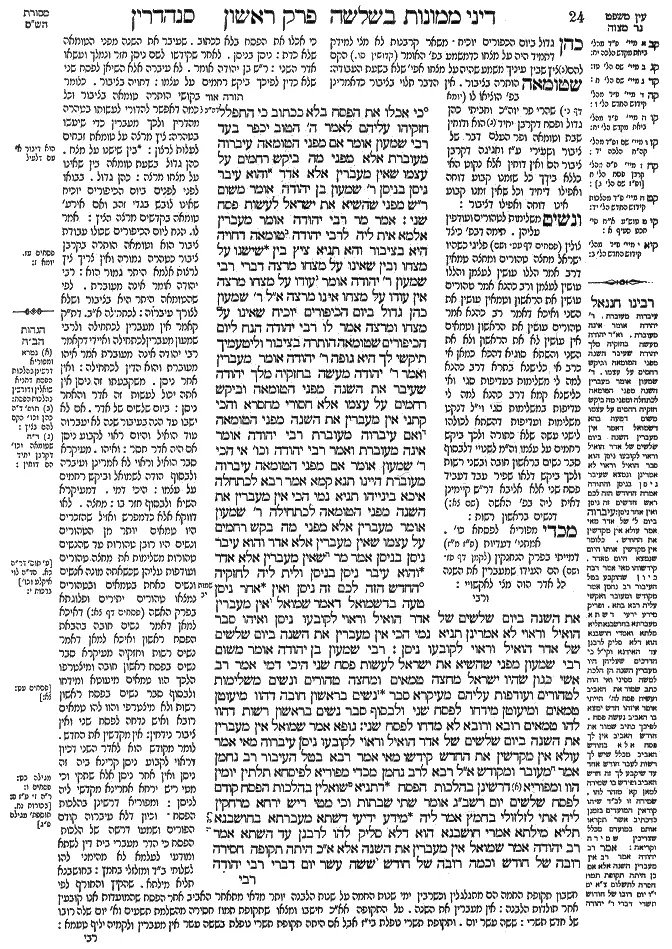
Sanhedrin 12b - Guemara
(דה"ב ל, יח) כי אכלו את הפסח בלא ככתוב כי התפלל חזקיהו עליהם לאמר ה' הטוב יכפר בעד רבי שמעון אומר אם מפני הטומאה עיברוה מעוברת אלא מפני מה ביקש רחמים על עצמו שאין מעברין אלא אדר והוא עיבר ניסן בניסן ר' שמעון בן יהודה אומר משום ר"ש מפני שהשיא את ישראל לעשות פסח שני:
אמר מר רבי יהודה אומר מעברין אלמא אית ליה לרבי יהודה טומאה דחויה היא בציבור והא תניא ציץ בין שישנו על מצחו ובין שאינו על מצחו מרצה דברי רבי שמעון ר' יהודה אומר עודו על מצחו מרצה אין עודו על מצחו אינו מרצה א"ל ר' שמעון כהן גדול ביום הכיפורים יוכיח שאינו על מצחו ומרצה אמר לו רבי יהודה הנח ליום הכיפורים שטומאה הותרה בציבור וליטעמיך תיקשי לך היא גופה ר' יהודה אומר מעברין ואמר ר' יהודה מעשה בחזקיה מלך יהודה שעיבר את השנה מפני הטומאה וביקש רחמים על עצמו אלא חסורי מחסרא והכי קתני אין מעברין את השנה מפני הטומאה ואם עיברוה מעוברת רבי יהודה אומר אינה מעוברת ואמר רבי יהודה וכו' אי הכי ר' שמעון אומר אם מפני הטומאה עיברוה מעוברת היינו תנא קמא אמר רבא לכתחלה איכא בינייהו תניא נמי הכי אין מעברין את השנה מפני הטומאה לכתחילה ר' שמעון אומר מעברין אלא מפני מה בקש רחמים על עצמו שאין מעברין אלא אדר והוא עיבר ניסן בניסן אמר מר שאין מעברין אלא אדר והוא עיבר ניסן בניסן ולית ליה לחזקיה (שמות יב, ב) החדש הזה לכם זה ניסן ואין אחר ניסן טעה בדשמואל דאמר שמואל אין מעברין את השנה ביום שלשים של אדר הואיל וראוי לקובעו ניסן ואיהו סבר הואיל וראוי לא אמרינן תניא נמי הכי אין מעברין את השנה ביום שלשים של אדר הואיל וראוי לקובעו ניסן:
רבי שמעון בן יהודה אומר משום רבי שמעון מפני שהשיא את ישראל לעשות פסח שני היכי דמי אמר רב אשי כגון שהיו ישראל מחצה טמאים ומחצה טהורים ונשים משלימות לטהורים ועודפות עליהם מעיקרא סבר נשים בראשון חובה דהוו מיעוטן טמאים ומיעוטן מידחו לפסח שני ולבסוף סבר נשים בראשון רשות דהוו להו טמאים רובא ורובא לא מדחו לפסח שני:
גופא אמר שמואל אין מעברין את השנה ביום שלשים של אדר הואיל וראוי לקובעו ניסן עיברוה מאי אמר עולא אין מקדשין את החדש קידשו מאי אמר רבא בטל העיבור רב נחמן אמר מעובר ומקודש א"ל רבא לרב נחמן מכדי מפוריא לפיסחא תלתין יומין הוו ומפוריא דרשינן בהלכות הפסח דתניא שואלין בהלכות הפסח קודם לפסח שלשים יום רשב"ג אומר שתי שבתות וכי מטי ריש ירחא מרחקין ליה אתי לזלזולי בחמץ אמר ליה מידע ידיעי דשתא מעברתא בחושבנא תליא מילתא אמרי חושבנא הוא דלא סליק להו לרבנן עד השתא אמר רב יהודה אמר שמואל אין מעברין את השנה אלא א"כ היתה תקופה חסירה רובה של חודש וכמה רובה של חודש ששה עשר יום דברי רבי יהודה
Comments from Rashi on Masechet Sanhedrin Page 12b
כי אכלו את הפסח בלא ככתוב . שעיבר את השנה מפני הטומאה שלא כדת: ניסן בניסן . לאחר שקידשו לשם ניסן חזר ונמלך ועשאו אדר השני: ר"ש בן יהודה אומר . לא עיברה אלא השיאן לפסח שני שלא כדין לפיכך ביקש רחמים על עצמו: דחויה בציבור . כלומר בקושי הותרה טומאה בציבור וכל כמה דאפשר להדורי לעשותו בטהרה מהדרין ולכך מעברין כדי שיעשו בטהרה: ציץ מרצה על טומאת זבחים לעלות לרצון: בין שישנו על מצח . כהן גדול בשעת טומאה בין שאינו על מצחו מרצה: כהן גדול . בבואו לפני לפנים ביום הכיפורים יוכיח שאינו לובש בגדי זהב ואם אירע' טומאה בקדשים מרצה הציץ: אמר לו . הנח ליום הכיפורים שכולו עבודת ציבור הוא וטומאה הותרה בקרבן ציבור כטהרה גמורה ואין צריך ציץ לרצות אלמא היתר גמור הוא: רבי יהודה אומר אינה מעוברת . לפי שהטומאה היתר היא בציבור ושלא לצורך עיברוה: לכתחילה א"ב . דת"ק קאמר אין מעברין לכתחילה ולרבי שמעון מעברין לכתחילה ואיידי דקאמר רבי יהודה אינה מעוברת אמר איהו מעוברת והוא הדין לכתחילה: ואין אחר ניסן . משקבעתו זה ניסן אין אתה יכול לעשות זה אדר והאחר ניסן: ביום שלשים של אדר . אם לא ישבו עד הנה בעיבור שנה לא יעברוה עוד הואיל והיום ראוי לקבוע ניסן אם היה אדר חסר: ואיהו . מעיקרא סבר הואיל וראוי לא אמרינן ועיברה ולבסוף הודה לשמואל וביקש רחמים על עצמו: היכי דמי . דמעיקרא השיא ולבסוף חזר בו: מחצה . לאו דווקא אלא כדמפרש ואזיל שהזכרים היו טמאים יותר מן הטהורים ונשים היו רובן טהורות עד שהנשים טהורות משלימות את מחצה טהורים ועודפות עליהן שכשאתה מונה אנשים ונשים כאחת בטמאים ובטהורים נמצאו טהורים יתירים ופלוגתא בפרק האשה (פסחים דף צא:) דאיכא למאן דאמר נשים חובה בהבאת הפסח ראשון ואיכא למאן דאמר נשים רשות וחזקיה מעיקרא סבר נשים בפסח ראשון חובה ומיצטרפו הלכך היו טמאים מיעוטא ומידחו ולבסוף סבר נשים בפסח ראשון רשות ולא מיצטרפי והוו להו טמאים רובא ואיש נדחה לפסח שני ואין ציבור נידחין: אין מקדשין את החדש . לומר מקודש הוא לאדר השני דכיון דראוי לקבוע ניסן קרינא ביה זה ניסן ואין אחר ניסן אלא שתקי וכי מטי ריש ירחא אחרינא מקדשי ליה לניסן: ומפוריא דרשינן בהלכות הפסח . וכיון דלא עיברוה קודם הפורים ושמעו דרשה של הלכות הפסח כי הדר מעברי בית דין לשתא ומודעי לעלמא לא מהימני להו לשלוחי ב"ד ומזלזלי בחמץ: בחושבנא תליא מילתא . שהקיץ והחורף לפי חשבון תקופת החמה הם מתגלגלין וכשרבין ימי שנות החמה על שנות הלבנה יותר מדאי מתאחר האביב אחר הפסח שהמועדות אנו קובעין אחר תולדות הלבנה: אין מעברין את השנה . על התקופה אא"כ חישבו ומצאו שתקופת תמוז חסירה מהשלמת תשעים וא' יום שלה רובו של חדש תשרי: ששה עשר יום . ותקופת תשרי נופלת בי"ז אבל אם היתה תקופת תשרי נופלת בששה עשר אין מעברין ולקמיה יליף טעמא:
Comments from Tosafot - Sanhedrin 12b
כהן גדול ביום הכפורים יוכיח . משאר קרבנות לא מצי למידק דתמיד היה על מצחו כדמשמע בפ' האומר (קדושין סו.) הקם להם ציץ שבין עיניך משמע שהיה על מצחו אפי' שלא בשעת העבודה: שטומאה הותרה בציבור . אין הדבר תלוי בציבור כדאמרינן בפ' הוציאו לו (יומא דף נ.) שהרי פר יוה"כ וחביתי כהן גדול ופסח דקרבן יחיד הוא ודוחין שבת וטומאה ופר העלם דבר של ציבור ושעירי ע"ז וחגיגה דקרבן ציבור הם ואין דוחין אלא נקוט האי כללא בידך כל שזמנו קבוע דוחה ואפילו דיחיד וכל שאין זמנו קבוע אינו דוחה ואפילו דציבור: ונשים משלימות לטהורים ועודפין עליהן . תימה דבפ' כיצד צולין (פסחים דף עט. ושם) פליגי כשהיו ישראל מחצה טהורים ומחצה טמאין דרב אמר הללו עושין לעצמן והללו עושין לעצמן ורב כהנא אמר טהורים עושין את הראשון וטמאין עושין את השני ואיכא דאמר רב כהנא אמר טהורים עושין את הראשון וטמאים אין עושין לא את הראשון ולא את השני והשתא סוגיא דהכא כמאן אי כרב אי כלישנא בתרא דרב כהנא למה לי משלימות בעדיפות סגי ואי כלישנא קמא דרב כהנא למה לי עדיפות במשלימות סגי וי"ל דנקט משלימות ועדיפות דהשתא לכולהו לישני עשה שלא כתורה ולכך ביקש רחמים על עצמו וה"מ לשנויי דלבסוף סבר נשים בראשון חובה ובשני רשות ולכך ביקש דלאו שפיר עבד דעביד פסח שני אלא אליבא דר"ש קיימינן דאית ליה בפ' האשה (שם צא:) דנשים בראשון רשות: מכדי מפוריא לפסחא כו' . אמתני' דעדיות (פ"ז מ"ז) דמייתי בפרק הנחנקין (לקמן סנהדרין דף פז. ושם) הם העידו שמעברין את השנה כל אדר הוה מצי לאקשויי:
Sanhedrin 12b - Mishnah translated into english
yet they ate the Paschal lamb not as is written. For Hezekiah had prayed for them, saying: May the good Lord pardon everyone who sets his heart to seek God…though he not be cleansed according to the purification that pertains to sacred items” (II Chronicles 30:18–19).
Rabbi Shimon says: If the court intercalated the year due to ritual impurity, it is indeed intercalated. But if ritual impurity is ultimately a legitimate reason for intercalating the year, for what reason did Hezekiah request compassion for himself? Because the court may intercalate only the month of Adar, and he intercalated the month of Nisan during the month of Nisan itself. Rabbi Shimon ben Yehuda says in the name of Rabbi Shimon: The incident did not involve the intercalation of the year; rather he appealed for mercy because he encouraged the Jewish people to bypass the standard first Pesaḥ and instead to perform the second Pesaḥ.
Having quoted the Tosefta in its entirety, the Gemara now clarifies several of its details. The Master said above: Rabbi Yehuda says: The court may intercalate the year due to ritual impurity, in order to delay the Paschal offerings, so that the people can perform them in a state of purity. Apparently, Rabbi Yehuda holds that the prohibition against performing the Temple service in a state of ritual impurity is merely overridden in cases involving the public. Although the offerings may be brought when most of the public is in a state of impurity, this course of action is not ideally permitted; one must attempt to find another way to perform the offerings in purity.
The Gemara asks: But isn’t it taught in a baraita: The frontplate effects acceptance whether it is on the forehead of the High Priest or whether it is not on the forehead of the High Priest; this is the statement of Rabbi Shimon. Rabbi Yehuda says: As long as it is on his forehead it effects acceptance; if it is no longer on his forehead it does not effect acceptance.
Rabbi Shimon said to Rabbi Yehuda: The case of the High Priest on Yom Kippur can prove that your statement is incorrect, as on Yom Kippur the frontplate is not on the forehead of the High Priest during the time that he wears only linen garments, and it still effects acceptance. Rabbi Yehuda said to him: Leave aside the case of the High Priest on Yom Kippur, as since the Temple service consists wholly of public offerings the atonement of the frontplate is unnecessary. Even without the frontplate, performing the Temple service in a state of impurity is permitted in cases involving the public. If Rabbi Yehuda holds that it is readily permitted to perform Temple service in the instance of public impurity, then why would he sanction intercalating the year in order to give the public more time to become ritually pure?
The Gemara rejects the question concerning the opinion of Rabbi Yehuda: And according to your reasoning, the Tosefta itself should pose a difficulty for you. The Tosefta states: Rabbi Yehuda says: The court may intercalate the year due to impurity. And Rabbi Yehuda said: There was an incident involving Hezekiah, king of Judea, who intercalated the year due to ritual impurity, and afterward he requested compassion for himself. Why would he request compassion after having made a legitimate decision? Rather, it must be concluded that the Tosefta is incomplete and this is what it is teaching: The court does not intercalate the year due to impurity, but if the court intercalated it, it is intercalated. Rabbi Yehuda says: Even if the court intercalated it, it is not intercalated. And to prove his point, Rabbi Yehuda said that there was an incident involving Hezekiah, who intercalated the year due to impurity and subsequently appealed for mercy.
The Gemara asks: If that is so, meaning if this is the correct way to understand the Tosefta, then the next statement in the Tosefta cannot be reconciled: Rabbi Shimon says: If they intercalated the year due to ritual impurity, it is indeed intercalated. According to this explanation, this is identical to the opinion of the first tanna, who also says that the intercalation is effective. Rava said: The difference between these two opinions is whether the year may be intercalated due to impurity ab initio. According to the first tanna, although the intercalation is valid after the fact, impurity is not an appropriate reason to intercalate the year. Rabbi Shimon holds that it is an appropriate reason. This is also taught in a baraita: The court may not intercalate the year due to impurity ab initio. Rabbi Shimon says: The court may intercalate the year due to impurity, even ab initio. Rather, according to this opinion, for what reason did Hezekiah request compassion for himself? Because the court may intercalate only Adar, but he intercalated Nisan during Nisan.
The Master said above: Hezekiah requested compassion because the court, when intercalating the year, may intercalate only Adar, and he intercalated Nisan during Nisan. How could Hezekiah act in this way? But doesn’t Hezekiah accept the following interpretive tradition: The verse states: “This month shall be for you the beginning of months; it shall be the first month of the year for you” (Exodus 12:2). This teaches that this month is Nisan, and another month cannot be Nisan. Therefore, the court cannot add another month of Nisan. The Gemara answers: Hezekiah erred with regard to the halakha that would later be expounded by Shmuel. As Shmuel says: The court may not intercalate the year on the thirtieth day of Adar, since although it is part of Adar, it is fit to establish it as the first day of Nisan. As the day that may be assigned as the New Moon of Nisan, it has the same status as does Nisan, and the year may not be intercalated then.
And Hezekiah held: We do not say the principle: Since it is fit. Since it was technically still Adar, he initially thought it was permitted to intercalate the year on that day. The Gemara notes: This opinion is also taught in a baraita: The court may not intercalate the year on the thirtieth day of Adar, since it is fit to establish it as the first day of Nisan.
The Gemara further analyzes the Tosefta quoted above: Rabbi Shimon ben Yehuda says in the name of Rabbi Shimon: Hezekiah requested compassion because he encouraged the Jewish people to perform the second Pesaḥ. What are the circumstances, such that Hezekiah acted in this unusual manner and later regretted his decision? Rav Ashi said: It was a case where half the Jewish people were impure and half were pure. And the women among them completed the ranks of the pure and the combined total then exceeded the impure ones. A majority of the men were impure, but as most of the women were pure, if they were included in the tally the majority of the public was then pure. Hezekiah was unsure whether the women should be counted, as he was unsure if they are obligated to bring the Paschal offering.
Initially, he thought women have an obligation to participate in the first Pesaḥ on the fourteenth of Nisan, so the minority of Jews are impure and the minority should be deferred to the second Pesaḥ. Therefore, he deferred most of the men, as they were ritually impure, to bypass the first Pesaḥ. In the end, he thought women are permitted but not obligated to participate in the first Pesaḥ. So when counting only the men, the impure were the majority of those obligated to bring the offering, and the majority is not deferred to the second Pesaḥ. Instead, they should have sacrificed the offering on the first Pesaḥ despite their impurity. Consequently, having deferred the majority when they should not have been deferred, he regretted his decision.
§ With regard to the question of intercalating the year on the thirtieth of Adar, the Gemara discusses the matter itself. Shmuel says: The court may not intercalate the year on the thirtieth day of Adar, although it is part of Adar, since it is fit to establish the day as the first of Nisan. If they intercalated the year on that day, after the fact, what is the halakha? Ulla says: The intercalation is effective and the court does not sanctify the month on that day, so that the intercalation will have been performed in Adar. The Gemara asks: If another court sanctified the month, what is the halakha? Rava says: The intercalation is void, as it turns out that the intercalation was performed in Nisan. Rav Naḥman disagrees and says: The year is intercalated and the month is also sanctified, because each court has performed an independently valid function.
Rava said to Rav Naḥman: Now, from Purim to Passover is thirty days, and from the time of Purim, we teach the community the halakhot of Passover. As it is taught in a baraita: The people ask questions with regard to the halakhot of Passover beginning thirty days before Passover. Rabban Shimon ben Gamliel says: They ask two weeks before Passover. If so, even during Adar, people know that Passover is approaching. And when the New Moon comes, if the court will distance the Passover holiday another month by adding another Adar at so late a date, then the people will come to treat the Passover prohibitions of leavened bread lightly, believing that the stated time of Passover is incorrect because the Sages decided the dates capriciously.
Rav Naḥman said to Rava: The masses know that the intercalated year is a matter dependent upon the calculation, which is determined by a complex process. Therefore they say: It is the calculation that did not conclusively emerge for the Sages until now, and they will therefore understand when the true date of Passover is.
§ With regard to intercalation on the basis of the season, Rav Yehuda says that Shmuel says: The court intercalates the year only if the season of Tammuz, i.e., the summer, was lacking its completion for most of the month of Tishrei, meaning that the summer season had begun so late in the calendar that the autumnal equinox would occur only after most of the month of Tishrei has passed. Since the festival of Sukkot, beginning on the fifteenth of Tishrei, must fall after the autumnal equinox, a month is added to the previous year, therefore causing the summer season to end and the autumn to begin at an earlier point on the Jewish calendar. This allows Sukkot to begin after the autumnal equinox, within the season of Tishrei. And how much is: Most of the month? Sixteen days; this is the statement of Rabbi Yehuda.
Traduction : The William Davidson digital edition of the Koren Noé Talmud, with commentary by Rabbi Adin Even-Israel Steinsaltz.