 Talmud Bavli
Bava Metzia 91b : Youtube
Daf TubeYoutube
1 video class :
Bava Metzia Page 91b
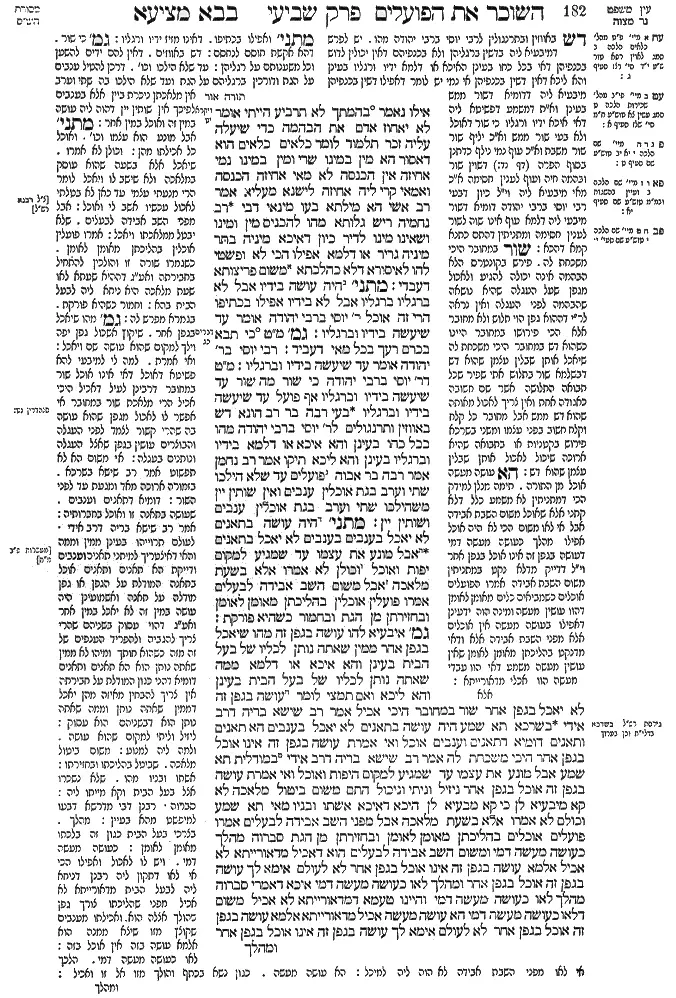
Bava Metzia 91b - Guemara
אילו נאמר (ויקרא יט, יט) בהמתך לא תרביע הייתי אומר לא יאחוז אדם את הבהמה כדי שיעלה עליה זכר תלמוד לומר כלאים כלאים הוא דאסור הא מין במינו שרי ומין במינו נמי אחיזה אין הכנסה לא מאי אחיזה הכנסה ואמאי קרי ליה אחיזה לישנא מעליא אמר רב אשי הא מילתא בעו מינאי דבי רב נחמיה ריש גלותא מהו להכניס מין ומינו ושאינו מינו לדיר כיון דאיכא מיניה בתר מיניה גריר או דלמא אפילו הכי לא ופשטי להו לאיסורא דלא כהלכתא משום פריצותא דעבדי מתני׳ היה עושה בידיו אבל לא ברגליו ברגליו אבל לא בידיו אפילו בכתיפו הרי זה אוכל ר' יוסי ברבי יהודה אומר עד שיעשה בידיו וברגליו גמ׳ מ"ט (דברים כג, כה) כי תבא בכרם רעך בכל מאי דעביד רבי יוסי בר' יהודה אומר עד שיעשה בידיו וברגליו מ"ט דר' יוסי ברבי יהודה כי שור מה שור עד שיעשה בידיו וברגליו אף פועל עד שיעשה בידיו וברגליו בעי רבה בר רב הונא דש באווזין ותרנגולים לר' יוסי ברבי יהודה מהו בכל כחו בעינן והא איכא או דלמא בידיו וברגליו בעינן והא ליכא תיקו אמר רב נחמן אמר רבה בר אבוה פועלים עד שלא הילכו שתי וערב בגת אוכלין ענבים ואין שותין יין משהילכו שתי וערב בגת אוכלין ענבים ושותין יין מתני׳ היה עושה בתאנים לא יאכל בענבים בענבים לא יאכל בתאנים אבל מונע את עצמו עד שמגיע למקום יפות ואוכל וכולן לא אמרו אלא בשעת מלאכה אבל משום השב אבידה לבעלים אמרו פועלין אוכלין בהליכתן מאומן לאומן ובחזירתן מן הגת ובחמור כשהיא פורקת גמ׳ איבעיא להו עושה בגפן זה מהו שיאכל בגפן אחר ממין שאתה נותן לכליו של בעל הבית בעינן והא איכא או דלמא ממה שאתה נותן לכליו של בעל הבית בעינן והא ליכא ואם תמצי לומר עושה בגפן זה לא יאכל בגפן אחר שור במחובר היכי אכיל אמר רב שישא בריה דרב אידי בשרכא תא שמע היה עושה בתאנים לא יאכל בענבים הא תאנים ותאנים דומיא דתאנים וענבים אוכל ואי אמרת עושה בגפן זה אינו אוכל בגפן אחר היכי משכחת לה אמר רב שישא בריה דרב אידי במודלית תא שמע אבל מונע את עצמו עד שמגיע למקום היפות ואוכל ואי אמרת עושה בגפן זה אוכל בגפן אחר ניזיל וניתי וניכול התם משום ביטול מלאכה לא קא מיבעיא לן כי קא מבעיא לן היכא דאיכא אשתו ובניו מאי תא שמע וכולם לא אמרו אלא בשעת מלאכה אבל מפני השב אבידה לבעלים אמרו פועלים אוכלים בהליכתן מאומן לאומן ובחזירתן מן הגת סברוה מהלך כעושה מעשה דמי ומשום השב אבידה לבעלים הוא דאכיל מדאורייתא לא אכיל אלמא עושה בגפן זה אינו אוכל בגפן אחר לא לעולם אימא לך עושה בגפן זה אוכל בגפן אחר ומהלך לאו כעושה מעשה דמי איכא דאמרי סברוה מהלך לאו כעושה מעשה דמי והיינו טעמא דמדאורייתא לא אכיל משום דלאו כעושה מעשה דמי הא עושה מעשה אכיל מדאורייתא אלמא עושה בגפן זה אוכל בגפן אחר לא לעולם אימא לך עושה בגפן זה אינו אוכל בגפן אחר
Comments from Rashi on Masechet Bava Metzia Page 91b
מתני' ואפילו בכתיפו . דאינו מזיז ידיו ורגליו: גמ' כי שור . דהא אקשת חוסם לנחסם: דש באווזים . דאין להם ידים להשען . וכל משענותם על רגליהן: עד שלא הילכו וכו' . דרכן להטיל ענבים על הגת ודורכין ברגליהם על הגת ועד שלא הילכו בה שתי וערב: אין מלאכתן ניכרת ביין אלא בענבים לפיכך אין שותין יין דהוה ליה עושה במין זה ואוכל במין אחר: מתני' אבל מונע הוא עצמו וכו' . ואוכל כל אכילתו מהן: וכולן לא אמרו . שיאכל אלא בשעה שהוא עוסק במלאכה ולא שישב לו ויאכל לומר הרי מנעתי עצמי עד כאן לא בטלתי לאכול עכשיו אשב לי ואוכל: אבל מפני השב אבידה לבעלים . שלא יבטל ממלאכתו ויאכל: אמרו פועלין אוכלין בהליכתן מאומן לאומן . כשגמרו שורה זו והולכין להתחיל בחבירתה ואע"ג דההיא שעתא לאו שעת מלאכה היא ניחא ליה לבעל הבית בהא: וחמור כשהיא פורקת . בגמרא מפרש לה: גמ' מהו שיאכל בגפן אחר . שיקוץ אשכול גפן יפה וילך למקום שהוא עושה שם ויאכל: ואי אמרת . למה לי למיבעי להא פשיטא דאוכל דאי אינו אוכל שור במחובר דרבינן לעיל דאכיל היכי אכיל הרי מלאכת שור במחובר אי אפשר לו לאכול מגפן שהוא עושה בה שהרי קשור לצמד לפני העגלה והבוצרים עושין בגפן שאצל העגלה ונותנים בעגלה: אי משום הא לא תפשוט אמר רב שישא בשרכא . בזמורה ארוכה מאד ומגעת עד לפני השור: דומיא דתאנים וענבים . שעושה בתאנה זו ואוכל בחברותיה: אמר רב שישא בריה דרב אידי . לעולם תרוייהו בעינן ממין וממה והאי דאיצטריך למיתני תאנים וענבים ודייקת הא תאנים ותאנים אוכל בתאנה המודלת על הגפן או גפן מודלה על תאנה ואשמועינן היה עושה במין זה לא יאכל במין אחר ואע"ג דהוי עסוק בשניהם שהרי צריך להגביה ולהפריד הענפים של זה מזה כשהוא חותך ומיהו לא ממין שאתה נותן הוא הא תאנים ותאנים דומיא דהני כגון המודלת על חבירתה אין צריך להבחין מאיזה מהן יאכל דממין שאתה נותן וממה שאתה נותן הוא דבשניהם הוא עסוק: ליזיל וליתי למקום שהוא עושה . ולמה ליה למנוע: משום ביטול מלאכה . שביטל בהליכתו ובחזירתו: אשתו ובניו מהו . שלא נשכרו אצל בעל הבית וקא מייתו ליה: סברוה . רבנן דבי מדרשא דבעו למיפשט מהא בעיין: מהלך . בצרכי בעל הבית כגון זה בלכתו מאומן לאומן: כעושה מעשה דמי . ויש לו לאכול ואפילו הכי אי לאו דתקון ליה רבנן דניחא ליה לבעל הבית מדאורייתא לא אכיל מפני שהליכתו צורך. גפן שהולך אצלה הוא ואכילתו מענבים שקוצץ מזו שיצא ממנה הוא אלמא עושה בזה אין אוכל בזה: לאו כעושה מעשה דמי . הלכך אי לאו מפני השבת אבידה לא הוה ליה למיכל: הא עושה מעשה . כגון נשא בכתף והולך מזו אל זו ואכיל:
Comments from Tosafot - Bava Metzia 91b
מין במינו נמי אחיזה אין הכנסה לא . תימה כיון דלא איירי קרח אלא בכלאים מנלן לאסור הכנסה מין במינו וי"ל דדייק מדנקט תנא לא יאחוז דלא יכניס הוה ליה למינקט דלא תכריע הכנסה משמע אלא משום הכי נקט אחיזה דלהכנסה לא איצטריך דקים ליה לתנא דאפילו מין במינו אסורה מונשמרת מכל דבר רע דדריש מיניה בפ"ק דע"ז (דף כ:) שלא יסתכל אדם לא בחמור ולא בחמורה לא בחזיר ולא בחזירה לא בעוף ולא בעופפת בשעה שנזקקין זה לזה ולהכי מוקי לא תרביע באחיזה באם אינו ענין: דש באווזין ובתרנגולין לרבי יוסי ברבי יהודה מהו . יש לפרש דמיבעיא ליה בדשין ברגליהן ולא בכנפיהם דאין יכולין לדוש בכנפיהן דאי בכל כחו בעינן האיכא או דלמא ידיו ורגליו בעינן והא ליכא דאין דשין בכנפיהן אי נמי יש לומר דאפילו דשין בכנפיהן מיבעיא ליה דדומיא דשור ממש בעינן וא"ת דמשמע דפשיטא ליה דאי איכא ידיו ורגליו כי שור דאוכל ולא בעי שור ממש וא"כ יליף שור שור משבת וא"כ עוף נמי נילף כדתנן בסוף הפרה (דף נד:) דשוין שור ובהמה חיה ועוף לענין חסימה א"כ מאי מיבעיא ליה וי"ל כיון דבעי רבי יוסי ברבי יהודה דומיא דשור מיבעי ליה דלמא עוף אינו שוה לתור לענין חסימה ומתניתין דהתם כתנא קמא דהכא: שור במחובר היכי משכחת לה . פירש בקונטרס הלא הבהמה אינה יכולה להגיע ולאכול מגפן שעל העגלה שהיא נושאה שהבהמה לפני העגלה ואין נראה לר"י דההוא גפן הוי תלוש ולא מחובר אלא הכי פירושו במחובר היינו כשהוא דש במחובר היכי משכחת לה שיאכל אותן שבלין עצמן שהוא דש דבשלמא שור בתלוש אתי שפיר שכל תבואה התלושה אשר שם חשובה כאגודה אחת ואין צריך לאכול מאותה שהוא דש ממש אבל מחובר כל קלח וקלח חשוב בפני עצמו ומשני בשרכא פירוש בקטניות או בתבואה שהיא ארוכה שיכול לאכול אותן שבלין עצמן שהוא דש: הא עושה מעשה אוכל מן התורה . תימה מנלן למידק הכי דמתניתין לא משמע כלל דלא קתני אלא שאוכל משום השבת אבידה אבל אי לאו משום הכי לא היה אוכל אפילו מהלך כעושה מעשה דמי דעושה בגפן זה אינו אוכל בגפן אחר וי"ל דדייק מדלא נקט במתניתין משום השבת אבידה אמרו הפועלים אוכלים כשמביאים כלים מאומן לאומן דהוו עושין מעשה ומינה הוה ידעינן דאפילו בעושה מעשה אין אוכלים אלא מפני השבת אבידה אלא ודאי מדנקט בהליכתן מאומן לאומן שאין עושין מעשה משמע דאי הוו עבדי מעשה הוו אכלי מדאורייתא:
Bava Metzia 91b - Mishnah translated into english
Had the Torah merely stated: “You shall not let your cattle copulate,” I would have said that a person may not hold the female animal when a male mounts it. Therefore, the verse states: “With a diverse kind” (Leviticus 19:19). This shows that it is a crossbreed of diverse kinds that is prohibited, from which it may be inferred that mating an animal of one species with an animal of its own species is permitted.
Rav Aḥadvoi bar Ami infers from the baraita: And even concerning mating an animal of one species with an animal of its own species, with regard to holding, yes, this is permitted, but with regard to inserting, no, this is not allowed. The fact that the tanna specifies the act of holding indicates that inserting is prohibited even in the case of two animals of the same species. The Gemara again rejects this claim: What is the meaning of holding in this context? It means inserting. And why does the tanna call it holding? It is a euphemism.
Rav Ashi said: This matter was asked of me by the members of the house of Rav Neḥemya, the Exilarch: What is the halakha with regard to bringing into the same pen an animal of one species with two other animals, one of its own species and the other of a species different from it? Is the halakha that since there is another animal of its own species, it will be drawn after its species, and therefore there is no concern whatsoever with regard to diverse kinds, or perhaps one should not act even in this manner, in case it leads to crossbreeding? And I resolved it for them by saying that there is a prohibition, but this was not in accordance with the halakha. The reason for my decision was due to the immorality of the slaves. I reasoned that if they are permitted to engage in this practice, they will intentionally crossbreed and claim that it occurred without their intervention.
MISHNA: If a laborer was performing labor with his hands but not with his feet, or with his feet but not with his hands, e.g., pressing grapes, or even if he was performing labor only with his shoulder, this one may eat the produce of the field. Rabbi Yosei, son of Rabbi Yehuda, says: A laborer may not eat unless he performs labor with his hands and with his feet.
GEMARA: The Gemara asks: What is the reason for the ruling of the Rabbis stated in the first clause of the mishna? The Gemara explains that the verse states: “When you come into your neighbor’s vineyard” (Deuteronomy 23:25). Since the Torah does not specify a particular kind of task, it is understood as referring to any labor he performs.
The mishna teaches that Rabbi Yosei, son of Rabbi Yehuda, says: A laborer may not eat unless he performs labor with his hands and with his feet. The Gemara asks: What is the reasoning of Rabbi Yosei, son of Rabbi Yehuda? The Gemara explains: This halakha is like that of a threshing ox; just as one is not required to let an ox feed unless it is performing labor with its hands and with its feet, as it uses all four of its legs to thresh, so too a laborer is not entitled to eat unless he is performing labor with his hands and with his feet.
§ With regard to a similar issue, Rabba bar Rav Huna raised a dilemma: If one threshed with geese and chickens, rather than four-legged animals, what is the halakha according to the opinion of Rabbi Yosei, son of Rabbi Yehuda? The Gemara clarifies the sides of the dilemma: Do we require threshing with all its force, as it is for this reason that an ox must thresh with all four of its legs, and that condition is fulfilled here, as these birds perform labor with all their strength, or perhaps we require that the animal must actually perform labor with its hands and with its feet, i.e., with all four legs, and this is not the case here? No answer was found, and the Gemara says that the dilemma shall stand unresolved.
Rav Naḥman says that Rabba bar Avuh says: With regard to laborers in a vineyard, until they have walked lengthwise and crosswise in the winepress, the first stage of the making of wine, they may eat grapes, as they are performing labor with grapes, but they may not yet drink wine, since their labor has not produced wine. Once they have walked lengthwise and crosswise in the winepress, they are now performing labor with wine as well, and therefore they may eat grapes and drink wine.
MISHNA: If a laborer was performing labor with figs he may not eat grapes; if he was performing labor with grapes he may not eat figs, as he may eat only the type of food with which he is working. This is the halakha even if he was employed to perform labor with both types of produce but is currently performing labor with only one of them. But he may hold himself back from eating until he reaches a place of good-quality grapes or figs and eat from these, as they are the same type of food.
And with regard to all of these cases the Sages said that he may eat only at the time of work. But due to the obligation to restore lost property to its owners, i.e., so that workers would not neglect their task, they said that laborers may eat as they walk from one row of a vineyard or plantation to another row, and upon their return from the winepress. And with regard to a donkey, it is permitted to eat when it is being unloaded. This statement will be explained in the Gemara.
GEMARA: A dilemma was raised before the Sages with regard to the ruling of the mishna: If a laborer was performing labor on this vine, what is the halakha concerning the possibility that he may eat from another vine? Do we require only that the food must be from the type that you are placing into the homeowner’s vessels, and this condition is fulfilled here, or perhaps we require that it must be from that very food which you are placing into the homeowner’s vessels, and this is not the case here?
And if you say that one who was performing labor on this vine may not in fact eat from another vine, a further question arises: With regard to an ox performing labor with produce attached to the ground, how can one enable it to eat? The ox is tied to the front of the wagon, while the laborers are working on a vine adjacent to the wagon. Consequently, it is impossible for the ox to eat from the vine on which labor is being performed. Rav Sheisha, son of Rav Idi, said: In the case of long branches it is possible for the animal to perform labor at one end of the branch while eating from the other.
This difficulty has been resolved, but the original dilemma remains. The Gemara therefore suggests: Come and hear a resolution from the mishna: If a laborer was performing labor with figs he may not eat grapes. This indicates that if the two types of produce are figs and other figs, similar to the figs and grapes mentioned in the mishna, he may eat. Now, if you say that one who was performing labor on this vine may not eat from another vine, how can you find these circumstances? Rav Sheisha, son of Rav Idi, said: The ruling of the mishna is stated with regard to a hanging vine, and he eats from one edge of the branch while working on the other side.
The Gemara offers another suggestion: Come and hear another resolution from the mishna: But he may hold himself back from eating until he reaches a place of good-quality fruit and eat. And if you say that one who was performing labor on this vine may eat from another vine, let him go and bring and eat. Why must he wait until he reaches that particular vine? The Gemara answers: There, the reason is due to the neglect of work caused by the laborer walking to the other vine. We do not raise the dilemma with regard to that case, as he may certainly not stop performing labor to go and eat elsewhere. When the dilemma was raised before us, it was with regard to a case where his wife and children are present. What is the halakha as to whether his family members, who are not performing labor, may bring him fruit?
Once again the Gemara suggests: Come and hear a resolution from the mishna: And with regard to all of these cases they said that he may eat only at the time of work. But due to the mitzva to restore lost property to its owners, the Sages said that laborers may eat as they walk from one row to another row, and upon their return from the winepress.
The Gemara explains the attempted resolution: The Sages assumed that the basic principle of this halakha is that a laborer who was walking is considered like one who was performing his labor, and it is therefore permitted for him to eat. And yet, it is due to the mitzva to restore lost property to its owner that he may eat, whereas by Torah law he may not eat. But if he is performing labor, why is he not allowed to eat? Apparently, this indicates that one who was performing labor on this vine may not eat from another vine, and therefore once he starts walking and is no longer alongside the vine he may not partake of it by Torah law.
The Gemara refutes this argument: No; actually, I could say to you that one who was performing labor on this vine may even eat from another vine, but a laborer who was walking is not considered like one who was performing his labor. The reason that he is not permitted to eat by Torah law is not because he is performing labor on a different vine, but because he is walking at the time.
The Gemara cites an alternative version of this discussion. There are those who say as follows: The Sages assumed that a worker who was walking is not considered like one who was performing his labor, and this is the reason that the baraita says that he may not eat by Torah law: Because he is not considered like one who was performing his labor. This indicates that if he is performing his labor, he may eat by Torah law. Apparently, it may be inferred that one who was performing labor on this vine may eat from another vine.
The Gemara rejects this claim: No; this is not a proof, as actually I could say to you that one who was performing labor on this vine may not eat from another vine,
Traduction : The William Davidson digital edition of the Koren Noé Talmud, with commentary by Rabbi Adin Even-Israel Steinsaltz.