 Talmud Bavli
The learning on the whole site is dedicated : L'ilui Nishmat Chemouel Eliezer ben Batcheva
The learning on the whole site is dedicated : L'ilui Nishmat Nissim ben Barukh Malka
The learning on the whole site is dedicated : L'ilui Nishmat Margalit bat Ledicia
Bava Metzia 4a : Youtube
Daf TubeYoutube
2 video classes :
Bava Metzia Page 4a
Bava Metzia 4a - Guemara
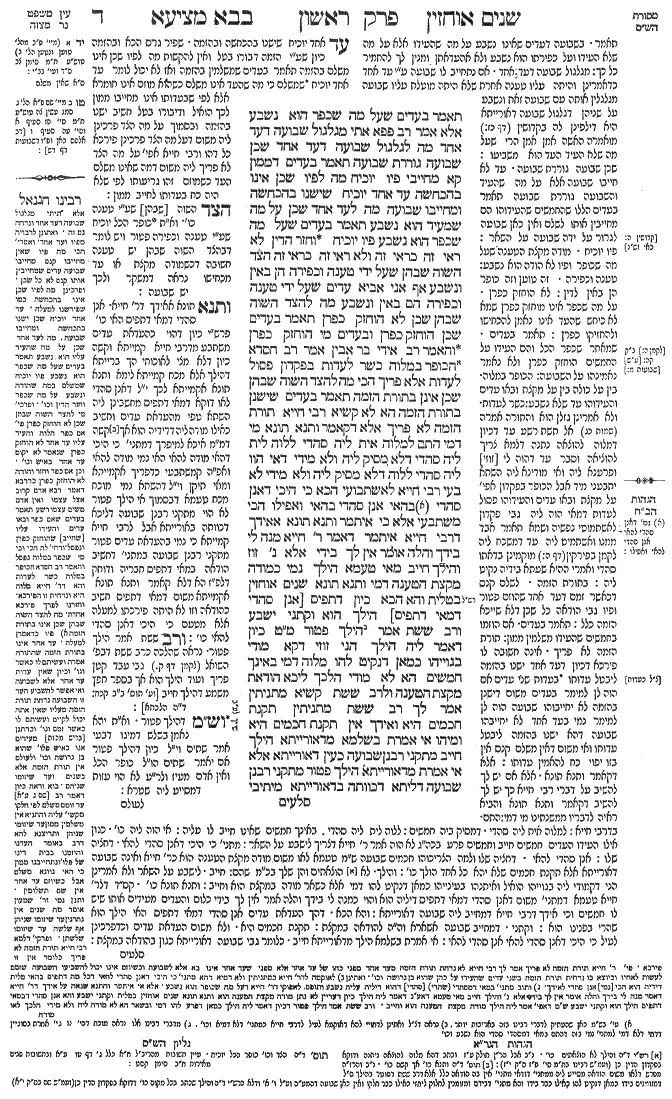
תאמר בעדים שעל מה שכפר הוא נשבע אלא אמר רב פפא אתי מגלגול שבועה דעד אחד מה לגלגול שבועה דעד אחד שכן שבועה גוררת שבועה תאמר בעדים דממון קא מחייבי פיו יוכיח מה לפיו שכן אינו בהכחשה עד אחד יוכיח שישנו בהכחשה ומחייבו שבועה מה לעד אחד שכן על מה שמעיד הוא נשבע תאמר בעדים שעל מה שכפר הוא נשבע פיו יוכיח וחזר הדין לא ראי זה כראי זה ולא ראי זה כראי זה הצד השוה שבהן שעל ידי טענה וכפירה הן באין ונשבע אף אני אביא עדים שעל ידי טענה וכפירה הם באין ונשבע מה להצד השוה שבהן שכן לא הוחזק כפרן תאמר בעדים שכן הוחזק כפרן ובעדים מי הוחזק כפרן והאמר רב אידי בר אבין אמר רב חסדא הכופר במלוה כשר לעדות בפקדון פסול לעדות אלא פריך הכי מה להצד השוה שבהן שכן אינן בתורת הזמה תאמר בעדים שישנן בתורת הזמה הא לא קשיא רבי חייא תורת הזמה לא פריך אלא דקאמר ותנא תונא מי דמי התם למלוה אית ליה סהדי ללוה לית ליה סהדי דלא מסיק ליה ולא מידי דאי הוו ליה סהדי ללוה דלא מסיק ליה ולא מידי לא בעי רבי חייא לאשתבועי הכא כי היכי דאנן סהדי בהאי אנן סהדי בהאי ואפילו הכי משתבעי אלא כי איתמר ותנא תונא אאידך דרבי חייא איתמר דאמר ר' חייא מנה לי בידך והלה אומר אין לך בידי אלא נ' זוז והילך חייב מאי טעמא הילך נמי כמודה מקצת הטענה דמי ותנא תונא שנים אוחזין בטלית והא הכא כיון דתפיס [אנן סהדי דמאי דתפיס] הילך הוא וקתני ישבע ורב ששת אמר הילך פטור מ"ט כיון דאמר ליה הילך הני זוזי דקא מודי בגוייהו כמאן דנקיט להו מלוה דמי באינך חמשים הא לא מודי הלכך ליכא הודאת מקצת הטענה ולרב ששת קשיא מתניתין אמר לך רב ששת מתניתין תקנת חכמים היא ואידך אין תקנת חכמים היא ומיהו אי אמרת בשלמא מדאורייתא הילך חייב מתקני רבנן שבועה כעין דאורייתא אלא אי אמרת מדאורייתא הילך פטור מתקני רבנן שבועה דליתא דכוותה בדאורייתא מיתיבי
Comments from Rashi on Masechet Bava Metzia Page 4a
תאמר . בשבועה דעדים שאינו נשבע על מה שהעידו אלא על מה שלא העידו ועל כפירתו הוא נשבע ולא אהעדאתן ומנין לך להחמיר כל כך: מגלגול שבועה דעד אחד . אם נתחייב לו שבועה ע"י עד אחד כדאמרינן והיתה עליו טענה אחרת שלא היתה מוטלת עליו שבועה מגלגלין אותה עם שבועה זאת ונשבע על שניהן דגלגול שבועה דאורייתא היא דילפינן לה בקדושין (דף כז:) מואמרה האשה אמן אמן הרי שעל מה שלא העיד העד הוא משביעו: שכן שבועה גוררת שבועה . עד לא חייבו שבועה אלא על מה שהעיד והשבועה גוררת שבועה תאמר בעדים הללו שהחמשים שהעידוהו הם מחייבין אותו לשלם ואין כאן שבועה לגרור על ידה שבועה על השאר: פיו יוכיח . מודה מקצת הטענה שעל מה שכופר ופיו לא הודה הוא נשבע: טענה וכפירה . זה טוען וזה כופר הן באין לדין: לא הוחזק כפרן . על מה שכפר אינו מוחזק כפרן שמא לא כיחש שהעד אינו נאמן להכחישו ולהחזיקו כפרן: תאמר בעדים . שמאחר שכפר הכל והם העידו על החמשים הוחזק כפרן ולא נאמר נאמינהו על השבועה: הכופר במלוה . בין על כולה בין על מקצת ובאו עדים והעידוהו עד שלא נשבע: כשר לעדות . ולא אמרינן גזלן הוא והתורה אמרה (שמות כג) אל תשת רשע עד דכיון דמלוה להוצאה נתנה דלמא צריך להוציאה וסבר עד דהוה לי [זוזי] ופרענא ליה ואי מודינא ליה השתא יתבעני מיד אבל הכופר בפקדון אפילו על מקצת ובאו עדים והעידוהו פסול לעדות דמאי הוה ליה גבי פקדון לאשתמוטי נפשיה ושמא תאמר אבד ממנו ואשתמיט ליה עד דמשכח ליה לקמן בפירקין (בבא מציעא דף ה:) מוקמינן בדאתו סהדי ואמרי ההיא שעתא בידיה נקיט ליה: בתורת הזמה . לשלם קנס דכאשר זמם דעד אחד שהוזם פטור ופיו גבי הודאה כל שכן דלא שייכא הזמה כלל: תאמר בעדים . אם הוזמו בחמשים שהעידו משלמין ממון: תורת הזמה לא פריך . אינה חשובה לו פירכא דכיון דעד אחד ישנו בהזמה ליבטל עדותו בעדות שני עדים אם הוה לן למימר בעדים משום דישנן בהזמה לא יחייבוהו שבועה הוה לן למימר נמי בעד אחד לא יחייבהו שבועה דהא ישנו בהזמה ליבטל עדותו ואי משום דאין משלם קנס אין בזו יפוי כח להאמין עדותו: אלא דקאמר ותנא תונא . אלא אם יש לך להשיב על דברי רבי חייא כך יש לך להשיב דקאמר ותנא תונא והביא ראיה לדבריו ממשנתינו מי דמי: התם . בדרבי חייא: למלוה אית ליה סהדי . דמסיק ביה חמשים: ללוה לית ליה סהדי . באינך חמשים שאינו חייב לו עליה: אי הוה ליה כו' . כגון אילו העידו העדים חמשים חייב וחמשים פרע בכה"ג לא הוה אמר ר' חייא דצריך לישבע על השאר: מתני' כי היכי דאנן סהדי להאי . דחציה שלו: אנן סהדי להאי . דחציה שלו ולמה הצריכוהו חכמים שבועה ש"מ טעמא לאו משום מקצת הטענה הוא כר' חייא ואינה שבועה דאורייתא אלא תקנת חכמים שלא יהא כל אחד הולך כו': והילך . לא הוצאתים והן שלך בכ"מ שהם: חייב . לישבע על השאר ולא אמרינן הני דקמודי ליה בגוייהו הואיל ואיתנהו בעינייהו כמאן דנקיט להו דמי אלא כשאר מודה במקצת הוא וחייב: ותנא תונא כו' . קס"ד דלר' חייא טעמא דמתני' משום דאנן סהדי דמאי דתפיס דיליה הוא והוי כמנה לי בידך והלה אמר אין לך בידי כלום והעדים מעידים אותו שיש לו חמשים וכי אידך דרבי חייא דמחייב ליה שבועה דאורייתא: והא הכא . דהך העדאת עדים אנן סהדי דמאי דתפיס האי הילך הוא שהרי בפנינו הוא: וקתני . דמחייב שבועה אשארא וה"ה להודאה במקצת: תקנת חכמים היא . ולא משום העדאת עדים וכדפרכינן לעיל כי היכי דאנן סהדי להאי אנן סהדי להאי: אי אמרת בשלמא מדאורייתא חייב . כלומר גבי שבועה דאורייתא כגון בהודאה במקצת:
Comments from Tosafot - Bava Metzia 4a
עד אחד יוכיח שישנו בהכחשה ובהזמה . שפיר גרס הכא ובהזמה כיון שע"י הזמה דבורו בטל ואין להקשות מה לפיו שכן אינו משלם בהזמה תאמר בעדים שמשלמין בהזמה ואז לא יכול לומר עד אחד יוכיח. שמשלם כי מה שהעד אינו משלם כשהוא מוזם אינו חומרא אלא לפי שבעדותו אינו מחייבו ממון לכך הואיל ודיבורו בטל חשיב ישנו בהזמה ובסמוך על מה הצד פרכינן ליה משום דעל מה הצד פרכינן פירכא כל דהו ורבי חייא אפי' על מה הצד לא פריך ליה משום דמה שאינו משלם העד כשמוזם זהו גריעותו לפי שלא היה כח בעדותו לחייב ממון: הצד השוה [שבהן] שע"י טענה כו' . וא"ת כופר הכל יוכיח שע"י טענה וכפירה פטור ויש לומר דבהצד השוה שבהן יש טענה חשובה דכשמודה מקצת או עד מכחישו נראה דמשקר ולכך יש שבועה: ותנא תונא אאידך דר' חייא . אנן סהדי דמאי דתפיס האי כו' פרש"י כיון דהוי כהעדאת עדים משתבע מדרבי חייא קמייתא וקשה כיון דלא מצי לאוכוחי הך ברייתא דהילך אלא מכח קמייתא לימא ותנא תונא אקמייתא לכך י"ל דאנן סהדי לאו דוקא דמאי דתפיס מחשבינן ליה השתא טפי מהעדאת עדים וחשיב כאילו מודה ליה דדידיה הוא אך קשה דמ"מ איכא למיפרך דמתני' כי היכי דהאי מודה להאי האי נמי מודה להאי ואפ"ה קמשתבעי כדפריך אקמייתא ומאי תיקן וי"ל דהשתא נמי מוכח מכח טעמא דבסמוך אי הילך פטור לא הוי מתקני רבנן שבועה דליכא דכוותה באורייתא אבל לרבי חייא קמייתא כי נמי בהעדאת עדים פטור מתקני רבנן שבועה במתני' דחשיב הודאה במאי דתפיס חבריה ודוחק דלפ"ז הא דלא קאמר ותנא תונא אקמייתא משום דמאי דתפיס חשיב כהודאה וזו לא היתה פירכתו למעלה אלא מטעם כי היכי דאנן סהדי להאי כו': ורב ששת אמר הילך פטור . נראה שהלכה כרב ששת דבפ' השואל (לקמן בבא מציעא דף ק.) גבי עבד קטן פריך ועוד הילך הוא אך בספר חפץ משמע דהילך חייב [וע' תוס' ב"ב קכח: ד"ה הלכתא]:
Bava Metzia 4a - Mishnah translated into english
Would you say the same with regard to two witnesses, in which case the defendant takes an oath with regard to the claim that he denies, and not with regard to the debt about which they testify?
Rather, Rav Pappa said: Rabbi Ḥiyya’s a fortiori inference is derived from the extension of an oath that the testimony of one witness obligates him to take. Once a defendant is obligated to take an oath, the plaintiff can demand that he take an oath with regard to other claims that he has against him as well.
The Gemara rejects this: What is notable about the extension of an oath that is obligated by the testimony of one witness? It is notable in that one oath leads to another oath. The obligation to take the second oath is not caused directly by the witness. Would you say the same in the case of witnesses, whose testimony renders the defendant liable to pay money? Incurring liability to pay one part of the claim does not extend further and incur liability to pay the rest.
The Gemara responds: The admission of one’s mouth can prove that an element other than an oath can cause the defendant to be obligated to take an oath with regard to the rest of the claim. Although the a fortiori inference from admission alone was already rejected, due to the claim of: What is notable about the admission of one’s mouth, it is notable in that it is not subject to contradiction; the testimony of one witness can prove that even testimony that is subject to contradiction renders one liable to take an oath.
The a fortiori inference from the testimony of one witness was also rejected, as what is notable about the extension of an oath resulting from the testimony of one witness? It is notable in that the defendant takes an oath with regard to the matter concerning that which he testifies. Would you say the same with regard to two witnesses, in which case the defendant takes an oath with regard to the claim that he denies? Admission to part of a claim by one’s mouth can prove this difference irrelevant, as a defendant can be required to take an oath even with regard to a claim that he denies.
And the derivation has reverted to its starting point. At this point, the halakha is derived from a combination of the two sources: The aspect of this case, admission, is not like the aspect of that case, the extension of an oath resulting from the testimony of one witness, and the aspect of that case is not like the aspect of this case. Their common denominator is that these cases come before the court with a claim and its denial, and the defendant is obligated to take an oath. I will also include in the obligation to take an oath the case of Rabbi Ḥiyya, where there is testimony of two witnesses about part of the debt, which comes before the court with a claim and its denial. And therefore the defendant is obligated to take an oath. This is the inference to which Rabbi Ḥiyya was referring.
The Gemara rejects this: What is notable about their common denominator, i.e., the common denominator shared by admission to part of a claim by the defendant and the extension of an oath resulting from the testimony of one witness? It is notable in that the defendant does not assume the presumptive status of one who falsely denies his debts. He has not been proven to be lying, so he is trusted to take an oath. Would you say the same with regard to the case of two witnesses who contradict the defendant’s denial of the plaintiff’s claim, where the defendant assumes the presumptive status of one who falsely denies his debts? In this case, he is no longer deemed trustworthy and his oath may not be credible.
The Gemara asks: But in a case where his denial is contradicted by two witnesses, does he assume the presumptive status of one who falsely denies his debts? But doesn’t Rav Idi bar Avin say that Rav Ḥisda says: One who denies a claim that he received a loan and is contradicted by witnesses is fit to bear witness in a different case. He does not assume the status of a confirmed liar, as perhaps he intended to return the money afterward and denied the claim only in order to buy time until he acquired the necessary funds to repay the loan. By contrast, if one denies receiving a deposit and witnesses testify that he is lying, he is disqualified from bearing witness in other cases, as in that case he has no reason to buy time and is clearly a robber. Therefore, Rabbi Ḥiyya’s a fortiori inference stands.
Rather, refute the inference like this: What is notable about their common denominator, i.e., the common denominator shared by admission to part of a claim by the defendant and the extension of an oath resulting from the testimony of one witness? It is notable in that these cases are not subject to the halakhot of conspiring witnesses. Even if witnesses testify that the single witness lied, he is not required to pay the defendant the sum that he sought to require him to pay, which is the punishment exacted upon conspiring witnesses. Would you say the same halakhot with regard to two witnesses, who are subject to the halakhot of conspiring witnesses?
The Gemara rejects this: This is not difficult, as Rabbi Ḥiyya does not refute this inference based on the punishment accompanying the halakhot of conspiring witnesses. In other words, Rabbi Ḥiyya does not accept this refutation, as while this halakha does not apply at all to the admission of a defendant, it does apply to the testimony of a single witness in that if two witnesses testify that the single witness is a conspiring witness, his testimony is rendered void.
The Gemara asks: But with regard to that which was stated (3a): And the tanna of the mishna also taught a similar halakha to that of Rabbi Ḥiyya, there is a difficulty. Is the case of the mishna comparable to the halakha of Rabbi Ḥiyya? There, in the case of witnesses to a loan, the creditor has witnesses to support his claim that there was a loan while the debtor does not have witnesses to support his claim that he does not owe the creditor anything. As, if the debtor had witnesses to support his claim that he does not owe the creditor anything, Rabbi Ḥiyya would not require him to take an oath. By contrast, here, in the case of the mishna, just as it is clear to us that this claimant has a right to the garment, as he is holding it, so too, is it clear to us that that other claimant has a right to the garment, as he is also holding it. Yet nevertheless, in the mishna each party is required to take an oath.
Rather, when the phrase was stated: And the tanna of the mishna also taught a similar halakha, it was stated with regard to another statement of Rabbi Ḥiyya. As Rabbi Ḥiyya says: If one says to another: I have one hundred dinars in your possession, and the other says in response: You have only fifty dinars in my possession, and here you are, handing him the money, he is obligated to take an oath that he does not owe the remainder.
What is the reason? One who says: Here you are, while immediately giving the money, is also considered like one who admits to part of the claim. It cannot be reasoned that by immediately handing over the amount to which he admits, the defendant thereby reduces the claim by the fifty dinars that he denies owing, and he is consequently exempt from taking an oath like any defendant who denies the claim entirely.
Concerning this ruling of Rabbi Ḥiyya, the Gemara comments: And the tanna of the mishna taught a similar halakha, citing the mishna beginning: If two people came to court holding a garment.
The Gemara explains the comparison: And here, in the mishna, since each one grasps half the garment, it is clear to us that what one grasps is in his possession, just as if the other one had said to him: Here you are, I am giving it to you. And the mishna teaches that he takes an oath. Evidently, in a case where one denies part of a claim that is brought against him, and with regard to the rest of the claim he says to the claimant: Here you are, he is obligated to take an oath.
And Rav Sheshet says: One who says about part of the claim: Here you are, and denies the rest of the claim, is exempt from taking an oath about the rest. What is the reason? Since he said to him: Here you are, those dinars that he admitted to owing are considered as if the creditor has them in his possession already, and with regard to the other fifty dinars, the defendant did not admit to owing them. Therefore, there is no admission to part of the claim.
The Gemara asks: But according to the opinion of Rav Sheshet, the mishna is difficult, as it seems to be a comparable case and yet an oath is required. The Gemara answers: Rav Sheshet could have said to you: The oath mentioned in the mishna is a rabbinic ordinance, which pertains specifically to that case. In general, a debtor who immediately hands over the money that he admits to owing is exempt from taking an oath.
And how would the other amora, Rabbi Ḥiyya, respond to this assertion? Indeed, he would agree that it is a rabbinic ordinance. However, granted, if you say that by Torah law one who says: Here you are, is obligated to take an oath, that explains why the Sages instituted the oath mentioned in the mishna, as it is similar to an oath administered by Torah law. But if you say that by Torah law one who says: Here you are, is exempt from taking an oath, would the Sages institute an oath that has no corresponding oath in Torah law? Clearly, there is a basis for the oath instituted by the Sages in Torah law, and that basis is the case where the defendant says: Here you are.
The Gemara raises an objection to the opinion of Rabbi Ḥiyya from a baraita:
Traduction : The William Davidson digital edition of the Koren Noé Talmud, with commentary by Rabbi Adin Even-Israel Steinsaltz.