 Talmud Bavli
The learning on the whole site is dedicated : L'ilui Nishmat Nissim ben Barukh Malka
The learning on the whole site is dedicated : L'ilui Nishmat Jacques Isaac Ben Amram Loubaton
The learning on the whole site is dedicated : L'ilui Nishmat אסתר בת חיים
Bava Metzia 102a : Youtube
Daf TubeYoutube
1 video class :
Bava Metzia Page 102a
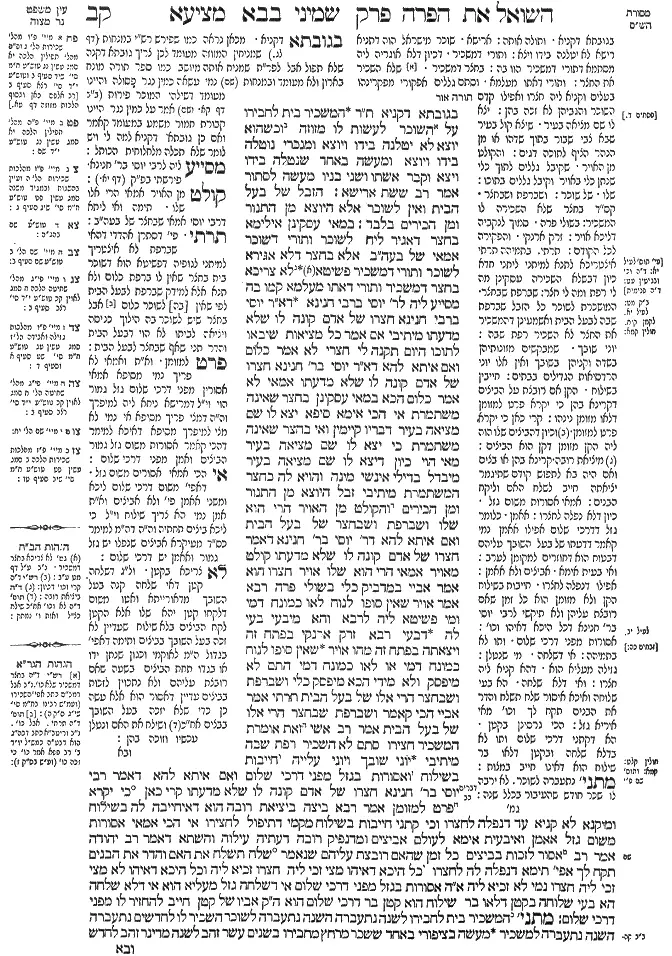
Bava Metzia 102a - Guemara
בגובתא דקניא ת"ר המשכיר בית לחבירו על השוכר לעשות לו מזוזה וכשהוא יוצא לא יטלנה בידו ויוצא ומנכרי נוטלה בידו ויוצא ומעשה באחד שנטלה בידו ויצא וקבר אשתו ושני בניו מעשה לסתור אמר רב ששת ארישא:
הזבל של בעל הבית ואין לשוכר אלא היוצא מן התנור ומן הכירים בלבד:
במאי עסקינן אילימא בחצר דאגיר ליה לשוכר ותורי דשוכר אמאי של בעה"ב אלא בחצר דלא אגירא לשוכר ותורי דמשכיר פשיטא לא צריכא בחצר דמשכיר ותורי דאתו מעלמא קמו בה מסייע ליה לר' יוסי ברבי חנינא דא"ר יוסי ברבי חנינא חצרו של אדם קונה לו שלא מדעתו מיתיבי אם אמר כל מציאות שיבאו לתוכו היום תקנה לי חצרי לא אמר כלום ואם איתא להא דא"ר יוסי בר' חנינא חצרו של אדם קונה לו שלא מדעתו אמאי לא אמר כלום הכא במאי עסקינן בחצר שאינה משתמרת אי הכי אימא סיפא יצא לו שם מציאה בעיר דבריו קיימין ואי בחצר שאינה משתמרת כי יצא לו שם מציאה בעיר מאי הוי כיון דיצא לו שם מציאה בעיר מיבדל בדילי אינשי מינה והויא לה כחצר המשתמרת מיתיבי זבל היוצא מן התנור ומן הכירים והקולט מן האויר הרי הוא שלו ושברפת ושבחצר של בעל הבית ואם איתא להא דר' יוסי בר' חנינא דאמר חצרו של אדם קונה לו שלא מדעתו קולט מאויר אמאי הרי הוא שלו אויר חצרו הוא אמר אביי במדביק כלי בשולי פרה רבא אמר אויר שאין סופו לנוח לאו כמונח דמי ומי פשיטא ליה לרבא והא מיבעי בעי לה דבעי רבא זרק ארנקי בפתח זה ויצאתה בפתח זה מהו אויר שאין סופו לנוח כמונח דמי או לאו כמונח דמי התם לא מיפסק ולא מידי הכא מיפסק כלי ושברפת ושבחצר הרי אלו של בעל הבית תרתי אמר אביי הכי קאמר ושברפת שבחצר הרי אלו של בעל הבית אמר רב אשי זאת אומרת המשכיר חצירו סתם לא השכיר רפת שבה מיתיבי יוני שובך ויוני עלייה חייבות בשילוח ואסורות בגזל מפני דרכי שלום ואם איתא להא דאמר רבי יוסי בר' חנינא חצרו של אדם קונה לו שלא מדעתו קרי כאן (דברים כב, ו) כי יקרא פרט למזומן אמר רבא ביצה ביציאת רובה הוא דאיחייבה לה בשילוח ומיקנא לא קניא עד דנפלה לחצרו וכי קתני חייבות בשילוח מקמי דתיפול לחצירו אי הכי אמאי אסורות משום גזל אאמן ואיבעית אימא לעולם אביצים ומדנפיק רובה דעתיה עילוה והשתא דאמר רב יהודה אמר רב אסור לזכות בביצים כל זמן שהאם רובצת עליהם שנאמר (דברים כב, ז) שלח תשלח את האם והדר את הבנים תקח לך אפי' תימא דנפלה לה לחצרו כל היכא דאיהו מצי זכי ליה חצרו זכיא ליה וכל היכא דאיהו לא מצי זכי ליה חצרו נמי לא זכיא ליה א"ה אסורות בגזל מפני דרכי שלום אי דשלחה גזל מעליא הוא אי דלא שלחה הא בעי שלוחה בקטן דלאו בר שילוח הוא קטן בר דרכי שלום הוא ה"ק אביו של קטן חייב להחזיר לו מפני דרכי שלום:
מתני׳ המשכיר בית לחבירו לשנה נתעברה השנה נתעברה לשוכר השכיר לו לחדשים נתעברה השנה נתעברה למשכיר מעשה בציפורי באחד ששכר מרחץ מחבירו בשנים עשר זהב לשנה מדינר זהב לחדש
Comments from Rashi on Masechet Bava Metzia Page 102a
בגובתא דקניא . ותולה אותה: ארישא . שוכר מישראל הוה דתניא רישא לא יטלנה בידו ויצא: ותורי דמשכיר . דכיון דלא אוגריה ליה. מסתמא דתורי דמשכיר הוו בה: בחצר דמשכיר . שלא השכיר את החצר: ותורי דאתו מעלמא . וסתם גללים אפקורי מפקרינהו בעלים וקניא ליה חצרו ואפילו קדם השוכר והגביהן לא זכה בהן: יצא לו שם מציאה בעיר . שיצא קול בעיר שבא צבי שבור בתוך שדהו או מן הנהר הציף לתוכה דגים: והקולט מן האויר . שקיבל גללים לתוך כלי שנתן כלי באויר וקיבל גללים בתוכו: שלו . של השוכר: ושברפת ושבחצר . קס"ד בחצר שלא השכירה לו המשכיר: בשולי פרה . סמוך לנקביה דליכא אויר: זרק ארנקי . והפקירה לכל הקודם: תרתי . בתמיהה תרתי איצטריכא לתנא למיתני ליתני חדא כיון דבשלא השכירה עסקינן מה לי רפת ומה לי חצר: שברפת שבחצר . המושכרת לשוכר כל הזבל שברפת שבה לבעל הבית ואשמעינן דהמשכיר את החצר לא השכיר רפת שבה: יוני שובך . שמבקשים מזונותיהן בשדה וקניהן בשובך ואין אלו יוני הרדסיאות הגדילים בבתים: חייבין בשילוח . הקן אם רובצת על הביצים דקרינא בהן כי יקרא פרט למזומן דלאו מזומן נינהו: קרי כאן כי יקרא פרט למזומן . וכיון דהביצים שלו הוה ליה הקן מזומן דקן הוא הביצים: מיציאת רובה . קרינא בהן או ביצים ואם היה בא לתפוש קודם שתיגמר יציאתה חייב לשלח האם וליקח הבנים: אמאי אסורות משום גזל . כיון דלא נפלה לחצרו: אאמן . כלומר גזל דדרכי שלום אפילו אאמן נמי קאמר דדעתו של בעל השובך עליהם דבטוח הוא דחוזרים למקומן לערב: ואי בעית אימא . אביצים ולא אאמן: אפילו דנפלה לחצרו . חייבות בשילוח הקן ולא מזומן הוא כל זמן שאם רובצת עליהן ולא תיקשי לרבי יוסי בר' חנינא דכל היכא דאיהו וכו': אסורות מפני דרכי שלום . ותו לא בתמיהה: אי דשלחה . מי שנטלן: גזילה מעליא הוא . דהא קניא ליה חצרו: ואי דלא שלחה . הא בעי שלוחה ואיכא איסור שלח תשלח והדר את הבנים תקח לך וכו' מאי איריא גזל: הכי גרסינן בקטן . הא דקתני דרכי שלום ותו לא בדלא שלחה ובקטן דלאו בר שילוח הוא דאינו חייב במצות: מתני' נתעברה לשוכר . לא ירבה לו שכר חודש שהעיבור בכלל שנה:
Comments from Tosafot - Bava Metzia 102a
בגובתא דקניא . מכאן נראה כמו שפירש רש"י במנחות (דף לג.) שמניחין המזוזה מעומד לכן צריך גובתא דקנה שלא תפול אבל לפר"ת שמניח אותה מיושב כמו ספר תורה מונח בארון ולא מעומד ובמנחות (שם) נמי עשאה כמין נגר פסולה והיינו מעומד דשילהי המוכר פירות (ב"ב דף קא. ושם) אמר על כמין נגר היינו קבורת חמור משמע במעומד קאמר ואם כן גובתא דקניא למה לי ויש לומר שלא תכלה מלחלוחית הכותל: לא יטלנה ויצא . אף על גב דאמר שמואל דמטילין מבגד לבגד גבי מזוזה אסור לפי שהמזיקין באין בבית שאין בו מזוזה וכשנוטלה כאילו מזיק אותן שידורו בבית: מסייע ליה לרבי יוסי בר' חנינא . פירשתי בפ"ק (דף יא.): קולט מן האויר אמאי הרי אלו שלו . תימה ואי ליתא דרבי יוסי אמאי שבחצר של בעה"ב: תרתי . פי' דסתרן אהדדי דהאי שברפת לא איצטריך למיתני לגופיה דפשיטא הוא דשוכר בית בחצר שאין לו ברפת כלום ולא תנא אלא למידק שברפת לבעל הבית לפי שאין [בה] לשוכר כלום אבל בחצר שיש לשוכר בה הילוך כניסה ויציאה לביתו לא הוי דבעל הבית והדר תני שאף שבחצר לבעל הבית: פרט למזומן . וא"ת ואמאי לא פריך נמי מסיפא אמאי אסורין מפני דרכי שלום גזל גמור הוי וי"ל דמרישא ניחא ליה למיפרך וה"ה דמצי פריך מסיפא אי נמי לא מצי למיפרך מסיפא דאיכא למימר דהכי קאמר אסורות משום גזל גמור הביצים ואמן מפני דרכי שלום: אי הכי אמאי אסורים משום גזל . דאפי' משום דרכי שלום ליכא ומשני אאמן פי' ולא אביצים וא"ת אמן נמי הא צריך שילוח וי"ל כי ליכא ביצים תחתיה וה"ה דה"מ למימר כס"ד מעיקרא אביצים שנפלו יש גזל גמור ואאמן יש דרכי שלום: לא צריכא בקטן . ול"ג דשלחה קטן דאי שלחה קנה בעל השובך מדאורייתא ואטו משום דלקחו קטן יהא שלו אלא הקטן לקח הביצים בלא שילוח שעדיין לא זכה בעל השובך בביצים ותימה דאפי' בגדול ה"מ לאוקמי וכגון שנתן ידו או בגדו תחת הביצים בשעה שאם רובצת עליהם ולא נתכוין לזכות בביצים עדיין דאסור הוא אלא עשה כן כדי שלא יזכה בעל השובך בבצים אח"כ ושילח את האם ונטלן עכשיו וזוכה בהן:
Bava Metzia 102a - Mishnah translated into english
to insert a mezuza inside a hollow reed and then affix the whole arrangement to the doorpost.
The Sages taught in a baraita: If one rents out a house to another, the responsibility to prepare a mezuza for it and affix it is upon the renter. And when he leaves, he may not take it in his hand and leave with it; rather, he must leave it there. But if he rented a house from a gentile, he may take it in his hand and leave with it. And there was an incident in which a renter took his mezuza in his hand and left with it, and as a punishment he eventually buried his wife and two sons.
The Gemara asks: Was the incident cited to contradict the ruling immediately preceding it, which permits one to take the mezuza? Rav Sheshet said: The incident relates to the first clause.
§ The mishna teaches: The manure found in the courtyard of a rented house, is the property of the landlord, and the renter has rights only to the ashes that come out of the oven and the stove, which can also be used as a fertilizer. The Gemara asks: With what are we dealing? If we say that the mishna is referring to a courtyard that is rented out to the renter, or where the manure was produced by the oxen of the renter, then why should it be the property of the landlord? It is clearly the property of the renter. Rather, the mishna must be referring to a courtyard that is not rented out to the renter, and the manure was produced by the oxen of the landlord. The Gemara asks: But if so, the ruling is obvious and need not have been taught.
The Gemara answers: No, the ruling is necessary in a case where the manure is in a courtyard of the landlord, and the source of the manure was oxen that came from the world at large and stood in the courtyard and produced the manure. The mishna rules that in such a case, the manure belongs to the landlord.
The Gemara suggests: That ruling in the mishna that any manure deposited in the landlord’s courtyard belongs to him supports the ruling of Rabbi Yosei, son of Rabbi Ḥanina, as Rabbi Yosei, son of Rabbi Ḥanina, says: A person’s courtyard effects acquisition for him of an item placed in it, even without his knowledge.
The Gemara raises an objection to this ruling from a baraita: If one says: Any lost items that come into my courtyard today, my courtyard should effect acquisition of them for me, he has not said anything of legal significance, and does not acquire those items. The Gemara explains the objection: And if it is so, that this ruling that Rabbi Yosei, son of Rabbi Ḥanina, says is correct, i.e., that a person’s courtyard effects acquisition for him of an item placed in it, even without his knowledge, then why has he not said anything of legal significance?
The Gemara resolves the difficulty: With what are we dealing here in the baraita? We are dealing with a courtyard that is not secured, as the halakha is that such a courtyard does not effect acquisition of items for its owner.
The Gemara questions this resolution: If so, say and try to explain accordingly the latter clause of the baraita that states: If knowledge of the existence of that lost item spread through the town, his statement stands and his courtyard acquires it. The Gemara explains the difficulty: And if the baraita is referring to a courtyard that is not secured, even where knowledge of the existence of that lost item spread through the town, what of it? Such a courtyard is unable to effect acquisition for its owner of items placed in it.
The Gemara answers: Once knowledge of the existence of that lost item spreads though the town, people withdraw themselves from it, as they assume that the owner of the courtyard will take it. Therefore, no one will even try to take it and the courtyard will be like a secured courtyard which can effect acquisition of items for its owner.
The Gemara raises an objection to Rabbi Yosei’s ruling from a baraita: Refuse of the oven and of the stove, i.e., ashes, and that which is collected in the renter’s vessel from the airspace of the courtyard, is the renter’s property. And refuse that is in the cowshed and in the courtyard, i.e., the manure, is the property of the landlord. The Gemara explains the question: And if it is so, that this ruling that Rabbi Yossi, son of Rabbi Ḥanina, says is correct, i.e., that a person’s courtyard effects acquisition for him of an item placed in it even without his knowledge, then with regard to refuse collected from the airspace of the courtyard, why is it the renter’s property? It was first in the airspace of the landlord’s courtyard, and should consequently be acquired by him immediately.
Abaye said: The baraita is referring to a case where the renter attached his vessel to a cow’s rear. Any manure produced by the cow would immediately enter the renter’s vessel, without first entering the airspace of the courtyard, and the renter would consequently acquire it.
Rava said: An item in the airspace of a courtyard that will not eventually come to rest in the courtyard itself is not regarded as though it had come to rest. Accordingly, even if the refuse traveled through the airspace of the courtyard, since it was always on course to enter the renter’s vessel, it is not acquired by means of the landlord’s courtyard.
The Gemara asks: And is this principle really so obvious to Rava? But didn’t he raise it as a dilemma? As Rava raised a dilemma: If one cast a purse through this doorway of a house and it went through the house and exited through that doorway, what is the halakha? Is an item in the airspace of a courtyard that will not eventually come to rest in the courtyard itself regarded as though it had come to rest, or is it not regarded as though it had come to rest?
The Gemara explains that Rava’s dilemma concerned a different case: There, in the case of the purse, nothing at all interposes between the purse and the floor of the house, and therefore Rava was unsure about the halakha. Here, where the renter’s vessel interposes, it was obvious to Rava that the renter’s vessel effects acquisition of the item.
The Gemara analyzes the latter clause of the above cited baraita: And refuse that is in the cowshed and in the courtyard is the property of the landlord. The Gemara asks: Can these two statements coincide? By stating that the refuse in the cowshed belongs to the landlord, it indicates that the refuse in the courtyard belongs to the renter. How, then, can the baraita continue to rule that even the refuse in the courtyard belongs to the landlord?
Abaye said that this is what the baraita is saying: And refuse that is in the cowshed that is located in the courtyard rented out to the renter is the property of the landlord. Extrapolating from Abaye’s statement, Rav Ashi said: That is to say that one who rents out his courtyard without specification of what is included in the rental agreement has not rented out a cowshed that is located in it.
The Gemara raises an objection to Rabbi Yosei’s ruling from another baraita: There is a mitzva to dispatch a mother bird if one wishes to take eggs from her nest (Deuteronomy 22:6–7). The mitzva applies only if the bird and eggs are ownerless. Doves of a dovecote and doves of an attic are subject to the obligation of dispatching the mother bird, as they are ownerless. Nevertheless, they are subject to the prohibition of robbery, due to a rabbinic ordinance to maintain the ways of peace.
The Gemara explains the question: And if it is so, that this ruling that Rabbi Yosei, son of Rabbi Ḥanina, says is correct, i.e., that a person’s courtyard effects acquisition for him of an item placed in it even without his knowledge, then a dovecote or attic will effect acquisition for its owner of any eggs inside them. Accordingly, one should apply here the principle that the mitzva to dispatch the mother bird from upon her nest applies only: “If it happened before you” (Deuteronomy 22:6) which excludes a bird or egg that is readily accessible, such as one that one owns, from the mitzva to dispatch the mother. Yet the baraita rules that the mitzva does apply in this case.
Rava said: It is from the time of the emergence of the majority of an egg from a mother bird’s body that one becomes subject to the obligation of dispatching her from upon her eggs. And the owner of a courtyard does not acquire the egg until it fully emerges and falls into his courtyard. And therefore, when the baraita teaches that in the case of doves of a dovecote and of an attic, one is subject to the obligation of dispatching the mother bird, it is referring to a time before the egg falls into his courtyard.
The Gemara asks: If that is so, that the baraita is referring to a case where the egg has not fully emerged, why does the baraita rule that they are forbidden by rabbinic law for others to take due to the prohibition of robbery? The Gemara answers: That ruling of the baraita is referring to their mother, i.e., the mother bird.
And if you wish, say instead: Actually, that ruling is referring to the eggs, and the reason the Sages enacted that taking them is robbery is because once the majority of an egg emerges, the dovecote or attic’s owner’s mind is upon the eggs to acquire them, although technically he will not acquire them until they fully emerge.
And now that Rav Yehuda says that Rav says: It is prohibited to acquire the eggs as long as the mother bird is upon them, as it is first stated: “Send away the mother” and only then: “And take the young for yourself” (Deuteronomy 22:7), even if you say that the eggs fully emerged and fell into his courtyard, he will not acquire them, because in any case in which a courtyard owner is able to acquire an item by himself, his courtyard can effect acquisition of it for him, but in any case in which he is unable to acquire an item by himself, his courtyard cannot effect acquisition of it for him either.
The Gemara asks: If that is so, that the baraita is referring to a case where the courtyard cannot effect acquisition of the eggs for him, why does the baraita rule: They are subject to the prohibition of robbery, due to a rabbinic ordinance to maintain the ways of peace? If one dispatched the mother bird, in which case the courtyard would automatically effect acquisition of the eggs, then taking them would be full-fledged robbery, and if one did not dispatch the mother bird, doesn’t he need to dispatch her before it is permitted to take the eggs? Either way, one will have transgressed Torah law. Why, then, does the baraita refer to a rabbinic prohibition of robbery, rather than one by Torah law?
The Gemara answers: The baraita is referring to a minor, who is not subject to the mitzva of dispatching the mother bird. The Gemara challenges this answer based on the latter clause of the baraita: Is a minor subject to the rabbinic prohibition of robbery enacted to maintain the ways of peace? The Gemara explains: This is what the latter clause of the baraita is saying: The father of a minor who took such eggs is obligated to return them to the owner of the dovecote or attic, due to the rabbinic prohibition of robbery instituted to maintain the ways of peace.
MISHNA: In the case of one who rents out a house to another for a year and then the year was intercalated, adding an additional month to that year, the fact that it was intercalated is to the benefit of the renter. Since the rental was defined in terms of a year, the additional month is automatically included, and the renter need not pay additional rent for it. If a landlord rented out a house to another for a year, with the price set as a certain sum for each of the months, and then the year was intercalated, the fact that it was intercalated is to the benefit of the landlord.
An incident occurred in Tzippori involving one who rented a bathhouse from another where they stated that the rent would be: Twelve gold dinars per year, a gold dinar per month, and then the year was intercalated.
Traduction : The William Davidson digital edition of the Koren Noé Talmud, with commentary by Rabbi Adin Even-Israel Steinsaltz.